

Mass Tort & Product Liability Lawyers
At King Law, we are national product liability lawyers who practice in an area of law called mass torts. We represent clients nationwide who are injured by dangerous drugs, defective medical devices, toxic chemicals, consumer products, and other goods and services. Many lawsuits related to such injuries are handled through a process called mass tort litigation. In a mass tort lawsuit, numerous people file individual lawsuits alleging similar harms from the same product or company.
Our mass tort attorneys at King Law fight for plaintiffs alleging injuries caused by companies, manufacturers, and other defendants. We represent our clients in established multidistrict litigations (MDLs), as well as emerging lawsuits that have not been centralized. View the active MDLs King Law is currently representing clients in.
This guide explains how mass torts and MDLs work, how they differ from class actions, and how an injured person can pursue an individual claim.
What Is a Product Liability Claim?
A product liability claim is a specific type of civil lawsuit involving a personal injury claim. A product liability lawsuit is filed by a plaintiff who alleges that a product they used injured or sickened them. In their claim, the plaintiff typically alleges that negligence on the part of a company led to their injury. By filing a product liability claim, a person is trying to recover compensation for losses related to that injury. Many product liability claims fall under an area of law called mass torts.
What Is a Mass Tort Lawsuit?
A mass tort is a legal action that occurs when multiple individuals are harmed by the same action, event, or omission. Put simply, mass torts occur when numerous people experience harm from a shared source and then take legal action.
A mass tort lawsuit is a civil lawsuit where a citizen files a lawsuit against another party. This is different from a criminal lawsuit, which is brought by government prosecutors and can result in jail time for a defendant.
In a mass tort lawsuit, an injured party (the plaintiff) is seeking damages (compensation) from a defendant. That defendant provided a product or service that the plaintiff used or was exposed to, and the plaintiff alleges that product caused them to become ill or injured them.
Plaintiffs in mass tort and product liability lawsuits often allege injuries from products such as pharmaceutical drugs, medical devices, household and industrial chemicals, consumer goods like foods or video games, and consumer services like social media or ridesharing.
Who Are the Common Defendants in Mass Tort Lawsuits?
Common defendants in mass tort lawsuits include pharmaceutical companies, medical device manufacturers, consumer goods manufacturers, and companies that provide consumer services. Defendants in a mass tort lawsuit typically are not people. Instead, they are corporations or companies that are accused of causing harm.
What Is the Purpose of a Mass Tort Lawsuit?
In a mass tort, individual plaintiffs are seeking compensation from defendants to help cover the costs of their injuries. This compensation can be granted from a jury award or settlement. If a plaintiff receives compensation, that money often covers medical bills, lost wages, and other losses associated with their injuries.
Mass torts also provide an avenue for holding large corporations accountable for negligence and wrongdoings that have harmed a large number of victims.
What is an MDL and How Is It Related to a Mass Tort?
MDL stands for multidistrict litigation. An MDL is created when a designated panel of judges (called the JPML) combines lawsuits from different federal courts into a single federal court under a single federal judge.
In order for multiple lawsuits to be centralized, the plaintiffs in the lawsuits have to allege similar injuries from a common defendant(s) (i.e., a mass tort). So, many MDLs result from mass torts, but not all mass torts become MDLs.
For example, mesothelioma lawsuits filed against asbestos companies are an example of a mass tort (i.e., many people harmed in the same way by an asbestos company). However, there is not an active centralized litigation against a single manufacturer, meaning these lawsuits do not have an associated MDL.
Are MCLs and MDLs the Same Thing?
MCLs (multicounty litigations) and MDLs are different but similar legal actions. MDLs centralize cases from separate federal districts into a single federal court. MCLs centralize cases from county courts into a state court (usually a state superior court). MCLs are typically created when numerous lawsuits about the same civil issues are filed in different courts within the same state. State supreme courts often decide to centralize lawsuits in a single state court.
What Is the Difference Between a Mass Tort, MDL, and a Class Action?
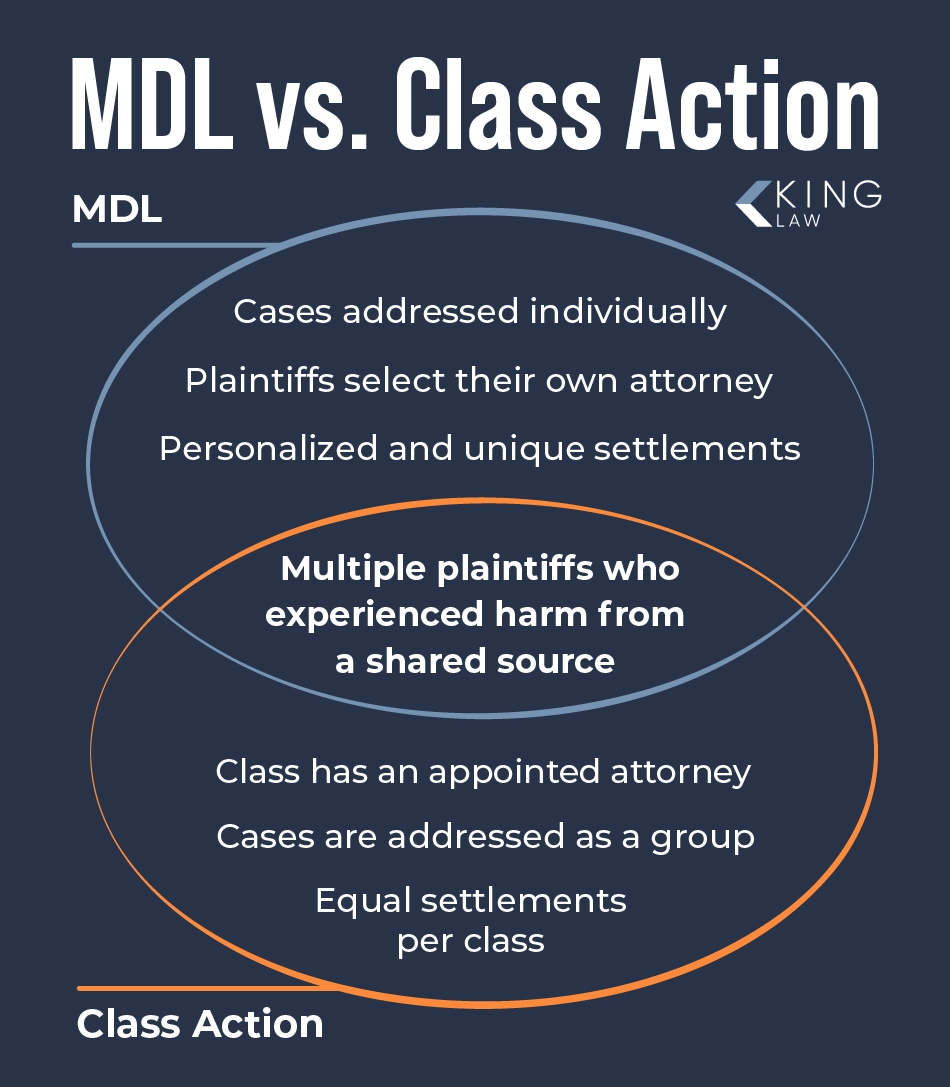
Mass torts (people alleging common harms from the same defendant) can lead to the creation of an MDL or a class action. However, MDLs and class actions have important similarities and differences. The table below describes how MDLs are different from class action lawsuits.
| MDL | Class Action Lawsuits |
|---|---|
| Each case is handled individually | Cases grouped into classes with shared outcomes |
| Plaintiff must file a lawsuit | Plaintiff may be automatically added |
| Plaintiffs have control over case and select an attorney | Lead attorney represents group |
| Pre-trial proceedings consolidated, but each case has its own facts | Cases share evidence, facts, and arguments |
| Individual settlements or awards based on each case | Settlements and awards distributed evenly by class |
In a mass tort, plaintiffs’ cases are handled individually, meaning each lawsuit moves through the process independently and is judged by its own merits. In a class action lawsuit, plaintiffs’ cases are grouped together by classes, and their lawsuits move through the legal process in a group. The specifics of each set of claims help determine which type of litigation is best suited to plaintiffs, defendants, and the courts.
What Are the Benefits of Creating and Joining an MDL?
In a mass tort, some aspects of the litigation are consolidated to streamline the legal process for the courts, plaintiffs, and defendants.
Here are the goals of centralizing lawsuits into an MDL:
- Streamline the legal process
- Avoid duplicative efforts among plaintiffs, defendants, attorneys, and the courts
- Encourage consistent rulings
Conserve personal and financial resources among all parties
The purpose of an MDL is to benefit all parties involved. That being said, there are several advantages to plaintiffs. Two of the main benefits to plaintiffs involve the discovery process and the compensation process.
The Discovery Process
Discovery is a phase of a lawsuit that occurs before trial and typically before settlement negotiations. During discovery, lawyers representing plaintiffs and defendants:
- Request and exchange information and documents
- Present evidence
- Identify experts
- Collect information about injuries from plaintiffs
- Conduct witness depositions and expert testimony (mostly with employees and experts)
The Compensation Process
In an MDL, each plaintiff has been harmed in a similar way by the same source. However, each of their cases is handled individually when it comes time for proving injuries and possible settlements. This means that people who file successful MDL lawsuits receive compensation that is unique to their injuries and circumstances. This is different from a class action, where each plaintiff would be assigned a class, and that class gets a pre-determined settlement.
MDL vs. Class Action Compensation
In an MDL, each case is handled individually and will reach its own outcome based on the strength of the case (amount of evidence, severity of illness, age at the time of injury, etc.).
What Is a Real-World Example of an MDL vs a Class Action?
To better understand an MDL versus a class action, it helps to have an example. Let us say that two people both had a faulty hernia mesh product implanted and experienced complications. Person A had a hernia recurrence and had the mesh replaced, but experienced no additional complications. However, Person B’s outcome was very different. The mesh implanted in Person B adhered to multiple organs, requiring multiple surgeries, extensive time lost from work, and permanent pain and disfigurement.
Under the MDL structure, Person B can pursue greater damages (compensation) in their hernia mesh lawsuit because their personal and financial losses were greater. In a class action claim, Person A and Person B could be part of the same class and receive the same flat-rate settlement.
Even though these two people are part of the same group lawsuit, their injuries are different, and their compensation should be different as well. A class action lawsuit is likely not a suitable legal option because the short- and long-term damages caused by the defective mesh are very different from plaintiff to plaintiff. This makes it hard to separate plaintiffs into a limited number of defined classes.
How is an MDL Created?
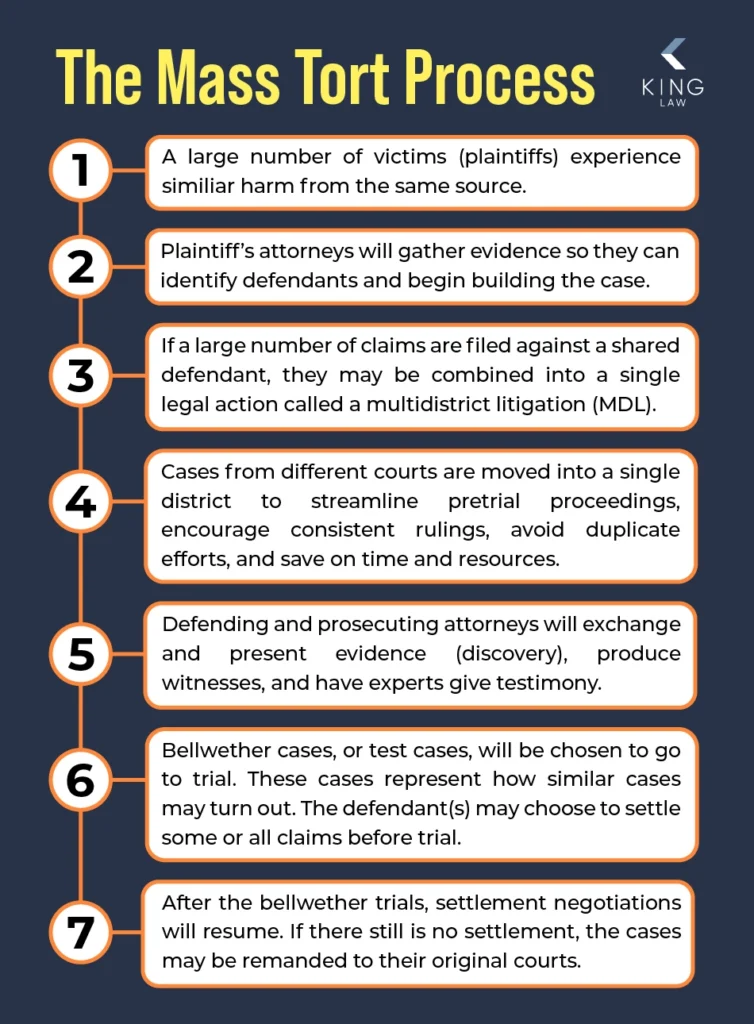
An MDL is created when a panel of federal judges (known as the Judicial Panel on Multidistrict Litigation [JPML]) decides to centralize multiple lawsuits in a single federal court. Those lawsuits must involve one or more common questions of fact. In many cases, they also have common injuries and common defendants.
Here are the steps for creating an MDL:
- Related federal lawsuits involving common questions of fact are filed in multiple federal district courts.
- Lawyers representing multiple plaintiffs in these cases submit a motion (i.e., a request) to the JPML asking it to centralize existing actions (i.e., lawsuits) filed within different federal courts.
- The JPML decides whether or not to add that request to an upcoming hearing.
- The JPML adds that case to an upcoming hearing.
- The JPML holds the hearing where lawyers for plaintiffs and defendants speak.
- The JPML decides whether or not to centralize the lawsuits listed in the motion.
- The JPML decides to create an MDL, and the lawsuits in the original request are centralized in a federal court of the panel’s choosing, under a selected judge.
- The existing cases are centralized in a single federal court, and new cases can be added to the MDL.
The JPML can also centralize lawsuits without receiving a motion to centralize lawsuits. It can decide what to do with its own authority.
Once the MDL is created, more plaintiffs are able to join it, assuming they meet certain criteria. Plaintiffs with existing lawsuits filed at the federal level may be able to join the MDL. People who have not filed a lawsuit yet but have experienced the alleged injury can also join the MDL.
What Are Some Examples of Active MDLs for Mass Torts?
Active mass tort MDLs range from personal injury lawsuits related to medical devices and drugs, to antitrust and security breach litigations, to consumer services and products.
Examples of active MDLs include lawsuits for injuries related to spinal cord stimulators/neuromodulators and the teen social media addiction litigation. The JPML maintains a list of active MDLs. Currently, there are 166 active MDLs proceeding in federal courts.
What MDLs is King Law Actively Representing Clients In?
No law firm can represent clients in every MDL, as MDLs cover a broad range of case types. At King Law, we represent clients in personal injury lawsuits focusing on physical and emotional injuries related to consumer goods. We represent clients in drug, medical device, toxic exposure, sexual abuse, social media, and other consumer product lawsuits.
Pharmaceutical Drug Lawsuits
- Birth Control Lawsuit
- Depo-Provera Lawsuit
- Dupixent Lawsuit
- Foundayo Lawsuit
- Gabapentin Lawsuit
- GLP-1 drugs (Ozempic, Wegovy, Mounjaro, Zepbound, Trulicity, Saxenda, and Rybelsus)
- Ketamine Lawsuit
- Oxbryta Lawsuit
- Suboxone Lawsuit
- Wegovy Pill
Medical Device Lawsuits
- AngioDynamics Port Catheter Lawsuit
- Bair Hugger Lawsuit
- Bard PowerPort Lawsuit
- Cartiva Toe Implant Lawsuits
- Hernia Mesh Lawsuit (Atrium, Bard, Covidien, Ethicon)
- Olympus Scope Lawsuit
- Paragard IUD Lawsuit
- Spinal Cord Stimulator Lawsuit
- Vaginal Mesh Lawsuit
Toxic Exposure & Environmental Lawsuits
- 1,4-dioxane Lawsuit
- AFFF Lawsuit
- Camp Lejeune
- Ethylene Oxide (EtO) Lawsuit
- Military Base Water Contamination Lawsuit
- Paraquat Lawsuit
- PFAS Water Contamination Lawsuit
- Roundup Lawsuit
- WL Gore PFAS Lawsuit
Sexual Abuse & Assault Lawsuits
- AAU Sexual Abuse Lawsuit
- Catholic Church Sex Abuse Lawsuits
- Grok Sexual Deepfakes Lawsuit
- Juvenile Hall Sex Abuse Lawsuits
- Lyft Sexual Assault Lawsuits
- Roblox Child Sexual Abuse Lawsuit
- Uber Sexual Assault Lawsuit
Technology, Social Media & Addiction Lawsuits
Other Consumer Product Lawsuits
- Baby Food Autism Lawsuit
- Hair Relaxer Cancer Lawsuit
- NEC Baby Formula Lawsuit
- Nitrous Oxide Lawsuit
- Talcum Powder Lawsuit
- Ultra-Processed Foods Lawsuit
*Please note that for some of the lawsuits listed above, King Law is not accepting new claims, although we are representing existing clients.
How Does Someone Join an MDL?
People often refer to becoming part of an MDL as “joining an MDL.” But, a plaintiff cannot simply join an MDL. In order to file a lawsuit as part of an MDL, someone typically hires a lawyer to file a personal injury claim in the appropriate federal court. Then that claim is transferred to the MDL through a conditional transfer order. However, some MDLs allow plaintiffs to file their claims directly in the court overseeing an MDL, therefore avoiding a transfer. An experienced attorney can advise which venue is appropriate and help file the claim.
Here is the step-by-step process for someone looking to file a personal injury lawsuit as part of the MDL process:
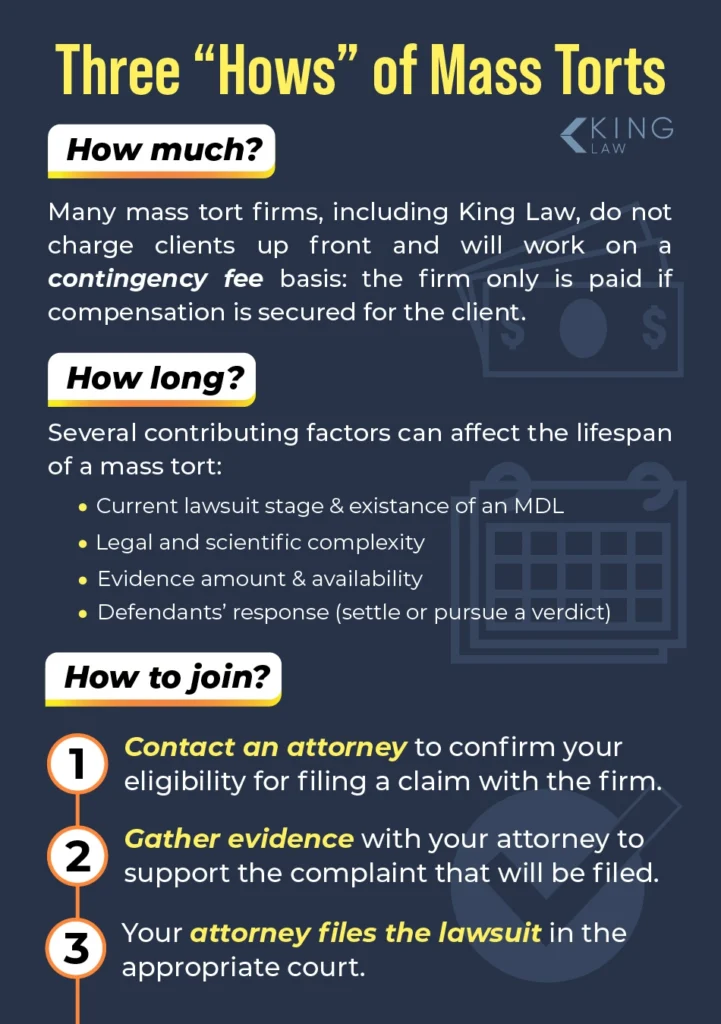
- The injured person reaches out to an attorney, who confirms their eligibility for filing a lawsuit with the firm and through the MDL. If the attorney thinks they have a case, the injured person signs a retainer, and the legal process begins.
- The plaintiff and their attorney start gathering evidence to file a legal complaint (lawsuit).
- The attorney files that lawsuit in the appropriate court. Some plaintiffs may be able to file directly as part of the MDL, and others may need to file a lawsuit in state court.
Successful mass torts can provide victims with compensation needed to pay for treatments, cover lost wages, and address other damages that resulted from the defendant’s wrongdoings. In addition, mass torts allow corporations and other responsible parties to be held accountable on a wide scale for their negligence or harm caused that could have been avoided.
Although financial compensation cannot take away pain, suffering, and other impacts of wrongdoings, it can ease monetary burdens on victims and their families. When people hold large companies and corporations accountable for wrongdoing, it can deter these companies from taking additional negative actions.
How Long Do Mass Tort Lawsuits Take?
Multiple factors can determine how long civil lawsuits take to settle. When someone files a personal injury or mass tort lawsuit, the amount of time it takes to complete that claim varies from case to case. For people who file as part of a late-stage mass tort, the lawsuit may take six months or fewer. However, most personal injury mass tort cases take a year or more to settle. Plaintiffs filing as part of a newly created MDL may have to wait a few years or more to conclude their claim.
However, potential plaintiffs have to file their claim before the applicable statute of limitations expires. That is why it is important for claimants to contact an attorney as soon as possible to avoid missing the deadline to file a claim.
Factors that can influence how long a mass tort claim takes include:
- What stage an existing MDL is in
- Whether or not an MDL has been created
- Availability and amount of evidence
- Legal and scientific complexity
- The defendants’ response and desire to settle or pursue a verdict
How Much Does it Cost to File as Part of an MDL/Mass Tort?
Reputable product liability and mass tort law firms like King Law do not charge clients money up front to file a case. Instead, we represent clients in mass tort lawsuits using contingency fees. A contingency fee means we only get paid for our legal work if we are able to secure compensation for our client. If our client does not receive a jury award or a settlement, they do not owe us for our services.
Contingency Fee
Some attorneys allow plaintiffs to pay only if their case is successful. They pay no upfront fees, and the attorney will collect an agreed-upon percentage of any settlement or award. Most mass tort lawsuits King Law accepts are on a contingency-fee basis, meaning our clients do not pay anything up front and only pay if they get paid.
Some attorneys allow plaintiffs to pay only if their case is successful. They pay no upfront fees, and the attorney will collect an agreed-upon percentage of any settlement or award. Most mass tort lawsuits King Law accepts are on a contingency-fee basis, meaning our clients do not pay anything up front and only pay if they get paid.
How Much Is an MDL Claim Worth?
Mass tort settlements vary greatly, depending on a number of factors. People who file a successful MDL claim could receive between $10,000 and $1,000,000 in compensation, though there is no standard settlement or jury award associated with a mass tort lawsuit.
- Aspects of a mass tort case that can influence settlement amounts include:
- Extent of damages (medical expenses, treatment costs, lost wages, pain and suffering, etc.)
- Amount and strength of evidence
- Age at the time of injury or diagnosis
- Severity of injury or illness
- Legal strategies of both parties
- Where the case is tried
When you have an initial consultation with an attorney, they can compare your case to others to give you a better understanding of your compensation potential. Filing a claim does not guarantee you will receive compensation.
Who Qualifies to File a Mass Tort Lawsuit?
Each litigation has different eligibility requirements. Eligibility will depend on the injury and the alleged cause of the injury. Factors that determine eligibility for a mass tort claim or MDL may include:
- The product or service involved
- When and how that product was used
- The injury or diagnosis
- When the injury occurred or was discovered
- The evidence connecting the injury to the defendant’s product or conduct
An attorney can review these factors to determine whether a potential plaintiff meets the criteria for a particular mass tort claim.
Have You Experienced Injuries from a Product or Service? Contact a Mass Tort Lawyer at King Law
If you’re ready to explore your legal options, contact a mass tort lawyer today. At King Law, we have experience handling these cases and understand what it takes to win. We will provide you with guidance, support, compassion, understanding, expertise, and resources from start to finish. Remember: Choosing the right attorney can have a significant impact on the potential of your case.
To schedule a free, no-obligation consultation, fill out our online form or call us at 585-287-8188.