

Spinal Cord Stimulator Lawsuit – September 2026 Update
Complete the form below to see if you qualify for a Spinal Cord Stimulator Lawsuit

People are filing spinal cord stimulator (SCS) lawsuits alleging the devices lead to injuries or do not provide adequate pain management. Lawsuits accuse companies like Boston Scientific, Medtronic, Abbott Laboratories, and Nevro Corp of not properly disclosing the possible risks of these devices. Some patients have experienced shocking, burning, lead migration, autonomic dysfunction, neurological injuries, and a lack of pain relief after having a spinal cord stimulator implanted.
In their lawsuits, patients say they were not properly warned about the alleged risks associated with SCSs. Additionally, some lawsuits allege that some manufacturers heavily modified SCS devices but did not go through appropriate FDA approvals. After experiencing injuries, undergoing revision surgeries, or requiring the removal of the implant, some people suffered financial, physical, and mental setbacks. In an effort to gain compensation for these losses, people are filing spinal cord stimulator lawsuits.
Key Takeaways
Here is some key information about spinal cord stimulator lawsuits:- Alleged injuries: Unsatisfactory pain relief, shocks, burns, lead migration, autonomic dysfunction (e.g., effects on heart rate, blood pressure, digestion), and neurological injuries (e.g., loss of bladder control, bowel issues, loss of mobility, or paralysis)
- Who may qualify: People who experienced any of the above injuries; those who had to have revision surgeries due to issues with their SCS; those whose injuries or SCS malfunction resulted in explant (i.e., device removal)
- Lawsuit type: Civil lawsuit for personal injuries filed against multiple medical device manufacturers and the FDA
- Possible defendants: Boston Scientific, Medtronic, Abbott, and Nevro Corp, FDA
- MDL or class action: An MDL (MDL 3181) for those alleging injuries from devices made by Boston Scientific and individual complaints filed against other manufacturers. There is no class action at this time.
- Status: Active MDL and active intake of new lawsuits
Who Qualifies for a Spinal Cord Stimulator Lawsuit?
You may qualify to file a spinal cord stimulator lawsuit if you received a spinal cord stimulator from Abbott, Boston Scientific, Medtronic, Nevro, or another manufacturer and:
- You experienced shocks, burns, lead migration, worsening pain, neurological injuries, or autonomic dysfunction
- You needed revision surgery or device removal
- Your family member died after alleged complications from a spinal cord stimulator
Spinal Cord Stimulator Lawsuit – 2026 Updates
September 24, 2026: Two Possible SCS MDLs Considered at JPML Hearing
Today, the judicial body responsible for creating multidistrict litigations (MDLs) held a hearing session where two spinal cord stimulator MDLs were on the agenda. The Judicial Panel on Multidistrict Litigation (JPML) heard arguments about creating two separate MDLs, one for injuries from Nevro SCSs and one for injuries from Abbott Laboratories SCSs. The judges on the JPML will decide whether or not centralization is warranted. If either MDL is created, people alleging injuries from their SCS devices could join a federal litigation representing multiple plaintiffs. The JPML should issue a decision soon.
September 1, 2026: Existing Spinal Cord Stimulator MDL Sees New Claims as JPML Will Consider Creating Two More MDLs
Spinal cord stimulators are the subject of renewed legal scrutiny as more patients file civil lawsuits against SCS manufacturers. As of September 1, 2026, there are 29 claims pending against Boston Scientific for alleged injuries caused by its SCS devices. Currently, this is the only federal MDL for patients. However, on September 24, 2026, the Judicial Panel on Multidistrict Litigation (JPML) is scheduled to hear arguments for creating SCS MDLs involving two new defendants: Abbott Laboratories and Nevro Corporation. If the JPML decides to centralize lawsuits against these defendants, two new MDLs for spinal cord stimulator patients would be created. These MDLs would give those alleging injuries from their devices a chance to pursue some parts of a civil lawsuit as a group, while allowing each case to proceed on its own merits.
July 30, 2026: Woman Files Lawsuit, Alleges that Spinal Cord Stimulator Malfunctioned
A woman from Alabama has filed a complaint accusing two companies of manufacturing a defective spinal cord stimulator. Her lawsuit alleges that she had a spinal cord stimulator implanted in October 2023 after being told that it would help her chronic pain. Her complaint claims that the woman suffered from shocking sensations, numbness in her legs, and worsening pain that she believes was related to the spinal cord stimulator.
July 24, 2026: Parties in Boston Scientific Spinal Cord Stimulator MDL File Joint Report
The parties in the spinal cord stimulator MDL against Boston Scientific and the FDA have filed a joint report outlining some of the legal issues in the MDL. For example, the parties present their positions on administrative matters, the process for creating Short Form Complaints to make it easier for people to join the MDL, and other matters. This document helps the judge understand what the parties disagree about and what needs to be discussed right away to streamline the legal process.
July 1, 2026: Two Dozen Claims Pending in SCS MDL as Other SCS MDLs Requested
As of July 1, 2026, there are 24 pending actions in the Boston Scientific spinal cord stimulator MDL. Although there is currently one active MDL for patients alleging injuries from SCS devices, two more MDLs could be created. The Judicial Panel on Multidistrict Litigation (JPML) has received two separate requests to centralize lawsuits against two other SCS manufacturers—Abbott Laboratories and Nevro. Since these requests have been submitted, the JPML has not issued a list of cases it will hear in its fall session.
June 22, 2026: Panel Asked to Create Two More Spinal Cord Stimulator MDLs
Two more requests have been filed, asking the JPML to create more spinal cord stimulator MDLs. One of those requests was filed by patients who claim they were harmed by Abbott’s spinal cord stimulators. The other request asked to establish an MDL for Nevro spinal cord stimulator lawsuits. In both requests, some of the lawsuits also accuse the FDA of wrongdoing.
June 5, 2026: Multidistrict Litigation Created for Spinal Cord Stimulator Lawsuits
The Judicial Panel on Multidistrict Litigation (JPML) has approved a request to create a dedicated MDL for spinal cord stimulator lawsuits against Boston Scientific. The new MDL is called In re Boston Scientific Corporation Spinal Cord Stimulator Products Liability Litigation (MDL No. 3181). Judge Josephine L. Staton is assigned to the MDL, and the MDL has been centralized in the Central District of California. People who have a valid spinal cord stimulator claim against Boston Scientific can file or transfer their claim into the MDL.
Read More News About Spinal Cord Stimulators and Associated Lawsuits
About the Spinal Cord Stimulator Lawsuit:
Why Are People Suing Spinal Cord Stimulator Manufacturers?
What Are the Alleged Injuries in Spinal Cord Stimulator Lawsuits?
Who Can File a Spinal Cord Stimulator Lawsuit?
Is There a Group Lawsuit for Spinal Cord Stimulator Injuries?
What Is Spinal Cord Stimulation?
How Does a Spinal Cord Stimulator Work?
Possible Spinal Cord Stimulator Side Effects
What Can Go Wrong With Spinal Cord Stimulators?
Severe Pain Reported After Spinal Cord Stimulator Surgery
Spinal Cord Stimulator Companies and Manufacturers Named in the Lawsuit
Who Qualifies to File a Spinal Cord Stimulator Lawsuit?
Recoverable Damages in the Spinal Cord Stimulator Lawsuit
What Proof Do I Need to File a Spinal Cord Stimulator Lawsuit?
How to File a Spinal Cord Stimulator Lawsuit
What Is the Deadline to File a Spinal Cord Stimulator Lawsuit?
Spinal Cord Stimulator Verdicts and Settlements
Why Are People Suing Spinal Cord Stimulator Manufacturers?
People are suing some manufacturers of spinal cord stimulators because they say the devices either did not help with their chronic pain and, in some cases, caused injuries to patients. In their lawsuits, plaintiffs allege that things manufacturers did and did not do contributed to their choosing to have a spinal cord stimulator installed and their subsequent injuries.
Here are some of the allegations submitted by plaintiffs who have filed spinal cord stimulator lawsuits:
- Design defects
- Failure to warn physicians and patients
- Injuries like burns, shocks, nervous system issues, and incontinence
- Lack of pain relief
- Misuse of PMA supplements and subsequent device modifications
- Revision surgeries or SCS device removal due to alleged complications or injuries
Legal Grounds in Spinal Cord Stimulator Lawsuits
Patients are suing spinal cord stimulator manufacturers, such as Boston Scientific, Medtronic, and Abbott Laboratories, because they allege that some models of spinal cord stimulators did not provide pain relief or resulted in injuries.
According to lawsuits filed by plaintiffs, here are the legal grounds and allegations in spinal cord stimulator lawsuits:
- Manufacturers used a Premarket Approval (PMA) to advance spinal cord stimulators to market, but they failed to offer independent clinical data about the safety of their devices or how well these devices worked.
- Manufacturers have introduced new SCS devices that are significantly different than the devices for which they received PMA for, using supplements to their initial PMAs.
- Manufacturers have failed to comply with regulatory requirements and provide adequate information to physicians and patients.
What This Means for Patients
The legal grounds of spinal cord stimulator lawsuits allege that some medical device manufacturers did not follow certain FDA rules for their medical devices. Lawsuits allege that manufacturers sidestepped the FDA’s approval process and made unregulated changes to some SCS models. Additionally, lawsuits allege that SCS manufacturers did not conduct all required reporting or monitoring, meaning physicians and patients could not perform a true risk assessment of a spinal cord stimulator. If these allegations can be proven in court, it means that decisions made by SCS manufacturers may have resulted in injuries to some patients.
What Are the Alleged Injuries in Spinal Cord Stimulator Lawsuits?
Plaintiffs who have filed spinal cord stimulator lawsuits have cited numerous injuries. Spinal cord stimulators interact with the body’s nervous system, meaning they have the potential to affect multiple functions and systems within a patient’s body.
Here are some of the injuries people with spinal cord stimulators are alleged to have experienced:
- Autonomic dysfunction (issues with circulatory or digestive systems)
- Burning
- Device lead migration
- Explant surgery (device removal)
- Loss of bowel control
- Loss of bladder control
- New or worsening pain
- Paralysis
- Revision surgery (repeat surgery to address device issues)
- Shocking sensations
- Death
This is not a full list of all possible injuries that someone may experience after having an SCS implanted. Patients who are unsure if their injury may qualify for a lawsuit can speak with our team to understand their legal options.
Who Can File a Spinal Cord Stimulator Lawsuit?
In order for someone to file a lawsuit against a spinal cord stimulator, they need to have experienced certain injuries or losses. The following people may be eligible to file a spinal cord stimulator lawsuit:
- A patient alleging certain injuries related to their SCS (e.g., shocks, burns, lead migration, autonomic dysfunction, or neurological injuries)
- A patient who did not experience adequate pain relief after SCS implantation
- A patient who had to have their SCS removed or repaired due to alleged device issues
- A surviving family member of someone who passed away but experienced alleged SCS injuries (i.e., a wrongful death claim)
- A spouse or child claiming losses due to alleged SCS injuries experienced by a spouse or parent
The spinal cord stimulator litigation is evolving. This list does not cover all of the things that could make someone eligible for a lawsuit. Our team of attorneys can advise on current eligible conditions and losses.
Is There a Group Lawsuit for Spinal Cord Stimulator Injuries?
On June 5, 2026, the Judicial Panel on Multidistrict Litigation created a type of centralized litigation called a multidistrict litigation (MDL) for some spinal cord stimulator lawsuits. The MDL is called In re Boston Scientific Corporation Spinal Cord Stimulator Products Liability Litigation (MDL No. 3181). This centralized legal action will allow lawsuits against one spinal cord stimulator manufacturer (i.e., Boston Scientific Corporation) to proceed in federal court. In its conditional transfer order, the JPML transferred 12 spinal cord lawsuits against Boston Scientific to federal court. Other eligible plaintiffs alleging injuries from Boston Scientific’s SCSs can file as part of this MDL.
The JPML did not choose to centralize lawsuits against Abbott Laboratories or Nevro. However, that is because it did not want to complicate the litigation. A future MDL could be created for patients alleging injuries from Abbott Laboratories and other manufacturers. These lawsuits can still move forward in state courts. You can read insights about the spinal cord stimulator MDL from our lead attorney, Robert King.
What Is Spinal Cord Stimulation?
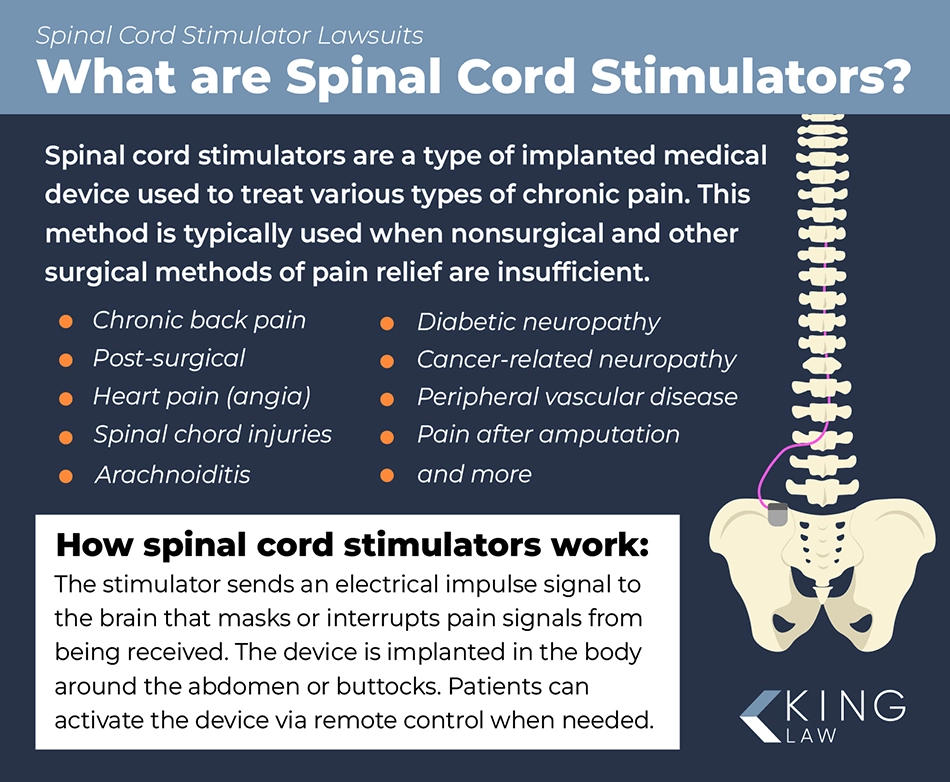
Spinal cord stimulation (also called neuromodulation therapy) is when a medical device sends electrical signals to nerves in the spine, with the goal of decreasing someone’s pain. To stimulate the spine, doctors implant a device called a spinal cord stimulator. These devices are sometimes known as pain pacemakers.
The spinal stimulation device has leads (like electrode stickers doctors put on your chest for an EKG), and these send electrical signals through the spinal cord. The device is implanted under the skin and often controlled and monitored wirelessly. This allows the patient and their medical team to see how the device is working and adjust the settings as needed.
Spinal cord stimulators are meant to be used after other surgical or medication-based treatments have been unsuccessful. Some of the conditions that spinal cord stimulators might be used to treat include nerve damage caused by diabetes (diabetic neuropathy), pain that does not go away after a back surgery (failed back surgery syndrome), and complex regional pain syndrome.
How Does a Spinal Cord Stimulator Work?
A spinal cord stimulator is a device that is implanted in someone’s back to help relieve severe or chronic pain (e.g., pain that does not go away). The device delivers a signal that helps to stop or mask the nerve pain signal, so the patient should feel a tingling or neutral sensation instead of shooting, sharp, or dull pain.
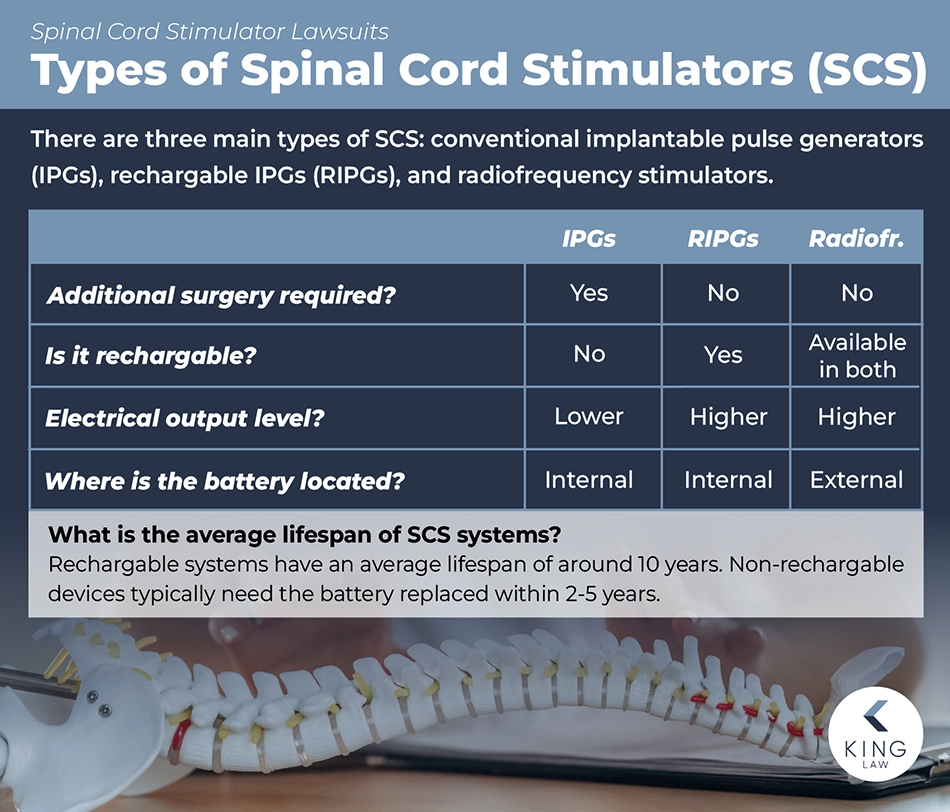
There are several different types of spinal cord stimulators. Some of them have rechargeable batteries that are implanted inside the patient. Others require the patient to have another surgery when their spinal cord stimulator’s battery runs out. Typically, patients can send the electrical signal themselves, which gives them more control over their pain relief. Spinal cord stimulator devices are controversial, and some medical professionals question whether they are truly effective, safe, and preferred over other, less-invasive measures.
Possible Spinal Cord Stimulator Side Effects
As with any procedure or medical implant, there is a range of possible side effects associated with spinal stimulators. Side effects of spinal cord stimulators include:
- Pain, discomfort, or mild swelling where the doctors implanted the device
- Tingling, twitching, or jolts of electricity
- Painful tingling
- Numbness
- Weakness
- Difficulty controlling or coordinating muscle movements
- Headaches
- Leaking spinal fluid
- Painful swelling or oozing from the implant site
- Sharp pain randomly or when moving
- Burning sensation
- Pain levels stay the same or worsen after the device is implanted
- Fever or chills
Some of these symptoms may show up right after you have the surgery to implant the spinal cord stimulator. However, these may appear days, weeks, or months later. You should report any signs to your doctor, because what you are experiencing may be the first stages of a serious adverse event. You may also be entitled to compensation if a defect in your spinal cord stimulator device harmed you.
FDA Recalls of Spinal Cord Stimulators
There has been a recall of Abbott spinal cord stimulators. The recall was issued after several Infinity and Proclaim stimulators would not turn back on after being placed in MRI mode. The recall was issued on September 13, 2023. Some people whose Abbott stimulators failed after being placed in MRI mode had to have a revision surgery to have a new device implanted.
What Can Go Wrong With Spinal Cord Stimulators?
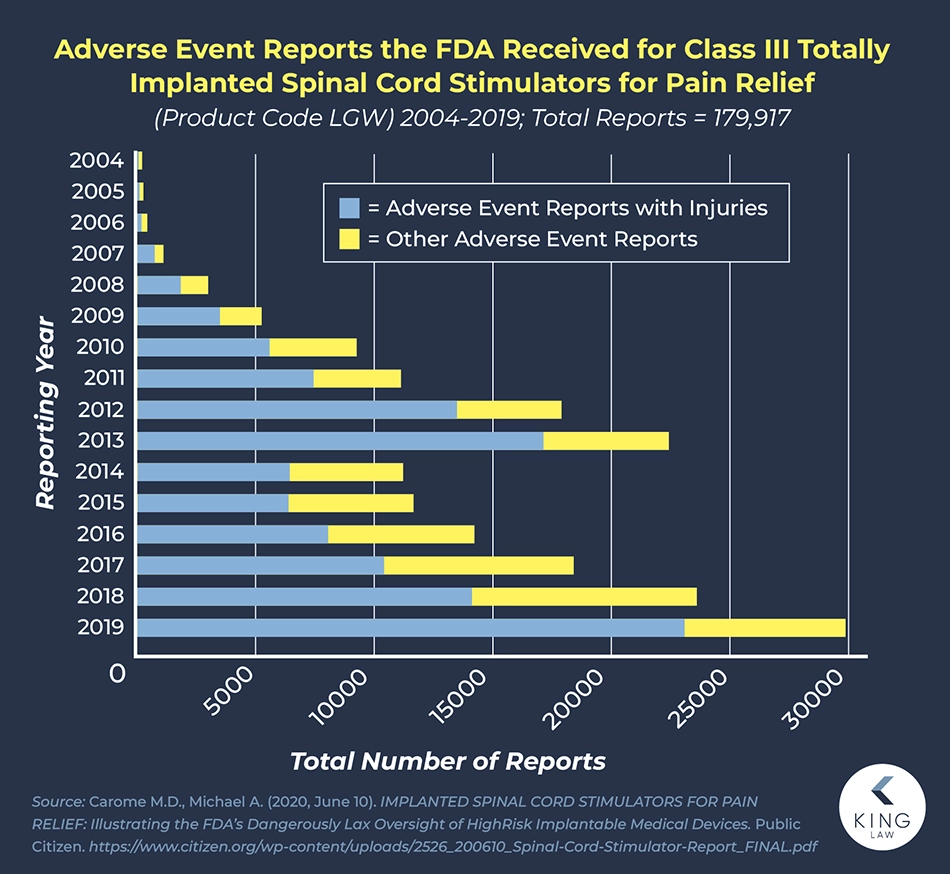
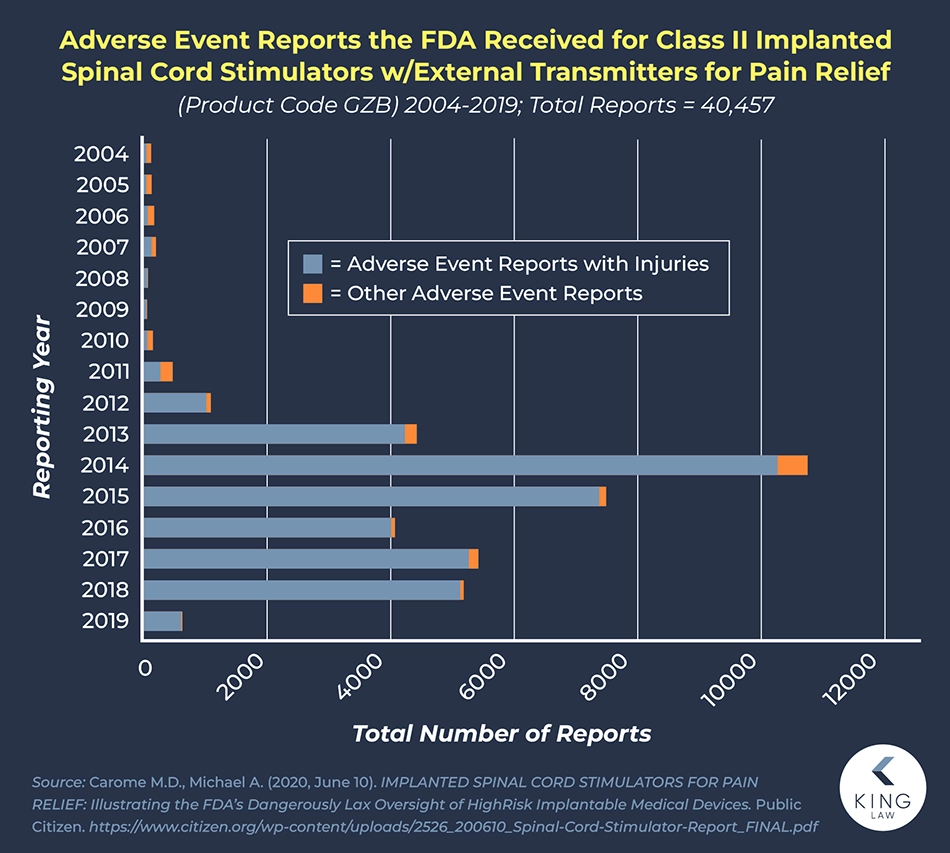
According to adverse event reports filed with the FDA, spinal cord stimulators can experience a range of malfunctions that can harm patients. According to data compiled by Public Citizen, which searched the FDA’s MAUDE database, there were 179,917 reports filed against implanted spinal cord stimulators between 2004 and 2019. Of those incident reports, 118,272 involved injuries, and 23,311 resulted in revision surgeries.
Things that can go wrong with a spinal cord stimulator include:
- Lead migration: The leads that were initially implanted in the spine may migrate from their original placement. Patients should monitor for signs of lead migration.
- Lead fractures: The wires that carry the electrical pulses may fracture/break, meaning the desired therapy is not delivered.
- Device damage: The device may become damaged and not work properly, send unnecessary shocks, or stop working altogether.
- Device power failures: The device’s power supply may fail, meaning the patient does not get any therapeutic benefit or decrease in their pain. A malfunctioning SCS battery may also cause burns or pain.
When these malfunctions happen, the patient can experience:
- Infection
- Increased pain
- Electric shocks
- Burns
- New nerve pain
According to data from 2016 to 2020, the FDA received 497 reports associated with patients’ deaths, 77,937 with patients’ injuries, and 29,294 with device malfunction. Often, these side effects result in people needing revision surgeries and new devices implanted.
According to research, patients who experience severe complications should work with their doctors to address concerns immediately. Prompt treatment of neurological injuries, infections, and biological complications can improve a patient’s long-term outcome.
Severe Pain Reported After Spinal Cord Stimulator Surgery
Spinal cord stimulators are intended to reduce patients’ chronic pain; however, some patients say that they have experienced new or worsening symptoms after having this device implanted. According to one study, about 20% to 40% of patients experience complications after having a spinal cord stimulator implanted.
For example, there have been several reports of people experiencing a blood clot after the implantation surgery. Others have suffered from excruciating pain, beyond the pain the patient experienced before the spinal implant. Some patients allege that the devices did not work at all, or they could not be switched into or out of MRI mode, which disables the electrical signals to control pain.
Some patients have had to have the device removed, switched out, or revised because of the complications they were experiencing. Additionally, some models of spinal cord stimulators have been recalled or have had warnings issued about them.
Spinal Cord Stimulator Companies and Manufacturers Named the Lawsuits
Some well-known medical device companies are being called out in spinal cord stimulator lawsuits filed by patients and surviving loved ones. These include Abbott (St. Jude), Boston Scientific, Medtronic, and Nevro. The claims being filed against these medical device companies include failure to warn of known risks, violating regulations, and designing defective and potentially harmful products.
Boston Scientific
Boston Scientific is being sued because of issues with several of its spinal cord stimulator models, including WaveWriter and Precision models. These devices experienced a range of problems, including where a routine system check would trigger a device reset that would make it stop sending the pain-relieving signals.
Boston Scientific is also under fire for improper dealings with the FDA. Some lawsuits allege that the company received FDA approval for a spinal cord stimulator design that was later altered and created a design defect. Plaintiffs also believe Boston Scientific was dishonest with patients and providers about the true risks, like the likelihood of the device migrating or burning the patient.
Medtronic
Medtronic’s spinal cord stimulators have also received criticism, including its now-recalled Intellis, Inceptiv, Vanta, and Restore series of implants and accessories. For example, according to a complaint, Medtronic has changed the design and features of its spinal cord stimulator dozens of times since it received FDA approval in 1984. Allegations in Medtronic lawsuits include that Medtronic has been marketing an unapproved version of the device for decades, putting patients at risk. Medtronic has also been forced to pay millions in settlements because it paid physicians to get them to use Medtronic’s devices.
Abbott (formerly St. Jude Medical)
Abbott (which acquired St. Jude Medical in January 2017) has had some of its spinal cord stimulators recalled by the FDA. For example, in 2023, the FDA recalled the Proclaim and Infinity series of spinal cord stimulators because these models would not leave MRI mode. Abbott’s Eon Mini charging systems were also defective and recalled because they would not charge correctly or they would overheat and burn patients. These device issues allegedly caused patients to suffer considerable pain, discomfort, and injuries. Lawsuits about Abbott spinal cord stimulators to allege actions taken and not taken by the company led to injuries in some patients.
Nevro Corp.
Nevro Corp. has faced several legal actions, including allegations of theft of trade secrets from competitor Boston Scientific and product liability actions filed by consumers. Some patients have suffered complications from Nevro’s high-frequency HF10 device. The electrodes (leads) in the device broke off or migrated, which allegedly caused severe pain and injuries to some patients. Battery problems also plague this model, with multiple reports of the battery glitching or not working at all. King Law is investigating lawsuits related to injuries from Nevro SCS devices.
Other Spinal Cord Stimulator Manufacturers
Other spinal cord stimulator manufacturers are being sued because their devices are allegedly causing pain and injury to patients. These include Saluda Medical, which makes the Evoke Closed Loop Stimulator system that some patients have had to have removed or revised after it was implanted. As more companies enter the spinal cord stimulator scene, they may be held accountable if they create defective devices or do not warn their patients about the range of risks to expect.
Recoverable Damages in the Spinal Cord Stimulator Lawsuit
Patients who experienced complications from a defective spinal cord stimulator may be able to secure compensation to address their losses. Payouts from a spinal cord stimulator lawsuit could include a financial award to cover the money they paid or lost because of their injuries. They may be eligible to file for a settlement to address non-monetary damages, such as loss of quality of life.
Economic Damages
Complications from spinal cord stimulators can come with an enormous cost, including:
- The medical costs to repair, switch out, or reposition the device
- Hospitalizations and doctor visits to diagnose and treat complications
- Lost wages
- A reduction in earning capacity because of device complications
- The costs of future treatments, surgeries, or therapies related to the spinal cord stimulator defect
The victim’s compensation package could include all past, current, and future financial impacts of the injuries from the defective device.
Non-Economic Damages
The victim may also qualify for the social, emotional, physical, relational, and other costs associated with the spinal cord stimulator’s defects. These could include the following injuries allegedly caused by SCS devices:
- Pain and suffering from going through the trauma caused by the defect
- Emotional distress
- The loss of quality of life or enjoyment in life because of the defect
- Permanent disfigurement or a permanent disability
The total amount of someone’s non-economic compensation package depends on factors like the extent of their losses and the proof they have to show they were harmed by the defective spinal cord stimulator.
What Proof Do I Need to File a Spinal Cord Stimulator Lawsuit?
To have a chance of winning your lawsuit, you need to be able to prove that you received a defective spinal cord stimulator and that it harmed you. Some of the evidence you might need to file a spinal cord stimulator lawsuit includes:
- The serial number for the device you received
- Medical records showing the date and location of your surgery
- Doctor’s notes about your complications
- Medical records about subsequent treatments or procedures you had after issues with your SCS
You might also save information about how your pain impacted your life, such as requests for time off work, a pain diary, or testimony from people who know you and your condition well. King Law can determine what evidence might be helpful in your situation and submit those requests to build a strong claim on your behalf.
How to File a Spinal Cord Stimulator Lawsuit
Filing a spinal cord stimulator claim requires you to follow a specific legal process. Some of the steps you might have to follow include:
- Step 1: Talking to a seasoned product liability or medical malpractice lawyer
- Step 2: Helping the attorney gather information about the spinal cord stimulator and how it impacted you
- Step 3: The lawyer writes up a legal complaint against the spinal cord stimulator’s manufacturer
- Step 4: The attorney prepares and responds to settlement proposals
- Step 5: Your attorney fights to get you a fair compensation package through the court system (if the medical device company does not settle)
King Law is prepared to help victims navigate the legal process of suing the companies that made defective spinal cord stimulators. We have actively involved in the SCS litigation and representing clients. We understand how much it can impact someone’s life when these devices malfunction and harm the person they were supposed to help.
What Is the Deadline to File a Spinal Cord Stimulator Lawsuit?
You need to file a spinal cord stimulator lawsuit within a specific amount of time. This timeframe is called the statute of limitations. The deadline is based on state law, and it can be 1 to 6 years from when you discover the defect in your spinal cord stimulator or from when you get hurt. However, in most states, the deadline is 1 to 2 years. There are exceptions that make this deadline longer or shorter, however. A spinal cord stimulator attorney is a valuable resource who can help you determine what your filing deadlines are and how to meet those so you do not miss out on key compensation.
Spinal Cord Stimulator Verdicts and Settlements
The spinal cord stimulator lawsuits are still in their early stages in civil state court; however, some victims have received compensation. For example, a New Jersey man won a $1.25 million settlement in 2024 after his spinal cord stimulator compressed his spinal column and significantly worsened his pain and mobility challenges. Other victims may be awarded settlement packages that reflect the total losses they experienced after having an SCS device implanted. King Law is closely tracking developments in the spinal cord stimulator litigation, including verdicts and settlements.
Average Spinal Cord Stimulator Settlement Amount
There is no guaranteed or average amount that victims will receive; however, our attorneys estimate that some victims who have a successful claim may qualify for up to $100,000 if their injuries are severe. However, that is a speculative estimate based on outcomes in other medical device torts. People who file successful claims may receive more or less than that amount.
Factors that can impact the total settlement value include whether the person lost income or earning capacity because of the allegedly defective device and the medical treatments required to revise, remove, or switch out the spinal cord stimulator.
Contact a Spinal Cord Stimulator Lawyer Today
If you were harmed by a spinal cord stimulator, reach out to our law firm today by calling (585) 496-2648 or submitting an online contact form. We offer free consultations, and we will also review and evaluate your case for free. We have years of experience going up against large medical device companies and holding them accountable for the harm their defective products inflict on unsuspecting patients.
This page is part of our broader investigation into spinal cord stimulator lawsuits. Learn how a spinal cord stimulator attorney can help you file a claim and learn more about pain related to batteries in spinal cord stimulators.
Previous News About Spinal Cord Stimulators and Associated Lawsuits
May 28, 2026: JPML Hears Case For Centralizing Spinal Cord Stimulator Lawsuits
On May 28, 2026, the Judicial Panel on Multidistrict Litigation (JPML) heard arguments about creating an MDL for lawsuits involving alleged spinal cord stimulator injuries. The JPML will consider if creating an MDL will benefit all parties involved, including the defendants (Abbott Laboratories and Boston Scientific Corporation), and the people alleging injuries. If an MDL is created, it would give people who want to file spinal cord stimulator injury lawsuits a new option. If the MDL is not approved, lawsuits will continue in state courts, as opposed to a federal venue.
April 16, 2026: JPML to Hear Case for Centralizing Spinal Cord Stimulator Lawsuits
A request has been submitted to the Judicial Panel on Multidistrict Litigation (JPML) to centralize multiple spinal cord stimulator lawsuits in federal court. The JPML will hold a hearing on May 28, 2026. If the JPML decides to approve the request, that will create a multidistrict litigation (MDL) for those alleging injuries from spinal cord stimulators. There are 12 plaintiffs listed in the centralization request, all of whom allege injuries from Boston Scientific’s or Abbott Laboratories’ spinal cord stimulators. If the MDL is created, it would allow plaintiffs to share in some pre-trial tasks, such as discovery (i.e., exchanging of information), expert testimonies and reports, and other important processes. An MDL can reduce the burdens on current and future plaintiffs, defendants, and the courts. People can still file spinal cord stimulator lawsuits at this time, whether or not the MDL is created.
February 20, 2026: Motion to Centralize Spinal Cord Stimulators Lawsuits Submitted to Federal Panel
The Judicial Panel on Multidistrict Litigation (JPML) has received a motion to centralize lawsuits filed by people alleging injuries from their spinal cord stimulator devices. If the JPML approves their motion, it would initiate a multidistrict litigation (MDL) for people seeking legal action against spinal cord stimulator manufacturers. If approved, MDL #3181 Abbott and Boston Scientific Spinal Cord Stimulator Products Liability Litigation would be created. Lawyers for the plaintiffs are requesting that all actions regarding their plaintiffs’ cases be consolidated in the U.S. District Court for the Northern District of Illinois. The JPML has not taken action on the petition yet. Plaintiffs in existing lawsuits allege that their spinal cord stimulators caused them multiple types of injuries, including “unsatisfactory pain relief, shocking, burning, lead migration, autonomic dysfunction, and neurological injuries.” Further, plaintiffs allege that Abbott and Boston Scientific did not do enough to protect them from or warn them about these possible injuries. According to the motion, there are 15 lawsuits in five different jurisdictions that could be centralized in a federal litigation.
May 7, 2026: Spinal Cord Stimulator Patient from Hawai’i Sues Abbott
A woman is suing Abbott after she experienced complications allegedly caused by the Eterna spinal cord stimulator. Her lawsuit claims the woman had the permanent Eterna spinal cord stimulator implanted after experiencing relief from the external trial version of the device. Her complaint alleges that the fully implanted Eterna spinal cord stimulator device was defective and caused her to experience shocking sensations, intense pain, numbness, incontinence, and other unwanted side effects. The complaint claims that the woman would like to have the device removed, but she is having difficulties finding a physician who will do so. As a result, the woman “continues to suffer from pain and symptoms” due to the spinal cord stimulator.
April 7, 2026: Louisiana Man Sues Boston Scientific After Having Spinal Cord Stimulator Implanted
A man from Louisiana has filed a lawsuit against Boston Scientific, claiming he experienced painful complications from the WaveWriter Alpha spinal cord stimulator system. According to his complaint, representatives from Boston Scientific told him that the spinal cord stimulator could provide significant pain relief if he had the implantable system put in. However, after he had the device implanted, he says he suffered from shooting pain and did not have a reduction in his pain levels. He alleges that he had to have the spinal cord stimulator removed because it was not helping his pain levels, and reprogramming the device did not help.
March 11, 2026: Man Files Spinal Cord Stimulator Lawsuit Against Boston Scientific
A Missouri man has sued Boston Scientific and the FDA, claiming that he experienced severe complications allegedly caused by the Precision Spectra spinal cord stimulator system. His complaint alleges that he had the device implanted in February 2019 after having success with an external trial spinal cord stimulator. The complaint alleges that the man experienced “burning pain and shocking sensations from the SCS leads.” His lawsuit claims that he had to have multiple surgeries afterward to revise the spinal cord stimulator, and the device is not helping his pain levels. He is suing Boston Scientific and the FDA, alleging that these organizations did not do enough to monitor and report safety concerns associated with the Precision Spectra spinal cord system.
March 16, 2026: Three Women Sue Abbott, Accuse Company of Failing to Warn About Spinal Cord Stimulator Risks
Three women have filed a lawsuit against Abbott Laboratories, which owns St. Jude Medical, and the FDA. This lawsuit involves alleged injuries from their spinal cord stimulator devices. According to the complaint, the women all had a spinal cord stimulator implanted to help address chronic medical conditions like ongoing pain. However, the complaint alleges that the spinal cord stimulator caused the woman to suffer new or worsening pain, nerve damage, and other complications. The women’s complaint also accuses Abbott of making dozens of material changes to the original design of the spinal cord stimulator and of failing to warn consumers about the device’s risks.
February 23, 2026: Man Sues Medtronic After Spinal Cord Stimulator Causes Shocking Sensations
A man in Illinois is suing Medtronic, claiming the company misled him about the safety of its spinal cord stimulator device. According to his complaint, the man had the device implanted to help with chronic neck and back pain. However, after the spinal cord stimulator was implanted, the man experienced painful and disruptive electrical shock sensations. He claims that he should have been warned about the increased risk of these complications, which he later learned had been reported to Medtronic and the FDA by past patients.
January 27, 2026: Man in Florida Sues Boston Scientific Over Spinal Cord Stimulator Battery Malfunction
Another man has filed a lawsuit against Boston Scientific after the battery on his spinal cord stimulator malfunctioned. The man says the spinal cord stimulator allegedly caused him to experience burns, electrical shocks, and new and worsening pain. He says he had the spinal cord stimulator surgically removed after these complications arose. In his complaint, he alleges that Boston Scientific’s representatives made false or misleading promises about the device’s effectiveness. He also claims that Boston Scientific’s representatives gave him medical advice about the spinal cord stimulator without having a medical license.
January 15, 2026: Case Lookback: Marine Veteran in Texas Becomes Paraplegic After Spinal Cord Stimulator Surgery
A Marine veteran suffered back pain after two decades of service, which had worn down his body. His doctors recommended that he cut back on pain pills and have a spinal cord stimulator implanted instead. Immediately after the surgery, he experienced severe pain on one side and then the other in his groin. Then, he could not feel his legs. His doctors rushed him to another hospital to have the spinal cord stimulator removed. They determined that one of the spinal cord stimulator leads had moved, causing a blood vessel to burst and spill blood into his spinal column, which killed many of his spinal nerves. He is now a paraplegic. Although this case is from 2019, it represents the possible injuries associated with spinal cord stimulators. People have filed lawsuits against spinal cord stimulator manufacturers, alleging the devices can malfunction and cause severe injuries.
January 5, 2026: Non-Invasive Spinal Cord Stimulator May be Approved
Spinal cord stimulators have been criticized as modes of treatment for chronic pain that is unresponsive to traditional therapies. Legal complaints and public reports suggest that the companies that made spinal cord stimulators were not transparent about the safety of the devices. At least one spinal cord stimulator manufacturer is accused of making post-approval modifications that strayed too far from the design that the FDA cleared for public use. Meanwhile, scientists are exploring minimally invasive and non-invasive ways to use electrical signals to mask and relieve chronic nerve pain.
December 18, 2025: Elderly Spinal Cord Stimulator Patient Suffers from Colon Blockage, Death
An elderly man received a spinal cord stimulator implant to address chronic pain. Shortly after the implantation procedure, the man developed Ogilvie’s syndrome, where the colon swells and blocks all contents from moving through the gut. The swelling became so severe that it tore through his cecum and caused several organs to shut down. Sadly, the man passed away. His death is alleged to be related to complications from the spinal cord stimulator device. Others who have received spinal cord stimulator implants have experienced side effects, which have resulted in electric shocks, infections, device migration, and other losses. They and their loved ones are filing lawsuits against the companies that made and sold these devices.
December 3, 2025: Virginia Woman Sues FDA and Boston Scientific Because of Alleged Defective Spinal Cord Stimulator
A Virginia patient had a WaveWriter Alpha system spinal cord stimulator implanted to reduce their chronic pain. After the procedure, they experienced severe complications, including being shocked by the device, the device detaching from its original spot, and new and worsening pain. Boston Scientific representatives met with them without their doctor and altered the device. They told them that other patients had not experienced these issues, which is contrary to adverse event reports cataloged by the FDA and Boston Scientific. They allege the FDA was negligent for allowing Boston Scientific to sell the WaveWriter spinal cord stimulator model even though it no longer matched the original, FDA-approved design. They are seeking compensation through a lawsuit against Boston Scientific.
November 18, 2025: Spinal Cord Stimulator Patient Sues FDA and Boston Scientific
A patient has filed a lawsuit against the company that made her spinal cord stimulator implant. Boston Scientific manufactured her Spectra WaveWriter spinal cord stimulator. The device moved out of place from where it was implanted, causing her to experience significant pain and discomfort. She also suffered heart problems because of the spinal cord stimulator. She believes Boston Scientific knew the device was defective but did not tell patients. In her complaint, she also criticized the FDA for allowing Boston Scientific to continue to make this model of the spinal cord stimulator. Boston Scientific’s current version is much different than the original that was approved by the FDA. However, the FDA has not required the company to submit new approvals to review spinal cord stimulator safety.
November 5, 2025: More Spinal Cord Stimulator Patients Come Forward About Complications
Two more spinal cord stimulator patients are speaking out about the complications they allegedly experienced because of SCS devices. Their care teams assured them these devices were safe, effective, and would improve their quality of life. One patient is so overcome with debilitating pain now that she can hardly get out of bed some days. One patient is “virtually paralyzed,” and he can no longer go to the bathroom on his own. Other spinal cord stimulator patients have had similar experiences, and some of them are suing the at-fault organizations, such as Boston Scientific, Medtronic, and even the FDA.
October 16, 2025: International Recall on Spinal Cord Stimulators While USA Patients Continue to Experience Complications
According to some reports, spinal cord stimulators have allegedly caused hundreds of patients to suffer from a range of injuries, including electric shocks, new or worsening nerve pain, paralysis, and loss of bladder or bowel control. Patients in the United States are filing lawsuits against the companies that made these devices, seeking compensation for their corrective surgeries and other losses. Meanwhile, the Therapeutic Goods Administration in Australia has recalled about a dozen spinal cord stimulator devices and restricted access to 52 others.
October 3, 2025: Spinal Cord Stimulators Are Alleged to Cause Unnecessary Pain and Physical and Mental Trauma to Patients
Australians are speaking out about their injuries after receiving a spinal cord stimulator implant to help them manage their pain. Patients suffered from complications like the device spontaneously shocking them, the electrodes detaching from their spine and piercing their skin, and worsening, unbearable pain. One patient had six revision surgeries before having the device removed entirely. Allegedly, American patients are experiencing similar issues with their spinal cord stimulator implants, and they are filing lawsuits against Boston Scientific, Medtronic, and other medical device companies.
September 17, 2025: Study Shows Some Spinal Cord Stimulators Fail Within Three Years
Researchers at the University of Sydney have found that about one in four (~25%) of spinal cord stimulator patients “will require invasive surgical reintervention to correct issues with the stimulator hardware.” The researchers’ findings were published in the Medical Journal of Australia. This study also showed that most of those hardware failures occurred within three years after the device was implanted in their studied cohort. The authors of the study stressed that these devices are often costly and ineffective, despite their reputation as being a preferred treatment for lower back pain. Patients who have suffered complications, including electric shocks and burns, are suing the manufacturers to hold them accountable for not designing a safer device or telling the public about the risks.
September 4, 2025: Spinal Cord Stimulators Are Among Devices With High FDA Flag Rate
According to an analysis in the journal Interventional Pain Medicine, spinal cord stimulators (SCS) are one of the most commonly flagged medical devices on the market. According to data researchers mined from FDA databases, SCS devices have led to more than 80,000 medical event reports from patients and doctors. This number of injury reports is high compared to other medical devices. The same paper examined information from legal databases and found that the average settlement for people hurt by spinal cord stimulators (SCS) was $1.9 million. However, this average was from a small number of cases and does not represent or guarantee a national average.
May 2, 2025: Man in Minnesota Takes Aim at Medtronic for Alleged Defective Spinal Cord Stimulator
A man had his doctor implant Medtronic’s Intellis spinal cord stimulator system in 2018 to help address his ongoing pain issues. A Medtronic service representative assisted with the procedure and helped him in the hospital, and they assured him then and afterwards that the device would deliver promised results. He experienced bothersome and painful complications after having the device implanted, including painful electrical shocks, worsening nerve pain in his back and limbs, and the inability to control his bladder. He says his doctor and the Medtronic representatives downplayed his concerns about ongoing pain and new and worsening symptoms. After learning about the regulatory issues involved in this defective device, he filed a lawsuit against Medtronic for its faulty spinal cord stimulator.
April 29, 2025: Michigan Man Cites Boston Scientific in Spinal Cord Stimulator Lawsuit
A man had the WaveWriter Alpha Spinal Cord Stimulator System implanted in March of 2023. Due to serious and bothersome complications, he had his doctor remove the device just 10 months later, in January of 2024. His doctor replaced it with a different Boston Scientific spinal cord stimulator model. He experienced startling and painful electrical jolts and nerve pain in the updated model. As instructed, he attempted to contact the Boston Scientific representative for help reprogramming the device. After a considerable delay, he received help from Boston Scientific, but the reprogramming efforts were unsuccessful, and the pain and electrical shocks continued. He learned of the numerous reports of electrical shocks, burns, and nerve pain experienced by others who had received spinal cord stimulator implants, which were not disclosed to him. He filed a lawsuit against Boston Scientific for his injuries related to his spinal cord stimulator device.
April 18, 2025: Medtronic Cited By Minnesota Woman for Its Restore or PrimeAdvanced Spinal Cord Stimulator
A woman suffered from chronic, uncontrolled pain. After years of efforts to manage her pain, her doctor recommended that she have Medtronic’s spinal cord stimulator implanted. She was told this device was safe and effective and would help reduce her pain levels. However, the device overheated, burned her back, sent painful and jarring electrical jolts throughout her body, and worsened her pain symptoms. According to her legal complaint, Medtronic has submitted hundreds of PMA supplements under P840001, since 1984. However, the company had not gone through the approval process or clinical trials for these modifications. She has filed a lawsuit related to the SCS made by Medtronic and is demanding answers and justice.
March 19, 2025: Illinois Woman Files Lawsuit Against Proclaim Spinal Cord Stimulator System Maker, Abbott
A woman is suing Abbott because of the permanent harm allegedly caused by its defective Proclaim Neurostimulation spinal cord stimulator system. She accuses Abbott of not being transparent with the FDA and the public about the safety issues and risks with its Proclaim Neurostimulation System. She experienced debilitating nerve pain, shearing cold sensations, and painful electrical jolts allegedly caused by the Proclaim system. She is suing Abbott to recover compensation and hold the company accountable for the dishonest marketing and sales practices.
April 28, 2024: More Spinal Cord Stimulator Patients Speak Out About Life-Altering Complications
According to public reports and lawsuits, spinal cord stimulators have harmed dozens of patients, inflicting paralysis, electric shocks, nerve damage, worsening pain, life-threatening infections, and other complications. A former spinal cord stimulator patient in Australia says she “thought she was going to die” because of the severe infection she believes that she got from the device. Other patients were paralyzed after what they thought was going to be a routine implantation procedure. Some patients say they were given the impression that spinal cord stimulators were safe and minimally invasive. Some of them are filing lawsuits because they believe they should have been warned about the potential risks of spinal cord stimulators.
April 12, 2024: Man in New Mexico Sues Nevro Over Defective HF10 Spinal Cord Stimulator
A man had a Nevro HF10 spinal cord stimulator implanted in March of 2021 to help treat his chronic back pain. During the trial period, the external device had relieved his pain; however, he started experiencing severe complications after having the full internal device implanted. He alleges the device caused him to suffer a range of side effects, including losing control of his bowels, struggling with mobility and muscle spasms, and heart problems. His doctor removed the device; however, the man still experiences permanent challenges, allegedly because of the damage the device allegedly caused to his spinal cord. He is suing Nevro to recover damages for his permanent losses allegedly caused by Nevro’s SCS.
Frequently Asked Questions (FAQs)
List of Sources Used in This Article
Here is a list of sources used to generate this article on spinal cord stimulator lawsuits. King Law adheres to strict editorial standards when creating content for this site.
- Abbott. Abbott Completes the Acquisition of St. Jude Medical. 4 Jan. 2017.
- Associated Press. Pain Relief Devices Under Scrutiny After Patient Injuries.
- Becker’s Spine Review. Boston Scientific, FDA Sued Over Spinal Implant.
- Boston Scientific. Spinal Cord Stimulator (SCS) Systems.
- Cleveland Clinic. Spinal Cord Stimulator (SCS): What It Is & Side Effects.
- Food and Drug Administration. About Manufacturer and User Facility Device Experience (MAUDE) Database.
- Food and Drug Administration. Abbott Medical Recalls Proclaim and Infinity IPGs Due to Inability to Exit Magnetic Resonance Imaging (MRI) Mode.
- Food and Drug Administration. MAUDE Adverse Event Report.
- Food and Drug Administration. Precision Spinal Cord Stimulator System PMA.
- Food and Drug Administration. Recall Information.
- Journal of Neurosurgery: Spine. Spinal Cord Stimulation: Viable Therapeutic Option?, vol. 32, no. 1, 2020, pp. 133–142.
- Justice Department. Medtronic to Pay Over $9.2 Million to Settle Allegations of Improper Payments to South Dakota Neurosurgeon. 26 July 2013.
- KVUE. Spinal Cord Stimulator Leaves Marine Paralyzed.
- Medtronic. Spinal Cord Stimulation.
- Nevro. Nevro HFX.
- Patel, Nimesh, et al. Spinal Cord Stimulation. StatPearls, StatPearls Publishing, 2024.
- Public Citizen. Spinal Cord Stimulators: Unsafe, Ineffective, and Overused. June 2020.
- Understanding Spinal Cord Stimulator Complications. PMCID, 2021.
- Therapy-Related Adverse Events Associated with Spinal Cord Stimulators. PubMed, 2023.
- Use of Spinal Cord Stimulators in Chronic Pain. PubMed, 2025.
- $1.25M Settlement Reached for Paralysis After Spinal Stimulator Implanted. New Jersey Law Journal, 30 Aug. 2024.
- Spinal Cord Stimulators Face Increased Scrutiny. Medscape, 2020.
- Complications and Outcomes of Spinal Cord Stimulation. Interdisciplinary Neurosurgery, 2023.
- To Hell and Back: Devices Meant to Ease Pain Are Causing Trauma. The Sydney Morning Herald, 5 Feb. 2022.
- FDA, Onward Medical, and the Push for Home-Use Spinal Cord Stimulators. STAT News, 17 Nov. 2025.
- Spinal Cord Stimulators Found to Be Costly and Ineffective. University of Sydney, 17 July 2025.
- Spinal Cord Stimulator Procedure. University of Rochester Medical Center Health Encyclopedia.
- United States Judicial Panel on Multidistrict Litigation. Hearing Session Filed – May 2026. May 2026.
- Wolter, T. Spinal Cord Stimulation for Neuropathic Pain: Current Perspectives. Journal of Pain Research, vol. 7, 2014, pp. 651–663.
- Spinal Cord Stimulation for Chronic Pain: A Review. PM&R, vol. 11, no. 4, 2019.
- Spinal Cord Stimulation in Chronic Pain Management. Pain Practice.
- Calls for Action on Spinal Cord Stimulators After Patients Left in Agony. ABC News Australia, 29 Apr. 2024.
- Spinal Cord Stimulators Cancelled by TGA. ABC News Australia, 19 Aug. 2024.