

Abbott Spinal Cord Stimulator Lawsuit (2026 Update)
Complete the form below to see if you qualify for a Spinal Cord Stimulator Lawsuit

Some patients who were implanted with Abbott Laboratories’ Infinity, Proclaim, and Eterna spinal cord stimulators (SCS) are filing lawsuits alleging they suffered injuries after the devices failed to function as expected. Plaintiffs report injuries ranging from electric shocks to burns, pain, incontinence, and nerve damage from migrating leads. In some cases, Abbott’s SCS would reportedly lock up in a non-functional “MRI-mode,” requiring surgical removal.
Lawsuits also allege that Abbott Laboratories made modifications to SCS that were outside of the pre-market approvals obtained for its devices. Plaintiffs allege that their Abbott devices were materially different from the ones that had received FDA approval, and those changes led to their injuries.
The Abbott spinal cord stimulator litigation is still in its early stages. Current lawsuits allege device defects, failure to adequately warn patients, and unusual behavior on the part of Abbott Laboratories’ sales staff and drug reps. Below, this article will cover the allegations, the state of the lawsuits, and how eligible patients can go about filing a lawsuit.
About the Abbott Spinal Cord Stimulator Lawsuit
Abbott Spinal Cord Stimulator Lawsuit Updates (2026)
What Is the Abbott Spinal Cord Stimulator Lawsuit About?
Which Abbott Spinal Cord Stimulator Devices Are Named in the Lawsuits?
Why Are People Filing Abbott Spinal Cord Stimulator Lawsuits?
What Injuries Are Linked to Abbott Spinal Cord Stimulator Lawsuits?
Who Qualifies to File an Abbott Spinal Cord Stimulator Lawsuit?
What Evidence Is Needed to Support an Abbott Spinal Cord Stimulator Claim?
Abbott Spinal Cord Stimulator Problems: Recalls and Safety Issues
What Are the Main Legal Claims Against Abbott?
How Is Abbott Defending These Lawsuits?
Is There a Deadline to File an Abbott Spinal Cord Stimulator Lawsuit?
Is There an Abbott Spinal Cord Stimulator Settlement?
How Can I File an Abbott Spinal Cord Stimulator Lawsuit?
King Law Is Actively Intaking Abbott Spinal Cord Stimulator Claims
Contact Robert King Law Firm For a Free Case Review
Abbott Spinal Cord Stimulator Lawsuit Updates (2026)
September 24, 2026: JPML Considers Creation of Abbott Spinal Cord Stimulator MDL
Today, the Judicial Panel on Multidistrict Litigation (JMPL) held a hearing session where it heard arguments for centralizing Abbott SCS lawsuits. If the JPML moves forward with centralization, a federal MDL would be created for cases involving Abbott SCS injuries. Abbott’s lawyers opposed centralization, claiming plaintiffs’ lawyers manufactured an urgent need to centralize. Plaintiffs’ lawyers argued that the injuries are widespread and similar enough where an MDL would be beneficial for all parties. The parties could not agree on which federal court the cases before the panel might be consolidated in. The Northern District of Illinois was discussed, as Abbott Laboratories is headquartered there. The JPML also asked plaintiffs to clarify the alleged injuries common among plaintiffs. The JPML will likely announce its decision in the coming weeks. Whether or not an Abbott SCS MDL is created as a result of this session, cases against Abbott’s SCS devices will likely continue through state and federal courts. King Law will continue to accept cases from clients alleging injuries from Abbott’s neuromodulator devices.
August 14, 2026: Judicial Panel to Decide if Abbott Spinal Cord Stimulator Lawsuits Should Be Consolidated into MDL
The Judicial Panel on Multidistrict Litigation will hear arguments for and against creating a new multidistrict litigation for lawsuits about Abbott spinal cord stimulators. According to a recent court filing, the Judicial Panel will have a hearing on this matter on September 24, 2026.
July 13, 2026: Over a Dozen People Sue Abbott Over Alleged Spinal Cord Stimulator Defects
Thirteen people have filed a group lawsuit against Abbott, accusing it of manufacturing defective spinal cord stimulators. All the plaintiffs say they had an Abbott spinal cord stimulator implanted and claim they experienced complications they were not told to expect. Some of the complications they say they suffered from include ineffective pain relief, electrical shock sensations to the wrong area of the body, new or worsening pain, and revision surgeries.
June 22, 2026: Motion Filed to Create MDL for Abbott Spinal Cord Stimulator Claims
On June 22, 2026, a motion was filed to ask the United States Judicial Panel on Multidistrict Litigation (JPML) to create a multidistrict litigation for spinal cord stimulator claims against Abbott. According to the motion, about 33 different plaintiffs have filed similar lawsuits about Abbott’s spinal cord stimulator devices. Ten of the Abbott SCS lawsuits mentioned in the request also bring claims against the FDA. The JPML may review the Abbott spinal cord stimulator MDL request and issue a ruling in the coming months.
June 5, 2026: MDL Not Created for Abbott Spinal Cord Stimulator Lawsuits, But Claims Move Forward
The Judicial Panel on Multidistrict Litigation (JPML) did not centralize lawsuits against Abbott Laboratories. In a June 5, 2026, transfer order, the JPML stated that creating an MDL against Abbott and Boston Scientific (a competitor) likely would “complicate case management due to the need to protect trade secret and confidential information.” However, a separate MDL may be created for those alleging injuries from Abbott’s stimulators. Currently, individual lawsuits can move forward outside of an MDL.
May 7, 2026: Hawai’i Woman Sues Abbott Over Alleged Spinal Cord Stimulator Side Effects
A Hawaiian woman filed a lawsuit against Abbott, alleging that her Eterna spinal cord stimulator has caused numerous unwanted side effects, including pain, numbness, and incontinence. The complaint also alleges that Abbott representatives made adjustments to the device without physician supervision. The legal filing also notes that the permanent SCS system implanted in the plaintiff bore little resemblance to the device approved under PMA P010032 and had significant changes to its hardware, firmware, user interface, waveform architecture, and battery system.
March 16, 2026: Trio Of Patients File Lawsuit, Claiming Abbott Failed To Warn of SCS Risks
Three women filed a lawsuit against Abbott, alleging that they were injured by their implanted spinal cord stimulators. The lawsuit also names the FDA as a defendant (in its official capacity for claims brought under the Administrative Procedures Act). The lawsuit alleges that the FDA’s decision to grant pre-market approval (PMA) to some SCS made by Abbott was erroneous. They allege that PMA P010033B was based on a regulatory shortcut and that the device was approved on a lower evidentiary basis than the 510(k) clearance standard. The plaintiffs describe experiencing limited pain relief after being implanted with permanent SCS devices, as well as side effects such as incontinence and electric shock sensations despite repeated device reprogrammings.
February 20, 2026: Proposal To Create An MDL For Spinal Cord Stimulator Lawsuits Sent To JPML
The JPML received a motion to centralize spinal cord stimulator lawsuits into multidistrict litigation (MDL). The motion follows the filing of several similar lawsuits involving spinal cord stimulator defects and injuries. If the centralization is approved, it would allow plaintiffs to file their cases in federal court and share duplicative processes between cases. The MDL proposal argues that actions taken and not taken by SCS manufacturers, like Abbott Laboratories, resulted in patients’ injuries. Allegations common to most of these cases include failure to conduct required clinical studies, device defects and manufacturing flaws, and the creation of modified devices without proper FDA approval.
December 11, 2025: Texas Woman Sues Abbott After Removing Stimulation Device
A Texas woman files a lawsuit against Abbott Laboratories, alleging that the Eterna SCS device was defective and materially different than the one approved by the FDA. The plaintiff claims she suffered pain and injuries due to stimulator lead migration, a common hardware malfunction, eventually necessitating the removal of the device. She is seeking compensation for her medical expenses and ongoing pain and suffering. While implanted, the plaintiff claims her device was reprogrammed by Abbott representatives without meaningful physician supervision.
November 7, 2025: FDA Issues A Class 2 Device Recall On Eterna Spinal Cord Stimulator
The FDA issues a Class 2 recall on Eterna Spinal Cord Stimulation Implantable Pulse Generators, Model 32400, a month after Abbott Laboratories warns physicians of a manufacturing flaw causing Bluetooth communication failures between the implant and the interface device. The notice sent by Abbott suggests moving away from potential sources of interference like household appliances, wireless routers, and electrical equipment. It also suggests that the user not operate any other wireless devices at the same time. Abbott had received 36 complaints at the time of notice, estimating a 0.088% occurrence rate. Of the 36, 15 involved devices losing communication prior to being implanted. They were subsequently not implanted.
March 19, 2025: Illinois Lawsuits Alleges Abbott Was Not Transparent With The FDA
An Illinois woman filed a lawsuit against Abbott, claiming that the device manufacturer did not sufficiently disclose the risks associated with the Proclaim Neurostimulation spinal cord stimulator system to the FDA. The complaint alleges that Abbott engaged in aggressive and deceptive marketing practices, and that the permanent device did not deliver pain relief results comparable to the trial stimulator, even after numerous adjustments. The lawsuit notes common reported side effects, like incontinence and visual and cognitive disturbances, as well as technical issues like rapid battery depletion.
2023 – 2024: MAUDE Receives Multiple Adverse Event Reports Involving Implanted Abbott Devices
The FDA’s MAUDE (Manufacturer and User Facility Device Experience) system logged adverse events involving Abbott spinal cord stimulators. One patient reported being unable to get a needed MRI due to her device being unable to enter MRI mode. In another report, a patient claimed that she had to turn off her device after it malfunctioned and caused her to become paralyzed and unable to breathe. She eventually had the implant surgically removed. Another patient reported nervous system symptoms and electric shock sensations after she underwent an MRI with an Abbott device implanted.
September 13, 2023: FDA Issues A Class 1 Recall On Proclaim XR and Proclaim Plus Spinal Cord Stimulators
The FDA issued a Class I recall, its most serious, on five models of its Proclaim neurostimulator series, as well as two models of the Infinity IPG, which is used for deep brain stimulation. The recall follows reports from patients who were unable to get their devices out of MRI mode and subsequently lost their ability to communicate with the device. Exiting MRI mode requires the clinician programmer who initially paired with the device. If the clinician programmer also lost their connection to the device, the only remaining option is to surgically remove and replace the implant.
What Is the Abbott Spinal Cord Stimulator Lawsuit About?
Abbott spinal cord stimulator lawsuits are product liability lawsuits filed by patients who allege adverse side effects after being implanted with Abbott SCS devices.
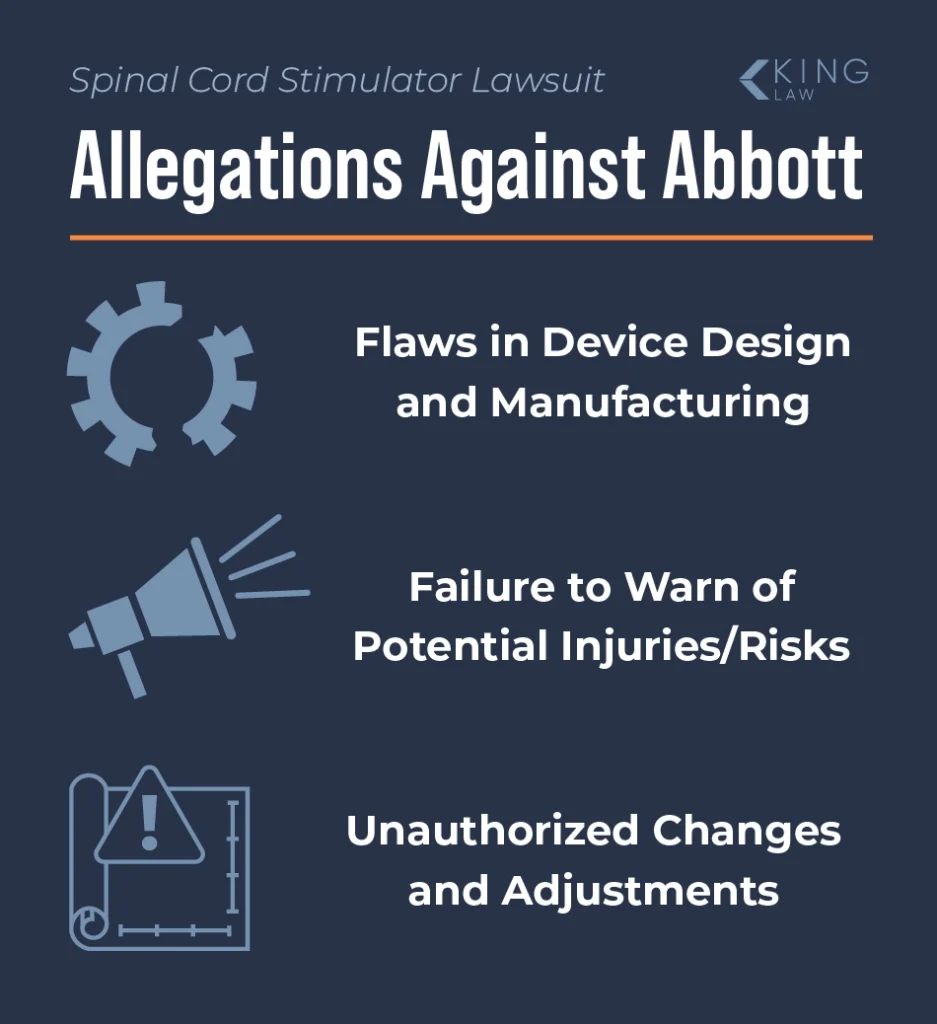
Allegations in SCS lawsuits filed against Abbott Laboratories include:
- Abbott should have known and warned patients about possible flaws and subsequent injuries related to some SCS models.
- Abbott marketed and sold devices that were often materially different than the ones that had undergone FDA evaluation.
- Abbott implemented changes to some SCS models, including changes to software, batteries, wireless communication, and wiring, that were substantial changes not authorized by their PMA.
- Abbott technicians frequently made adjustments to the devices without meaningful physician oversight.
- Abbott’s business practices may have introduced defects that caused the devices to function improperly, sometimes injuring patients.
The modification argument is a central issue in these cases. Abbott’s SCS is a Class III medical device. As Class III medical devices, significant changes generally must undergo FDA review through the PMA supplement process before being marketed.
Are Abbott Spinal Cord Stimulator Lawsuits Class Actions?
Abbott spinal cord stimulator lawsuits are currently not part of a class action proceeding or a multidistrict litigation (MDL). However, a proposal to consolidate these cases into an MDL was submitted to the Judicial Panel on Multidistrict Litigation (JPML) in February 2026, and a hearing was held on May 28, 2026. After the hearing, the JPML chose only to consolidate spinal cord stimulator cases against Boston Scientific into an MDL.
In a transfer order issued June 5, 2026, the JPML chose not to create an MDL for spinal cord stimulator lawsuits against Abbott. However, the MDL made its decision based on not wanting to create an MDL against two different manufacturers with different products. So, an MDL for Abbott lawsuits could be created in the future. However, patients can still file lawsuits against Abbott, just not as part of MDL 3181.
Which Abbott Spinal Cord Stimulator Devices Are Named in the Lawsuits?
Numerous Abbott SCS models and related implantable pulse generators have been named in lawsuits and regulatory actions. All of these devices are intended to treat chronic pain symptoms by electrically stimulating the spinal cord through leads implanted near the spinal cord. According to legal complaints obtained by King Law, models frequently named in lawsuits include:
- The Proclaim SCS line
- Proclaim XR 5
- Proclaim XR 7
- Proclaim Plus 5
- Proclaim Plus 7
- Proclaim 5 Elite
- Proclaim 7 Elite
- The Eterna SCS system
- Infinity 5 and 7 neurostimulators, often used in conjunction with Proclaim devices.
Some lawsuits have also named older, legacy devices developed by St. Jude Medical, including the Prodigy, Eon, and Genesis models. Abbott Laboratories acquired St. Jude Medical in 2017.
Why Are People Filing Abbott Spinal Cord Stimulator Lawsuits?
People who are filing Abbott spinal cord lawsuits report worsening symptoms after being implanted with an SCS, along with electric shocks, irritation, or injury from lead migration, nerve damage, and incontinence. Some report their device permanently entering a locked “MRI mode” or rapid battery depletion.
In some cases, these issues necessitated additional surgeries to remove the SCS devices, and patients experienced complications. The lawsuits also claim that Abbott sales representatives became involved in programming or adjusting the devices, often without physician supervision.
Abbott is expected to defend these cases, relying heavily on the concept of federal preemption. This immunity from state-level civil action applies to medical devices that receive the FDA’s
What Injuries Are Linked to Abbott Spinal Cord Stimulator Lawsuits?
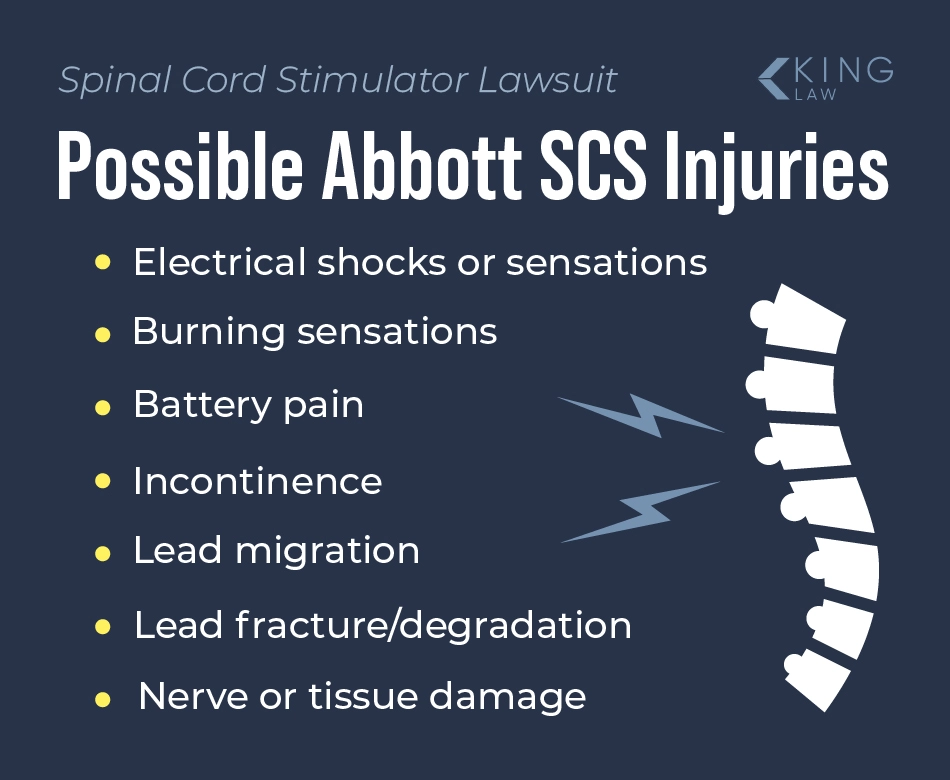
Injuries linked to Abbott cord spinal cord stimulators range from device-induced physical injuries to surgical risks involved with implanting or removing an ineffective or malfunctioning SCS. Reported injuries include:
- Electrical shocks or sensations
- Burning sensations
- Battery pain
- Lead migration and subsequent tissue damage or inflammation
- Lead fracture/degradation
- Infections
- Nerve or tissue damage
- Incontinence
- Rapid battery depletion/slow charging
- Inability to exit MRI mode, rendering the device ineffective
- Bluetooth connection issues
- Surgeries to remove, revise, or replace a device that is not working as intended
These injuries are in addition to the economic costs of the devices, surgeries, and complications.
Who Qualifies to File an Abbott Spinal Cord Stimulator Lawsuit?
Individuals who suffered a qualifying injury due to an implanted Abbott Laboratories spinal cord stimulator may be eligible to file a lawsuit.
People who allege injuries from one of the following devices may be able to pursue a lawsuit against Abbott:
- Proclaim XR, Plus, or Elite models
- Eterna spinal cord stimulator
- Infinity 5 or Infinity 7
- A St. Jude Medical legacy system like Eon, Eon Mini, or Prodigy
*Note: This is not a complete list and other models may qualify
Additionally, the lawsuit needs to be filed within the relevant statute of limitations. Due to the complexity of medical device litigation, it’s advisable to have your claim reviewed by an experienced attorney to understand if you may have a viable claim against Abbott.
What Evidence Is Needed to Support an Abbott Spinal Cord Stimulator Claim?
Abbott spinal cord stimulator claims need to be supported by evidence that establishes a link between an injury and known issues with the implanted device. The stronger the body of evidence, the stronger the claim. The following items can serve as evidence in an Abbott SCS case:
- Implant records
- Explant (device removal) or surgical revision records
- Device ID cards
- Operative reports
- Infection or injury records
- ER visits
- Recall letters
- Records showing lost wages or ongoing or worsening disability
- Imaging showing lead migration
- Records of interactions with pharmaceutical reps
Evidence particular to your injuries–for example, burns suffered from an overheating device–should also be included.
Abbott Spinal Cord Stimulator Problems: Recalls and Safety Issues
Regulatory actions, such as FDA Class I and II recalls, are important details in the Abbott spinal cord stimulator lawsuits. These actions are a record of design or manufacturing defects that can serve as evidence in product liability lawsuits. Below are some of the safety actions relevant to the Abbott spinal cord stimulator lawsuits.
2023 MRI Mode Class I Recall
On July 18, 2023, Abbott Laboratories initiated a recall on multiple implantable pulse generators (IPGs) after 186 reported incidents of the devices entering and subsequently being unable to leave MRI mode. In this state, the devices can lose the ability to communicate with their paired controller devices (such as a smartphone). Exiting the mode required the patient to track down the clinician who programmed the device. If that individual could not be found, or if they had lost their own connection to the device, the inactive device would have to be surgically removed or replaced. The affected models were:
- Proclaim XR 5 IPG Model 3660 (formerly Proclaim 5 Elite)
- Proclaim XR 7 IPG Model 3662 (formerly Proclaim 7 Elite)
- Proclaim Plus 5 IPG Model 3670
- Proclaim Plus 7 IPG Model 3672
- Proclaim DRG IPG Model 3664
- Infinity 5 IPG Model 6660
- Infinity 7 IPG Model 6662
A total of 155,028 Abbott SCS devices were recalled. The FDA identified this recall as Class I, the most serious type of recall, wherein “there is a reasonable probability that the use of or exposure to a violative product will cause serious adverse health consequences or death.”
2025 Bluetooth Communication Class II Recall
On October 6, 2025,
Class II Overheating And Battery Weld Recalls (2011-2013)
Prior to Abbott Laboratories’ acquisition of St. Jude Medical, the FDA enforced two Class II recalls on predecessor SCS models, the Eon and Eon Mini. The first was initiated due to overheating risks during wireless charging that could result in first or second-degree burns and emergency surgeries. The second recall involved defective battery welding, which could crack over time, allowing battery fluids to leak and disrupt electrical circuitry.
What Are the Main Legal Claims Against Abbott?
Lawyers representing the plaintiffs in the Abbott spinal cord stimulator lawsuits are using existing legal theories and precedents to build their product liability claims.
Legal theories in Abbott Spinal Cord Stimulator lawsuits:
- Manufacturing defect: A manufacturing defect occurs when the product deviates from its design during production, making it more dangerous to use than the design would imply. Many plaintiffs are arguing that the SCS device they received was different than the device they tested and/or point to product recalls as evidence of defective components.
- Design defect: A product has a design defect when it is dangerous to use even when manufactured correctly. This is more difficult to prove, given the FDA’s pre-market approval of Abbott’s SCS devices, though some lawsuits are alleging that the company changed the design post-approval or failed to report adverse events.
- Failure to warn: This legal theory argues that the manufacturer did not adequately inform consumers of the risks of using the product. Though they may share some traits in common, note that a failure to warn does not necessarily establish fraudulent concealment.
- Negligence: Negligence uses a “reasonable person” standard to evaluate the conduct of the defendant, arguing that the defendant failed to exercise the caution and due diligence one would expect of a reasonable person with similar knowledge and abilities in that situation. The negligence theory is frequently used in product liability lawsuits to claim corporations were negligent in their duty to avoid harming their consumers.
- Fraudulent concealment: Fraudulent concealment alleges that the defendant hid or suppressed information about their product, such as failing to report adverse events to the FDA.
- Breach of warranty: A breach of warranty may be invoked in cases where a manufacturer fails to meet stated or implied safety, performance, or quality guarantees to the consumer. Abbott SCS “MRI mode” bugs, for example, could theoretically fall under breach of warranty.
The legal theories used in individual complaints may vary depending on the circumstances of the case.
What Role Do Abbott Sales Representatives Play in the Lawsuits?
Multiple lawsuits against Abbott Laboratories allege that the company responded to patient complaints by sending sales representatives to make adjustments to their implanted spinal cord stimulators without the supervision of a physician.
These plaintiffs argue that these representatives may not have had the technical expertise or medical knowledge to properly calibrate the devices, possibly leading to non-therapeutic or dangerous settings, as well as delayed medical care.
These allegations introduce an additional angle to the lawsuits beyond product liability, raising questions about informed consent and medical supervision.
How Is Abbott Defending These Lawsuits?
Abbott Laboratories is expected to defend against these lawsuits by using the concept of federal preemption. Established by the 1976 case Riegel v. Medtronic, this precedent means that, once the FDA approves a medical device’s design, manufacturing process, and warning labels, no state-level court can establish requirements different from or in addition to those federally approved. This makes it difficult, for example, for plaintiffs to argue that Abbott SCS devices have design defects. Instead, those plaintiffs need to plead claims that run parallel to federal regulations without contradicting them.
For example, arguments that a Proclaim XR should not have been designed with Bluetooth connectivity would likely be dismissed. Instead, plaintiffs in the Abbot spinal cord lawsuit may argue that the FDA approved a Bluetooth interface that was reasonably hardened against the risk of permanently locking up, and that they received a product that did not meet these FDA standards. Early motions to dismiss these cases may succeed if plaintiffs fail to allege enough violations tied to Abbott’s federal duties, which is why federal regulatory actions like Class I and II recalls are particularly relevant.
Is There a Deadline to File an Abbott Spinal Cord Stimulator Lawsuit?
All Abbott spinal cord stimulator lawsuits need to be filed within a deadline established by each plaintiff’s jurisdiction’s statute of limitations. Statutes of limitations vary from state to state and by the legal theory under which the claim is being made.
Typically, patients have between one and three years from the date of the injury, or one to three years from the date upon which the injury is discovered to have been caused by the defendant. In the case of wrongful death lawsuits, the deadline is measured from the victim’s date of death instead. Consult with an attorney quickly after discovering your injury to understand which deadlines apply to your case. Some deadlines may be short or longer.
Is There an Abbott Spinal Cord Stimulator Settlement?
As Abbott spinal cord stimulator lawsuits are still in the early stages, no settlement standard has yet been established. Future settlement results will likely vary depending on the severity of the injury or the number and complexity of the corrective surgeries required.
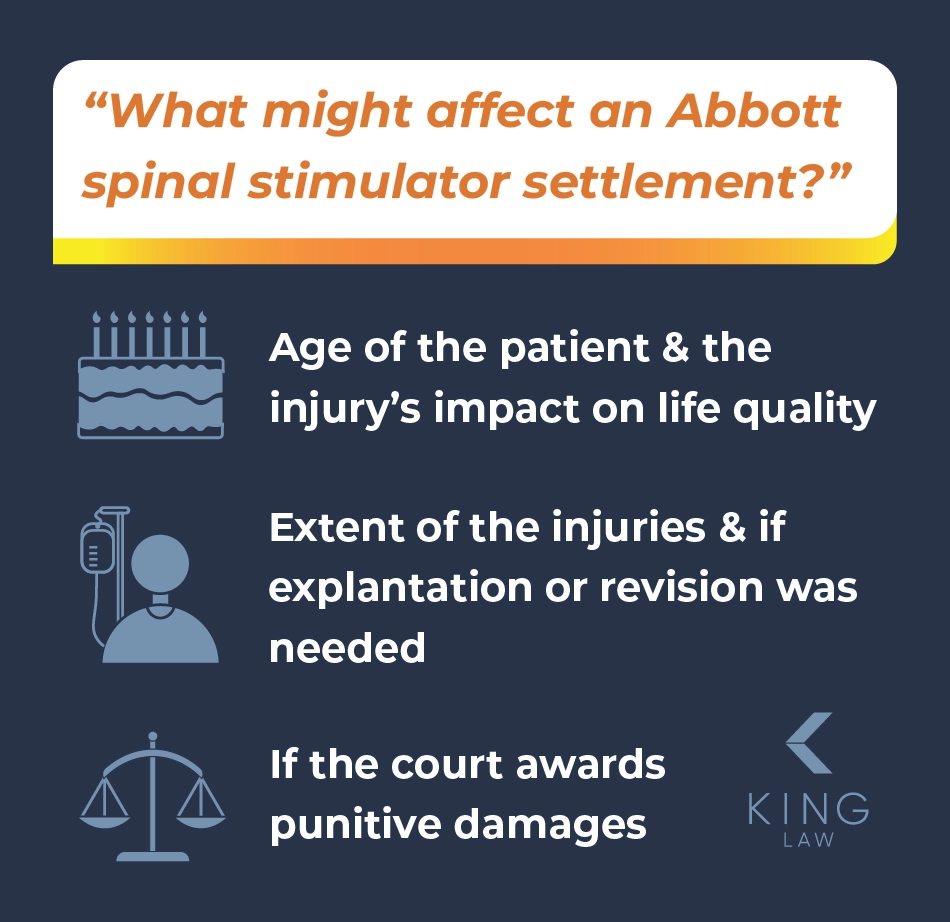
Factors affecting a settlement and associated compensation include:
- The age of the patient
- The extent of injuries
- Whether an explantation or revision surgery was involved
- The specific financial losses of each plaintiff
- Specific impacts on quality of life
Filing a lawsuit does not guarantee someone compensation, and each claim and potential compensation is unique. King Law is closely monitoring verdicts and settlements in the various SCS litigations.
How Can I File an Abbott Spinal Cord Stimulator Lawsuit?
If you have been injured by an Abbott spinal cord stimulator, you should act quickly to preserve evidence and your right to seek compensation. Given the complexity of medical device product liability lawsuits, it is generally advisable that you have your case evaluated by an experienced attorney. The steps to filing an Abbot spinal cord stimulator lawsuit are:
- Consult with an attorney experienced in product liability law.
- Work with your attorney to gather evidence.
- Submit your claim within your state’s statute of limitations.
- Proceed to discovery, sharing evidence with the defense.
- Negotiate a settlement or proceed to trial.
Should the Abbott spinal cord stimulator lawsuits be consolidated into an MDL, bellwether trials would be conducted that would then influence the discovery and settlement phases of your lawsuit, should you join that MDL.
King Law Is Actively Intaking Abbott Spinal Cord Stimulator Claims
King Law is actively reviewing Abbott spinal cord stimulator claims from patients who have experienced serious complications from the devices in all 50 states. Our attorneys have decades of experience litigating complex medical product liability claims and getting our clients the compensation they are due. We work on a contingency basis, so there is no upfront cost to pursuing a claim, and we only take payment if we secure you compensation.
Contact Robert King Law Firm For a Free Case Review
If you have been injured by an Abbott SCS, contact the Robert King Law Firm today for a free case review with no obligations at (585) 270-8882, or by submitting a form on this website. Our spinal cord stimulator attorneys can review your device information, medical records, and symptoms to evaluate your case and advise you on your next steps.
Frequently Asked Questions (FAQs)
Sources Used in This Article
Here is a list of sources used to generate this article on spinal cord stimulator lawsuits. King Law adheres to strict editorial standards when creating content for this site.
- “MAUDE Adverse Event Report: Abbott Neuromodulation Division – Infinity Deep Brain Stimulation System.” Manufacturer and User Facility Device Experience (MAUDE) Database, U.S. Food and Drug Administration, 2023, https://www.accessdata.fda.gov/scripts/cdrh/cfdocs/cfmaude/detail.cfm?mdrfoi__id=17990049&pc=LGW. Accessed 11 June 2026.
- “MAUDE Adverse Event Report: Abbott Neuromodulation Division – Infinity Deep Brain Stimulation System.” Manufacturer and User Facility Device Experience (MAUDE) Database, U.S. Food and Drug Administration, 2024, https://www.accessdata.fda.gov/scripts/cdrh/cfdocs/cfmaude/detail.cfm?mdrfoi__id=20505966&pc=LGW. Accessed 11 June 2026.
- “Abbott Completes the Acquisition of St. Jude Medical.” Abbott MediaRoom, Abbott Laboratories, 4 Jan. 2017, https://abbott.mediaroom.com/2017-01-04-Abbott-Completes-the-Acquisition-of-St-Jude-Medical. Accessed 11 June 2026.
- “Abbott Medical Recalls Proclaim and Infinity IPGs Due to Inability to Exit Magnetic Resonance Imaging (MRI) Mode.” U.S. Food and Drug Administration, 14 Dec. 2023, https://www.fda.gov/medical-devices/medical-device-recalls-and-early-alerts/abbott-medical-recalls-proclaim-and-infinity-ipgs-inability-exit-magnetic-resonance-imaging-mri-mode. Accessed 11 June 2026.
- “Class 1 Device Recall: Eon Mini Implantable Pulse Generator.” Medical Device Recalls Database, U.S. Food and Drug Administration, 2012, https://www.accessdata.fda.gov/scripts/cdrh/cfdocs/cfres/res.cfm?id=107454. Accessed 11 June 2026.
- “Class 1 Device Recall: Eon Mini Implantable Pulse Generator.” Medical Device Recalls Database, U.S. Food and Drug Administration, 2013, https://www.accessdata.fda.gov/scripts/cdrh/cfdocs/cfres/res.cfm?id=112696. Accessed 11 June 2026.
- “Classify Your Medical Device.” U.S. Food and Drug Administration, updated 16 Sept. 2024, https://www.fda.gov/medical-devices/overview-device-regulation/classify-your-medical-device. Accessed 11 June 2026.
- “In re: Abbott Laboratories Spinal Cord Stimulator Products Liability Litigation, MDL No. 3181, Transfer Order.” Judicial Panel on Multidistrict Litigation, 26 May 2026, https://www.jpml.uscourts.gov/sites/jpml/files/MDL-3181-Transfer_Order-5-26.pdf. Accessed 11 June 2026.
- “Urgent Medical Device Correction Letter: Eterna Spinal Cord Stimulation System.” Abbott Neuromodulation, Oct. 2025, https://www.neuromodulation.abbott/content/dam/nm/neuromodulation/downloadables/productadvisories/100325/25-112653-UrgentMedicalDeviceCorrectionLetter_Eterna.pdf. Accessed 11 June 2026.
- “Z-1767-2025: Eterna Spinal Cord Stimulation System Recall.” Medical Device Recalls Database, U.S. Food and Drug Administration, 2025, https://www.accessdata.fda.gov/scripts/cdrh/cfdocs/cfres/res.cfm?id=216508. Accessed 11 June 2026.