

Spinal Cord Stimulator Removal Complications
Complete the form below to see if you qualify for a Spinal Cord Stimulator Lawsuit

Spinal cord stimulator removal, also known as SCS explantation, is generally a safe surgery. However, the device’s proximity to delicate nervous system structures can lead to complications in some patients. Although uncommon, serious complications may include infections, internal bleeding, cerebrospinal fluid leaks, nerve injuries, or retained lead fragments.
SCS explantation requires surgery. The complexity and overall risk of the surgery also depends on the type of lead on the SCS, with paddle leads typically requiring longer procedures due to complex scar tissue.
SCSs are typically removed when the device is no longer manages pain, causes complications, causes an infection, or is no longer medically appropriate. The device may also be explanted at the patient’s request. Once a patient’s spinal cord stimulator is removed, it can no longer modify pain signaling. This means that the pain the device was treating will likely return.
About the Spinal Cord Stimulator Removal Complications
What Is Spinal Cord Stimulator Removal?
Why Are Spinal Cord Stimulators Removed?
Are Spinal Cord Stimulator Removal Complications Common?
Most Common Spinal Cord Stimulator Removal Complications
Complication Risk by Type of SCS Removal
Who Is at Higher Risk for Spinal Cord Stimulator Removal Complications?
How Doctors Try to Prevent SCS Removal Complications
What Happens During Spinal Cord Stimulator Removal?
Recovery After Spinal Cord Stimulator Removal
King Law Is Investigating Spinal Cord Stimulator Explantation Claims
Contact Robert King Law Firm for a Free Case Review
What Is Spinal Cord Stimulator Removal?
Spinal cord stimulator removal refers to a surgical procedure performed to remove an SCS device. This type of surgery is called an explantation, which is the opposite of implantation. SCS removal is typically done to correct an issue with the device or one of its components. Sometimes patients have a revision surgery, where the SCS is repaired instead of removed.
SCS devices are used to treat chronic pain through neurostimulation by way of an implantable pulse generator (IPG). An SCS is implanted in the mid-to-lower thoracic spine area or the cervical spine region. When the device malfunctions or becomes less effective due to factors like lead migration, physicians may perform one of the following types of spinal cord stimulator removal surgery:
- Complete removal: Leads and IPG are both removed. This is usually only done if the patient wishes to discontinue the therapy or when patients require imaging that cannot safely be performed with their type of SCS.
- Revision surgery: One or more implanted elements of the device are repaired, repositioned, or replaced instead of being fully removed.
The two main implanted components of an SCS are the IPG and the leads, which include the wires, electrodes, and anchors.
Why Are Spinal Cord Stimulators Removed?
Spinal cord stimulators are removed when the device breaks, stops providing pain relief, or poses a medical risk to the patient. Removing or revising parts of the device can restore pain coverage to the patient or decrease the risk of secondary complications like infections or nerve compression.
Most Common Reasons Spinal Cord Stimulators Are Removed:
These are some of the most common reasons spinal cord stimulators are removed:
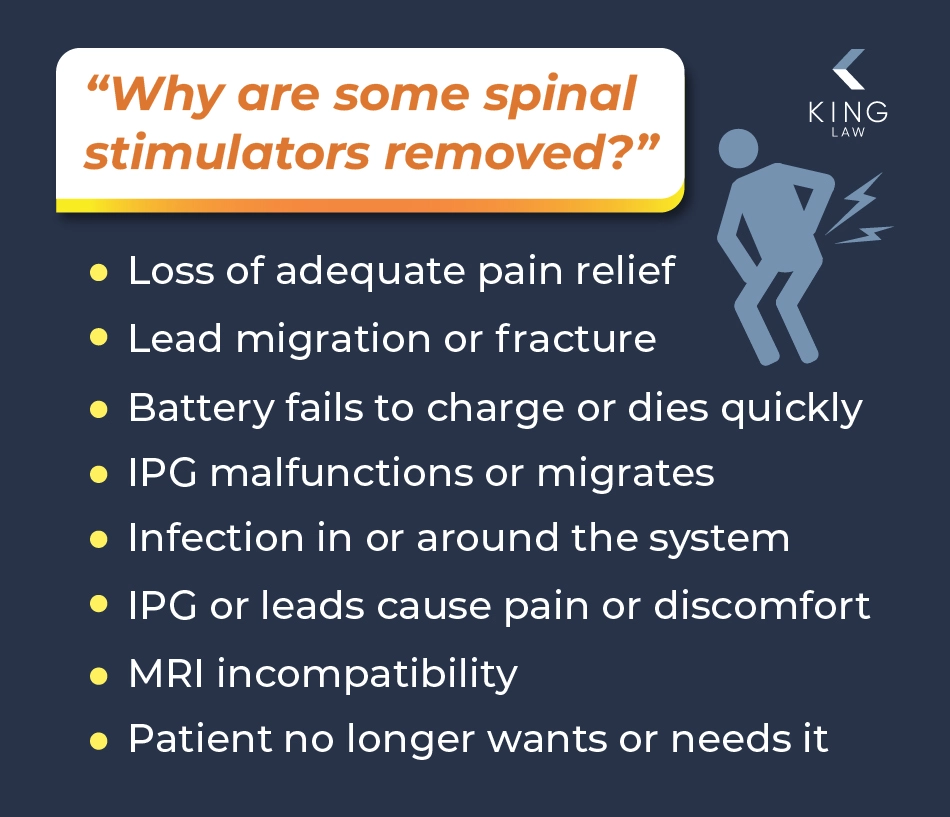
- Loss of pain relief: The device no longer provides adequate pain relief.
- Lead migration or lead fracture: The leads move, break, or stop delivering stimulation properly.
- Battery failure: The device can no longer be charged or does not hold a charge for long.
- IPG failure: The generator malfunctions, migrates, or becomes uncomfortable.
- Infection: An infection develops around the incision, battery pocket, or implanted system.
- Pain at the implant site: The IPG or leads cause discomfort.
- MRI incompatibility: The patient needs imaging that cannot be safely performed with the device in place.
- Patient preference: The patient no longer wants or needs the device.
Lead migration is the
Are Spinal Cord Stimulator Removal Complications Common?
Major spinal cord stimulator removal complications are uncommon,
- The leads have been implanted for many years.
- The patient has paddle leads. This type of lead is more stable than cylindrical percutaneous leads, but is harder to revise or explant (remove).
- The patient has heavy scar tissue or has had previous spine surgeries.
- The device is being removed due to an infection.
- The leads have fractured or are difficult to access after migration.
- The patient has health issues, such as obesity.
Most explantation and revision surgeries involving percutaneous leads are performed using minimally invasive techniques.
Most Common Spinal Cord Stimulator Removal Complications
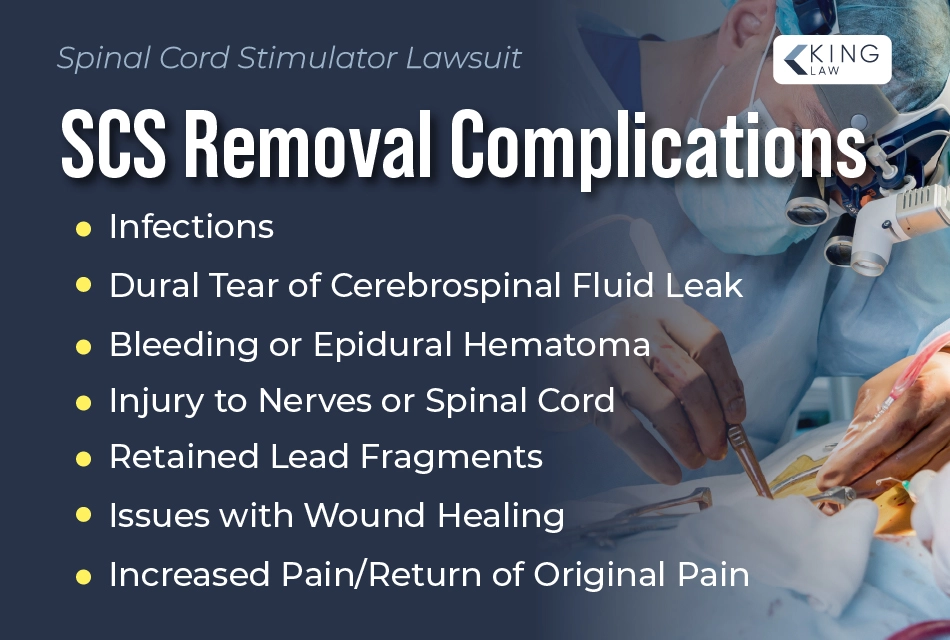
The most common spinal cord stimulator removal complications are minor and include issues like superficial infections, fluid build-up, and pain or inflammation around the surgical site. These complications are generally temporary or easily resolved. Major complications are less common but more serious, frequently requiring medical intervention. Below are the most common major complications associated with spinal cord stimulator removal and how they are treated. How often these spinal cord stimulator complications are experienced is reflected in the table below.
| Complication of SCS Removal | How Many Patients Affected |
| Infection | Up to 2.45% |
| Spinal fluid leak | 0.3% to 7% |
| Bleeding or hematoma | Up to 2.6% |
| Nerve injury | Up to .42% |
| Paralysis | Extremely rare |
| Retained lead fragments | Varies |
| Wound healing | Varies |
Note: These statistics are taken from findings from individual studies and do not necessarily reflect statistics at large.
Infection After Spinal Cord Stimulator Removal
Patients suffer infections after spinal cord stimulator removals at similar rates to surgeries in general, at around 2.45%. A
Common signs of surgical site infections include:
- Thick, cloudy discharges from the wound
- Noticeable odor from the incision
- An opening in the incision line
- Redness or color changes in skin beyond the edge of the wound
- Pain when you touch the area around the wound
- The incision area is warm or hot to the touch
- Fever greater than 101 ℉
- Chills
- Sweating
Many surgical site infections are superficial. However, some infections can spread to other areas of the body. Keep in contact with your medical provider if symptoms worsen, particularly if you experience any swelling, discharge, or pain when you gently touch the infected area.
Cerebrospinal Fluid Leak or Dural Tear
A cerebrospinal fluid (CSF) leak can occur if the outer membrane of the spinal cord, the dura mater, is mechanically penetrated during the removal surgery. Dural tears are rarely seen during first-time spinal cord stimulator implantations, accounting for 0.3% to 7% or less of all complications. However, they can occur if the epidural needle used to place the SCS leads accidentally punctures the protective layer.
While rarely life-threatening, dural tears complicate surgery and cause the patient pain and discomfort. However, if a tear is not recognized and addressed during surgery, it can lead to symptoms like back pain, head aches, nausea, and vomiting. In rare cases, a dural tear can lead to central nervous system infections, fluid leakage, and more serious neurological symptoms, such as muscle weakness, numbness, or nerve pain.
Bleeding or Epidural Hematoma
Bleeding can occur both during and after surgery and lead to a spinal epidural hematoma (SEH). Bleeding in the tight spinal canal can form clots that place pressure on or cut off blood to the spinal cord. This bleeding can cause neurological symptoms like pain, numbness, or weakness. Symptomatic hematomas are a very rare complication of removing percutaneous leads, but they are more common in paddle lead surgeries, affecting around 2.6% of patients.
Nerve Injury or Spinal Cord Injury
SCS implantations and revisions present a very small risk of spinal cord injury. The baseline risk of long-term neurological injury is around 0.42% for implantations, with a paralysis rate of around 0.03%. For straight removals, the rate of spinal cord injuries is near zero, even when accounting for complex scar tissue, such as in the case of paddle lead extractions. Permanent paralysis following spinal cord stimulator removal appears to be extremely rare, with only isolated reports in the literature.
Retained Lead Fragments
Lead fractures, whether they occur prior to or during surgery, are a potential complication with SCS explantation. Fragments may accidentally or intentionally be left behind after revisions or explantations. Surgeons will run a cost-benefit analysis on removing deeply-embedded lead fragments. Sometimes, extracting lead fragments carries the risk of more serious complications like dural tears. Abandoned lead fragments may complicate MRIs or, rarely, present an infection or migration risk.
Wound Healing Problems
Patients who have an SCS removal surgery may experience problems with their surgical wounds healing. There are also specific risks related to the subcutaneous pocket that surgeons create to house the IPG. Wound healing problems after an SCS removal include:
- Wound dehiscence, or the parting of a surgically closed incision line.
- Skin erosion from persistent pressure and friction.
- Necrosis due to decreased blood flow.
Additionally, secondary factors that affect blood flow to the wounds, such as diabetes, tobacco use, or scar tissue, may complicate healing.
Increased Pain or Return of Original Pain
Since SCS device therapy masks the original pain through ongoing stimulation, removing the device ends the therapy. If the underlying cause of pain hasn’t resolved, it will generally return. In some cases, the patient may temporarily experience hyperalgesia, or increased pain as they acclimate to the loss of pain relief coverage.
Complication Risk by Type of SCS Removal
Not all SCS removals use the same surgical procedures. Each type of removal comes with different risks and possible complications. Paddle lead removal, for example, requires more complex surgery. In some studies, it is correlated with higher risks of complications. There is mixed long-term data on just how much riskier one removal type is than another.
Percutaneous Lead Removal
Thin, cylindrical percutaneous leads are relatively easy to remove. Generally, their removal only takes about an hour under general anesthesia, and the complication rate is likely low. There is minimal available data isolating rates of percutaneous lead removal. However, a systematic review found that percutaneous leads had consistently higher removal rates than paddle leads. For example, removal rates were almost twice as high for percutaneous leads at three months (4.4% vs. 2.4%), with the gap lowering over time to 10.8% vs. 9.1% at the two-year mark.
Paddle Lead Removal
Paddle leads require a more complex open surgery called a laminectomy, which removes bone to create an opening for the electrode array. Explantations need to pass through the same opening created during implantation, which requires a more complex surgery than with percutaneous leads. It may also require further bone removal and operating upon more complex scar tissue. Still, the rate of major complications from paddle lead removal is low (2.94%) according to a 2018 study, with one incident of a postoperative cerebrospinal fluid leak and one suprafascial hematoma out of 68 cases.
IPG or Battery Removal
IPG problems are the third-most-common reason for explant behind insufficient pain relief and infection. Pain at the IPG pocket is cited as the fourth-most-common in the systematic review. As is the case with percutaneous leads, most available data does not isolate the risks of IPG removal, but it is considered a relatively minor operation that rarely directly results in major complications.
Who Is at Higher Risk for Spinal Cord Stimulator Removal Complications?
Some patients may be at a higher risk of SCS removal complications than others, particularly smokers and patients who have undergone repeated explantations. A 2023 retrospective review of paddle explantations found that the procedure was relatively safe overall, with the highest rates of complications seen in:
- Smokers
- Individuals undergoing their third or higher explantation
- Diabetic patients (though this finding was not considered to be statistically significant)
Broader surgical risk factors typically cite obesity and age as risk factors, though studies have not linked obesity to worse outcomes for SCS explants, while age is actually associated with lower risks for this procedure. Cervical spine SCS surgeries are generally higher risk than thoracic spine operations.
How Doctors Try to Prevent SCS Removal Complications
Doctors employ multiple techniques and protocols to minimize the risk of SCS removal complications. These preventative measures include:
- Preoperative planning and adjustments to medications
- Imaging (x-ray, CT, or MRI)
- Intraoperative fluoroscopy and neuromonitoring
- Infection controls and sterile environments
- Surgical techniques like controlled scar dissection
- Proactive repair to control minor complications and prevent major ones
- Managing subcutaneous IPG pockets
These techniques help keep the rates of major complications low, even when working with the complex paddle lead extractions. Additionally, new techniques are also being developed to minimize the risk of surgery-related traumas, like inserting a rigid stylet directly into a failed percutaneous lead instead of reintroducing a needle.
What Happens During Spinal Cord Stimulator Removal?
Spinal cord stimulator removal procedures may vary somewhat depending on the type of lead and whether the SCS is being revised or completely removed. The surgery typically takes between 60 to 150 minutes and is performed as an outpatient procedure.
Spinal Cord Stimulator Removal Process:
The spinal cord stimulator removal process follows these general steps:
- Anesthesia: Most removals are done under general anesthesia, though some simpler procedures may use sedation and local anesthesia.
- Incisions: The surgeon may make a 1- to 2-inch incision over the generator pocket. The surgeon will also usually reopen the incision that was used to implant the leads.
- IPG removal: The battery is disconnected from the leads and removed. The surgeon will also wash and cauterize the subcutaneous battery pocket.
- Percutaneous lead removal: Leads are carefully withdrawn from the epidural space.
- Paddle lead removal: This often involves an open laminectomy to separate the paddle lead array from dense scar tissue.
- Wound closure: Incisions are closed with sutures, staples, or surgical glue.
Discharge time often depends on the type of lead removal. Percutaneous lead removals and revision patients can often go home within a few hours of the procedure. Paddle procedures often, but not always, involve an overnight stay for observation.
Recovery After Spinal Cord Stimulator Removal
Recovery after spinal cord stimulator removal surgery is relatively quick, so long as there are no complications. Healing is typically faster than with implantation, averaging between 2 to 6 weeks. The timeline often looks something like this:
- First 24 hours: Patients may be actively monitored, particularly in the case of paddle lead removal. Monitoring may include pain control and wound dressing.
- First 1 to 2 weeks: Patient will usually be instructed in wound care, avoiding soaking the incision, watching for signs of infection, and following up with the surgeon.
- First 2 to 6 weeks: Gradual return to activity, avoiding heavy lifting, limiting bending and twisting.
If the SCS system was completely removed and the underlying pain condition is still present, the patient will typically begin alternative pain management therapies.
King Law Is Investigating Spinal Cord Stimulator Explantation Claims
Most people who have their spinal cord stimulators removed do so because of complications with the device or inadequate pain relief. Some of these complications may be due to how the devices were designed, meaning the manufacturer may be liable for the injury.
King Law is actively investigating potential claims involving patients who underwent spinal cord stimulator removal surgery after suffering serious complications. We are reviewing cases from patients interested in filing a spinal cord stimulator lawsuit:
- Device failure
- Burning sensation/burns
- Electric shocks
- Lead wire fracture
- Lead wire migration
- Stimulator migration
- Paralysis
This is not a full list of injuries, and eligibility criteria may change over time. Contact our firm to discuss your possible legal options. Our lawyers work on a contingency basis, so there are no upfront costs to pursuing your claim.
Contact Robert King Law Firm for a Free Case Review
If you have recently had an SCS device removed or revised and believe the device manufacturer may be liable, call King Law at (585) 496-2648 or complete the form on this page for a free case review today. Our reviews are 100% confidential, and there’s no obligation to continue with your claim. Our attorneys are actively representing spinal cord stimulator injury cases. We can help you understand your eligibility and possible compensation avenues.
Frequently Asked Questions (FAQs)
The most common complication of spinal cord stimulator removal is the return of the underlying pain, but bleeding, nerve injuries, and infections are uncommon but major side effects.
Major complications of spinal cord stimulator removal are uncommon, particularly in the case of percutaneous lead removal. The incidence of major complications for all SCS removal surgery is under 3%.
Spinal cord stimulator removal is generally not considered dangerous and is often performed as an outpatient surgery.
Fever, swelling, increasing pain at the incision site, and foul-smelling discharges are signs of an infection during spinal cord stimulator removal.
SCS leads may sometimes break during removal, although these usually are not considered a major complication.
Spinal cord stimulator lead fragments left behind may interfere with MRIs. In rare cases, they may present a risk of tissue or nerve damage.
Pain may temporarily get worse after a spinal cord stimulator removal surgery as the body reacclimates to the loss of pain coverage.
If the underlying cause of pain has not resolved, the original pain will usually return.
Surgery-related pain typically resolves within six weeks, but may resolve within a few days. The original pain that was being treated by the SCS will usually return, unless it has been addressed through other interventions.
Recovery from SCS surgery typically takes 2 to 6 weeks.
Warning signs after spinal cord stimulator removal include fever, swelling, increasing pain at the incision site, cloudy discharges, and foul odors from the wound. Loss of sensation, worsening leg weakness, or bowel/bladder dysfunction may indicate a nerve injury.
You should seek medical assistance if you have progressive weakness or numbness, loss of bladder control, severe headaches, dizziness, or signs of an infection at the surgical site.
Yes, you can get another SCS after removal, though typically this would be performed as a revision surgery.
You may be able to sue for complications after spinal cord stimulator removal if the surgery was due to a known hardware or software issue or medical negligence.
List of Sources
King Law adheres to strict editorial standards when creating content for our site. Here is a list of sources used to write this article.
American Society of Regional Anesthesia and Pain Medicine (ASRA). “Complications of Spinal Cord Stimulator Implantation.” ASRA News, 7 Aug. 2019.
AnesKey. “Spinal Cord Stimulator Complications: Lead Migration and Malfunction.” AnesKey.
Core EM. “Spinal Epidural Hematoma.” Core EM.
Cleveland Clinic. “Surgical Wound Infection.” Cleveland Clinic.
Cleveland Clinic. “Hyperalgesia.” Cleveland Clinic.
de Andrés, José, et al. “Complications of Spinal Cord Stimulation: Identification, Treatment, and Prevention.” Neuromodulation, 2021.
Dones, Ignacio, and Giuseppe Levi Vismara. “Spinal Cord Stimulation Complications: A Review.” World Neurosurgery, vol. 124, 2019, pp. e1211-e1220.
Elsamadicy, Ahmed A., et al. “Spinal Cord Stimulator Failure: Evaluation and Management.” Neurosurgical Focus, 2017.
Harris, John A., et al. “Management of Complications Following Spinal Cord Stimulation.” Neuromodulation, 2022
Health and Disability Commissioner (New Zealand). “Case 03HDC10773.” 2004.
Hopkins Medicine. “Spinal Cord Stimulator Removal: Questions and Answers.” Johns Hopkins Medicine.
Jain, S., et al. “Revision Surgery After Spinal Cord Stimulator Implantation.” Journal of Clinical Medicine, 2025.
Journal of Neuroscience and Neurological Engineering. “[Article by Linqiu Zhou].” Vol. 6, no. 2.
Kumar, K., et al. “Complications of Spinal Cord Stimulation and Their Management.” Pain Physician.
Mayo Clinic. “Laminectomy.” Mayo Clinic.
Neupsy Key. “Dural Tears.” Neupsy Key.
North, Richard B., et al. “Spinal Cord Stimulation for Chronic Pain: Complications and Management.” Neurosurgery, 2012.
Pain Medicine Case Reports. “Case Report.” Pain Medicine Case Reports.
Pain Medicine Case Reports. “Case Report.” Pain Medicine Case Reports.
ProQuest. “Complications Associated with Spinal Cord Stimulators.”
Rosenow, Joshua M., et al. “Spinal Cord Stimulation Failure and Revision Surgery.” Journal of Neurosurgery, vol. 125, no. 4.
Spine Center Los Angeles. “Spinal Cord Stimulator.”
Terry, R., et al. “Imaging of Spinal Cord Stimulators and Associated Complications.” American Journal of Roentgenology, 2011.
U.S. National Library of Medicine. “Neurological Complications Associated with Spinal Cord Stimulation.” PMC, 2024.
U.S. National Library of Medicine. “Complications and Outcomes Following Spinal Cord Stimulator Revision Surgery.” PMC, 2025.
World Neurosurgery. “Complications Following Spinal Cord Stimulator Implantation.” World Neurosurgery, 2025.
World Neurosurgery. “Complications Following Spinal Cord Stimulator Implantation.” World Neurosurgery, 2025. (Duplicate URL provided.)
Neuromodulation. “Recent Advances in Spinal Cord Stimulation Safety and Complication Management.” Neuromodulation, 2026.
Yakovlev, Alexander E., et al. “Prevention and Management of Intrathecal Drug Delivery and Spinal Cord Stimulation System Complications.” Anesthesiology, 2004.