

Can a Spinal Cord Stimulator Cause Paralysis?
Complete the form below to see if you qualify for a Spinal Cord Stimulator Lawsuit

Paralysis is a rare but documented potential complication of spinal cord stimulator implantation. Paralysis may occur due to a complication during implantation surgery or for other reasons after the surgery. Some patients have experienced paralysis after part of the spinal cord stimulator caused permanent nerve damage. The overall risk of paralysis from a spinal cord stimulator implantation surgery is thought to be small. However, many spinal cord stimulator manufacturers list paralysis as a potential adverse event of implantation surgery.
About Spinal Cord Stimulator Paralysis
How Common Is Paralysis From a Spinal Cord Stimulator?
Which Brands of Spinal Cord Stimulators List Paralysis as a Risk?
What Symptoms After a Spinal Cord Stimulator Surgery Might Need Emergency Care or Precede Paralysis?
How Can a Spinal Cord Stimulator Lead to Paralysis?
Does Paralysis or Weakness Start Days, Months, or Years After Implantation?
Is Paralysis After a Spinal Cord Stimulator Permanent?
King Law Is Investigating Paralysis and Serious Spinal Cord Stimulator Injuries
Contact Robert King Law Firm for a Free Case Review
How Common Is Paralysis From a Spinal Cord Stimulator?
Paralysis is a rare but recognized potential adverse event from spinal cord stimulators. Studies have not reliably estimated how often spinal cord stimulators may cause permanent paralysis. However, paralysis in the lower part of the body (also called paraplegia), neurological damage, nerve damage, and reactive tissue are noted on some manufacturers’ patient safety information (e.g., Boston Scientific’s spinal cord stimulator safety information). Other spinal cord stimulator manufacturers have put similar warnings on their device’s safety labels.
Researchers have explored spinal cord injuries and how they may be linked to spinal cord stimulators. Some of the spinal cord injuries researchers have examined include paralysis, nerve damage, sensory changes, muscle weakness, pain, and related symptoms.
For example, one group of researchers noted that spinal cord injuries occurred within 45 days after a spinal cord stimulator implant
Which Brands of Spinal Cord Stimulators List Paralysis as a Risk?
Most major manufacturers of spinal cord stimulators include paralysis as a possible adverse event of the device and the implantation surgery.
- Abbott: Warns of paralysis due to placement of leads in the epidural space.
- Boston Scientific: Lists paralysis as a potential complication from surgery, adverse reaction to the device’s material, and leads being placed in the epidural space.
- Medtronic: Notes paralysis may occur due to an adverse reaction to the implant material, leads in the epidural space, and epidural hematomas (internal bruises around the spinal cord).
- Nevro: Paralysis is listed as a potential complication of the implant surgery for all SCS patients and as a high risk if a spinal cord stimulator is implanted in a “poor surgical candidate.”
| Brand and Model | Paralysis Listed on Safety Warnings? |
|---|---|
| Abbott Laboratories (Proclaim™ Plus and Proclaim™ XR SCS Systems, Eterna™ SCS System) | Yes (link to label) |
| Boston Scientific (Precision™ System Precision Spectra™ System Precision Novi™ System Precision Montage™ MRI System Spectra WaveWriter™ System WaveWriter Alpha™ System WaveWriter Alpha™ Prime System) | Yes (link to label) |
| Medtronic (Inceptiv™, Inceptiv™ LT, Intellis™ Pro, Intellis™, Vanta™, Sequentia™ LT) | Yes (link to label) |
| Senza® HFX iQTM System & Senza® HFXTM Trial System | Yes (link to label) |
What Symptoms After a Spinal Cord Stimulator Surgery Might Need Emergency Care or Precede Paralysis?
Having a spinal cord stimulator implanted requires surgery. As with all surgeries, spinal cord stimulator implantation has risks. Patients who have an SCS implant should closely follow their physician’s instructions for aftercare and monitor themselves for serious side effects. Some side effects could indicate or lead to a serious outcome, such as loss of mobility.
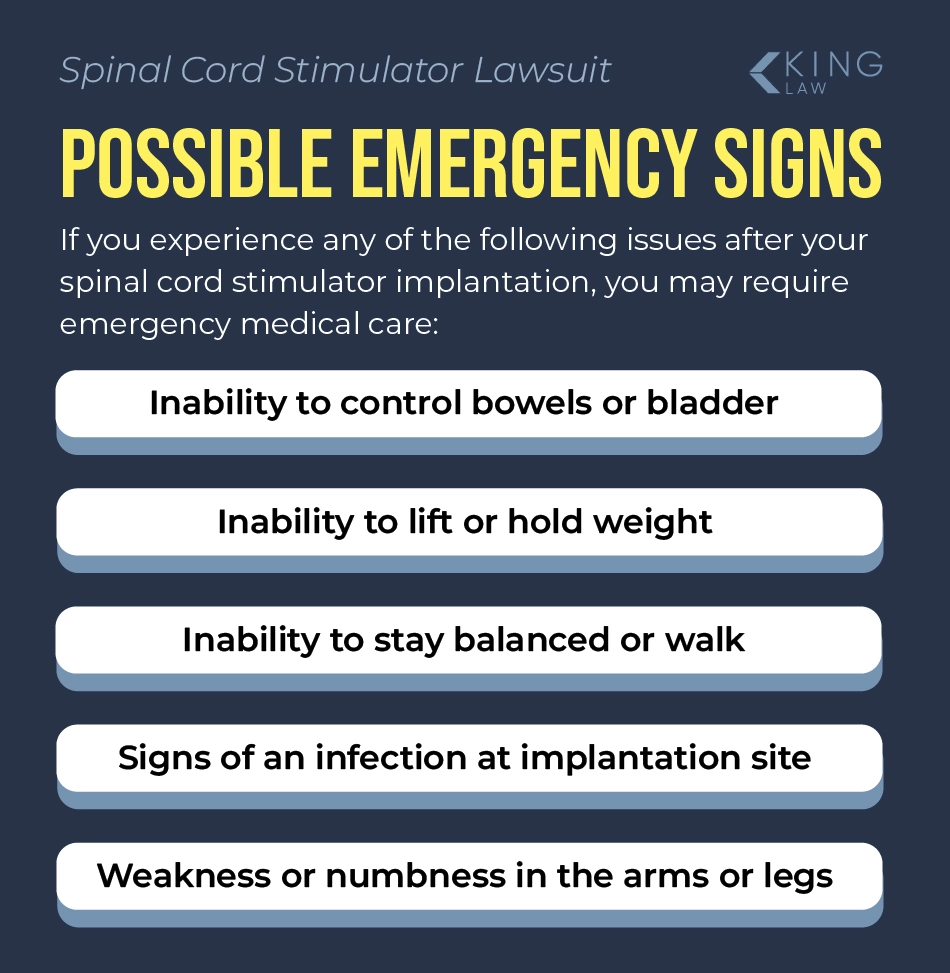
The following symptoms after a spinal cord stimulator surgery may require emergency care:
- Inability to control bowels or bladder
- Inability to bear or lift weight
- Inability to walk or stay balanced
- Signs of infection at the implantation site (e.g., redness, swelling, pus, pain)
- Weakness in the arms or legs
Experiencing muscle weakness,
Some discomfort or pain around the incision site within a day or so of having the spinal cord stimulator implanted may be normal. However, patients should discuss these and other symptoms with their doctor to make sure an underlying complication is not occurring. Spinal cord stimulator patients with concerning or severe symptoms may need to go to the emergency room for evaluation.
How Can a Spinal Cord Stimulator Lead to Paralysis?
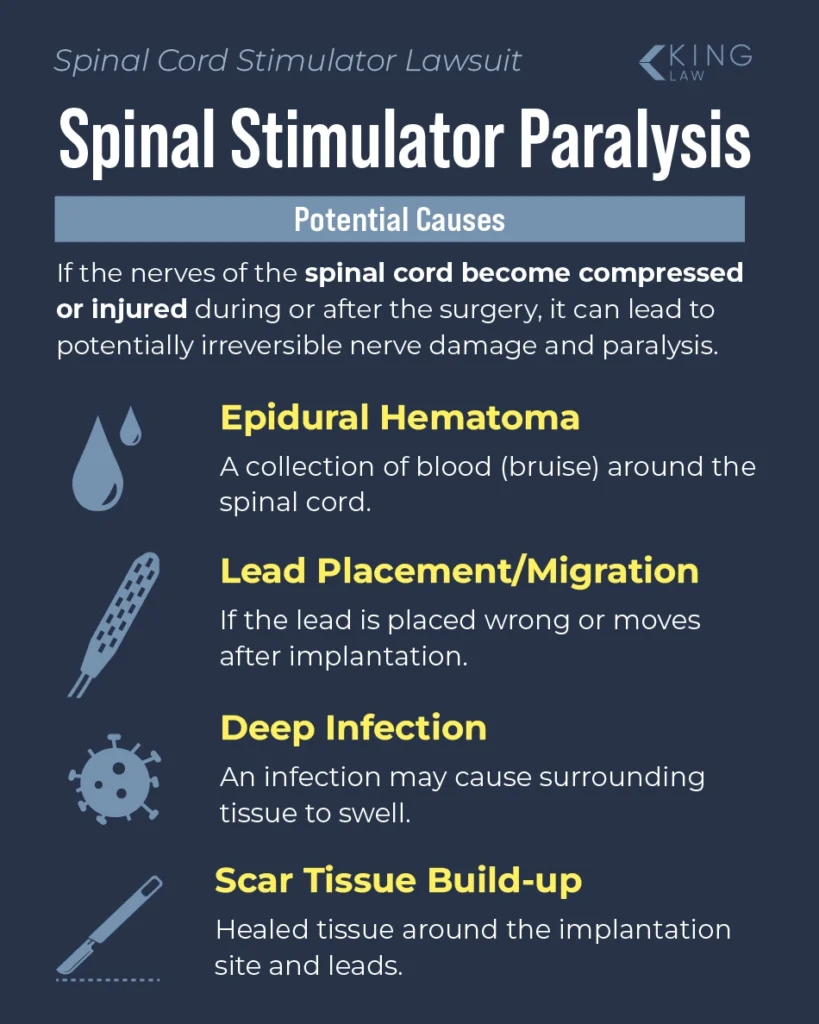
A spinal cord stimulator may lead to paralysis if the nerves are compressed or injured during or after the surgery, such as from a surgical error, improper lead placement, lead migration, or an infection. Uncontrolled bleeding under the skin (a hematoma) can also compress the nerves and cause nerve damage that can lead to paraplegia (i.e., paralysis in a part of the lower body).
Bleeding That Compresses the Spinal Cord
In several case reports, spinal cord stimulator patients have experienced temporary and permanent paralysis due to an epidural hematoma related to the device or surgery. An epidural hematoma is a collection of blood (a bruise) around the spinal cord. An epidural hematoma compresses the spinal cord and can damage it, especially if the patient does not seek treatment right away. Patients with an epidural hematoma after spinal cord stimulator surgery may feel weakness, loss of feeling, and changes in bowel or bladder function.
Injury or Compression During Lead Placement
Lead placement or migration can cause a range of symptoms and spinal cord trauma. For example, the simulator’s lead may be placed in the wrong area or move away from the targeted area during implantation surgery, resulting in nerve damage. Likewise, the leads may migrate from their original spot and damage the spinal cord. Spinal cord stimulator leads may compress (press up against) or bruise the spinal cord, sometimes resulting in paralysis.
Deep Infection Around the Spinal Cord
If a deep infection forms around the spinal cord, the swollen tissue (called an epidural abscess) can compress the spinal cord and cause neurological damage. An epidural abscess is an emergency and needs to be treated immediately to limit the risk of long-term damage. An epidural abscess can form if the surgical wound becomes infected. Medical research suggests that some spinal cord stimulator patients have
Scar Tissue That Causes Delayed Spinal Cord Compression
Scar tissue can build up around the implanted leads and potentially compress the spinal cord. The compression, if severe or left untreated, can result in nerve damage that may become permanent. In one case example, a woman developed weakness on her left side years after having a spinal cord stimulator implanted. Her doctors did tests and discovered that scar tissue from the surgery and fibrosis from other causes had compressed her cervical spinal cord.
Does Paralysis or Weakness Start Days, Months, or Years After Implantation?
Paralysis or weakness can begin days, months, or years after a spinal cord stimulator is implanted. The paralysis or weakness may be related to a complication from how the spinal cord stimulator was implanted, the patient’s reaction to what the device is made of, a manufacturing defect, or another cause. The following table helps explain when symptoms may appear and what those could be related to.
| Examples of when SCS symptoms appear | Some of the possible explanations |
|---|---|
| During or soon after a permanent or trial spinal cord stimulator implant | Injury or compression occurred during the procedure |
| Days after SCS implantation | Epidural hematoma, compression injury, or deep infection |
| Months or years after SCS implantation | Scar tissue, infection, reactive tissue (e.g., allergic reaction), or device-related complication |
However, each patient is unique, and only a qualified physician can help spinal cord stimulator patients understand what their symptoms may mean. Just because someone has a spinal cord stimulator device implanted and experiences neurological symptoms does not automatically mean the device caused those symptoms.
Is Paralysis After a Spinal Cord Stimulator Permanent?
Paralysis after a spinal cord stimulator device is implanted may be permanent. However, whether or not the paralysis is permanent depends on several factors, including why the patient is experiencing paralysis, how quickly they are evaluated, and the treatments received. Sometimes, removing the spinal cord stimulator device can help relieve device-related neurological symptoms. However, some patients have suffered severe and permanent paralysis and permanent other injuries.
What Published Cases Show About Recovery
Published case reports suggest that spinal cord stimulator patients have experienced a range of outcomes following implantation of a trial or permanent device. The table below highlights some neurological complications that spinal cord stimulator patients have experienced. However, these are examples and do not mean all patients with an implanted spinal cord stimulator are likely to experience these outcomes.
| Medical source | What was reported |
|---|---|
| Four-patient case series, 2010 | One patient had complete paraplegia, two had incomplete paraparesis, and one recovered neurological function after completing acute rehabilitation therapy to treat device-related complications. |
| Epidural hematoma case report, 2024 | A patient developed an epidural hematoma days after having a spinal cord stimulator implanted. Patient remained paraplegic despite device removal and surgical treatment. |
| Fibrous scar tissue case report, 2024 | A patient’s delayed motor weakness improved after removal of compressive tissue. The patient had a spinal cord stimulator implanted about four years before developing these complications. |
How Can My Doctor Evaluate New Weakness or Loss of Movement?
Your spinal cord stimulator doctor can use the following tests to evaluate your muscle weakness or loss of movement:
- Neurological exam to identify and measure the severity of symptoms
- MRI or other imaging scans (if compatible with the spinal cord stimulator)
- Blood tests to see if you have an infection
Depending on the results of your doctor’s evaluation, your doctor may order more tests or proceed with treatment. Treatment options may include antibiotics, surgery to correct or remove the device (i.e., explantation), scar tissue removal, reprogramming the spinal cord stimulator, or other measures. However, removing an SCS can result in numerous complications, so patients should discuss all possible treatment options with their physician.
When a patient is having imaging studies done, patients should make sure the technicians know they have a spinal cord stimulator, that it is in the correct mode, and that it is compatible with the type of imaging scans your doctor ordered.
King Law Is Investigating Paralysis and Serious Spinal Cord Stimulator Injuries
King Law is investigating cases of paralysis or serious spinal cord injuries that may be related to spinal cord stimulators. Our spinal cord stimulator injury attorneys provide free case reviews to understand why the patient had a spinal cord stimulator implanted, what symptoms they experienced after having the device implanted, and how those might relate to a device-related defect or complication.
Some of the evidence we review includes the patient’s medical records, device details, spinal cord stimulator trial and implant dates, post-implant symptoms, and other related records. We can help you determine if your paralysis may be due to a problem with your spinal cord stimulator or the surgery.
Contact Robert King Law Firm for a Free Case Review
Some patients who experienced paraplegia (paralysis) may have grounds to file a spinal cord stimulator lawsuit against the device manufacturer. Contact Robert King Law Firm to schedule a free case review with an experienced spinal cord stimulator attorney on our team. Call us at (585) 496-2648 or fill out an online contact form today.
Frequently Asked Questions (FAQs)
Sources
- Bara, Gregor A., and Jost Thissen. “Cervical Epidural Abscess due to Implantation of a Spinal Cord Stimulation Lead.” Clinical Case Reports, vol. 10, no. 6, 2022, e05931. https://doi.org/10.1002/ccr3.5931.
- Baur, Alexander, and Keith Lustig. “Spinal Epidural Hematoma and Permanent Paraplegia Following Spinal Cord Stimulator Implantation: A Case Report.” Journal of Spine Surgery, vol. 10, no. 3, 2024, pp. 576–582. https://doi.org/10.21037/jss-23-139.
- Boston Scientific. Spinal Cord Stimulator System Information for Patients. Boston Scientific Neuromodulation Corporation, 97035804-01, Rev. A. U.S. Food and Drug Administration.
- Boston Scientific. “MRI and Medical Procedures.” Boston Scientific.
- Cambridge University Hospitals NHS Foundation Trust. “Spinal Cord Stimulation – Single Stage.” Cambridge University Hospitals.
- Falowski, Steven, et al. “Spinal Cord Injury Induced by a Cervical Spinal Cord Stimulator.” Neuromodulation: Technology at the Neural Interface, vol. 14, no. 1, 2011, pp. 34–37. https://doi.org/10.1111/j.1525-1403.2010.00313.x.
- Leeds Teaching Hospital. “Discharge Advice Following Implantation of a Permanent Spinal Cord Stimulator (SCS) or Peripheral Nerve Stimulator (PNS).” Leeds Teaching Hospitals NHS Trust, edition 2. June 2025.
- Maeda, Takuma, et al. “A Late Complication Related to Percutaneous Implantable Leads for Spinal Cord Stimulation: Myelopathy due to Fibrous Scar Tissue.” NMC Case Report Journal, vol. 11, 2024, pp. 273–278. https://doi.org/10.2176/jns-nmc.2024-0106.
- Mamun, Noushad, et al. “Spinal Cord Stimulator Implantation with Immediate Post-Operative Paraplegia: Case Report.” Interventional Pain Medicine, vol. 2, no. 2, 2023, article 100251. https://doi.org/10.1016/j.inpm.2023.100251.
- Royal National Orthopaedic Hospital NHS Trust, Chronic Pain Team. “A Patient’s Guide to Frequently Asked Questions: Spinal Cord Stimulators.” Royal National Orthopaedic Hospital NHS Trust.
- Smith, Clark C., et al. “A Report of Paraparesis Following Spinal Cord Stimulator Trial, Implantation and Revision.” Pain Physician, vol. 13, no. 4, 2010, pp. 357–363.