

Can a Spinal Cord Stimulator Cause Bowel Problems?
Complete the form below to see if you qualify for a Spinal Cord Stimulator Lawsuit

Patients with implanted spinal cord stimulators (SCS) have reported bowel problems. Reported post-implant problems include constipation, gastroparesis, incontinence, and abdominal discomfort. As the GI tract is heavily influenced by the nervous system, studies suggest SCS may affect digestive processes in some patients. If a patient has a spinal cord stimulator implanted and starts experiencing new digestive issues, the device may be associated with those symptoms.
This article will discuss existing research into SCS-related bowel problems and potential medical and legal remedies for individuals experiencing gastrointestinal issues after having an SCS device implanted.
About Spinal Cord Stimulator Bowel Problems
What Bowel Problems Have Been Reported With Spinal Cord Stimulation?
When Do Bowel Symptoms After a Spinal Cord Stimulator Need Urgent Care?
Why Might Bowel Problems Start After a Spinal Cord Stimulator?
What Does Medical Research Show About SCS and Bowel Problems?
How Can Doctors Check Whether the Stimulator Is Contributing to Bowel Issues?
Can Reprogramming or Removing the Stimulator Help Bowel Symptoms?
King Law Is Investigating Spinal Cord Stimulator Injuries
Contact Robert King Law Firm for a Free Case Review
What Bowel Problems Have Been Reported With Spinal Cord Stimulation?
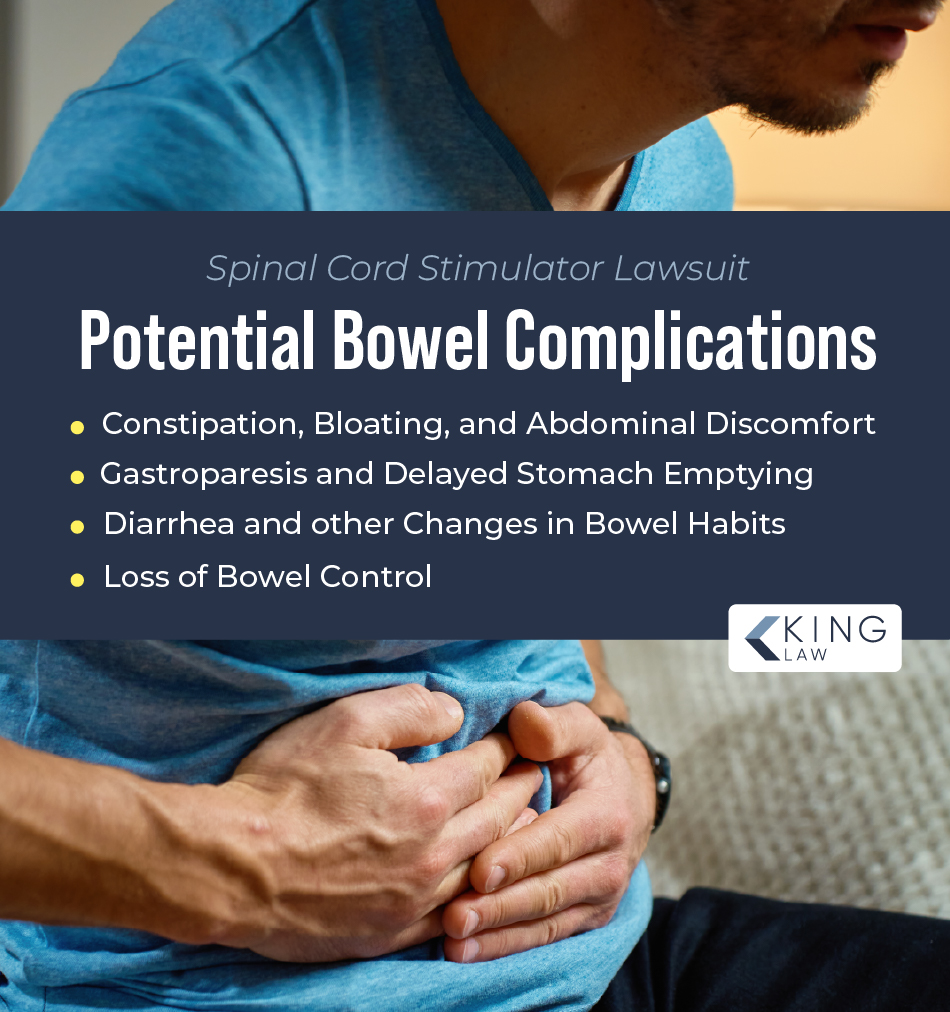
Bowel problems reported after an SCS implant range from constipation to diarrhea to nausea, to noticeable changes in digestion and defecation. In more extreme cases, bowel problems may also include loss of bowel control. A 2026 meta-study of gastrointestinal changes related to spinal cord stimulation found that the most commonly reported undesired bowel changes were:
- Worsened nausea
- Diarrhea
- Constipation
However, most of the patients in the study reported desired GI changes such as decreased nausea and reduced diarrhea.
Constipation, Bloating, and Abdominal Discomfort
Though uncommon, there have been notable cases of constipation, bloating, and abdominal discomfort allegedly associated with an SCS. A
In a more recent case, a 42-year-old
Gastroparesis and Delayed Stomach Emptying
Though rare, gastroparesis has been observed in some patients following SCS implantation. Gastroparesis, sometimes called stomach paralysis, is a disorder in which the stomach’s normal muscle contractions are disrupted, which delays or stops it from emptying. Diabetes is the most common identifiable cause, but a third to half of all cases present with no clear cause. In the linked case, a 42-year-old patient presented with severe constipation when the SCS device was turned on. The patient eventually elected to have the device removed. However, some patients have had an SCS implanted to help address severe pain resulting from gastroparesis.
Diarrhea or Changes in Bowel Habits
Diarrhea accounted for 2 of the 13 undesired GI changes identified in a 2026 meta-review that examined gastrointestinal changes after an SCS implantation. Additionally, a
Loss of Bowel Control
Bowel incontinence has been associated with SCS in at least one distinct case. Bowel incontinence is characterized by a loss of muscle control of the bowels, resulting in unintentional and uncontrolled fecal discharge. When the patient’s SCS device was turned on, the patient experienced improvements in pain but loss of bladder and bowel control. Turning the stimulation off resolved bladder and bowel symptoms.
When Do Bowel Symptoms After a Spinal Cord Stimulator Need Urgent Care?
Not all bowel symptoms after a spinal cord stimulator implant require immediate medical care. Broadly speaking, symptoms that imply serious nerve damage, nerve dysregulation, or an infection require urgent care. Mild bowel symptoms should still be reported to the implanting clinician if they’re persistent, but do not necessarily require immediate intervention. The table below indicates when urgent medical care might be needed when a patient is experiencing gastrointestinal symptoms.
| Symptom or change | Recommended action |
|---|---|
| New loss of bowel or bladder control after implantation | Seek emergency care immediately. |
| New limb weakness or inability to stand or bear weight after implantation | Seek emergency care immediately. |
| Constipation with persistent abdominal pain, inability to pass gas, vomiting, fever, or blood in the stool | Seek emergency care immediately. |
| Persistent new constipation, bloating, or diarrhea without the warning signs above | Contact the implanting clinician or treating medical team promptly for evaluation. |
Why Might Bowel Problems Start After a Spinal Cord Stimulator?
There are several reasons why bowel problems might start after a spinal cord stimulator implantation, not all of which are directly related to the device. Bowel symptoms may be affected by SCS stimulation, pain medications, or other neurological issues, or result from a combination of these issues. A knowledgeable clinician can help evaluate your symptoms and determine potential causes.
Possible Effects of Stimulation on Digestive Nerve Signaling
SCS stimulation is known to affect autonomic systems, including sympathetic and parasympathetic pathways involved in the increase or decrease of bowel motility. However, the exact mechanism remains uncertain. The effects of SCS stimulation on the digestive system for any particular patient can be hard to predict. For example, SCS stimulation has also been linked to improvements in bowel symptoms, as well as bowel issues for other patients.
Pain Medicines and Other Causes of Constipation
Bowel symptoms such as constipation may not be directly caused by the SCS, but by other factors related to the SCS implantation surgery or other pain management strategies such as medication. Opioids, for example, can cause constipation, abdominal pain, slowed GI transit, and even gastroparesis. Reporting any changes in medications after your SCS implant as part of a patient’s symptom history can help your providers identify the cause of symptoms.
Neurological Symptoms That Need Separate Assessment
Some neurological symptoms may not be the result of stimulation or medication, but complications from the implantation procedure itself. Symptoms that need a separate assessment from bowel complications include:
- New or increased weakness (difficulty walking, foot drop, etc.)
- Sensory loss
- Sphincter dysfunction
- Balance issues
- New sexual dysfunction
These may be a sign of nerve damage or compression and require urgent evaluation.
What Does Medical Research Show About SCS and Bowel Problems?
Medical research reports both adverse and improved bowel symptoms following SCS implantation. However, most of the medical research on the topic comes from case reports, and a 2026 systematic review on the topic concluded that overall evidence is currently limited and low certainty. Some case studies have reported a cessation of bowel symptoms when the SCS devices were turned off or explanted.
| Publication | Evidence and relevant finding | What it establishes |
|---|---|---|
| Jin et al., Neuromodulation, published online July 24, 2026 [1] | Systematic review of 21 studies involving 143 patients with abdominal pain; predominantly case reports/series, with both beneficial and adverse GI changes. | The review found 86 instances of desired GI changes and 13 undesired. Evidence for both was determined to be limited and low certainty. |
| La Grua, Neuromodulation, 2009 [2] | Clinical report describing constipation, abdominal pain, and distension during stimulation. | A possible link to SCS stimulation. Patient experienced reduced symptoms when stimulation settings were reduced below paresthesia threshold. The symptoms disappeared after SCS therapy ceased. |
| Manjunath et al., Surgical Neurology International, 2023 [3] | A patient reported severe constipation when stimulation was on at an 18-month follow-up and later chose explantation. | Symptoms presented when SCS device was on. The case report suggests possible SCS- induced parasympathetic blockage, suggesting further investigation. |
| Thakkar et al., Anesthesia & Analgesia, 2003 [4] | Two patients experienced severe GI symptoms that led to discontinuing stimulation despite pain relief. | GI effects can be clinically significant in individual cases. |
Note: Although case reports do suggest a link in particular instances, available evidence does not currently provide dependable risk ratios for developing SCS-related bowel problems.
How Can Doctors Check Whether the Stimulator Is Contributing to Bowel Issues?
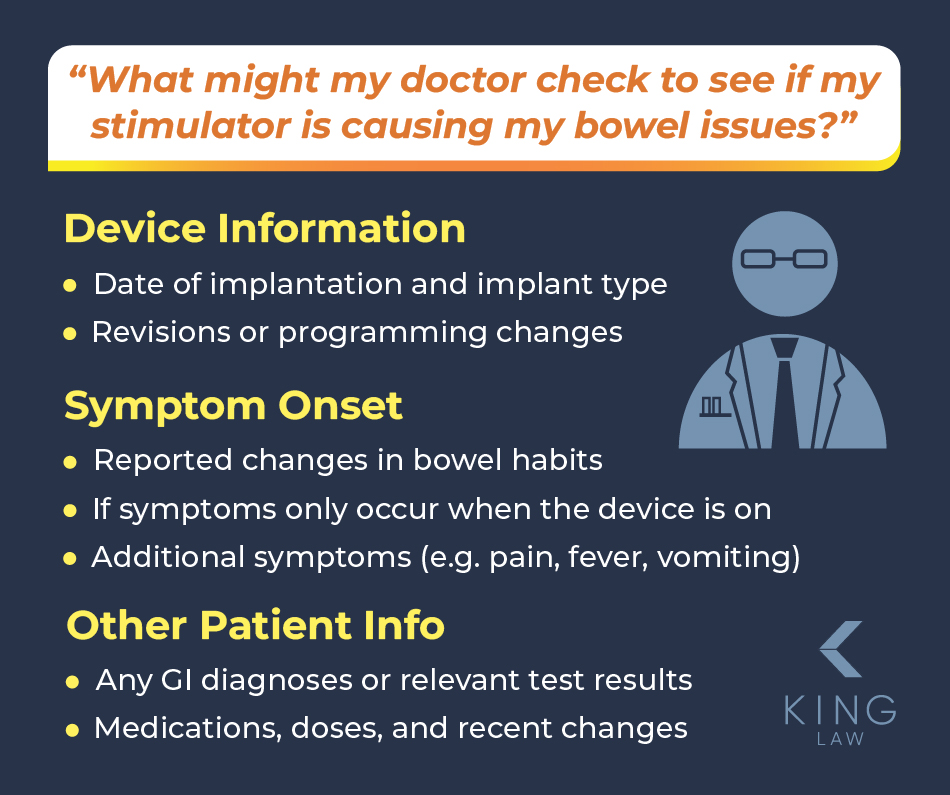
Doctors can check whether a stimulator is contributing by evaluating your symptom history, the timing of symptoms, your medications, and your device history. This may include information like:
- Reported changes in bowel habits
- The implant date
- Device revisions or programming changes
- Whether the symptoms only occur when the device is on
- Medication names, doses, and changes in medication
- Additional symptoms like pain, vomiting, fever, or a change in bladder habits
- Any GI diagnoses or relevant test results
Your evaluation may involve different specialists, such as the implanting physician, a gastroenterologist, or a neurologist. Identifying the cause of your symptoms may involve changing medications and/or your SCS device settings.
Can Reprogramming or Removing the Stimulator Help Bowel Symptoms?
Individual case studies have reported improvement or cessation of bowel symptoms in specific patients when their SCS device was reprogrammed or removed. Whether or not this course of action is effective depends on the underlying cause of your bowel symptoms. Your provider may experiment with different settings or turning off the device to see how it affects your bowel symptoms. Discuss your symptoms with your clinician and follow their device instructions when applicable.
In some cases, patients have elected to have their SCS devices explanted, but be aware that this, itself, carries some risks.
King Law Is Investigating Spinal Cord Stimulator Injuries
King Law is currently investigating spinal cord stimulator injuries and lawsuits, including their effects on the GI tract and bowel issues. If your digestive issues are thought to be caused by SCS lead migration or device migration, you may be eligible to file a lawsuit with King Law.
Our attorneys working on spinal cord stimulator cases can review your medical treatment history, device records, and revision reports to determine if your SCS device manufacturer could be liable for your GI tract-related injuries and pain and suffering. Consultations are free with no obligation to continue. Our attorneys work on contingency, so there’s no upfront cost to pursuing your claim.
Contact Robert King Law Firm for a Free Case Review
If you have been diagnosed with bowel problems after an SCS implantation, contact Robert King Law Firm today for a free case review by submitting a form on this site or calling (585) 496-2648. Be ready to provide your device brand, implant date, symptom timeline, diagnoses, and treatment history if you have access to them.
Frequently Asked Questions (FAQs)
Sources
King Law uses stringent editorial standards when creating content for this site. Here is a list of sources used while writing this article.
- Epstein, Nancy E., and Marc A. Agulnick. “Perspective/Short Review: Adverse Events Associated with Placement of Spinal Cord Stimulators (SCS).” Surgical Neurology International, vol. 17, 2026, p. 258. https://doi.org/10.25259/SNI_405_2026.
- Guy’s and St Thomas’ NHS Foundation Trust. “Sacral Neuromodulation Treatment.” Guy’s and St Thomas’ NHS Foundation Trust. Accessed October 1, 2026.
- Jin, Haiyue, et al. “A Systematic Review of Gastrointestinal Changes Related to Spinal Cord Stimulation.” Neuromodulation: Technology at the Neural Interface. July 2026. https://doi.org/10.1016/j.neurom.2026.07.649.
- La Grua, Marco. “Rare Side-Effects during Spinal Cord Stimulation: Gastrointestinal Symptoms.” Neuromodulation: Technology at the Neural Interface, vol. 12, no. 2, April 2009, pp. 161–163. https://doi.org/10.1111/j.1525-1403.2009.00202.x.
- Leeds Teaching Hospitals NHS Trust. “Discharge Advice Following Implantation of a Permanent Spinal Cord Stimulator (SCS) or Peripheral Nerve Stimulator (PNS).” Leeds Teaching Hospitals NHS Trust. Accessed October 1, 2026.
- Manjunath, Anusha, et al. “Spinal Cord Stimulation-Induced Gastroparesis: A Case Report.” Surgical Neurology International, vol. 14, 21 July 2023, p. 250. https://doi.org/10.25259/SNI_1133_2022.
- Müller-Lissner, Stefan, et al. “Opioid-Induced Constipation and Bowel Dysfunction: A Clinical Guideline.” Pain Medicine, vol. 18, no. 10, Oct. 2017, pp. 1837–1863. https://doi.org/10.1093/pm/pnw255.
- National Institute of Diabetes and Digestive and Kidney Diseases. “Gastroparesis.” National Institute of Diabetes and Digestive and Kidney Diseases. January 2018.
- National Institute of Diabetes and Digestive and Kidney Diseases. “Symptoms & Causes of Constipation.” National Institute of Diabetes and Digestive and Kidney Diseases. May 2018.
- Samejima, Soshi, et al. “Mapping the Iceberg of Autonomic Recovery: Mechanistic Underpinnings of Neuromodulation following Spinal Cord Injury.” The Neuroscientist, vol. 30, no. 3, June 2024, pp. 378–389. https://doi.org/10.1177/10738584221145570.
- Smeijers, Steven, et al. “Spinal Cord Stimulation and Urinary Dysfunction.” Pain Medicine, vol. 23, no. 7, July 2022, pp. 1204–1211. https://doi.org/10.1093/pm/pnac019.
- Thakkar, Nikhil, Neil Roy Connelly, and Peter Vieira. “Gastrointestinal Symptoms Secondary to Implanted Spinal Cord Stimulators.” Anesthesia & Analgesia, vol. 97, no. 2, August 2003, pp. 547–549. https://doi.org/10.1213/01.ANE.0000068981.30265.82.