

Spinal Cord Stimulator Lawsuit Verdicts and Settlements
Complete the form below to see if you qualify for a Spinal Cord Stimulator Lawsuit

There are no publicly reported verdicts and settlements against spinal cord stimulator manufacturers as of June 2026. However, some spinal cord stimulator patients have secured compensation from medical malpractice lawsuits. This page explores the publicly available verdicts and settlements that spinal cord stimulator patients have won for medical malpractice claims. As this litigation evolves, this page will contain settlement information for product liability lawsuits filed against medical device manufacturers.
Lawsuits against spinal cord stimulator manufacturers accuse the companies of failing to warn of risks, designing defective products, and engaging in other types of misconduct. The MDL against Boston Scientific (a spinal cord stimulator manufacturer) is in its early stages, and compensation outcomes may be added to this page as the MDL progresses. Claims against other spinal cord stimulator manufacturers, such as Abbott Laboratories and Nevro, may be consolidated into new MDLs in the future.
About the Spinal Cord Stimulator Lawsuit Settlements
Have There Been Any Spinal Cord Stimulator Lawsuit Settlements?
Have There Been Any Spinal Cord Stimulator Lawsuit Verdicts?
What Medical-Malpractice Verdicts and Settlements Have Involved Spinal Cord Stimulators?
What Other Personal-Injury Settlements Have Involved Spinal Cord Stimulators?
Is There an Average Spinal Cord Stimulator Lawsuit Settlement?
What Are the Projected Spinal Cord Stimulator Settlement Amounts?
How Much Could a Spinal Cord Stimulator Lawsuit Be Worth?
What Injuries Could Increase an SCS Settlement?
How Will Future Spinal Cord Stimulator Settlements Likely Be Calculated?
What Compensation May Be Available in an SCS Lawsuit?
What Is the Spinal Cord Stimulator MDL?
Which Manufacturers Are Named in Spinal Cord Stimulator Lawsuits?
Could an SCS Recall Affect Settlement Value?
When Could Spinal Cord Stimulator Settlements Begin?
How Could Bellwether Trials Affect SCS Settlements?
How Would a Spinal Cord Stimulator Settlement Be Paid?
What Should Patients Do If They Believe Their SCS Caused an Injury?
King Law Is Actively Investigating Spinal Cord Stimulator Injury Claims
Contact Robert King Law Firm For a Free (and Confidential) Case Review
Have There Been Any Spinal Cord Stimulator Lawsuit Settlements?
As of June 2026, there are no publicly reported settlements against Abbott, Boston Scientific, Medtronic, or Nevro for defective spinal cord stimulators. Instead, patients who have received spinal cord stimulator settlements from the manufacturers may have done so privately. A Boston Scientific spinal cord stimulator MDL was formed in June 2026, but there is no global settlement or reports of individual settlements yet.
Have There Been Any Spinal Cord Stimulator Lawsuit Verdicts?
As of July 2026, there have not been any widely publicized verdicts against spinal cord stimulator manufacturers for product liability or failure-to-warn claims. However, some spinal cord stimulator patients have received verdicts because a jury thought their providers committed medical malpractice.
The current litigation involving patients filing claims against spinal cord stimulator manufacturers is in its very early stages. These lawsuits allege failures on the part of neuromodulation device manufacturers. There is no public information that any of these lawsuits have settled or gone to trial.
What Medical-Malpractice Verdicts and Settlements Have Involved Spinal Cord Stimulators?
According to published reports, some spinal cord stimulator patients have received verdicts and settlements from medical providers. These patients sued their doctor or hospital, not the spinal cord stimulator manufacturer. Patients who sue the spinal cord stimulator manufacturer may receive a different outcome in their lawsuits.
In a product liability lawsuit, the patient accuses the spinal cord stimulator manufacturer of making a mistake in how they made, sold, or warned people about the spinal cord stimulator products. In a medical malpractice lawsuit, the spinal cord stimulator patient accuses their healthcare providers of making a mistake when they diagnose or treat the patient.
The following examples are awards received for medical malpractice lawsuits related to spinal cord stimulator implants.
$1.25 Million Orlando Figueroa Settlement
According to public reports, in August 2024, a New Jersey man received a $1.25 million settlement from his doctor. Allegedly, the man’s doctor did not order the right imaging before implanting the spinal cord stimulator. The man claims this medical mistake caused the doctor to implant the spinal cord stimulator in a place where it did not fit. The man alleged that this error caused the spinal cord stimulator to hurt his spinal cord, leading to mobility problems and loss of bladder control.
$4.5 Million Amy Douglas Jury Verdict
A woman received a $4.5 million jury verdict after her surgeon allegedly implanted a spinal cord stimulator in the wrong place. According to public reports, the doctor knew about this mistake and did not tell the woman about it later. The woman had to have follow-up surgeries to remove the spinal cord stimulator and treat a damaged nerve root.
$10 Million John Douglas Cox Jury Verdict
A man from Washington won a $10 million jury verdict after emergency room professionals ordered the wrong imaging tests. Reports suggest the man went to the emergency room because he was experiencing a spinal infection after having a spinal cord stimulator implanted. Since the doctors ordered the wrong tests, the man’s spinal infection was not diagnosed and treated in time to avoid permanent damage to his spine.
What Other Personal-Injury Settlements Have Involved Spinal Cord Stimulators?
Some patients received settlements because they were badly injured during accidents and had to be treated with a spinal cord stimulator. Here are examples of those settlements:
- A construction worker received $7.4 million after needing a spinal cord stimulator implant after an accident.
- A carpenter won a $7 million settlement after needing a spinal cord stimulator implanted to address neck pain from an accident.
- Worker secured $5.5 million settlement after suffering an injury that required a spinal cord stimulator implant.
- A car accident victim received a settlement and had to use a spinal cord stimulator daily to treat pain from their injuries.
In these cases, the patients were suing a third party who hurt them, rather than the company that manufactured the spinal cord stimulator or the doctor who implanted it. Other patients may receive a different outcome, even if their case seems similar to the above.
Is There an Average Spinal Cord Stimulator Lawsuit Settlement?
There is no average spinal cord stimulator lawsuit settlement. The spinal cord stimulator lawsuit MDL is in its early stages, and no global settlement has been reached. Moreover, individual spinal cord stimulator lawsuits against the manufacturers have not been publicized. So it is unknown how much those cases have settled for or if settlements have been reached in the past. Verdicts and settlements that have been publicized were for lawsuits against medical providers or other third parties, which are different from product liability claims. Thus, they cannot be used to estimate payouts for lawsuits filed against medical device companies.
What Are the Projected Spinal Cord Stimulator Settlement Amounts?
Some legal scholars estimate that some spinal cord stimulator patients could receive $50,000 or more in compensation. However, these estimates are purely speculative, based on similar medical device lawsuits. No spinal cord stimulator settlements have been reported in product liability lawsuits, so it is unknown how much the payouts for these cases could be.
Many factors influence final payouts for settlements, including:
- The severity of the person’s losses
- The strength of their claim
- Whether they file their lawsuit on time
- Each state’s liability laws (for lawsuits filed outside the MDL)
Sometimes in MDLs or centralized state litigations, group settlements are arranged between plaintiffs and defendants. Oftentimes, group settlements are organized into tiers, with each tier receiving settlements based on a formula. This settlement formula often takes into account things like:
- The specific injury the patient experienced
- The age of the patient
- Necessary long-term care and treatment
- The type/brand of neuromodulation device they were implanted with
- Resulting impacts on quality of life
Below are estimates for possible settlement tiers for spinal cord stimulator lawsuits. It is important to note that these tiers are merely estimates, and no compensation is ever guaranteed. Actual settlements, should they be received, could be much higher or lower than these estimates.
Possible Tier 1 Settlements: $250,000 to $500,000 or More
In a tiered settlement, people with severe or permanent losses may qualify for higher payouts in Tier 1. Injuries that could fall into a Tier 1 settlement category include paralysis, severe nerve damage, permanent loss of bowel or bladder control, or severe lifelong medical setbacks that were caused or worsened by the spinal cord stimulator. However, these amounts are estimates. There is no spinal cord stimulator settlement at this time.
Possible Tier 2 Settlements: $100,000 to $250,000
Spinal cord stimulator patients who have moderate losses could be eligible for Tier 2 payouts if the settlement is structured this way and the patient meets other criteria. Losses that could fall into the Tier 2 category may include electrical shocks, lead migration without permanent complications, battery failure, revision surgery, and device removal. However, there is no final settlement yet, so all projections are hypothetical.
Possible Tier 3 Settlements: $50,000 to $100,000
In a tiered settlement, Tier 3 compensation packages could include spinal cord stimulator patients who suffered temporary or less severe losses. Patients in the Tier 3 category might include those who experienced new or worsening pain, temporary loss of therapy, or minor device malfunctions. However, no global settlement exists, so no such tier exists at this time.
How Much Could a Spinal Cord Stimulator Lawsuit Be Worth?
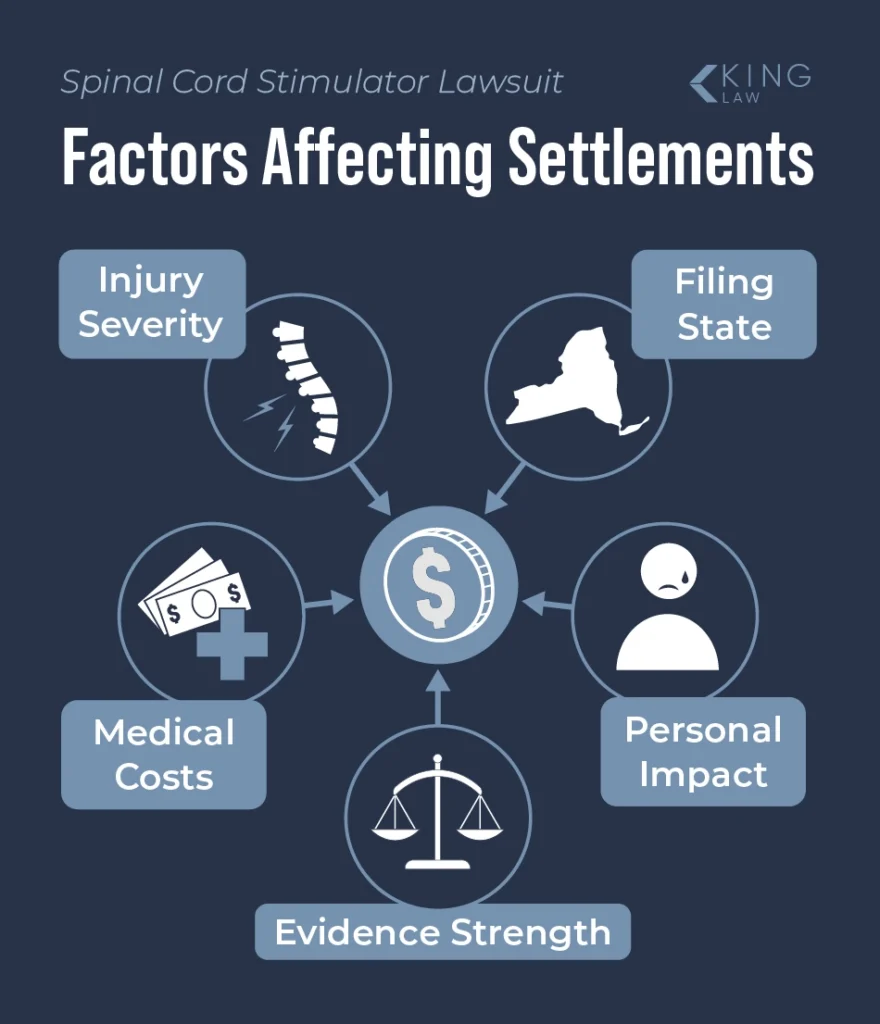
Factors that can influence how much a spinal cord stimulator lawsuit is worth include:
- Severity of the person’s losses and injuries
- Strength of their lawsuit
- Whether the spinal cord stimulator was part of a recall
- Cost of medical services
- Whether they needed to have surgery to correct or remove the implant
- Whether they file their case before the deadline expires
- Other case-specific factors
There is no guarantee that a spinal cord stimulator patient will receive a payout for their losses. An attorney focusing on spinal cord stimulator cases is a good resource to help patients understand their options and potential recovery.
What Injuries Could Increase an SCS Settlement?
Spinal cord stimulator (SCS) patients who suffer from severe injuries may be eligible for a higher compensation package if they suffered severe injuries or the jury finds that the defendant acted with certain types of negligence. Injuries that may qualify someone for an increased spinal cord stimulator settlement include the following:
- Partial or complete paralysis
- Permanent nerve damage
- Loss of bowel or bladder control
- Severe infections
- Permanent increase in pain after device removal
Surviving family members may also qualify for compensation if their loved one dies due to spinal cord stimulator complications, such as a severe infection.
How Will Future Spinal Cord Stimulator Settlements Likely Be Calculated?
Spinal cord stimulator settlements may be calculated based on the terms that the parties agree to. For example, past settlements for other mass torts have involved organizing the plaintiffs into tiers based on the product they used, their diagnosis, age, and other factors.
In those cases, each tier’s payout might be calculated using an agreed-upon formula in the settlement. Other settlements for product liability cases (like those for medical devices) have been negotiated individually. In those situations, settlements reflected the patient’s individual losses and case-related factors. Spinal cord stimulator settlements may follow a similar pattern.
What Compensation May Be Available in an SCS Lawsuit?
Compensation that may be available to patients who win their spinal cord stimulator lawsuits includes:
- Pain and suffering
- Medical expenses
- Past and future treatment costs
- Lost income
- Loss of earning potential
- Emotional distress
- Loss of mobility
- Loss of independence
- Loss of quality of life
- Wrongful death damages (e.g., funeral and burial costs and loss of support)
In some states, spinal cord stimulator patients may also qualify for punitive damages to punish the manufacturer for egregious wrongdoing. However, these damages can only be awarded by a jury in a trial.
What Is the Spinal Cord Stimulator MDL?
The new spinal cord stimulator MDL (MDL No. 3181) was created on June 5, 2026, and is a dedicated federal group claim for qualifying spinal cord stimulator lawsuits against Boston Scientific. Federal spinal cord stimulator lawsuits can be filed or transferred into the MDL if they meet the eligibility criteria.
At this time, only spinal cord stimulator claims against Boston Scientific have been consolidated into an MDL. However, a new MDL may be created for claims against other spinal cord stimulator manufacturers. Currently, requests have been filed to create an MDL for patients with Nevro SCCs and an MDL for patients with Abbott Laboratories neuromodulators. Patients with other types of stimulators may still file individual or group claims even if they do not transfer their case into an MDL.
Which Manufacturers Are Named in Spinal Cord Stimulator Lawsuits?
Some of the spinal cord stimulator manufacturers named in lawsuits include Boston Scientific, Abbott Laboratories (St. Jude Medical), Medtronic, and Nevro (Globus). Each of these companies made its own spinal cord stimulators and accessories, which some patients say have caused unexpected complications.
Boston Scientific Spinal Cord Stimulators
Boston Scientific manufactured the Precision, Spectra WaveWriter, and WaveWriter Alpha systems. Some of the problems that have been reported about these models include electrical shocks, unexpected resets, software problems, lead migration and fracture, loss of therapy, and battery pain or recharging issues. Some federal claims against Boston Scientific have been consolidated into MDL 3181.
Abbott and St. Jude Spinal Cord Stimulators
Abbott (formerly St. Jude) has manufactured the Proclaim and Eterna spinal cord stimulator systems and accessories. Some of the challenges that patients claim to have experienced with these models include device connection problems, battery issues, loss of therapy, lead migration, and electrical shocks. Claims against Abbott (St. Jude) are proceeding separately from those against the other manufacturers.
Nevro and Globus Spinal Cord Stimulators
Nevro (now owned by Globus) made the Senza and HFX spinal cord stimulator series. Allegations that have been made about these models include lead problems, burns, nerve injuries, and programming concerns. Lawsuits against Nevro (Globus) are being brought separately from those against the other manufacturers.
Medtronic Spinal Cord Stimulators
Medtronic manufactured the Restore, Intellis, and Vanta spinal cord stimulator systems and accessories. Lead migration, lead fracture, battery failure, loss of therapy, and infection were some of the problems reported for the Medtronic spinal cord stimulator systems. At this time, a Medtronic spinal cord stimulator MDL has not been created. However, a Medtronic MDL may be created in the future if enough spinal cord stimulator patients file lawsuits and ask to consolidate their claims.
Could an SCS Recall Affect Settlement Value?
Evidence that a spinal cord stimulator or its accessories have been recalled may strengthen someone’s claim. When a device or accessory is recalled, it is due to a known problem associated with that device. A device recall shows that the manufacturer was aware of a potential problem or risk associated with a device.
If the recall is related to the spinal cord stimulator patient’s alleged complication, it may help support their lawsuit against the manufacturer. Having a stronger lawsuit may help increase the chance that a spinal cord stimulator patient receives a higher payout. However, having a spinal cord stimulator that is part of a recall or alert does not guarantee that someone will receive a settlement.
When Could Spinal Cord Stimulator Settlements Begin?
It is unknown when the spinal cord stimulator settlements could begin because the lawsuits are in their early stages. Mass settlements, if they occur, are likely two or more years away.
At this time, the spinal cord stimulator lawsuits may need to move through the discovery phase before settlement talks begin or result in a final agreement. In some coordinated proceedings, settlement talks are not finalized until after a few trials occur, which may help guide discussions. It is unlikely that there would be mass settlements for at least two years, if not more.
How Could Bellwether Trials Affect SCS Settlements?
Bellwether trials can help guide settlement talks in other spinal cord stimulator lawsuits. Bellwether trials are real “test trials” of a few plaintiffs’ cases in an MDL. The parties in other spinal cord stimulator lawsuits can use the outcome of the Bellwether trial to learn about how the judge and jury responded to different arguments and how much the final verdict was (if applicable). These details can help guide future settlement discussions in other spinal cord stimulator lawsuits.
How Would a Spinal Cord Stimulator Settlement Be Paid?
Spinal cord stimulator settlements will be paid based on the agreement made between the parties. For example, some spinal cord stimulator settlements may be paid in a lump sum, multiple payments, or through a court-administered payment plan. The spinal cord stimulator patient will have a chance to review, negotiate, and decide whether to accept or reject a settlement offer before it is finalized.
In some settlement arrangements, the attorney’s fees, court expenses, and other administrative costs may be paid before the check is sent to the spinal cord stimulator patient. As part of the settlement agreement, the spinal cord stimulator patient may be required to formally dismiss their lawsuit against the manufacturer.
What Should Patients Do If They Believe Their SCS Caused an Injury?
If patients believe their spinal cord stimulator has malfunctioned or injured them, here are some steps they can take:
- Seek medical care
- Talk to a lawyer about their concerns
- Document their pain and symptoms
- Find out which company made their spinal cord stimulator
- Locate device information (e.g., model number), service history, and device-related reports
A seasoned attorney can help spinal cord stimulator patients understand if their device was part of a recall and locate important records. A lawyer can also start filing a spinal cord stimulator claim.
King Law Is Actively Investigating Spinal Cord Stimulator Injury Claims
King Law is reviewing spinal cord stimulator claims against Boston Scientific, Abbott (St. Jude), Nevro (Globus), Medtronic, and other manufacturers. Patients who had a spinal cord stimulator implanted and believe they suffered from an unexpected complication are encouraged to call our office to schedule a free appointment.
Contact Robert King Law Firm For a Free (and Confidential) Case Review
Contact the Robert King Law Firm today by calling (585) 496-2648 or filling out this form to schedule a free consultation. We provide free case reviews for spinal cord stimulator patients so they can learn about their legal options without worrying about cost. We take cases on a contingency basis, meaning we only get paid if you receive compensation. There is no upfront cost to filing a case.