

Medtronic Spinal Cord Stimulator Lawsuit (2026 Update)
Complete the form below to see if you qualify for a Spinal Cord Stimulator Lawsuit

Medtronic spinal cord stimulator lawsuits accuse the company of failing to warn about serious complications allegedly caused by its spinal cord stimulator systems, including Inceptiv, Intellis, Synergy, Vanta, Vectris, and Restore. Additionally, spinal cord stimulators, accessories, and device software made by Medtronic have been the subject of at least 23 recalls.
Patients with Medtronic spinal cord stimulators claim they experienced complications, such as painful electric shocks, burning sensations, new or worsening pain, lead migration, battery or charging problems, nerve damage, paralysis, and surgery to correct, remove, or replace the neuromodulation device.
This page provides a summary of Medtronic spinal cord stimulator lawsuits, including which devices may be named in those lawsuits, some of the allegations against Medtronic, and who may qualify for compensation for their injuries, pain, and suffering.
About the Medtronic Spinal Cord Stimulator Lawsuit
What Is the Medtronic Spinal Cord Stimulator Lawsuit?
FDA Injury Reports and Recalls Related to Medtronic Spinal Cord Stimulators
What Are the Accusations Against Medtronic in the Lawsuit?
Reported Problems Associated with Medtronic Spinal Cord Stimulators
Which Medtronic Spinal Cord Stimulator Models Are Mentioned in the Lawsuit?
Who Can File a Medtronic Spinal Cord Stimulator Lawsuit?
What Evidence Is Needed to File a Medtronic Spinal Cord Stimulator Lawsuit?
How Long Do I Have to File a Medtronic Spinal Cord Stimulator Lawsuit?
Estimated Medtronic Spinal Cord Stimulator Lawsuit Settlement Amounts
King Law Is Actively Investigating Medtronic Spinal Cord Stimulator Claims
What Is the Medtronic Spinal Cord Stimulator Lawsuit?
The Medtronic spinal cord stimulator lawsuit is a product liability lawsuit that claims Medtronic’s spinal cord stimulator systems caused patients to experience serious and unexpected complications. Medtronic spinal cord stimulators are implanted to help reduce patients’ chronic pain by sending electrical signals that block pain signals. However, some patients claim that hundreds of modifications to the company’s SCS devices have affected treatment outcomes.
Is there an MDL for Medtronic Spinal Cord Stimulator Lawsuits?
At this time, there is no MDL for Medtronic spinal cord stimulator lawsuits. The Judicial Panel on Multidistrict Litigation consolidated lawsuits for spinal cord stimulators made by one of Medtronic’s competitors. However, the panel did not create an industry-wide MDL that included Medtronic SCS systems at that time. That said, the panel might approve a future request to create an MDL for Medtronic spinal cord stimulator lawsuits.
Why Are Patients Suing Medtronic Over Its Spinal Cord Stimulators?
People are suing Medtronic after experiencing injuries, inadequate pain relief, and new medical issues after having an SCS implanted. Medtronic received premarket approval for its SCS on November 11, 1984, via PMA P840001. Since that time, as of October 2026, it has filed over 634 supplements (modifications) to its implantable spinal cord stimulators. In their lawsuits, patients allege that these modifications often resulted in substantial changes to the devices and that the devices should have gone through new FDA reviews and approvals.
FDA Injury Reports and Recalls Related to Medtronic Spinal Cord Stimulators
Medtronic’s spinal cord stimulators, accessories, and software/programs have been the subject of 23 FDA recalls since 2006. According to recall notices posted on the FDA’s website, Medtronic’s SCS devices, accessories, and software have been subject to FDA Class 2 and Class 3 recalls. These recalls have affected how the company’s neuromodulation devices (SCS) operate.
Here is a list of issues cited in FDA recalls of Medtronic spinal cord stimulators:
- Software issues that resulted in an inability to resume therapy
- Device issues that required surgical replacement or removal of the SCS
- Lead migration as a result of insert separation within the anchor (learn more about symptoms of SCS lead migration)
- The wireless rechargers becoming unresponsive
- Loss of stimulation/therapy
- Wireless rechargers in the kits unable to enter a recharging session
- Over-stimulation or stimulation due to a lead electrode other than what was intended
- Mispackaging of lead kits, resulting in wrong implements being used
- Accessory stylets that are not the correct length
- Incorrect lead electrode spacing information printed on the shelf box and the sterile pack labeling
- Curved tip introducer needle making the advancing or withdrawing a lead difficult
- A cardioversion procedure damaging the electronics in the device
- Loss of therapy during recharging of device due to insufficient coupling between recharger and device
- Incorrect internal memory parameter that affect charging
- Inability to reprogram
- Software issue that can permanently disable communication with an implantable neurostimulator
- Inaccuracies with stated battery life and device cycling
- Product packaging labeling that does not distinguish between permanent surgical implant and trialing/screening use
- SCS unable to establish a session with the Implantable Neurostimulator, resulting in patients experiencing inadequate or excessive therapy and experiencing non-optimal pain relief.
- Device apps not functioning as intended when using the SCS
It is important to note that not all recalls are associated with actual injuries to patients. However, the volume of recalls shows that there have been multiple issues with Medtronic’s SCS devices, their accessories, and device software and firmware.
List of Recalled Medtronic Neuromodulation Products and Accessories
Here is the current list of recalls related to Medtronic’s SCS devices, the class of each recall, and the date of that recall.
Source: FDA Medical Device Recalls Related to Medtronic Neuromodulation Devices
What Are the Accusations Against Medtronic in the Lawsuit?
Many of the accusations in lawsuits related to Medtronic spinal cord stimulator lawsuits are associated with multiple modifications made to already-approved devices. Multiple lawsuits allege that the company made substantial changes to devices that materially altered the devices’:
- Design
- Firmware
- Charging interface
- Patient-control algorithms
Plaintiffs in multiple lawsuits allege that Medtronic changed their devices and accessories to the point that those devices were different from what the FDA approved. Plaintiffs argue that many SCS devices should have gone through a new FDA approval. Instead, plaintiffs allege they were implanted with devices that were not properly studied or reviewed, which then injured them. Medtronic maintains that it followed all FDA approval regulations and that its devices are safe.
Formal Allegations in SCS Lawsuits Against Medtronic
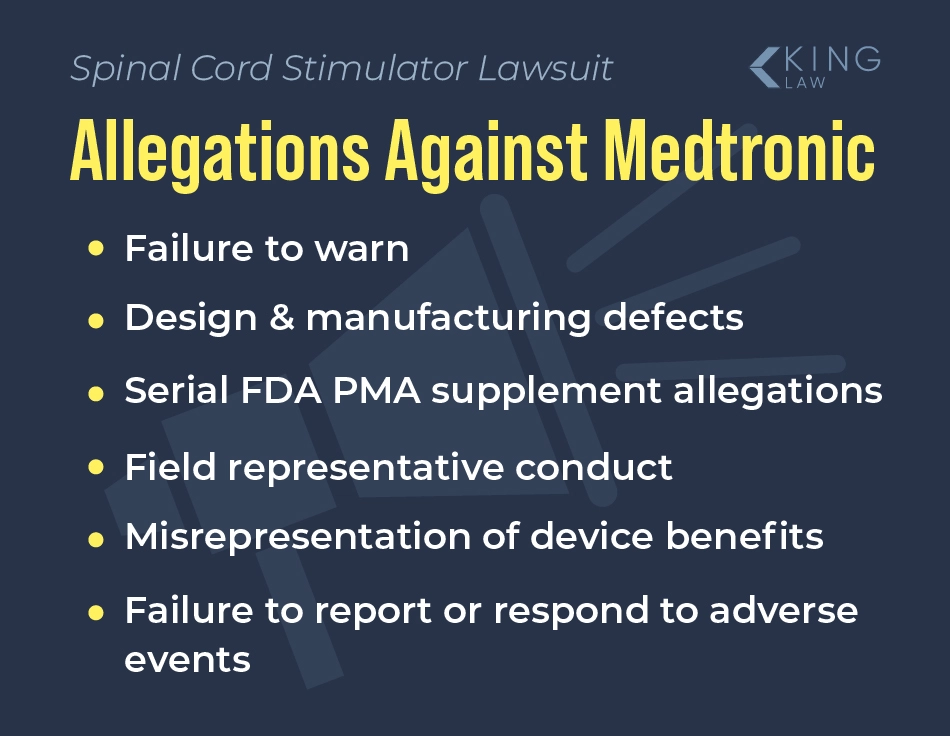
Some of the accusations that patients have made against Medtronic include the following:
- Failure to warn: Patients accuse Medtronic of not warning about serious complications, such as shocks, lead migration, loss of therapy, infection, or device malfunction.
- Defective design or manufacturing issues: Patients have accused Medtronic of designing or manufacturing spinal cord stimulators and components in a way that makes them more likely to malfunction.
- Serial FDA PMA supplement allegations: Some patients claim that Medtronic misused the PMA supplement process by submitting dozens of changes to its first FDA-approved design and using those to make new SCS models instead of requesting approval for a new design.
- Painful shocks and erratic stimulation: Patients allege that they experienced unexpected, painful, sporadic, and uncomfortable jolting, burning, or shocking stimulation.
- Field representative conduct: Patients claim they were misled by Medtronic representatives about what to expect when they received the implantable spinal cord stimulator. Lawsuits have also claimed that the representatives were involved in reprogramming or implanting the device when they should not have been.
- Misrepresentation of device benefits: Patients believe they were misled about the potential benefits and risks of the implanted spinal cord stimulator as compared to the trial version.
- Failure to report or respond to adverse events: Patients believe that Medtronic failed to track, report, or warn patients about adverse events reported to the FDA.
| “Medtronic breached this duty by failing to disclose that its firmware modifications, energy delivery patterns, and device interface had contributed to a growing number of patient complaints and injuries—including those involving battery failure, painful shocks, stimulation loss, lead migration, and loss of efficacy.” |
| Source: Lawsuit against Medtronic related to injuries from its Intellis SCS (Case No: 3:26-cv-205) |
Reported Problems Associated with Medtronic Spinal Cord Stimulators
According to reports from the MAUDE (Manufacturer and User Facility Device Experience) database, patients have experienced a range of complications after having a Medtronic spinal cord stimulator implanted. Thousands of injury reports related to Medtronic SCS devices have been submitted to the MAUDE. For example, between April 22, 2026, and May 29, 2026, MAUDE received 500 injury reports from patients with the Intellis SCS made by Medtronic.
Here are some adverse event reports the FDA has received involving spinal cord stimulators made by Medtronic:
- Paralysis and nerve pain
- New or worsening pain
- Electrocution sensations, buzzing, or burning
- Battery or charging problems
- Programming issues
- Infection
- Device shutting off and on on its own
- Lead migrating, breaking, or moving out of position
- Loss of mobility
- Surgery to replace, remove, or fix the spinal cord stimulator or its parts (and any associated SCS removal complications)
Spinal cord stimulator patients who have experienced these or other complications may have a claim against Medtronic. However, not every Medtronic spinal cord stimulator who has experienced a complication is automatically eligible for compensation. Eligibility depends on multiple factors, including what Medtronic and your doctors told you about the spinal cord stimulator, the timing and seriousness of your complications, and the applicable liability law.
Which Medtronic Spinal Cord Stimulator Models Are Mentioned in the Lawsuit?
Several spinal cord stimulators manufactured by Medtronic have been named in lawsuits or adverse event reports. Medtronic has made many types of spinal cord stimulator systems, including:
- Medtronic Intellis
- Medtronic Intellis Pro
- Medtronic Intellis LT / Model 97716
- Medtronic Vanta
- Medtronic Inceptiv
- Medtronic Inceptiv LT
- Medtronic RestoreSensor
- Medtronic RestoreUltra
- Medtronic PrimeAdvanced
- Medtronic Itrel / Itrel II
- Medtronic Synergy
- Vectris SureScan MRI leads
- Medtronic clinician programmer or recharger systems
Some of the above devices have been named in lawsuits and adverse event reports. However, lawsuits or adverse event reports that mention the above devices may concern older models or firmware that have since been updated. Liability is determined on a case-by-case basis.
How Do I Find Out the Model of My Medtronic Spinal Cord Stimulator?
You can find out the model of your Medtronic spinal cord stimulator in the following ways:
- Check your implant card (your doctor may have given this to you after your procedure).
- Check your online or physical medical records from when you had the implant done.
- Ask your pain-management doctor.
- Request hospital records from the facility where you had the procedure done.
- Contact Medtronic to ask what device you were implanted with.
- Look for model numbers in imaging studies you have had done (i.e., MRI or radiology reports).
Save as much information or components (including charging cables) from the device and any replacement parts that you have received since the first implant. You can use the model number to research adverse events, lawsuits, and other databases that may be associated with your Medtronic spinal cord stimulator system.
Who Can File a Medtronic Spinal Cord Stimulator Lawsuit?
Based on our law firm’s unique criteria, patients may be able to file lawsuits if they had a Medtronic spinal cord stimulator system implanted and experienced an unexpected complication. Our intake specialists will review your case and potentially eligibility.
What Evidence Is Needed to File a Medtronic Spinal Cord Stimulator Lawsuit?
If you choose to file a lawsuit against Medtronic, your attorney will work to compile specific evidence about the company, its internal records and affairs, PMA approvals, recalls, scientific literature, and other specific evidence about your SCS device.
As a plaintiff in an SCS lawsuit against Medtronic, you will need to gather specific information to support your claim. Your lawyer can help you gather this information.
Here is some of the evidence you will need to gather to proceed with an SCS claim against Medtronic:
- Implant cards
- Serial numbers
- Programming records
- Firmware update records
- Notes from Medtronic representative interactions
- Applicable recall notices
- Medical records
- Financial records
- Witness and personal accounts of pain, suffering, and effects on daily life
How Long Do I Have to File a Medtronic Spinal Cord Stimulator Lawsuit?
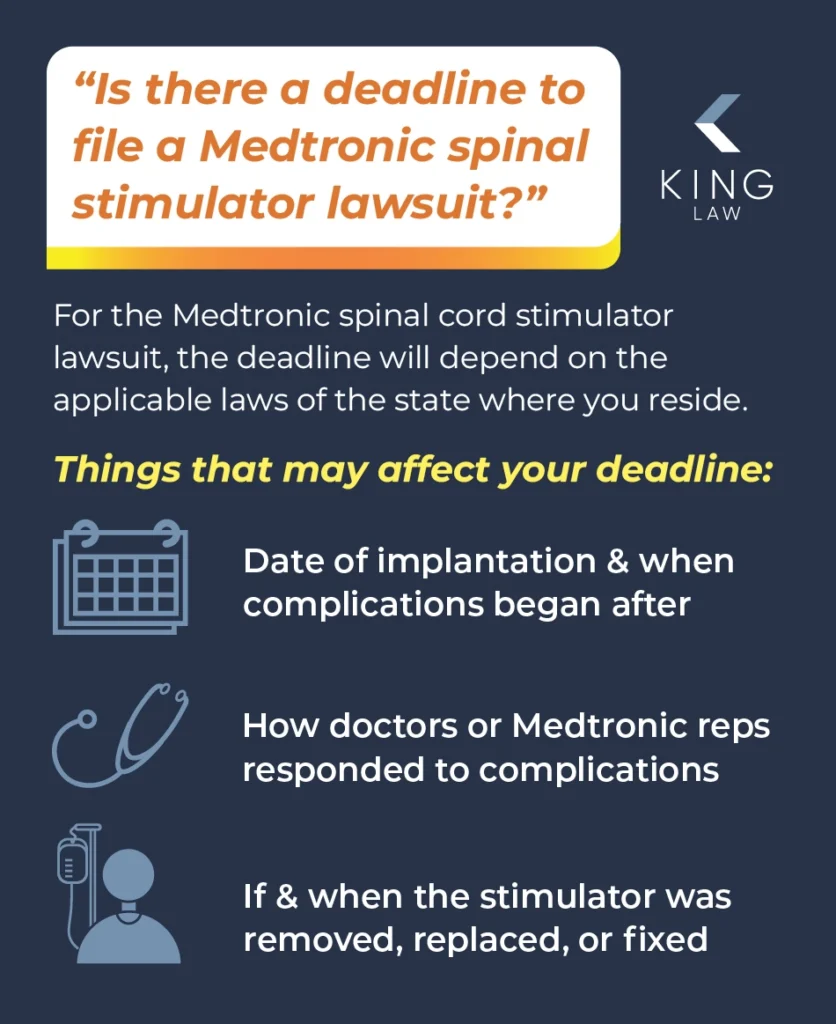
How long you have to file a Medtronic spinal cord stimulator lawsuit depends on the applicable statute of limitations. The statute of limitations is determined by state law. Some of the factors that can influence how state law may calculate the filing deadline include:
- When the patient had the spinal cord stimulator system implanted
- When the patient started experiencing complications
- How their doctors or Medtronic representatives responded to those complications
- When the patient discovered or could have discovered that their Medtronic spinal cord stimulator could be defective
- When the patient had surgeries to remove, replace, or fix the Medtronic spinal cord stimulator
- When the patient died from spinal cord stimulator complications (if a wrongful death case)
- What exceptions may apply to the applicable statute of limitations (legal filing deadline)
Because every state calculates statute of limitations differently, it is important for Medtronic spinal cord stimulator patients to talk to a seasoned lawyer about their unique situation.
Estimated Medtronic Spinal Cord Stimulator Lawsuit Settlement Amounts
Medtronic spinal cord stimulator lawsuit payouts via settlements may reflect the unique losses and other case-related factors in that patient’s situation. For instance, some Medtronic spinal cord stimulator patients who have a strong liability claim and significant losses may receive a higher payout than those who do not. However, there is no guarantee that a Medtronic spinal cord stimulator patient will receive a settlement if they file a lawsuit. An attorney can help spinal cord stimulator patients determine what compensation they could be eligible for if they file a claim against Medtronic.
King Law Is Actively Investigating Medtronic Spinal Cord Stimulator Claims
King Law is reviewing potential claims from Medtronic spinal cord stimulator patients who believe they experienced serious complications that they were not properly warned about. We can help patients by requesting and reviewing medical records, complication history, device information, applicable laws, and other relevant matters. We are prepared to help spinal cord stimulator patients pursue compensation from Medtronic.
Contact Robert King Law Firm to Start Your Free Case Review
Contact (585) 496-2648 or fill out this form to schedule a free consultation with an experienced personal injury lawyer on our team. We may be able to help you secure compensation if you had a Medtronic spinal cord stimulator implanted and experienced serious complications.