

1,4-dioxane Lawsuit for Water Contamination [2026 Update]
Complete the form below to tell us about your case

Exposure to 1,4-dioxane in drinking water may increase the risk of developing some types of cancer. Some industrial companies have discharged the chemical, resulting in contamination of nearby community water supplies. Municipalities and water authorities are filing lawsuits against the companies that they say contaminated public water supplies.
1,4-dioxane is a byproduct of industrial products (like soaps, detergents, paints, and cosmetics). The EPA, National Toxicology Program (NTP), and other agencies have identified 1,4-dioxane as a likely or reasonably anticipated human carcinogen. Now, water suppliers are taking legal action in hopes of securing compensation for remediation efforts.
In this article, you will find the latest updates on the 1,4-dioxane lawsuits and research, information about what 1,4-dioxane is, where it is found, and the possible health risks of 1,4-dioxane exposure. This page also provides information for water suppliers on filing a 1,4-dioxane lawsuit, key filing deadlines, and estimated 1,4-dioxane lawsuit payouts.
About the 1,4-Dioxane Lawsuit
1,4-Dioxane Lawsuit News and Updates – October 2025
What Is the 1,4-dioxane Lawsuit About in 2026
What Is 1,4-dioxane and Why Is It in Drinking Water
What Locations Have 1,4-dioxane Contaminated Drinking Water
What Cancers and Health Conditions Are Linked to 1,4-dioxane
Who Is Being Sued in the 1,4-dioxane Lawsuit
Federal and State Regulation of 1,4-Dioxane
Who Can File a 1,4-dioxane Lawsuit
How Can I File a 1,4-dioxane Lawsuit
What Is the Deadline to File a 1,4-dioxane Lawsuit
Estimated 1,4-Dioxane Lawsuit Settlements and Payout Amounts
King Law Is Investigating 1,4-dioxane Claims
1,4-Dioxane Lawsuit News and Updates – 2026 Update
September 2, 2026: North Carolina Appeals Court to Hear Case Over New 1,4-Dioxane Rules
An appeals court in North Carolina has been asked to decide if North Carolina’s Department of Environmental Quality acted lawfully when it passed and enforced new rules about 1,4-dioxane discharges. Several municipalities sued DEQ, claiming the department did not follow the proper procedure when it passed the new 1,4-dioxane limits. However, the DEQ believes it acted lawfully. On September 2, 2026, several organizations asked to join the 1,4-dioxane appeal by filing an amicus curiae brief.
July 22, 2026: 1,4-dioxane Detected at 90 Times EPA’s Safe Discharge Levels in NC
The North Carolina Department of Environmental Quality’s Division of Water Resources (DWR) has confirmed that it detected large amounts of 1,4-dioxane in a creek that affects several public water supplies. The DWR confirmed that the City of Asheboro Wastewater Treatment Plant discharged 1,4-dioxane into Hasketts Creek, with a sample collected on July 10 registering at 2,010 parts per billion (ppb). According to EPA toxicity calculations for safe discharge levels, the discharge should be 22 ppb or less. DWR sent notices to the Bladen Bluffs Water System, Brunswick County, Cape Fear Public Utility Authority, the City of Dunn, the Fayetteville Public Works Commission, Harnett Regional Water, International Paper Co., Pender County, Pilgrim’s Pride Water System and the City of Sanford. The EPA categorizes 1,4-dioxane as a likely human carcinogen, capable of causing cancer. This discharge is another example of how cancer-causing chemicals can migrate throughout water supplies and be consumed by Americans.
July 7, 2026: Hempstead, New York, Approves More Funding to Address 1,4 Dioxane Pollution
More towns and municipalities are working to address 1,4 dioxane in their public water supplies. Recently, the Hempstead Town Board has approved funding to continue efforts to remove 1,4 dioxane from public water supplies. The funding will be used to upgrade the existing 1,4 dioxane treatment equipment and wells and for other related purposes.
May 14, 2026: DEQ Says North Carolina Needs Numeric Limits for 1,4-dioxane Discharges
Some North Carolina lawmakers are pushing for voluntary reductions in 1,4-dioxane wastewater discharges from companies. However, according to an investigation by WUNC News in North Carolina, the secretary of the North Carolina Department of Environmental Quality (DEQ), Reid Wilson, says that voluntary standards without strict limits will burden utility providers. In a statement to WUNC, Wilson said not imposing specific regulations would create a “…situation where water utilities have to install really expensive technology to filter out these contaminants from their drinking water supplies before they supply it to people’s homes.” The DEQ’s public comment period on the issue will close on June 15, 2026. Many water suppliers are faced with bearing the cost of filtering 1,4-dioxane from citizens’ water supplies. The human-made chemical has been categorized by the USEPA as likely to be carcinogenic to humans. Many water suppliers have filed lawsuits against the companies that have discharged the chemical into waterways, possibly jeopardizing human health in surrounding communities.
May 12, 2026: Study Examines How Heavy Rainfall May Spread Pollutants Like 1,4 Dioxane at Superfund Sites
A new study, which is in preprint, is examining how mass rainfall events may spread contaminants at superfund sites. “Lessons Learned from a Pilot Study of the Relationship Between Rainfall and Levels of Contaminants in Water Bodies Adjacent to Superfund Sites on Long Island, New York USA” examined how heavy rainfall might dilute concentrations of pollutants like 1,4 dioxane in water at a superfund site and spread those contaminants around and outside the area. The authors concluded that researchers should continue to examine “the links between rainfall and movement of contaminants in groundwater that might impact human exposure and health effects near old industrial waste sites,” especially as severe weather becomes more common.
April 26, 2026: Wilmington, North Carolina Residents Speak Out About Proposed 1,4-Dioxane Regulations
1,4-dioxane is a chemical solvent that can pollute water sources and is classified as a “probable human carcinogen” by the EPA. 1,4-dioxane can be released into water sources by manufacturing plants that make other products, including detergents. Several communities in North Carolina were informed that 1,4-dioxane may be found in some drinking water supplies, such as in the Wilmington area. North Carolina has proposed several regulatory changes that may help limit how much 1,4-dioxane enters those drinking water supplies. However, some Wilmington residents believe the proposed 1,4-dioxane rules are not strict enough and would allow the alleged polluters to police themselves.
March 12, 2026: 1,4-Dioxane Contamination Site in Ann Arbor Declared Superfund
The EPA has declared Gelman Sciences, Inc., in Ann Arbor, Michigan, to be a Superfund site. According to the EPA’s announcement, Gelman Sciences contaminated nearby water sources with 1,4-dioxane for about 25 years. The EPA has said that this contamination created a 1,4-dioxane plume in the water, which stretches about 3 miles long and 1 mile wide. The plume has reached drinking water sources. Adding this site to the Superfund list will help the EPA prioritize efforts to hold the company accountable and take steps to clean up the contamination.
February 1, 2026: Public Comment Period Opens for New 1,4-Dioxane Regulation in North Carolina
The North Carolina Environmental Management Commission has voted in favor of a new regulation that would help identify and minimize 1,4-dioxane in public water supplies. The 60-day public comment period for this regulation opened on February 1, allowing community members to share their opinions on the proposed rule. If the rule becomes binding, it would require water suppliers to test for 1,4-dioxane, report the results, and, if necessary, outline a plan to lower 1,4-dioxane levels. Cities, towns, and other municipalities are taking legal action against companies for allegedly allowing 1,4-dioxane to get into water supplies.
January 16, 2026: California Agency Seeks to Change Policies to Help Protect Californians from 1,4 Dioxane
California’s Department of Toxic Substances Control has proposed regulatory changes that would make some products containing over 1 ppb of 1,4-dioxane a Priority Product under California law. This potential regulatory action could affect product labeling on some shampoos and detergents. Items on the Priority Products list must meet certain safety standards to be sold in the state. Manufacturers that do not follow these regulations may have to pay a fine or seek an exemption if they can prove why they cannot or should not comply. The comment period for the proposed 1,4-dioxane regulation is open from January 16, 2026, to March 2, 2026.
January 8, 2026: North Carolina Officials Consider Methods to Remove 1,4-Dioxane from Local Water Supply
In 2025, the Cape Fear Public Utility Authority created a steering committee to brainstorm how to remove 1,4-dioxane from the water supplies in New Hanover, North Carolina, and the surrounding region. There are three potential strategies in the running, some of which could cost up to $17 million. 1,4-dioxane is a human-made solvent found in detergents, soaps, and other products. It does not break down in water or stick to other materials, so it can easily move through connected water supplies. However, some studies have shown that 1,4-dioxane is associated with an elevated cancer risk, and many businesses have been discharging it into public water supplies for years, putting residents at risk. Municipalities are filing lawsuits, considering tightened restrictions, and finding other ways to reduce the 1,4-dioxane contamination levels.
November 7, 2025: Brenntag Mid-South Allegedly Contaminated NC Drinking Water with 1,4 Dioxane
Brenntag-Mid South, a chemical company, was cited for failing to comply with North Carolina’s water quality rules. According to a November 2025 warning letter, Brenntag Mid-South may have contaminated some Durham drinking water supplies with 1,4-dioxane and other chemicals. Research studies have suggested that drinking water that is contaminated with 1,4-dioxane may be associated with an increase in cancers and other diseases. The North Carolina Department of Environmental Quality has asked Brenntag Mid-South to take specific steps to address the violations and help keep 1,4-dioxane out of the drinking water near its facility.
October 22, 2025: EPA Holds Hearing In NC About 1,4-Dioxane Water Contamination
The EPA held a public hearing in Asheboro, North Carolina, on October 22, 2025. At the hearing, local residents urged the EPA to limit the amount of 1,4-dioxane allowed in discharges from businesses. The hearing followed a long legal battle between North Carolina business owners, residents, the City of Asheboro, the North Carolina Department of Environmental Quality (DEQ), and the EPA. Community members at the meeting asked the EPA to uphold its objections to the water quality plan submitted by the DEQ because the plan lacked enforceable measures to limit 1,4-dioxane, a probable carcinogen. Residents are worried that if businesses are allowed to discharge the chemical, the Cape Fear Basin could become polluted with the chemical. Millions of people rely on the basin for drinking water. 1,4-dioxane is not removed by conventional filtration systems, and removing the chemical is costly. Residents argued that costs should fall on the businesses that discharge the chemical, not public water systems and residential property owners.
July 13, 2025: Environmental Groups Sue 1,4-Dioxane Dischargers for Contaminating North Carolina Drinking Water
Cape Fear River Watch and Haw River Assembly have filed a lawsuit against the City of Asheboro, North Carolina, and StarPet because they allegedly allowed 1,4-dioxane to get into residents’ drinking water. 1,4-dioxane is considered by many prominent agencies to be “reasonably anticipated to be a human carcinogen.” StarPet has allegedly been releasing the chemical at levels exceeding EPA health advisory benchmarks. Nearly 1 million people depend on water from the City of Asheboro, and they may be at an increased risk of developing cancer and diseases of the kidney and liver because of the toxins in their drinking water.
July 16, 2024: Winyeh Rivers Alliance Sues South Carolina Government, Fiber Industries for Allowing 1,4-Dioxane Pollution
A local advocacy group is suing the state and a private company over 1,4-dioxane contamination. The group, Winyeh Rivers Alliance, is suing the South Carolina Department of Health and Environmental Control and Respondent Fiber Industries for not properly managing and filtering out waste that has 1,4-dioxane in it. The group believes the Department of Health and Environmental Control did not follow state and federal law when it issued permits for the private company to discharge 1,4-dioxane into water supplies.
March 23, 2023: Companies Face 1,4-Dioxane Pollution Lawsuit from New Jersey Attorney General
New Jersey’s Attorney General is taking aim at the Dow Chemical Company, Vibrantz Corporation, Legacy Vulcan, and other chemical manufacturers who have let 1,4-dioxane seep into groundwater supplies in New Jersey. New Jersey’s AG accuses these organizations of violating state and federal water quality regulations and failing to warn the public about the dangers of 1,4-dioxane in their drinking water. The AG is requesting compensation to remove the 1,4-dioxane from affected drinking water supplies and asking the court to require these companies to stop releasing 1,4-dioxane into New Jerseyans’ water supplies.
November 30, 2017: Suffolk County Water Authority Files 1,4-Dioxane Lawsuit Against Chemical Manufacturers
The Suffolk County Water Authority in New York has filed a lawsuit against companies that have polluted the water with 1,4-dioxane. According to the complaint, over a million Suffolk County residents have been put at risk of developing cancer because of the 1,4-dioxane in their drinking water. The companies responsible for the pollution include Dow Chemical, Procter & Gamble, Ferro Corporation, Vulcan Materials, and Shell Oil. The Suffolk County Water Authority says the companies may have been discharging 1,4-dioxane into the environment since about the 1960s. The Water Authority seeks compensation (such as the cost to measure and reduce 1,4-dioxane levels in drinking water) as well as punitive damages. The court is expected to hold a trial in the fall of 2025.
April 2012: CDC Publishes Warning About 1,4-Dioxane Risk to Consumers
The
What Is the 1,4-dioxane Lawsuit About in 2026?
Water authorities and municipalities are suing companies that have been polluting the groundwater and drinking water with 1,4-dioxane. The chemical poses a threat to human health. The USEPA classifies 1,4-dioxane as “likely to be carcinogenic to humans.” Studies have linked 1,4-dioxane exposure to liver and kidney toxicity and to an increased risk of cancer, depending on the amount, duration, and type of exposure.
Lawsuits allege that chemical manufacturers like Dow Chemical, DuPont, Chemours, and Dynax knew they were exposing people to 1,4-dioxane but did not warn them about the dangers of the chemical. Those bringing the lawsuits are requesting compensation for water filtration and cleanup costs and other damages because of 1,4-dioxane water pollution.
Is the 1,4-dioxane Lawsuit a Class Action Lawsuit?
The 1,4-dioxane lawsuit includes consumer class action lawsuits, individual claims, and actions filed by governments and municipalities on behalf of residents. One such class action for 1,4-dioxane was filed on behalf of Nantucket, Massachusetts.
The civilian class action and individual claims focus on holding the companies accountable for allegedly harming people’s physical health by polluting the water with 1,4-dioxane. In these legal actions, civilians are requesting reimbursement of medical expenses, lost wages, and other personal losses.
The lawsuits filed by cities, towns, water districts, and states seek to hold 1,4-dioxane polluters accountable for violating pollution laws and recouping the taxpayer costs of filtering and cleaning up water.
What Is 1,4-dioxane and Why Is It in Drinking Water?
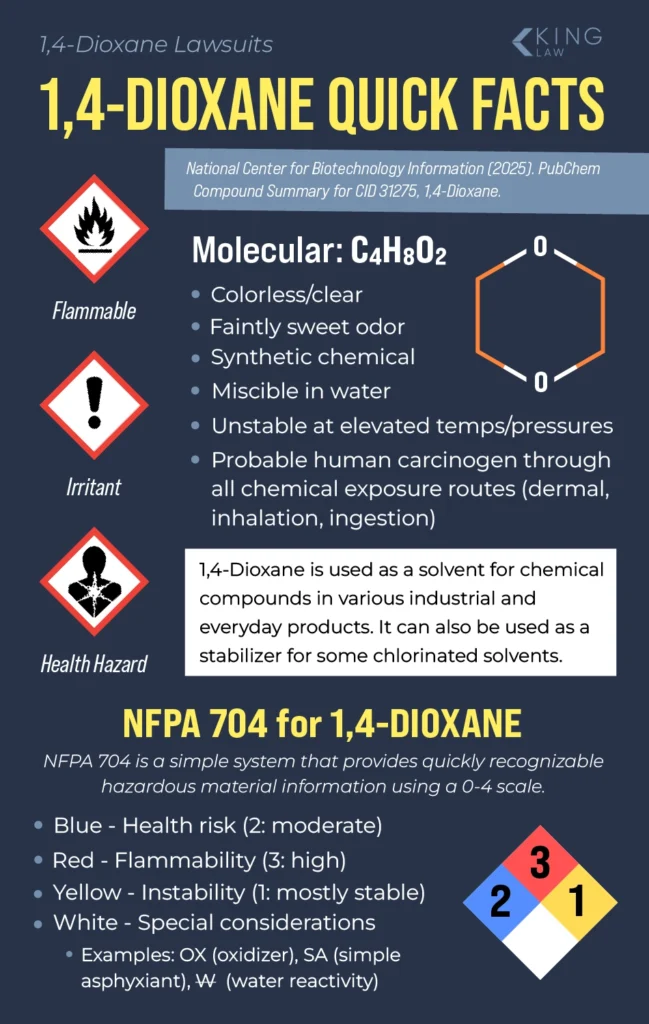
1,4-dioxane is a human-made chemical that is used to stabilize or dissolve other chemicals. It is in some drinking water supplies because of emissions and discharges from manufacturing plants, as well as leakage from landfills.
1,4-dioxane is a byproduct of ingredients in shampoos, glues, lotions, soaps, and paints. 1,4-dioxane mixes easily with water (miscible), cannot be filtered out of water easily, and can be inhaled, ingested, or potentially absorbed through skin contact. For example, one study (Evaluation of natural attenuation of 1,4-dioxane in groundwater using a 14C assay) 1,4-dioxane stays in the environment for long periods of time because it degrades extremely slowly.
OSHA cautions that
1,4-dioxane has entered drinking water supplies because industrial processes and landfill waste have caused this chemical to leach into the soil and groundwater. Civilians, state and local governments, and other organizations are filing lawsuits to hold chemical companies accountable for releasing 1,4-dioxane into the environment.
What Locations Have 1,4-dioxane Contaminated Drinking Water?
1-4-Dioxane has been found in the drinking water supplies of millions of Americans. More citizens are discovering contamination as public reports reveal the true extent of the pollution. Governments and advocacy groups filed legal actions in North Carolina, New Jersey, South Carolina, Massachusetts, New York, and other states. The goal of these lawsuits is to hold companies who discharge the chemical accountable for letting 1,4-dioxane get into residents’ drinking water. Here are some of the states where water suppliers and other entities have taken legal action for 1,4-dioxane pollution.
Asheboro, North Carolina
Two advocacy groups have sued the City of Asheboro, Indorama Ventures, and StarPet for allegedly discharging 1,4-dioxane into Haskett Creek. According to the complaint, about 900,000 people in North Carolina get their tap water from this creek. StarPet makes industrial plastics, and it “pays Asheboro to accept its industrial waste into the city’s municipal wastewater system.”
The Great Oak Landfill and other organizations also give Asheboro money to accept its waste. The advocacy group alleges that Asheboro does not remove 1,4-dioxane from its water systems. So, the contaminated water enters the creek and is consumed by people, fish, and wildlife.
The advocacy groups accuse Asheboro of knowingly violating federal and state water quality and environmental laws for years. This lawsuit is still pending. People who drank water that came from Haskett Creek and Asheboro may be at an increased risk of developing disease related to 1,4-dioxane ingestion.
New Jersey
New Jersey’s Attorney General has filed a lawsuit because his department discovered that more than 700 locations in New Jersey have 1,4-dioxane levels that are unsafe. A 2015 water quality report revealed that New Jersey’s drinking wells are twice as likely to have 1,4-dioxane in them compared to the national average.
According to the New Jersey AG’s complaint, 1,4-dioxane levels in New Jersey soared to over 15 times what the EPA deems as potentially safe. Part of this is due to New Jersey’s historically high rates of industrial, military, and manufacturing operations. 1,4-dioxane is a common byproduct of some industrial processes, like the manufacturing of plastics, glue, and paints. The New Jersey Attorney General seeks to hold negligent corporations accountable for poisoning the drinking water with 1,4-dioxane.
Black Creek in Darlington, South Carolina
The Black Creek in Darlington, South Carolina, is contaminated with 1,4-dioxane coming from Fiber Industries, according to a legal complaint. Advocacy group Winyeh Rivers Alliance has filed a lawsuit against Fiber Industries, Ltd., and the South Carolina Department of Health and Environmental Control.
The complaint alleges that the SC Department of Health allowed Fiber Industries to release over 25,000 to 70,000 times the amount of 1,4-dioxane allowed under federal and state water quality standards. The group believes that more than 300,000 people are at risk of getting cancer because they get their drinking water from three contaminated intakes in South Carolina: The City of Georgetown, Horry County’s Bull Creek intake, and Georgetown County’s Waccamaw Neck intake.
Winyeh Rivers Alliance believes that North Carolina’s government did not do enough to prevent Fiber Industries from polluting residents’ drinking water.
Suffolk County, Long Island, New York
Suffolk County residents in New York may be drinking water contaminated with unsafe levels of 1,4-dioxane, a likely carcinogen. The Suffolk County Water Authority has filed a lawsuit because several companies, such as powerhouse brands like Shell Oil and Procter & Gamble, are putting 1,4-dioxane into people’s drinking water. The legal complaint notes that the defendant corporations have been using toxic chemicals since as early as 1945.
1,4-dioxane does not readily degrade when released into the environment. 1,4-dioxane easily migrates from one water source to another because it is water soluble and is not easily absorbed by soil or organic material.
The defendant corporations attempted to have the lawsuit dismissed. However, a judge rejected the dismissal request, and Suffolk County Water Authority will get to hold a full trial on the 1,4-dioxane pollution matter.
What Cancers and Health Conditions Are Linked to 1,4-dioxane?
Many animal and human studies have found a possible association between long-term exposure to 1,4-dioxane and an increased risk of number of cancers, diseases, and other health conditions, including:
- Liver cancer
- Kidney cancer
- Nasal cavity tumors (in rats)
- Liver and kidney disease
- Respiratory problems
- Lung cancer
- Central nervous system issues
Scientists are still working to understand how 1,4-dioxane might increase someone’s cancer risk. However, multiple animal studies and observational studies involving humans have shown a possible association between 1,4-dioxane exposure and cancer.

Who Is Being Sued in the 1,4-dioxane Lawsuit?
Corporate defendants and some state and local governments are being sued in the 1,4-dioxane lawsuit. Companies that are named as defendants in 1,4-dioxane lawsuits include:
- DuPont
- Dow Chemical
- Fiber Industries
- Gelman Sciences, Inc.
- Legacy Vulcan
- Procter & Gamble
- Shell Oil
- StarPet
These companies and others are accused of releasing unsafe amounts of 1,4-dioxane into the environment through industrial processes, improper waste management, and toxic byproducts from commercial goods.
The lawsuits claim that the companies knew they were discharging high levels of 1,4-dioxane into the soil and water and did not tell anyone, despite the known risks. Several state agencies (like the South Carolina Department of Health and Environmental Control) are also being sued for not doing more to alert the public and prevent more 1,4-dioxane from entering streams and drinking water supplies.
Federal and State Regulation of 1,4-Dioxane
Federal agencies, including the EPA, have identified 1,4-dioxane as posing potential risks to human health. The EPA issued health guidelines to keep workers and consumers safe from 1,4-dioxane exposure. The EPA is conducting further assessments about 1,4-dioxane and expects to issue final, binding water quality regulations. Historically, the EPA recommended levels of 0.35 ppb to 3.5 ppb, depending on the different circumstances surrounding exposure. However, these levels are guidelines and not enforceable.
Some states have passed water quality regulations to decrease the 1,4-dioxane levels in their citizens’ tap water supplies. For example:
- Michigan worked with the EPA to create a Superfund to address significant 1,4-dioxane pollution from Gelman Sciences, Inc.
- California law requires public water suppliers to notify consumers if the 1,4-dioxane levels are 1 microgram per liter or more. 1,4-dioxane levels of 35 micrograms per liter or more require the California water supplier to take action to lower them.
- New York State is in the process of creating statewide maximum contaminant levels for 1,4-dioxane.
Several states have experienced historically high 1,4-dioxane contamination from industrial runoff and poor waste management by companies and local governments. Lawsuits have been filed to hold 1,4-dioxane polluters accountable and encourage much-needed regulatory change.
Who Can File a 1,4-dioxane Lawsuit?
Currently, King Law and our legal partners are investigating lawsuits filed by water suppliers. We are accepting 1,4-dioxane water-contamination lawsuits from the following entities:
- Cities
- States
- Municipalities (e.g., cities, towns, counties)
- Water authorities
Our team of lawyers understands the nuances of filing lawsuits as a public entity. We understand how to pursue compensation to address remediation costs and public safety concerns. Our attorneys and associates have represented municipalities in other water contamination lawsuits, including PFAS lawsuits.
How Can My District File a 1,4-dioxane Lawsuit for Water Contamination?
Your district can file a 1,4-dioxane lawsuit by following these steps:
- Step 1: Schedule a no-obligation, free consultation with a lawyer who is taking 1,4-dioxane cases and experienced in filing cases for municipalities.
- Step 2: Work with the attorney to determine if your jurisdiction meets the eligibility criteria to file a 1,4-dioxane lawsuit against the entities responsible for contaminating your water supply.
- Step 3: Your attorney gathers information to file a lawsuit, including water quality reports, water testing reports, and reports submitted by private companies to state and federal agencies.
- Step 4: Your attorney negotiates your settlement with the 1,4-dioxane polluters or takes the case to trial if no settlement is reached.
- Step 5: If your case is successful, your water district receives funds to cover legal fees, remediation, testing, and other costs.
Contact King Law to understand your possible filing options for a 1,4-dioxane water contamination lawsuit. King Law works with premier environmental litigation partners who know how to take on chemical companies and win.
What Is the Deadline to File a 1,4-dioxane Lawsuit?
The deadline to file a 1,4-dioxane lawsuit depends on the type of case your jurisdiction is filing and where the case is filed. Each state has its own laws about how long entities have to file claims related to water pollution. Moreover, there are exceptions that can change when the 1,4-dioxane lawsuit filing deadlines fall. Talking to an attorney early on can help you prepare and submit your 1,4-dioxane lawsuit before your deadline expires and evidence is lost.
Estimated 1,4-Dioxane Lawsuit Settlements and Payout Amounts
Settlements and payouts for water suppliers will vary greatly depending on the amount of water contaminated, the duration and extent of the contamination, how many residents’ drinking water is affected, and expected remediation costs.
It is likely that remediation will cost water providers millions of dollars. Some remediation lawsuits involving widespread contamination have recovered substantial sums, though outcomes vary significantly.
A potential payout could help cover costs associated with addressing 1,4-dioxane contamination, including:
- Remediation of the existing water supply
- Mechanisms to prevent future contamination
- Treatment system upgrades
- Previous and future water quality testing
- Long-term water quality monitoring
- Projects to connect some residents to cleaner water supplies during remediation efforts
- Infrastructure updates necessary to address contamination
Our team can help you understand what costs your district incurred and how those costs might be offset by a successful claim.
King Law Is Investigating 1,4-dioxane Claims
Our attorneys and partners at King Law are well-versed in environmental contamination cases. We have demonstrated experience representing people and municipalities harmed by contaminated drinking water. We can use that knowledge to craft a strong legal strategy to seek a 1,4-dioxane settlement on your district’s behalf.
Contact a 1,4-dioxane Lawyer Today
If your district is covering costs related to 1,4-dioxane in your water, contact our team today by calling (585) 496-2648. King Law is ready to help you understand your legal rights when filing as a jurisdiction. We can help your district take on the company that contaminated your drinking water supply with 1,4-dioxane. We will fight on behalf of your district and its residents.
Frequently Asked Questions (FAQs)
List of Sources Used in This Article
Here is a list of sources used in this article. King Law strives to use authoritative sources so our readers can feel confident about what they read on this page.
- Agency for Toxic Substances and Disease Registry. “Toxicological Profile for 1,4-Dioxane.” U.S. Department of Health and Human Services, Aug. 2012.
- Agency for Toxic Substances and Disease Registry. “ToxFAQs™ for 1,4-Dioxane.” U.S. Department of Health and Human Services, updated 2024.
- BillTrack50. “Bill Detail: North Carolina Legislation Concerning 1,4-Dioxane.” BillTrack50, 2025.
- California Department of Toxic Substances Control. “Manual Dish Detergents and Shampoo Containing 1,4-Dioxane.” California DTSC, 2024.
- Cape Fear Public Utility Authority. “Notice of Intent to Enforce.” North Carolina Division of Water Resources, 2025.
- Center for Public Integrity. “N.C. Has Allowed a Likely Carcinogen Into Three Rivers Serving 900,000 People.” North Carolina Health News, 13 July 2025.
- Environmental Protection Agency. “Technical Fact Sheet: 1,4-Dioxane.” EPA, Jan. 2014.
- Environmental Protection Agency. “EPA Adds Gelman Sciences Inc. in Ann Arbor, Michigan, to the Superfund National Priorities List.” EPA, 2026.
- Environmental Protection Agency. “EPA to Hold Public Hearing on City of Asheboro’s Wastewater Treatment Plant Proposed Permit.” EPA, 2025.
- Environmental Protection Agency. “EPA Proposes to Add Gelman Sciences Inc. in Ann Arbor, Michigan, to the Superfund National Priorities List.” EPA, 2024.
- Environmental Protection Agency. “Revised Risk Determination for 1,4-Dioxane.” EPA, Nov. 2024.
- Fossen, Charlie. “‘No Limits, No Accountability’: Area Residents Rebuke State’s Proposed PFAS, 1,4-Dioxane Rules.” Port City Daily, 26 Apr. 2026.
- Fossen, Charlie. “State PFAS and 1,4-Dioxane Rules Advance; Public Comment Period to Open.” Port City Daily, 13 Jan. 2026.
- Fossen, Charlie. “Vote Coming on PFAS, 1,4-Dioxane Rules That Critics Say Allow Polluters to Police Themselves.” Port City Daily, 4 Jan. 2026.
- Fossen, Charlie. “CFPUA Assesses Treatment Options for 1,4-Dioxane; Pilot Test Could Come Next Year.” Port City Daily, 27 July 2025.
- Guajardo, Celeste. “NC Regulators Are Choosing to Not Set Numeric Limits on Chemical Pollution in Waterways. Why?” WUNC, 14 May 2026.
- Huron River Watershed Council. “1,4-Dioxane.” HRWC, accessed 3 June 2026.
- Karimi, Roxanne. “Scientific Contributions.” ResearchGate, accessed 3 June 2026.
- National Center for Biotechnology Information. “1,4-Dioxane.” TOXNET Profile, NCBI Bookshelf.
- National Center for Biotechnology Information. “Health Effects of 1,4-Dioxane.” NCBI Bookshelf.
- National Center for Biotechnology Information. “Environmental Fate and Transport of 1,4-Dioxane.” NCBI Bookshelf.
- Nantucket, Massachusetts. “Legal Action Regarding 1,4-Dioxane Contamination.” Town of Nantucket, accessed 3 June 2026.
- New Jersey Department of Environmental Protection. “Complaint Against Chemical Manufacturers for 1,4-Dioxane Contamination.” 23 Mar. 2023.
- New Jersey Office of the Attorney General. “State of New Jersey v. Chemical Manufacturers: Complaint.” 23 Mar. 2023.
- North Carolina Department of Environmental Quality. “REMINDER: Public Hearings Scheduled on Proposed 1,4-Dioxane Monitoring, Minimization Rules.” 24 Mar. 2026.
- National Toxicology Program. “1,4-Dioxane.” Report on Carcinogens, U.S. Department of Health and Human Services.
- Occupational Safety and Health Administration. “1,4-Dioxane.” OSHA Chemical Database, accessed 3 June 2026.
- Preprints.org. “Preprint Manuscript 202605.0779.” Preprints.org, 2026.
- Safe Drinking Water Authority. “1,4-Dioxane.” California State Water Resources Control Board, accessed 3 June 2026.
- Suffolk County Water Authority. “Complaint Regarding 1,4-Dioxane Contamination.” 30 Nov. 2017.
- Suffolk County Water Authority. “Order Denying Motion for Summary Judgment in SCWA Dioxane Litigation.”
- Suffolk County Water Authority. “SCWA Lawsuit Against Chemical Manufacturers Over 1,4-Dioxane Contamination Moves Forward.” SCWA, 2024.
- Southern Environmental Law Center. “Complaint Regarding Asheboro 1,4-Dioxane Pollution.” 3 June 2025.
- Wikipedia Contributors. “Miscibility.” Wikipedia, accessed 3 June 2026.
- World Health Organization. “Diquat Chemical Fact Sheet.” WHO.
- WPDE Staff. “Lawsuit Claims Toxic Chemical Threatens Horry, Georgetown County Drinking Water.” WPDE, 2025.
- Yale School of Public Health. “FAQ: 1,4-Dioxane.” Yale Superfund Research Center, accessed 3 June 2026.
- Zhang, et al. “Occurrence, Fate, and Treatment of 1,4-Dioxane in Water Systems.” International Journal of Environmental Research and Public Health, 2023.
- “Treatment Technologies for 1,4-Dioxane Removal from Water: A Review.” Journal of Hazardous Materials, 2022.