

What Are the Symptoms of a Perforated Colon From a Colonoscopy?
Complete the form below to see if you qualify for a Olympus Scope Lawsuit

Symptoms of a perforated colon from a colonoscopy include abdominal pain or swelling, fever, chills, nausea, vomiting, rapid heart rate, bleeding, and confusion. Sometimes, a colon perforation can cause an infection that leads to sepsis or organ failure. Colon perforations can be life-threatening and should be treated by a doctor as soon as symptoms arise.
About the Symptoms of a Perforated Colon From a Colonoscopy
How Soon Would You Know If Your Colon Was Perforated During a Colonoscopy?
What Are The Symptoms Of A Perforated Colon?
How Do Doctors Diagnose A Perforated Colon?
Is Severe Abdominal Pain After a Colonoscopy a Sign of Perforation?
Can a Perforated Colon Cause Bloating or a Swollen Stomach After Colonoscopy?
Can Fever or Chills After a Colonoscopy Mean a Perforated Colon?
Can Nausea and Vomiting Be Symptoms of a Perforated Colon?
Can Rectal Bleeding After Colonoscopy Be a Sign of Perforation?
What Are the Signs of Sepsis From a Perforated Colon After Colonoscopy?
Can Shoulder Pain or Chest Pain Happen With a Colon Perforation?
What Is the Difference Between Post-Polypectomy Syndrome and a True Perforation?
Who Is More Likely to Have a Colon Perforation From Colonoscopy?
Can You Die From a Perforated Colon After Colonoscopy?
What Should You Do If You Think Your Colon Was Perforated During a Colonoscopy?
How Do Doctors Treat a Perforated Colon?
How Long Does It Take to Recover From a Perforated Colon?
Summary: What Are the Main Warning Signs of a Perforated Colon From Colonoscopy?
How Soon Would You Know If Your Colon Was Perforated During a Colonoscopy?
Patients may show symptoms of a perforation during the colonoscopy, within 24 hours afterward, or, sometimes, a few days later. In one rare case, a patient did not find out she had a perforation until over 2 months after her colonoscopy. Patients should tell their doctor about any new or worsening symptoms or changes after a colonoscopy. Patients may want to consult their doctors if they are still feeling unwell a week after a colonoscopy.
What Are The Symptoms Of A Perforated Colon?
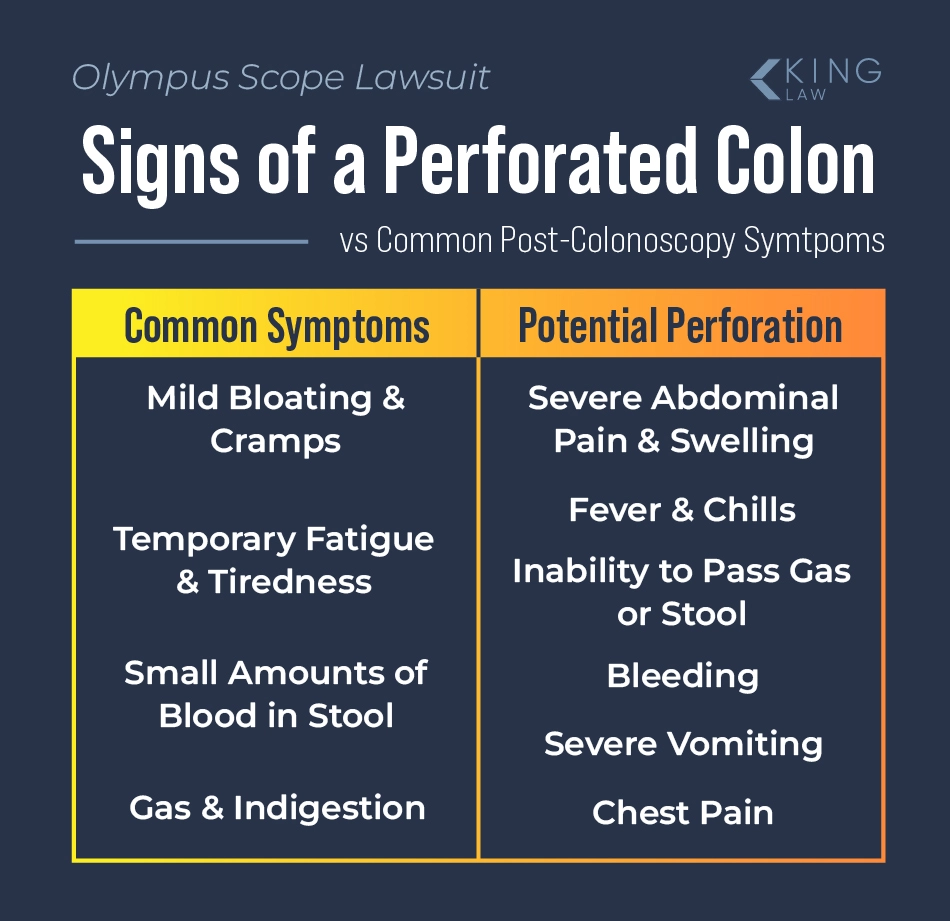
Symptoms of a perforated colon include:
- Severe abdominal pain
- Abdominal swelling that gets worse
- Chest pain
- Bleeding
- Inability to pass gas or stool
- Severe vomiting
- Fever and chills
If you have a perforation, these symptoms may be severe and get worse with time. The symptoms of a perforated colon may appear during the colonoscopy or within hours or days afterward. Report any concerning symptoms to your doctor, even if you do not think they are severe or life-threatening at that time.
How Do Doctors Diagnose A Perforated Colon?
Doctors can use several tests to diagnose a perforated colon, including:
- Physical exam (to check for abdominal tenderness)
- CT scan (to find a tear or swelling)
- Blood tests (to check white blood cell count or for bacteria in the blood)
- X-Ray (to see if there is free air in the abdomen)
- Diagnostic colonoscopy (if safe and needed to visually locate a perforation)
- Urine sample (sometimes used to rule out other causes)
These tests help doctors find a tear in the colon, bacteria in the blood, free air in the abdomen, or other signs of what may be causing the patient’s symptoms.
Is Severe Abdominal Pain After a Colonoscopy a Sign of Perforation?
One of the
If someone has a bowel perforation, the abdominal pain is more likely to last longer than a couple of hours or days, be severe, and come on suddenly. Someone with a bowel perforation may also experience a fever, vomiting, or an inability to pass gas or stool.
Can a Perforated Colon Cause Bloating or a Swollen Stomach After Colonoscopy?
A bowel perforation can lead to a swollen stomach and bloating after a colonoscopy. Perforations can cause symptoms that prevent gas and stool from passing through the intestines and leaving the body. The stomach may swell (become distended) as the gas and waste build up in the body. The person may also develop peritonitis, an infection of the abdominal lining, which can cause swelling, a fever, severe pain, and the inability to pass any gas or stool.
Can Fever or Chills After a Colonoscopy Mean a Perforated Colon?
If the person develops an infection because of the colon perforation, they may experience fever and chills after a colonoscopy. A perforated bowel can allow gas and stool to leak into the abdominal cavity. This may cause the peritoneum to become infected (peritonitis), leading to fever, chills, a rapid heart rate, and worsening abdominal pain. An untreated bowel perforation or other colonoscopy complications can lead to an infection. A post-colonoscopy infection can lead to sepsis, which can cause fever and chills and be life-threatening.
Can Nausea and Vomiting Be Symptoms of a Perforated Colon?
A
Can Rectal Bleeding After Colonoscopy Be a Sign of Perforation?
Sometimes, a bowel perforation can cause rectal bleeding. Mild rectal bleeding or spotting may be from polyps being removed during the procedure. However, severe, persistent, new, or worsening bleeding is not normal (typical) and may mean the person has an infection, perforation, or other internal injury from the colonoscopy. Bleeding that is accompanied by pain, fever, dizziness, fainting, weakness, or abdominal swelling should be addressed by a doctor immediately.
What Are the Signs of Sepsis From a Perforated Colon After Colonoscopy?
A perforated colon may lead to sepsis, which is an overwhelming immune response to an infection. Symptoms of sepsis include:
- Very high or very low body temperature
- Weak, irregular, or rapid heartbeat
- Low blood pressure
- Clammy skin
- Confusion
- Chest tightness or difficulty breathing
Sepsis is life-threatening and will not go away without prompt treatment. Anyone who thinks they have sepsis, a perforated bowel, or an infection after a colonoscopy should go to the doctor immediately.
Can Shoulder Pain or Chest Pain Happen With a Colon Perforation?
Shoulder or chest pain may happen if someone has a bowel perforation after a colonoscopy. A colon perforation can cause gas and air to leak out of the intestines and become trapped in the body. This can cause pressure and swelling that makes it hard for the person to breathe.
The abdominal pain may also radiate to the person’s shoulder as referred pain, where the body experiences pain in one area but actually feels it in another. Shoulder, neck, and abdominal pain may also be caused by a secondary infection, such as peritonitis, or by subcutaneous emphysema, a swelling of the chest or neck when gas or air is trapped in the deep layers of the skin.
What Is the Difference Between Post-Polypectomy Syndrome and a True Perforation?
Post-polypectomy syndrome and bowel perforation have several symptoms in common, but they are different conditions. Post-polypectomy syndrome is a deep tissue burn that is caused by the doctor cauterizing and removing a polyp during a colonoscopy. The deep tissue burn does not create a hole that goes all the way through the intestines. It can cause fever, abdominal pain, swelling, and other symptoms. Post-polypectomy syndrome is rarely fatal, and it is treated with rest, fluids, observation, and antibiotics.
A bowel perforation is a hole in the intestines, and it can quickly become life-threatening. A bowel perforation can be caused by diverticulitis, a mistake during a colonoscopy, or other factors. Symptoms of a bowel perforation include persistent or severe abdominal pain or swelling, fever, chills, and the inability to pass gas or stool. Bowel perforations may be treated by closing the perforation, administering antibiotics, and taking other measures. Doctors may use a CT scan to determine if someone has a bowel perforation or post-polypectomy syndrome.
Who Is More Likely to Have a Colon Perforation From Colonoscopy?
Anyone may experience a bowel perforation from a colonoscopy. However, someone may have a higher risk of a bowel perforation in the following circumstances:
- They are having a therapeutic colonoscopy (e.g., having polyps removed).
- They are elderly or have a weakened immune system.
- They have an underlying condition, like diabetes, liver disease, chronic heart disease, or dementia.
- The person has irritable bowel syndrome or inflammatory bowel disease.
- The person has large polyps or diverticulitis.
Before having a colonoscopy, the patient should talk to their doctor about the risks and benefits of the procedure, including the chance of a bowel perforation.
Can You Die From a Perforated Colon After Colonoscopy?
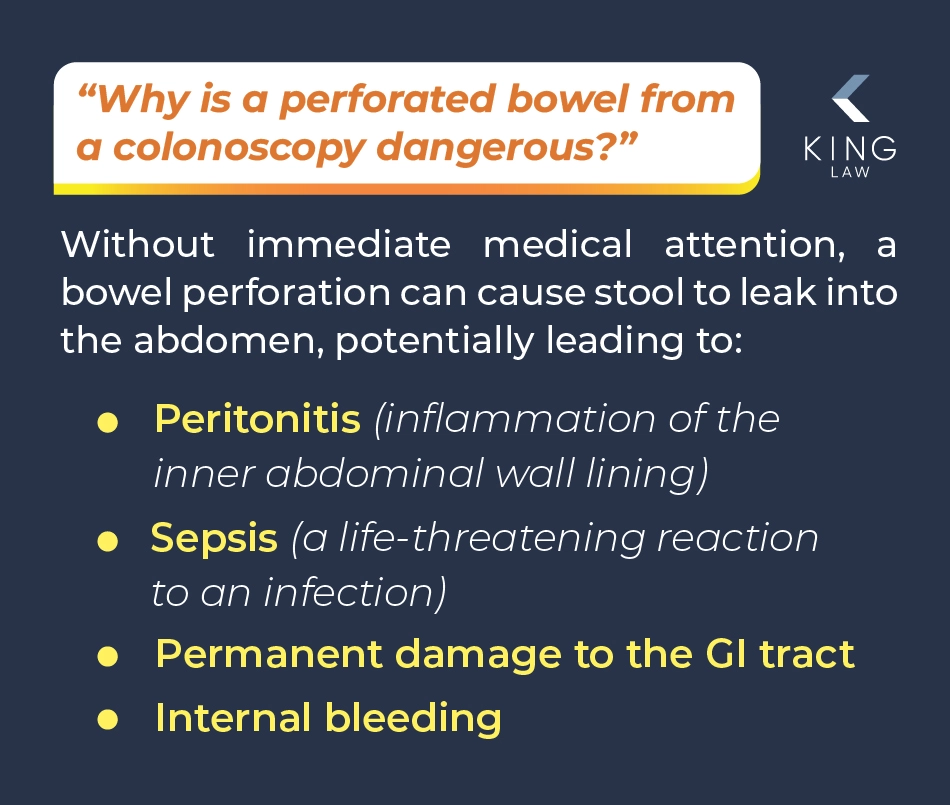
A perforated colon may be fatal if not treated early and quickly. A perforated bowel may allow waste to escape from the intestines into the abdominal cavity, causing a dangerous infection and swelling. The bowel perforation may trigger sepsis, septic shock, and organ failure. For this reason, patients who believe they might have a bowel perforation are encouraged to immediately seek treatment.
What Should You Do If You Think Your Colon Was Perforated During a Colonoscopy?
If you think your colon was perforated during a colonoscopy, you should go to the doctor immediately. If you wait to see if symptoms improve first, you may be putting your health and life at greater risk. Only a doctor can tell you if you have a bowel perforation from a colonoscopy and, if so, how to treat it.
How Do Doctors Treat a Perforated Colon?
Methods that doctors may use to treat a perforated colon include:
- IV antibiotics
- IV fluids
- Surgery
- Colostomy (temporary or, in rare cases, permanent)
- Observation in the hospital
- Fluid and food restriction
- Pain medication
- Nasogastric tube (NG Tube) placement
How Long Does It Take to Recover From a Perforated Colon?
It can take weeks or months to recover from a perforated colon, depending on how severe the perforation was and how quickly the person gets treatment. Some perforations may require doctors to cut out (resect) part of the bowel. Some patients may need colostomy bags if the perforation is severe and destroys a significant portion of the bowel.
Summary: What Are the Main Warning Signs of a Perforated Colon From Colonoscopy?
Some of the warning signs of a perforated colon from a colonoscopy include:
- Fever
- Chills
- Abdominal pain that gets worse, comes on suddenly, or is persistent
- Abdominal distension (swelling or rigidness)
- Inability to pass gas or stool
- Rapid heart rate
- Shortness of breath
- Nausea or vomiting
Go to the doctor if you experience troubling symptoms after a colonoscopy. You may have a bowel perforation or other injury that needs to be treated urgently.
Contact King Law for a Free Case Review
The attorneys at King Law are reviewing potential lawsuits related to colonoscopy infections. If you experienced an infection or bowel perforation from a colonoscopy, contact us today by dialing (585) 496-2648 or filling out an online form. King Law can help you determine if you qualify for compensation because of a defective colonoscope or a medical error. We provide free consultations and case evaluations for colonoscopy patients, and there are no upfront legal fees to hire us.
Frequently Asked Questions (FAQs)
Source List
Adebisi, Ajibola A., et al. “Evaluation of Morbidity and Mortality in Iatrogenic Colonic Perforation During Colonoscopy: A Comprehensive Systematic Review and Meta-Analysis.” Cureus, vol. 16, no. 11, 2024, e73302.
Florida Agency for Health Care Administration. “Gastrointestinal Perforation.” FloridaHealthFinder.
Florida Agency for Health Care Administration. “Subcutaneous Emphysema.” FloridaHealthFinder.
Jones, Mark W., et al. “Bowel Perforation.” StatPearls, StatPearls Publishing, updated 14 Sept. 2025.
Lohsiriwat, Varut. “Colonoscopic Perforation: Incidence, Risk Factors, Management and Outcome.” World Journal of Gastroenterology, vol. 16, no. 4, 2010, pp. 425–430.
Mayo Clinic. “Sepsis: Symptoms and Causes.” Mayo Clinic.
MedlinePlus. “Gastrointestinal Perforation.” MedlinePlus Medical Encyclopedia, U.S. National Library of Medicine.
MedlinePlus. “Subcutaneous Emphysema.” MedlinePlus Medical Encyclopedia, U.S. National Library of Medicine.
Rai, Vinay, and Nitin Mishra. “Colonoscopic Perforations.” Clinics in Colon and Rectal Surgery, vol. 31, no. 1, 2018, pp. 41–46.
ScienceDirect. “Colon Perforation.” ScienceDirect Topics, Elsevier.
Waddingham, William, et al. “Complications of Colonoscopy: Common and Rare—Recognition, Assessment and Management.” BMJ Open Gastroenterology, vol. 10, no. 1, 2023, e001193.
“A Rare Case of Extremely Delayed Presentation of Colonoscopic Perforation.” The American Journal of Gastroenterology, vol. 109, 2014.