

School Board Lawsuit Against Social Media [2026 Update]
Complete the form below to tell us about your case

School districts and local governments are filing lawsuits against social media companies for the damages and costs incurred while addressing youth social media addiction. Many school districts have diverted staff and financial resources to address the multiple mental health and behavioral issues related to social media addiction.
Lawsuits filed by school districts allege that students, budgets, and communities have been harmed by rampant social media use. School districts and local governments are hiring attorneys to file lawsuits against companies like Google, Meta, Snap, and ByteDance. These lawsuits allege that social media companies have created a youth mental health crisis that schools and local governments are left paying for.
By filing a lawsuit, school districts and local governments can seek compensation for mental health, disciplinary, safety, staffing, and educational costs associated with combating the impacts of student social media addiction.
About the School District Social Media Litigation:
What Is the School District Social Media Litigation?
Why Are School Districts Filing Lawsuits?
How Do Social Media Platforms Allegedly Encourage Addiction?
How Can Social Media Affect a School District?
What Are School Districts Seeking in Their Lawsuits?
Why Should a School District Consider Participating?
What Types of Districts May Qualify?
What Do School Districts Have to Do to File a Lawsuit?
What Information Does a District Have to Provide?
What Is the School District Social Media Litigation?
The school district social media litigation involves school districts and local governments seeking compensation to redress alleged damages caused by youth social media addiction. Current lawsuits filed by school districts focus on allegedly addictive platform features, youth targeting features, recommendation systems, and inadequate safeguards. Lawsuits allege that social media companies have caused addiction to their platforms through deliberate design, distribution, and marketing tactics. Furthermore, the lawsuits allege that impulsive social media use has resulted in financial losses for school districts.
Districts are filing these claims as part of multidistrict (MDL) No. 3047, IN RE: Social Media Adolescent Addiction/Personal Injury Products Liability Litigation. This is a federal litigation that school districts from all 50 states may be eligible to join. Interested school districts can talk to one of our attorneys about eligibility and requirements for filing a claim as part of this MDL. King Law is also taking cases from individual plaintiffs (minors) who want to join the social media addiction lawsuit.
Fast Facts For School Districts and the Youth Social Media Addiction MDL
| Name of litigation: | IN RE: Social Media Adolescent Addiction/Personal Injury Products Liability Litigation |
| Type of lawsuit: | Civil, product liability |
| Defendants: | Meta: Facebook and Instagram Snap Inc.: Snapchat ByteDance: TikTok Google: YouTube |
| Core claim: | Social media companies intentionally designed their products to be addictive to youth, directly impacting youth mental health and incurring costs to school districts |
| Legal accusations: | Public nuisance and negligence |
| Seeking compensation for: | Financial losses for addressing youth mental health crisis in schools |
| Number of school districts involved: | More than 1,200 |
| Venue: | Northern District of California (Federal Court) |
| Judge: | U.S. District Judge Yvonne Gonzalez Rogers |
| MDL Created: | 2022 (read the master complaint for districts for MDL No. 3047) |
| Still accepting new claims: | Yes |
| Settlements: | Yes (via first bellwether trial in June 2026 and prior to a fall 2026 trial) |
| Next bellwether trial: | Scheduled for February 2027 |
Why Are School Districts Filing Lawsuits?
School districts are filing lawsuits against social media companies for costs associated with the physical and mental health injuries related to social media addiction in student populations.
Many school districts have to divert staff and financial resources to treating the multiple issues caused by social media addiction, including:
- Student mental health needs
- Classroom distractions
- Online bullying and harassment
- Threats and safety concerns
- Disciplinary incidents
- Cellphone policy enforcement
- Parent meetings and administrative work
Diverting staff and financial resources to these issues diverts public (tax) and state resources intended for education and other student services. Many school districts are bearing the financial burden of addressing problems created by student addiction to social media platforms. This diversion of resources directly impacts many programs intended to enrich the educational and social development of students. Many districts are forced to use their limited resources to combat issues caused by social media companies, who are alleged to have purposefully designed their platforms to increase engagement from minors.
How Do Social Media Platforms Allegedly Encourage Addiction?
Many lawsuits, internal documents, and research studies have examined how certain actions taken by social media companies have led to youth social media addiction. Lawsuits allege that social media platforms, like Facebook, Instagram, YouTube, Snapchat, and TikTok, have intentionally designed their platforms to addict children and adolescents.
Some of the social media features that are alleged to be addictive to children and teens include:
- Personalized recommendations
- Endless scrolling and autoplay
- Likes, streaks, and notifications
- Ineffective age verification
- Limited parental controls
- Barriers to reducing or ending use
- Inadequate age-verification measures
- Intermittent variable rewards and reciprocity
- Visible social metrics
- Disappearing messages that can allow for bullying
Lawsuits allege that social media companies deliberately include such design features to maximize youth engagement. These design features are alleged to drive engagement and increase advertising revenue for social media companies. However, many school districts have to bear the costs associated with student social media addiction.
Are Youth and Teens Really Addicted to Social Media?
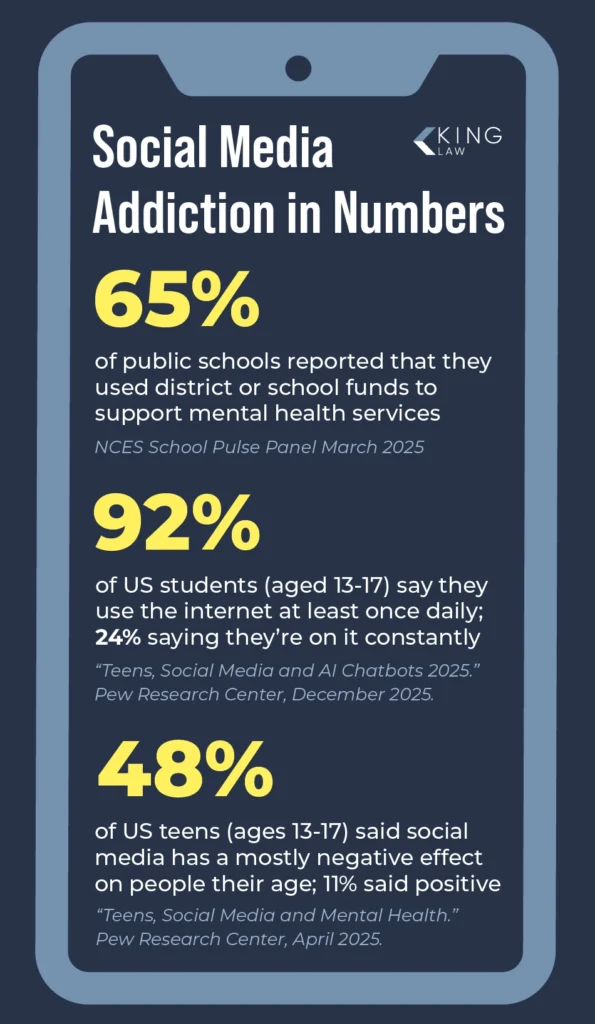
According to data from a 2025 Pew Research Poll, teens ages 13 to 17 are using social media very frequently. According to a poll called “Teens, Social Media, and AI Chatbots 2025,” as many as 76% of teens use social media daily, with 17% admitting to using social media ‘almost constantly,” including during school hours. The Pew Research poll found that surveyed teens used social media at the following rates:
| Platform | % of Teens Using ‘Almost Constantly’ | % of Teens Using Several Times/Day |
| Youtube | 17% | 43% |
| TikTok | 21% | 34% |
| 12% | 31% | |
| Snapchat | 12% | 26% |
| 3% | 9% |
Source: Pew Research; Teens, Social Media, and AI Chatbots 2025; Survey of U.S. teens conducted September 25, through October 29, 2025.
These statistics underscore what many school teachers and administrators already know: many students are engaging in problematic social media use that interferes with their education and depletes school resources.
How Can Social Media Affect a School District?
Students who spend excessive time on social media may experience a range of negative emotional and physical side effects that have direct impacts on students and learning. Kids who regularly use social media can experience impacts to their psychological health, including addictive behaviors, body dissatisfaction, online bullying, anxiety, sleep deprivation, depression, self-harming behaviors, eating disorders, emotional dysregulation, decreased attention spans, and disruptive behaviors. Each of these outcomes has possible impacts on individual students, school operations, classroom behavior, and school resources.
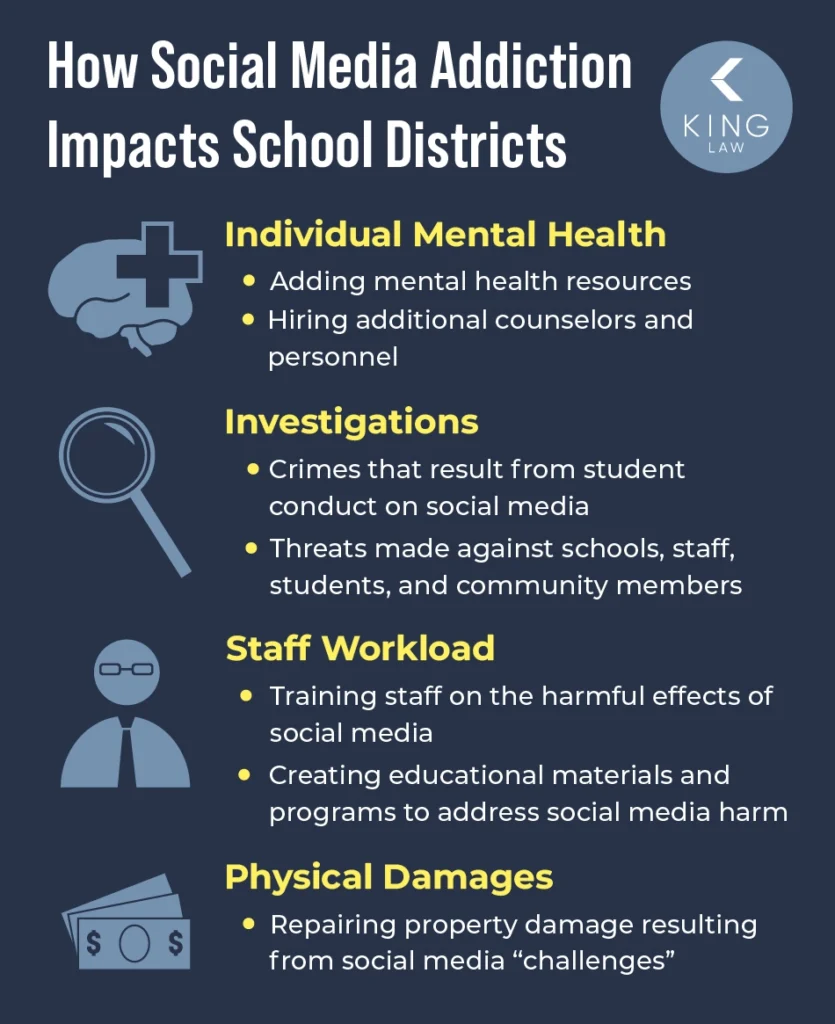
Some of the ways school districts are forced to address the effects of social media addiction include:
- Providing additional mental health resources for students and teachers
- Hiring additional counselors and personnel
- Training staff on the harmful effects of social media
- Creating educational materials, after-school programs, and similar services to address social media addiction and harm
- Investigating crimes that result from student conduct on social media
- Investigating threats made against schools, students, and members of the community over social media
- Repairing property damage resulting from students damaging school property due to social media addiction or online challenges
Mental Health Services
Many school districts report needing additional mental health counseling and programs for students in K-through-12 schools. In their lawsuits, districts allege that social media has an outsized impact on student mental health. Data from government studies supports this increased demand.
According to the U.S. Department of Education’s Institute of Education Sciences (IES), schools across the United States are seeing an increased demand for student mental health services. Recent data from the School Pulse Panel (SPP), which surveys public K-through-12 schools on high-priority education topics, has found that many schools are experiencing increased demand for mental health services. Here are some of the results from the report for the 2024-2025 school year (School Pulse Panel: Surveying high-priority, education-related topics):
- 53% of public schools reported that the percentage of students who have sought school-based mental health services increased compared to last school year.
- 36% of public schools reported that the percentage of staff expressing concerns with themselves or their colleagues exhibiting depression, anxiety, trauma, or emotional dysregulation/disturbance has increased compared to last school year.
- 70% of public schools reported that they needed more support for student and/or staff mental health.
School districts often have to address the mental health impacts students experience due to extensive social media use.
Classroom Disruptions
Many school districts, as well as local and state governments, have had to enact legislation and policies to address classroom disruptions due to cell phones and social media use. School districts across the United States have enacted cell phone bans, attempting to combat student social media obsessions, learning disruptions, levels of student distraction, and the associated educational and mental health impacts.
Many teachers lose instructional time to enforcing these policies. An increasing number of students are finding it difficult to disengage with social media apps, causing repeated disruptions in the classroom.
Bullying and Discipline
Unfortunately, social media platforms have enabled many students to engage in and become victims of online bullying. Once bullying begins online, the effects often spill over to interactions at school. Teachers and school administrators are often required to investigate complaints from students and parents that involve online bullying on social media platforms. Schools often have to deal with student conflicts, student threats, student mental health effects, investigations, disciplinary hearings, and other issues stemming from cyberbullying.
School Safety
Student safety is a top priority for school districts. Oftentimes, teachers and administrators receive reports of threats to student safety related to interactions online. Some of the ways social media may present threats to student safety include:
- Threats sent via social media platforms
- Self-harm behaviors or mental health struggles resulting from compulsive social media use
- Harmful, so-called “challenges” that result in injuries to students
Students who regularly use social media may engage in behaviors that are harmful to themselves or others. School districts often have to redirect resources and staff to address issues involving student safety.
Staffing and Training
Many school districts have been struggling to keep pace with the outsized impact student social media use has on students and staff. Many school districts have added additional staff to monitor students, enforce new district policies, and help students battling mental health issues due to social media use. Many districts also have to spend additional time and resources to develop staff and student training about the possible harms associated with social media addiction.
Property Damage
Some school districts have seen an increase in property damage inflicted by students. In some cases, students may damage electronic devices loaned to them by their schools. Similarly, many districts have experienced school property damage after students reenact social media challenges. Social media trends and challenges may encourage students to damage buildings, bathrooms, sports equipment, electronics, and other physical school property.
What Are School Districts Seeking in Their Lawsuits?
By filing a lawsuit as part of the social media addiction MDL, a school district or local government entity can attempt to recuperate financial losses associated with social media addiction.
School districts who choose to file a lawsuit against social media companies can pursue the following damages:
- Funding for past and future interventions for treating student mental health issues
- Funding for additional staffing and training resources (past and present)
- Educational and prevention program costs
- Safety and disciplinary expenses
Some districts have also pursued changes to allegedly harmful platform practices, hoping to effect long-term changes in conduct from social media companies.
Specific Damages Sought in Lawsuits Filed by School Districts Against Social Media Companies
Here are some of the detailed damages school districts and local governments are claiming in social media lawsuits:
- Increased costs for additional school resource officers, psychologists, and counselors providing therapy and support for mental health issues related to social media use
- Costs related to therapy and disciplinary actions related to online bullying, harassment, and threats
- Increased staff costs for monitoring and confiscating phones used to access social media in classroom settings
- Costs for hiring counselors and medical professionals to address social and emotional issues related to student social media use
- Developing lesson plans and educational materials for students, parents, and the community about the potential harms of social media use
- Costs associated with meeting with students and parents for disciplinary actions related to social media use at school
- Costs of repairing or replacing physical damages related to youth social media addiction (e.g., tablets or other school-owned property)
Filing a lawsuit does not guarantee any entity compensation for all or any of these losses. An attorney experienced in social media addiction cases can advise school administrators on which losses they may be able to pursue in a claim.
Why Should a School District Consider Participating?
School districts that file a claim as part of the youth social media addiction MDL may be able to recover compensation for past and future expenses incurred by the district. These funds can be used for programs that can help districts and their students deal with the ill effects of social media use. Many of these costs have already been absorbed by taxpayers or local governments. If a school district receives compensation from a successful claim, that money could be redirected to student and staff support services or address budget gaps created by social-media related expenditures.
Additionally, these lawsuits may encourage voluntary or regulatory reforms aimed at curbing youth social media addiction and its effects on students. Lawsuits filed by school districts can encourage changes on behalf of social media companies that could benefit students over the long term.
How Can Filing a Lawsuit Against a Social Media Company Help Your District?
Many school districts have spent thousands of hours and redirected funds to combat the problems caused by social media addiction. Filing a claim against a social media company can help your district recover expenditures for youth mental health services and education. Filing a lawsuit can also enable your district to obtain future damages to fund future programs targeted at treating and preventing cyber addiction at your school.
What Types of Districts May Qualify?
Any public school that has experienced losses associated with student social media addiction may qualify to file a claim against a social media company. Many school districts and local governments have qualified to file lawsuits against the owners of Instagram, Snapchat, Facebook, YouTube, and TikTok. Any public school in the United States can request a free case evaluation with our law firm.
If your school district has had to engage in any of the following due to social media use by students, your district may have a viable claim:
- Increased counseling or mental health referrals
- Additional mental health staffing
- Social-media-related discipline
- Bullying, harassment, or threats
- Classroom or cellphone disruptions
- Staff training and policy changes
- Property damage from online challenges
- Increased administrative or safety costs
Your school district does not have to have experienced all of these losses to file a claim. Our experienced attorneys can advise on which types of damages your district may qualify for.
What Do School Districts Have to Do to File a Lawsuit?
In order for a school district to file a social media addiction claim, that district can speak to a qualified attorney about filing a case. If the school district decides to move forward with the claim, they will need to provide documentation and evidence to support the losses cited in its claim.
Additionally, districts will need to complete a plaintiff fact sheet (see an example plaintiff fact sheet for school districts joining the social media MDL) and provide all court-mandated documentation to support their case. Attorneys can assist districts throughout this process. A district’s lawyer can also ensure all court deadlines are met for filing and documentation. The district’s attorney can provide guidance throughout the process and keep the district informed of changes in requirements.
Steps for School Districts to File a Social Media Lawsuit
- Seek an initial evaluation: An authorized district representative can speak with an attorney about filing a social media claim. That attorney will ask initial questions about the district’s experiences and losses.
- Retain a lawyer and file a claim: If the district decides to move forward with an MDL claim, their attorney will file the lawsuit by way of a short-form complaint.
- Gather evidence and information: After the legal complaint is filed, the district will need to gather additional records and documentation requested by their attorney.
- Complete a plaintiff factsheet: Each school district filing in the MDL will need to complete a plaintiff factsheet (PFS). A PFS is a court-ordered questionnaire used during the fact-finding phase of the lawsuit. The district will have to provide specific information about enrollment, staffing, mental health services, expenses, policies, and budgets.
- Respond to attorney inquiries: Once the lawyer has filed all required documentation and court materials, the district will need to respond to any additional inquiries. Throughout a litigation, the required materials may change, or supplemental materials may be needed. It is important to respond to all attorney inquiries in a timely fashion.
- Await possible settlement negotiations: Because bellwether trials have already been chosen in this MDL, it is unlikely that most cases filed by school districts will go to trial. Instead, individual social media companies may choose to engage in settlement negotiations with individual districts.
What Information Does a District Have to Provide?
When a school district files a claim, they will have to provide supporting evidence that harms caused by student social media addiction impacted district operations and resulted in increased investments in certain types of student support services.
General information school districts will have to provide to file a social media claim includes:
- Number of schools in the district
- Student enrollment numbers
- Employee counts
- Teacher counts
- Organizational charts
- Mental Health Staffing Information
- Information about staffing trends
- District budgets
- Health services budgets
- Mental health budgets
Some of the additional information that school districts will need to supply to support a strong social media addiction claim includes documentation related to the following actions:
- Hiring additional school counselors or support personnel to help students facing mental health challenges or bullying
- Expanding mental health programs available to students
- Creating task forces to research and investigate the impacts of social media use on the district
- Expenditures related to additional staff training and new policy implementation
- Costs of increasing student supervision
- Documentation of classroom disruptions
- Costs related to investigating and implementing disciplinary actions
Additionally, school districts can support their claims by documenting the increased costs year-over-year (YoY) associated with the effects of student social media addiction. Some of the data schools can provide attorneys and the courts with include changes in:
- Mental health staffing and budget
- Total budget
- Counseling referrals
- Disciplinary reports
- Cellphone and social media policies
- Safety or threat reports
- Staff training materials
- Records of separately tracked expenses
These and other materials will serve as documentation about expenses school districts have incurred due to the alleged negative impacts of student social media addiction. Each district’s attorney will work with them to request documentation that will support the specific losses cited in the district’s lawsuit.
Why Work With King Law?
King Law has been involved with the social media addiction MDL since its inception in 2022. Our attorneys have been actively filing claims and representing clients seeking compensation from social media companies. When your district works with King Law, we will be involved in each step of the claim process. We have decades of experience filing lawsuits on behalf of individuals and entities looking to hold corporations accountable for the wrongs inflicted on everyday people.
King Law provides school districts with the following litigation services:
- Evaluate the district’s potential claim
- Provide insights on potential losses that districts may be able to claim
- Coordinate with district leadership
- Assist with filing requirements and documentation gathering
- Ensure claims are filed within the applicable statute of limitations
- Provide legally defensible answers to common questions asked by school boards and communities
- Help complete Plaintiff Fact Sheets
- Respond to court inquiries
- Guide the district through the litigation process, including possible litigation or settlement negotiations
Request a Confidential Case Evaluation
If you are a superintendent, school board member, district counsel, finance officer, or another authorized representative of a school district, you can request a free case evaluation through King Law. This case evaluation is confidential, and requesting an evaluation does not mean you have to move forward with a case. Our attorneys can share the information you need to determine possible next steps for your district.
School administrators have seen first-hand how students, teachers, classrooms, and the school community have been negatively impacted by youth social media addiction. We believe that social media companies have intentionally designed their platforms to be addictive, hurting students, school districts, and communities.
If you choose King Law to represent your case, we only take payment if we are able to secure compensation for your district. We work on a contingency-fee basis, meaning your district will not owe legal fees if you do not receive compensation.
If your district has spent time, money, and resources addressing the ills of social media addiction, contact us to better understand your possible legal options. Fill out the form above or contact us at (585) 496-2648 to start the process.
Frequently Asked Questions for School Districts Filing Social Media Mental Health Lawsuits
If you are a designated representative of a K-through-12 public school in the United States, you may be able to file a social media claim on behalf of your district.
Plaintiffs’ lawyers allege that social media companies intentionally designed their platforms to be addictive to students and neglected to implement adequate safeguards to protect schools and students. Social media companies may be ordered to pay damages by juries or may choose to settle with school districts who file claims.
Addressing harms caused by social media addiction has resulted in financial costs to districts. Any funds spent on addressing youth mental health harms, increased staffing, disciplinary actions, staff and student trainings, or similar losses could be claimed in a lawsuit.
School districts do not need to use a lawyer to file a claim. However, entities part of a complex litigation, like an MDL, often benefit from the specialized knowledge of a lawyer familiar with such cases.
Our firm works on a contingency basis, meaning we do not take any payment unless we are able to secure compensation for a school district. If we secure a payout, we will take an agreed-upon percentage of the award.
There have not been mass settlements in social media addiction lawsuits, so an average compensation range has not been established. However, schools that can demonstrate deep losses may receive more in compensation.