

Cyberbullying Lawsuit (2026 Update)
Complete the form below to see if you qualify for a Social Media Addiction Lawsuit

Many children experience cyberbullying while gaming and using social media. When the problems caused by online bullying are severe, some parents are deciding to take legal action. Parents may be able to file a youth cyberbullying lawsuit if their child was harassed, threatened, or exploited on social media platforms. These lawsuits allege that social media companies failed to protect minors from online abuse and harassment and failed to take the proper actions upon discovering harassment.
If your child suffered emotional distress, self-harm, or other harm linked to cyberbullying, you may qualify for compensation. The impacts of cyberbullying can be catastrophic and have lifelong impacts on those bullied and their families. King Law is representing minors, young adults, and families who have endured mental health injuries, physical injuries, or the loss of a loved one as a result of online bullying. We can help you file a lawsuit against the companies that we believe enable online abuse.
About the Youth Cyberbullying Children Lawsuit
Youth Cyberbullying Children Lawsuit News Updates and Case Developments (April 2026)
What Is a Cyberbullying Lawsuit?
What Is the Definition of Online Bullying?
How Do Social Media Platforms Allegedly Enable Cyberbullying?
Which Social Media Platforms Are Named in Cyberbullying Lawsuits?
Are Social Media Companies Legally Responsible for Cyberbullying?
What Types of Cyberbullying Lead to Lawsuits?
What Are the Effects of Cyberbullying on Children & Teens?
What Evidence Is Needed to File a Cyberbullying Lawsuit?
What Compensation Can Be Recovered in a Cyberbullying Lawsuit?
What Should Parents Do If Their Child Is Being Cyberbullied?
How Can I File a Cyberbullying Lawsuit?
Is There a Deadline to File a Cyberbullying Lawsuit?
Cyberbullying Lawsuit Settlements for Children and Young Adults
King Law Is Investigating Cyberbullying Lawsuits for Children & Teens
Start Your Free Case Review With a Cyberbullying Lawyer Today
Youth Cyberbullying Children Lawsuit News Updates and Case Developments (2026 Update)
Lawsuits are being brought by people who were the victims of cyberbullying. Some of these lawsuits accuse social media companies of allowing cyberbullying and other harmful conduct to occur on their platforms.
September 10, 2026: Judge Rules that a Social Media Company Misled Consumers About App’s Safety
A Texas judge has ruled that a company misled consumers about its efforts to keep children safe online. According to the ruling, the company’s app exposed users to harmful and inappropriate content, including graphic or sexually suggestive images, violence, and profanity. The company had repeatedly assured consumers that it was taking specific steps to prevent this. However, the judge determined that these statements misrepresented the company’s actual practices and how effective those practices were at keeping children safe. The Texas Attorney General will now proceed to trial on its claims against the company.
September 10, 2026: New California Law Protects Children from Harmful Features on Social Media Apps
A new California law aims to safeguard children from harmful and addictive features on social media platforms. Another California law signed on September 10, 2026, was named after a boy who ended his life in April 2025 after extensive conversations with an AI chatbot. Together, the new laws limit how AI chatbots interact with children and what addictive features children under 16 are exposed to online.
August 26, 2026: 51 Attorneys General to Receive Up to $17 Billion Settlement from Social Media Company
51 attorneys general have settled their claims against a major social media company. According to the settlement, 51 states and US territories will receive up to $17 billion from the social media company in exchange for dropping their child online safety and privacy claims involving two of the company’s platforms. New Mexico and Florida’s attorneys general did not consent to the settlement, so this agreement does not resolve their claims. The judge approved the settlement on August 26, 2026. The settlement requires the company to make important changes to how its platforms work, including adding the option for underage accounts to not have a personalized feed.
August 25, 2026: Social Media Company CEO Testifies in Trial About State AG Claims
According to public reports, the head of a social media company has testified in the trial over claims brought by a group of state attorneys general. Public sources say the CEO testified that very few teens knew about, or turned on, a safety feature called Take a Break when it launched on the app in 2021. However, reports show that, in 2021, the CEO wrote that early testing data estimated that over 90% of teens who used the Take a Break feature kept it on. In 2024, the Take a Break safety feature was turned on by default for some accounts, about a year after state attorneys general began suing the company. Another employee testified that research showed that teen accounts saw content involving suicide, bullying, nudity, and violence 1.5 times more often than adult accounts on that company’s platform.
August 19, 2026: Former Engineer Testifies Against Social Media Company in State AG Trial
The former director of engineering and online safety at a major social media company has testified against the company. The man had also served as a consultant for teen well-being and online safety for another company owned by his former employer. The man testified that he believed the CEO of his former employer fostered a company culture that valued growth and engagement over children’s safety. He said that, in 2021, he emailed the CEO directly about his concerns about whether teens were safe online.
August 12, 2026: Trial in State Attorneys General Group Lawsuit Against Meta Begins Today
The parties have started the jury selection process for a trial in a lawsuit brought by several state attorneys general. The parties have scheduled opening statements for August 18, 2026. According to reports, the trial may last seven weeks. The trial includes claims filed by a group of state attorneys general who believe Meta designed its platforms to be addictive and misled the public about the risks of children using its platforms.
August 10, 2026: Section 230 Does Not Make Social Media Companies Immune from Lawsuits, Appeals Court Says
An appeals court has held that Section 230 of the Communications Decency Act does not make social media companies immune from being sued. In issuing this ruling, the appeals court also dismissed appeals filed by two social media companies in an active multidistrict litigation about alleged harms stemming from social media use. The appeals court said that Section 230 is intended to be used as a defense against liability in lawsuits, where appropriate.
July 29, 2026: China Drafts Proposed Cyberbullying Law that Aims to Protect Users from Harmful Content and AI-Enabled Abuse
China’s Cyberspace Administration has published a proposed draft of a new cyberbullying law. If adopted, the law may help protect users in China from cyberbullying and AI-enabled abuse. According to public reports, the proposal may also require companies to track and report “cyberbullying content generated or spread using AI technology.” The Chinese government is seeking public comment from people in China until August 28, 2026.
July 28, 2026: Parents Sue After Teenage Son Takes Own Life After Receiving Suicide and Self-Harm Content on Social Media
The parents of a boy who took his own life have filed a lawsuit against several social media companies. According to the lawsuit, which is joined by other children impacted by social media, the son allegedly became addicted to social media and was sent and recommended self-harm and suicide-themed content in the days before he died. The complaint alleges that the parents monitored their son’s account, had full parental controls in place, and were led to believe that they could rely on the social media platform’s safety features.
June 19, 2026: U.K. Bans Some Social Media Platforms for Children Under 16 Years Old
The U.K. has banned people from using some social media platforms if they are under 16. According to the U.K. government, platforms like TikTok, Instagram, and YouTube are included in the ban. However, some programs strictly used for messaging (like WhatsApp) may not be banned. The U.K. has also said it may restrict some features (like strangers being able to contact young people) on gaming platforms, too, even if the user is 16 or 17. Some advocates believe that these types of bans may help protect children from cyberbullying, exploitation, social media addictions, and other harm.
May 21, 2026: Social Media Companies Agree to Pay Multimillion-Dollar Settlement to Kentucky School District
A Kentucky school district has secured a settlement from several social media companies. In its lawsuit, Breathitt County School District alleged that the companies designed their platforms to be addictive to young people, leading some students to suffer from anxiety, depression, self-harm, cyberbullying, and mental health setbacks. In agreeing to the settlement, Meta denies any wrongdoing and denies all allegations.
May 20, 2026: HHS Report Says Half of Teens Have Experienced Cyberbullying
The U.S. Surgeon General and Department of Health & Human Services have issued a report called “U.S. Surgeon General’s Advisory: Surgeon General’s Warning on the Harms of Screen Use.” The report says that 5 out 10 teens have experienced cyberbullying at some point in their lives. It defines cyberbullying as using online platforms and messaging “to embarrass, harass, threaten, or harm another person.” Further, it says chronic cyberbullying is connected with negative emotional, psychological, and physical impacts like depression, anxiety, and social withdrawal.
May 1, 2026: More Than 2,500 Lawsuits Remain in Litigation for Alleged Harms Caused by Social Media Use
As of May 1, 2026, there are 2,527 lawsuits pending against several social media companies, in a centralized, federal litigation. Some of these lawsuits accuse the companies of creating platforms that encourage social media overuse, which sometimes leads to cyberbullying and mental health impacts. Some of those legal complaints claim that the online environment of some of these platforms may harm young people’s mental health, especially if those people have been bullied online. Parents, young people, school districts, state governments, and others have filed cyberbullying claims that have been consolidated into an active MDL.
April 10, 2026: Judge Denies Meta’s Attempt to Dismiss Massachusetts AG Lawsuit
A judge rejected Meta’s request to dismiss a lawsuit filed by the Massachusetts Attorney General. The Massachusetts Attorney General claims that Instagram (Meta) is a product that can be dangerous to children. The AG also alleged that Instagram did not have enough safeguards in place to protect children from harmful content, cyberbullying, or exploitation attempts. Meta argued that it was shielded from liability by the federal Communications Decency Act. However, the court determined that the Act did not protect Meta from liability and allowed the Massachusetts AG’s lawsuit to move forward.
March 24, 2026: Meta Ordered to Pay Settlement in Child Exploitation Lawsuit Brought by New Mexico Department of Justice
A jury in New Mexico found that Meta was liable for being dishonest with parents and young people about the safety of its platform. According to the legal complaint, Meta allegedly knew that its platform was dangerous to children and put them at risk of being exploited or harassed, but Meta did not do enough to track or stop it. A jury sided with the New Mexico Department of Justice and ordered Meta to pay over $375 million. Meta and other social media companies are also facing lawsuits for not doing enough to protect children from cyberbullying.
June 27, 2022: Mother of Teen Files Class Action Lawsuit Over Online Bullying of Her Son
A mother (Kristin Bride), several anonymous plaintiffs, and the Tyler Clementi Foundation filed a lawsuit against the former messaging apps YOLO and LMK, which were extensions of Snapchat. The lawsuit alleges that the anonymous messaging apps allowed teens to be bullied online. Kristin Bride’s son took his own life after experiencing “physical threats, obscene sexual messages and propositions” on the online platforms. The lawsuit alleges that Yolo and LMK falsely represented themselves to minors and parents. For example, the lawsuit says Yolo falsely stated that “it would reveal the names of users who engage in harassment or bullying and ban them, and that there would be zero tolerance for objectionable conduct like harassment or bullying.
What Is a Cyberbullying Lawsuit?
Cyberbullying lawsuits are civil claims that accuse social media companies, individuals, schools, and other organizations of not protecting children from harmful online behavior, including cyberbullying and online harassment. Children and teens who experience online bullying can suffer from a range of physical and psychological harms.
Lawsuits have been filed against Snapchat, Instagram, Facebook, TikTok, YouTube, and additional messaging apps for their alleged role in the online harassment of children. Lawsuits involving cyberbullying may accuse social media of negligence, failing to warn or protect consumers, designing a defective platform, or other legal claims.
Can You Sue a Social Media App for Cyberbullying?
Parents of minors and some young adults can file viable lawsuits against social media companies. Social media companies have been trying to shield themselves from lawsuits, citing protections under Section 230 of the Communications Decency Act.
At its most basic, this law says that online publishers cannot be held legally liable for content people post. However, lawsuits argue that the apps themselves are a product that can harm people, especially young users.
Can Parents Sue for Cyberbullying?
Parents and guardians can file lawsuits on behalf of minor children who experienced online bullying and harassment. They can pursue damages and compensation on behalf of their children.
What Is the Definition of Online Bullying?
According to
- Made fun of, called names, or insulted
- Spread rumors
- Shared private information, photos, or videos
- Threatened with harm
- Tried to make them do things they did not want to do
- Excluded from activities, social media, or communications
Statistics About Online Bullying of Children and Teens
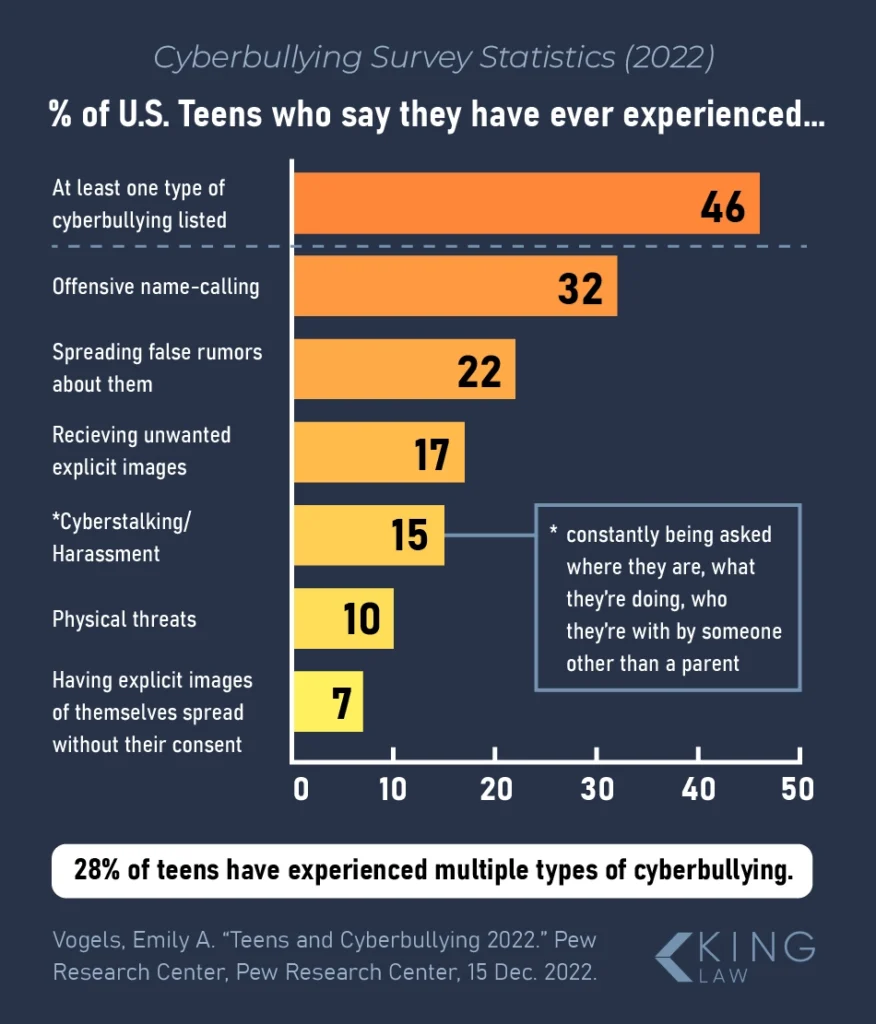
Data about youth online bullying varies depending on the timeframe and reporting outlet. According to the National Center for Education Statistics, a U.S. government outlet, 21.6% of students have been bullied online or by text. According to data from the Pew Research Center, 46% of U.S. teens ages 13 to 17 have experienced some form of cyberbullying. That same survey found that 17% of teens ages 13 to 17 have been sent explicit images they did not ask for.
According to a cyberbullying report from the CDC, girls are about twice as likely as boys to be bullied online. Similarly, members of the LGBTQIA+ community were about twice as likely to be bullied online than their heterosexual peers.
How Do Social Media Platforms Allegedly Enable Cyberbullying?
Lawsuits against social media companies allege that the platforms enable or facilitate bullying in the following ways:
- Not having proper safeguards in place to protect youth from cyberbullying
- Not removing content that is flagged as harassment or reporting it via parental controls on the account
- Allowing anonymous communications on their apps
- Not removing or banning users who engage in online bullying
- Misleading parents and youth about anti-bullying policies and app safety
According to some lawsuits and public reports, social media features that may enable or worsen cyberbullying include the following:
- Anonymity: Perpetrators can act anonymously online, which may make them feel like it is safe or less risky for them to cyberbully.
- Public Sharing: Content posted online can be publicized and shared by the perpetrator and anyone who reads it, increasing the reach and impact of the harm.
- 24/7 Access: Because of technology like phones, tablets, and computers, cyberbullies and the harm they cause are always there.
- Algorithm Promotion: The way that social media platforms are designed may promote harmful content if it generates high user engagement.
- Indexing: Search engines, social media, AI chatbots, and other online services may index harmful posts and promote them to other users.
- Security Features: Social media apps may not have enough safeguards in place to prevent children and teens from being exposed to inappropriate or harmful content or communication.
The above features may create a virtual environment that encourages or fails to stop problematic online behaviors. Many parents have filed lawsuits related to exploitation or childhood addiction to social media platforms.
Why Is Cyberbullying Different Than Traditional Bullying?
One of the ways that cyberbullying may be more impactful on victims is that victims cannot leave or escape from the environment in which the harmful content occurs. Instead, the cyberbully and the cyberbullying are with them wherever they and their technology (e.g., cellphone or tablet) are.
Also, youth being bullied online may be harassed by anonymous users or those under an alias or fake name. The anonymity offered by social media platforms may embolden some bullies.
Additionally, evidence of cyberbullying behaviors may also remain online permanently, which may extend how long the harms can continue to occur. For example, if a cyberbully publishes a harmful or shameful post about a victim, the content may go viral or be shared indefinitely.
Which Social Media Platforms Are Named in Cyberbullying Lawsuits?
Some of the social media platforms named in the cyberbullying lawsuits include the following:
Some of the lawsuits claim that the way these apps are designed and operate may maximize user engagement without considering the costs to the user. Some people allege that the companies were aware of the risks of underage users being bullied, harassed, or becoming addicted to the platform, but failed to take steps to warn about or prevent this.
How Might Facebook Contribute to Cyberbullying?
According to legal complaints, Facebook may contribute to cyberbullying because people can rapidly and easily post, share, and comment on threads. Some of these lawsuits claim Facebook’s algorithm may promote harmful, humiliating, or false content if it increases user engagement.
The group dynamics on the Facebook platform may encourage or fail to stop cyberbullying. People can also use Facebook Messenger to send harassing messages. Additionally, Facebook Messenger Kids allows younger users to send messages to each other.
Some reports have noted that Facebook was slow to remove content that was flagged as harmful, threatening, inappropriate, or untrue. For example, one study suggested that some content that violated Facebook’s community standards resulted in only about 24% less engagement (e.g., viewing or sharing) within 48 hours than the post would have had if it had not been removed. The reviewers believed that the time delay between the content being flagged and Facebook removing it was the major factor.
How Might Instagram Contribute to Cyberbullying?
Some legal complaints and public reports have claimed that Instagram users experienced cyberbullying because of images (e.g., selfies) they posted on the platform. Some users say they were put down, humiliated, threatened, or sexually harassed after or because of images or content they posted online.
Instagram’s design may encourage comparison-driven behaviors, such as criticizing, shaming, or mocking someone’s appearance, gender expression, or features. In-app communication features on Instagram (e.g., likes/dislikes, followers, public comments) may also intensify feelings of social and peer pressure and disapproval.
How Might TikTok Contribute to Cyberbullying?
Some lawsuits against TikTok have alleged that TikTok’s design may have encouraged excessive and harmful use. For example, some legal complaints have claimed that TikTok exposed children to content promoting self-harm and disordered eating, even though the children were underage and using an age-restricted account.
TikTok’s viral video-sharing features, “duets,” and social feedback loops may also magnify harm and impact. For example, TikTok content that is threatening, humiliating, dangerous, or harmful can be spread beyond the victim’s social group.
How Might Snapchat Contribute to Cyberbullying?
Lawsuits and public reports have suggested that Snapchat’s disappearing content features, private messaging, filters, and group messaging may amplify and encourage cyberbullying. For example, cyberbullies may be more likely to send threatening or inappropriate messages on Snapchat because the messages disappear unless saved or screenshotted.
Predators and bullies may also be able to send private messages to children on Snapchat. Snapchat has been sued by at least one attorney general who accused the platform of allowing children and young people to be exposed to profane, illegal, and sexual content on the app.
How Might YouTube Contribute to Cyberbullying?
Some people have accused YouTube of contributing to cyberbullying because it contains video-based content, public comments, reaction videos, and social feedback (e.g., likes and shares). Visual and video-based content are more difficult for the app to screen for harmful or inappropriate material. Long and short-form videos (e.g., YouTube shorts) may also draw in and keep users engaged.
YouTube’s sharing, commenting, reaction, and live feeds features may also increase the impact of negative experiences, such as online shaming, humiliation, or threats. Cyberbullies on YouTube may also be encouraged to target people because it may increase the chance of their videos becoming viral and gaining more followers.
Are Social Media Companies Legally Responsible for Cyberbullying?
Social media companies may be legally responsible for cyberbullying behaviors. Some laws shield publishers from liability. Social media companies have argued that they are publishers, providing a platform for others to post content. Because of that, they have argued that the companies are not liable for harm that may be caused by content on their platforms.
However, victims and advocates argue that the social media companies are active participants in what content is posted and promoted on their sites, how it is distributed, and how people interact with it. Victims and advocates claim social media companies are legally responsible for some of the harm that may be linked to their platforms.
What Types of Cyberbullying Lead to Lawsuits?
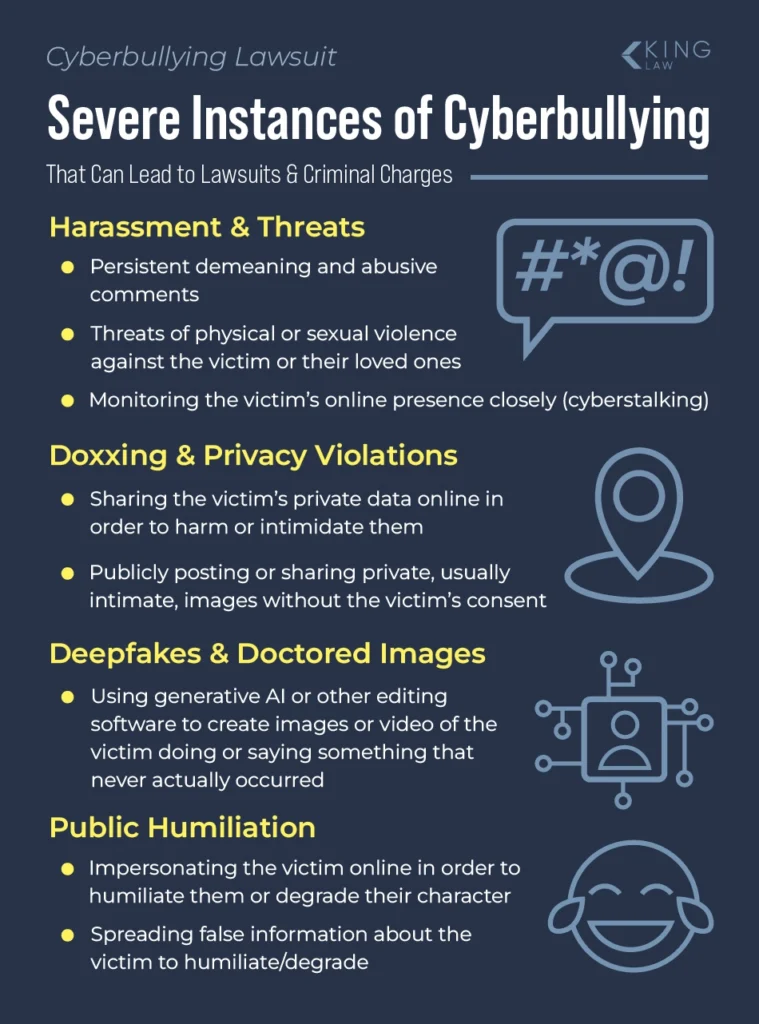
Some people can sue if they experience serious or severe types of cyberbullying. For example, people may be able to sue if someone tries to threaten, harass, or exploit them. Someone may also qualify to file a claim if another person reveals their private information online or uses their image or likeness (e.g., through deepfakes) without their permission.
Harassment and Threats
A cyberbully may be sued if they threaten, abuse, or repeatedly insult someone online. These attempts can occur through private messages, group messages, or public posts. States have laws that say what type of conduct qualifies as threatening, abusive, or insulting. However, one of the key factors is whether the target feels afraid, humiliated, emotionally distressed, anxious, depressed, or some other negative state. In some cases, the platform they use to post these messages may be legally liable.
Public Humiliation and Viral Content
Cyberbullies may also be held accountable if they publicly humiliate, embarrass, or defame someone. For example, a cyberbully or the platform they use may be sued if they post embarrassing videos or pictures of someone. Or they may be held liable if they spread rumors that become viral or cause long-term damage to someone’s reputation.
Doxxing and Privacy Violations
Another form of cyberbullying involves doxxing and privacy violations. Doxxing (also called doxing) occurs when someone maliciously gathers and posts another person’s private information without that person’s consent. For example, the doxxer may post someone’s full name, address, work information, phone number, or social security number. The doxxer does this to harm, embarrass, stalk, or threaten the target of the doxxing. Doxxing is illegal and dangerous.
Deepfakes and AI-Generated Abuse
Cyberbullies may also be held accountable if they use deepfakes or AI-generated content to abuse, exploit, humiliate, or threaten others. Deepfakes are AI-generated videos or audio recordings that look real but are not. Some cyberbullies are using deepfake or AI technology to create fake videos of people to humiliate, exploit, or threaten them. Cyberbullies or the tech companies that made the software they use (e.g., Grok) may be legally responsible for the harm caused by the deepfakes.
What Are the Effects of Cyberbullying on Children & Teens?
Some studies have suggested that cyberbullying negatively impacts children’s mental, emotional, and physical well-being. Some lawsuits and public reports have also described similar effects that cyberbullying has had on children.
Children and teens who experience bullying online may experience the following negative impacts:
- Mental health effects (e.g., anxiety, depression, PTSD)
- Suicide and self-harm risk
- Academic and social consequences
Mental Health Effects
Cyberbullying and social media may negatively impact children’s mental health. For example, some research studies have found that Instagram use among adolescent girls may be associated with body image issues, as well as
(according to a study called “The Perfect Storm: A Developmental–Sociocultural Framework for the Role of Social Media in Adolescent Girls’ Body Image Concerns and Mental Health”). Children who are cyberbullied may also experience higher levels of depression, anxiety, loneliness, isolation, and low self-esteem.
Suicide and Self-Harm Risk
Victims of cyberbullying may also be at a higher risk of experiencing self-harm, suicidal thoughts, and suicide attempts. For example, one observational study looked at emergency room data for children who went to two Canadian hospitals for mental health reasons from January 2011 to January 2015. In the study, children who had been cyberbullied were 11.5 times more likely to have gone to the emergency room because of suicidal ideation compared to those who had not been bullied at all.
Academic and Social Consequences
Children who are victims of cyberbullying may be more likely to skip school and experience a drop in grades. Children who have been cyberbullied may also have problems making friends or withdraw from social or extracurricular activities.
Who Qualifies to File a Youth Cyberbullying LawsuitWho Can File a Cyberbullying Lawsuit for Children?
Children may be eligible to bring a lawsuit if they can prove that they were the victim of cyberbullying and it caused them emotional, mental, or psychological harm. Parents and legal guardians may qualify to file a lawsuit if they believe their children were the victims of cyberbullying.
Here is what someone needs in order to qualify for a cyberbullying lawsuit against a tech company:
- Must have been a minor when the harassment occurred
- There must be documented harassment or abuse
- The harassment must have resulted in mental health or physical harm
- There must have been platform involvement (failure to act, design issues, etc.)
Young people may also be able to file a lawsuit on their own behalf once they are old enough (e.g., are 18 years old or more). Contact an attorney to learn what the updated eligibility criteria are and how parents and young people can protect their legal rights.
What Evidence Is Needed to File a Cyberbullying Lawsuit?
In order to file a lawsuit against a social media company about cyberbullying, you will have to collect specific information to support your case. An attorney can work with victims of cyberbullying to gather evidence to help strengthen their claims.
Evidence to support a youth cyberbullying lawsuit can include:
- Profile and account information for the person who experienced online harassment
- Profile information about the person who committed the harassment
- Digital records or downloads of the harassing, threatening, or embarrassing content (e.g., images, videos, screengrabs, and similar documentation)
- Medical or mental health records about the bullying and related treatment
- Dates/timestamps when the alleged harassment occurred
- Witness and family documentation
- Any reports made to schools, medical professionals, or therapists about the harassment and bullying
- Documentation of reports sent to social media platforms
- Records showing the victim asked the cyberbully to stop communicating with or about them (if applicable)
We recognize that gathering evidence to support a lawsuit about cyberbullying can be mentally challenging work. Our team can advise you on the specific information we need to build a comprehensive claim.
What Compensation Can Be Recovered in a Cyberbullying Lawsuit?
Cyberbullying victims may recover a range of compensation if they win their lawsuit, including:
- Pain and suffering
- Medical treatment
- Therapy costs
- Prescription medication expenses
- Loss of quality of life
Wrongful death compensation may also be available to people whose family members tragically took their own lives because of cyberbullying.
What Should Parents Do If Their Child Is Being Cyberbullied?
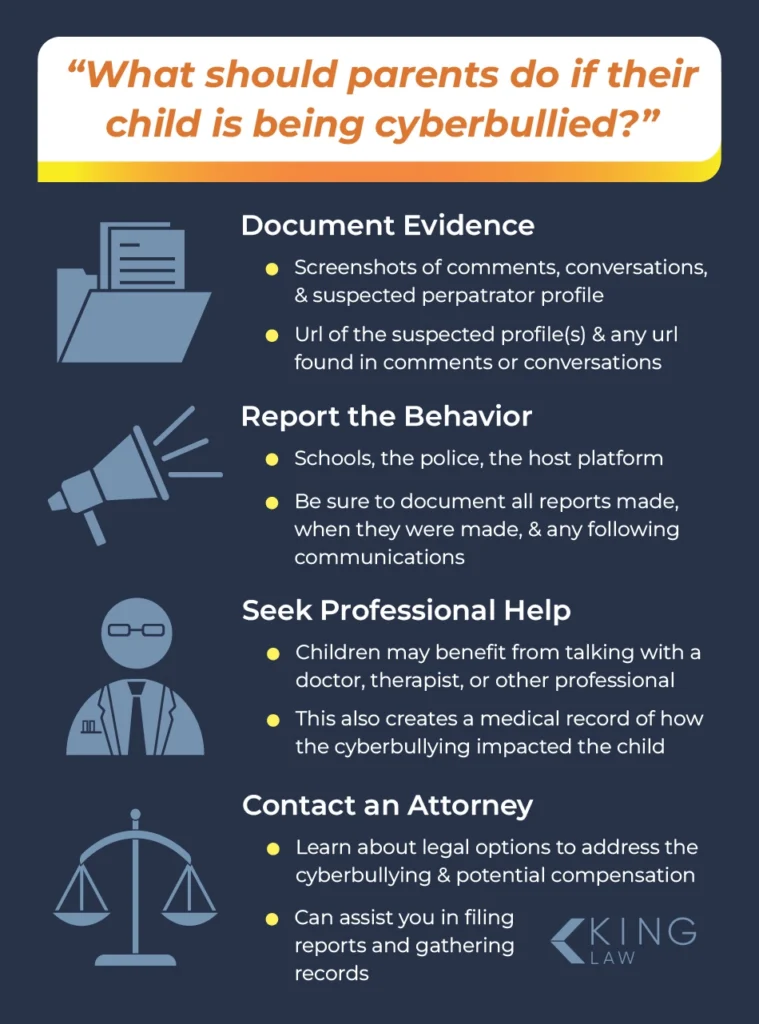
Steps that parents can take to help protect their children if they are being cyberbullied include documenting the abuse, reporting it to the platform or police, seeking professional help, and contacting a lawyer.
Step 1: Document the Evidence
Parents can document evidence of cyberbullying, such as by taking screenshots, recording links, and creating a dated log. For example, they can print or save problematic messages and note when they were sent and on which platform. Documenting the evidence of the attack helps describe what happened and gives authorities a way to track it.
Step 2: Report the Behavior
Parents can also report the cyberbullying behavior to the authorities, including the platform, school, or the police. Parents should send reports to the platform and school in writing so there is a clear, traceable log of what was said, to whom, and when.
Step 3: Seek Professional Help
Parents may also benefit from taking their children to see a doctor, therapist, or other professional after a cyberbullying attack. Doing so helps make sure their children have the mental health support they need to heal and thrive. It also creates a record about the cyberbullying attack and how it impacted the child.
Step 4: Contact a Lawyer to Discuss Legal Options
Parents can reach out to a lawyer to explore legal options to address the cyberbullying and recover compensation, if possible. Attorneys can also help parents report the cyberbullying to the platform and the police and gather records of the online attacks.
How Can I File a Cyberbullying Lawsuit?
Filing a cyberbullying lawsuit involves taking the following steps:
- Talk to an attorney to determine if you experienced cyberbullying and may qualify for compensation.
- Work with your attorney to gather evidence from Facebook, TikTok, Instagram, Snapchat, YouTube, or other platforms where the cyberbullying occurred.
- Your attorney prepares and files a legal complaint against the platform or individual responsible for the cyberbullying.
- Your attorney will attempt to negotiate a settlement with the social media companies or individuals.
An attorney can help people navigate the steps involved in a cyberbullying lawsuit effectively and strategically.
Is There a Deadline to File a Cyberbullying Lawsuit?
There is a deadline to file a cyberbullying lawsuit, but it depends on the applicable state law, the type of claim being filed, and whether an exception applies. State law dictates how long people have to file a cyberbullying lawsuit. A reputable attorney is a good resource for victims of cyberbullying to learn what their rights are and how to protect them so they do not miss out on compensation because of a delayed filing.
Cyberbullying Lawsuit Settlements for Children and Young Adults
Cyberbullying lawsuit settlements will vary widely from victim to victim, and filing a lawsuit does not guarantee someone compensation. Cyberbullying settlements are determined on a case-by-case basis, and they depend on factors like the applicable damages laws, the strength of the person’s case, and whether they file on time.
For example, cyberbullying cases involving a child’s death or suicide may result in higher compensation payouts. However, this is not a guarantee. An attorney can help people estimate their potential settlement and take steps to maximize their possible claim.
King Law Is Investigating Cyberbullying Lawsuits for Children & Teens
King Law is actively reviewing and accepting claims involving children and young adults who were cyberbullied on social media. We are prepared to file lawsuits against TikTok, Facebook, Snapchat, Instagram, YouTube, and other social media companies if they allegedly failed to protect young people from cyberbullying. Our team seeks to hold these companies responsible and seek compensation on behalf of children, young people, and families who were impacted by cyberbullying.
Start Your Free Case Review With a Cyberbullying Lawyer Today
If you or your children were cyberbullied, contact an attorney by calling (585) 496-2648 or filling out an online form. Our intake specialists are standing by to help you schedule a consultation with one of our seasoned cyberbullying attorneys. We provide free case evaluations, and we take cyberbullying lawsuits on a contingency basis, meaning you pay zero dollars in upfront legal fees.
Frequently Asked Questions (FAQs)
List of Sources Used In This Article
King Law used the following sources when writing this article about cyberbullying lawsuits. We apply rigorous editorial standards to create content for our visitors.
“Attorney General Paxton Sues Snapchat for Deceiving Parents and Endangering Texas Kids.” Office of the Attorney General of Texas, 2026. Accessed 21 Apr. 2026.
“Cyberbullying.” StopBullying.gov, U.S. Department of Health & Human Services. Accessed 21 Apr. 2026.
“Cyberbullying Linked with Suicidal Thoughts and Attempts Among Young Adolescents.” National Institutes of Health, 2024. Accessed 21 Apr. 2026.
“Duet.” TikTok Support. Accessed 21 Apr. 2026.
“Meta Must Face Youth Addiction Lawsuit, Massachusetts Court Rules.” Reuters, 10 Apr. 2026. Accessed 21 Apr. 2026.
“Resources for Individuals on the Threat of Doxing.” Department of Homeland Security, Jan. 2024. Accessed 21 Apr. 2026.
“Student Reports of Bullying: Results From the 2022 School Crime Supplement to the National Crime Victimization Survey (NCES 2024-109rev).” National Center for Education Statistics, 2024. Accessed 21 Apr. 2026.
Thomsen, E., et al. “Student Reports of Bullying: Results From the 2022 School Crime Supplement to the National Crime Victimization Survey.” U.S. Department of Education, 2024.
“The City of New York et al. v. Meta Platforms Inc. et al..” Bloomberg Law. Accessed 21 Apr. 2026.
“Cyberbullying and Online Harassment.” Oxford Academic, 2026. Accessed 21 Apr. 2026.
“Cyberbullying and Adolescent Mental Health.” National Institutes of Health. Accessed 21 Apr. 2026.
Kowalski, Robin M., et al. “Bullying in the Digital Age: A Critical Review and Meta-Analysis.” National Institutes of Health. Accessed 21 Apr. 2026.
“Social Media Use and Mental Health Outcomes in Adolescents.” Open Science Framework, 2024. Accessed 21 Apr. 2026.
“Cyberbullying and Education Outcomes.” Taylor & Francis Online, 2020. Accessed 21 Apr. 2026.
“Youth Risk Behavior Survey Data Explorer.” Centers for Disease Control and Prevention, 2023. Accessed 21 Apr. 2026.