

Snapchat Lawsuit for Teen Addiction & Mental Health Issues [2026 Update]
Complete the form below to see if you qualify for a Social Media Addiction Lawsuit

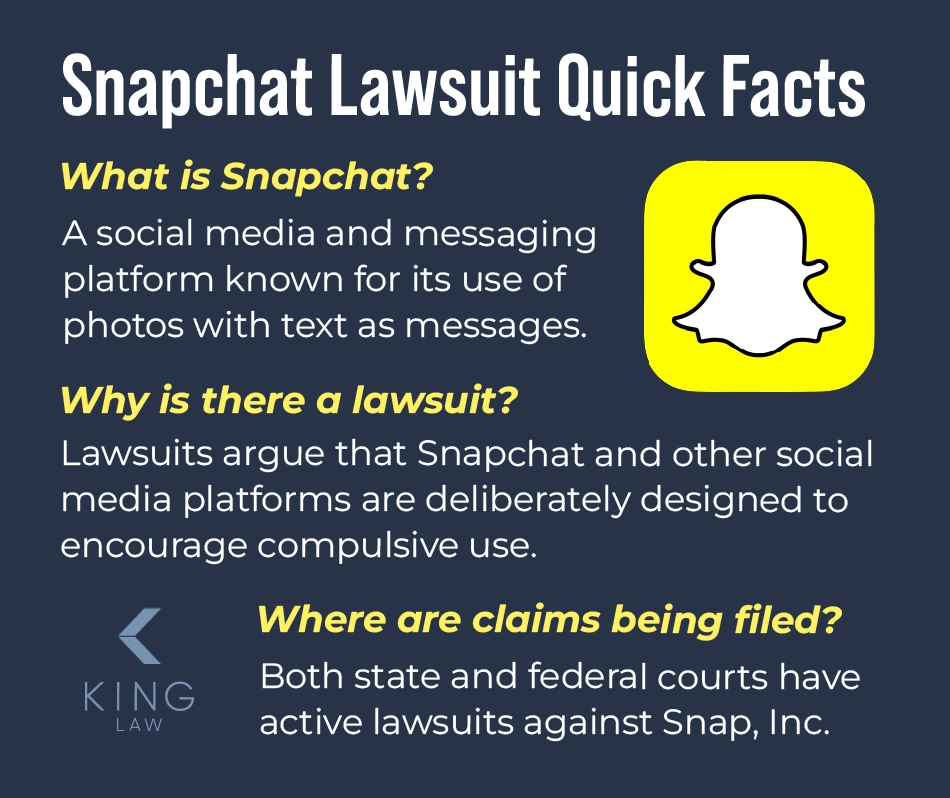
Snapchat is among the social apps facing lawsuits on the basis that its design contributes to teen addiction, mental health issues, body dysmorphia, sexual exploitation, cyberbullying, and other harms. The lawsuits claim Snapchat is designed to promote compulsive use through features like Snapstreaks, filters, push notifications, and Snapscore that provide quick and fleeting “dopamine hits.” Additionally, some lawsuits claim minors were exposed to sexual conversations on the app.
This page will cover the claims against Snapchat, why Snapchat might be held liable in court, allegations against Snapchat, lawsuit developments, and who might qualify to file a mental health issue lawsuit.
About the Snapchat Lawsuit:
Why Are People Filing Snapchat Lawsuits?
What Mental Health Injuries Are Linked to Snapchat Lawsuits?
Are There Lawsuits About Sexual Abuse on Snapchat?
What Does the Snapchat Lawsuit Claim Snap Inc. Did Wrong?
Where Are Snapchat Lawsuits Being Filed?
Is Snapchat Addiction a Real Medical Diagnosis?
Which Snapchat Features Are Alleged to Drive Addiction in Teens and Adolescents?
How Might Snapchat Affect Teen Mental Health?
Why Are Teens More Vulnerable to Snapchat Addiction Claims?
What Evidence Is Needed For a Snapchat Lawsuit?
Who Can File a Snapchat Lawsuit?
How Can I File a Lawsuit Against Snapchat?
How Long Do Families Have to File a Snapchat Lawsuit?
What Are the Snapchat Lawsuit Settlement and Payout Amounts?
King Law Is Investigating Snapchat Lawsuits for Teen Mental Health Injuries
What Is the Snapchat Lawsuit?
The Snapchat lawsuit is a civil lawsuit representing youth, parents, and young adults who say the app is addictive in nature, harms youth mental health, and allows for exploitation of children. These lawsuits allege that Snapchat is a product and, as such, has a legal obligation to protect minors. Plaintiffs allege Snap Inc. did not do enough to protect young users and instead engaged in tactics to make kids compulsively engage with the app.
Lawsuits say that Snap’s design, policies, and marketing all directly impacted the mental health and wellbeing of some minors. Allegations include that these design defects led to injuries.
Why Are People Filing Snapchat Lawsuits?
People are filing Snapchat lawsuits to pursue compensation for their injuries and to hold Snapchat Inc. accountable for the alleged harms its product caused.
Parents and young people who are filing Snapchat lawsuits claim that they or their children suffered harm due to Snapchat’s design and practices. According to some research, heavy social media use is correlated with population-level increases in mood disorders, and lawsuits argue that Snapchat’s features are designed to promote compulsive use.
Some plaintiffs have also reported cyberbullying, sextortion, and solicitation of illegal services on the app. Some of the Snapchat complaints are wrongful death lawsuits that allege the app exposed their loved one to extreme psychological distress that eventually led to suicide.
What Mental Health Injuries Are Linked to Snapchat Lawsuits?
Snapchat plaintiffs have reported a number of injuries they connect to compulsive use of the app. The most common reported injuries from social media use are depression and anxiety, according to a report by the U.S. Department of Health and Human Services.
Here are some of the injuries listed in lawsuits against Snapchat:
- Anxiety
- Body dysmorphia
- Depression
- Eating disorders
- Self-harm
- Sleep disruption
- Suicidal ideation
These injuries can result in the following outcomes for kids and teens:
- Social comparisons between friends and popular parasocial accounts.
- Cyberbullying
- Disruption of routines and sleep
- Body image comparison
- Exposure to harmful content
Are There Lawsuits About Sexual Abuse on Snapchat?
Yes, people are filing lawsuits related to Snapchat being used to sexually harass and exploit children and teens. These lawsuits say that Snap Inc. failed to enact adequate safety features to protect its minor users. Without these safety features, adults were able to connect and chat with minors. In some cases, those adults engaged in grooming, sextortion, and abuse of children.
Snap Inc. was recently named in a lawsuit involving the sexual assault of a minor. Allegations in that lawsuit, which was filed by parents in Missouri, include that Snap suggested that their 11-year-old daughter connect with a man she had never met. The girl did not have mutual connections with the girl, and Snapchat did not warn her about connecting with adult strangers. Instead, the lawsuit alleges that the app suggested the two become friends on Snapchat. That man groomed the girl and sexually assaulted her in real life. That man was convicted in criminal court. However, the parents allege that Snap Inc. bears some responsibility for the harm inflicted on their daughter. They have filed a lawsuit in civil court, saying the company did not do enough to protect their daughter and other minors using the app.
What Does the Snapchat Lawsuit Claim Snap Inc. Did Wrong?
The Snapchat lawsuits argue that, rather than just passively drawing attention, the app is deliberately designed to encourage compulsive use. App developers often attempt to hack dopamine reward loops (sometimes referred to as compulsion loops). Lawsuits allege that Snapchat includes app features it knows present risks to children.
What Are the Allegations Against Snap Inc.?
Many lawsuits allege that Snapchat, despite being aware of the defects in its design, failed to adequately warn users of the risks of using the platform or take reasonable steps to address the defects.
Plaintiffs in the Snapchat lawsuit allege that, as a product and company, Snapchat:
- Has a defective design
- Fails to warn parents and youth of possible risks
- Is negligent in providing a duty of care
- Misrepresents safety features and the overall safety of the platform
- Uses addictive engagement systems targeted at minors
Where Are Snapchat Lawsuits Being Filed?
There are currently Snapchat lawsuits proceeding through state and federal courts. The federal lawsuits are part of a multidistrict litigation (MDL) consolidated in the U.S. District Court for the Northern District of California for social media addiction lawsuits.
Separately, there are lawsuits being filed as part of a state-level centralized litigation in California (
Additionally, some states have taken independent action against Snapchat. These lawsuits have been filed by state attorneys general on behalf of each state’s youth. States that have filed lawsuits against Snapchat include:
Parents and young people who are interested in pursuing a Snapchat lawsuit should speak with an attorney to understand the best court venue based on their circumstances.
Is There a Snapchat Class Action Lawsuit?
Currently, there is not a class action lawsuit against Snap Inc. involving mental health claims. Instead, many plaintiffs have joined the MDL or JCCP, which are both centralized lawsuits with similarities to a class action. In an MDL and JCCP, lawsuits share some of the discovery process while still being resolved as individual lawsuits. While Snap recently settled a prospective bellwether trial out of court, thousands of lawsuits are still pending in the MDL.
Is Snapchat Addiction a Real Medical Diagnosis?
Snapchat addiction is not currently recognized as a standalone clinical diagnosis or DSM condition. Proposals to create a social media use disorder often point to established behavioral addiction disorders like gambling disorder, or even provisional classifications like internet gaming disorder.
Like other dopamine-driven activities, social media usage triggers addiction-like symptoms in a substantial minority of users, with a WHO survey estimating addiction rates to be around 11% in 2022, while another study found rates of adolescent social media addiction to be as high as 24.4%. In determining whether a behavior is addictive, psychologists look for:
- Salience: Is the behavior consuming thoughts and a dominant part of the person’s routine?
- Mood modification: Does engaging in the behavior reliably alter the individual’s mood?
- Tolerance: Does the individual require more of the behavior over time to achieve the same effect?
- Withdrawal: Does the individual experience physical or emotional distress when they stop the behavior?
- Conflict: Does the behavior create problems at work, school, or in personal relationships?
- Relapse: Does the individual struggle to cut back on the behavior despite being aware of the negative consequences of the behavior?
While a formal Snapchat addiction diagnosis does not exist, the lawsuits focus on consequences of the compulsive behavior, which may themselves be formal diagnoses, like generalized anxiety disorder.
Which Snapchat Features Are Alleged to Drive Addiction in Teens and Adolescents?
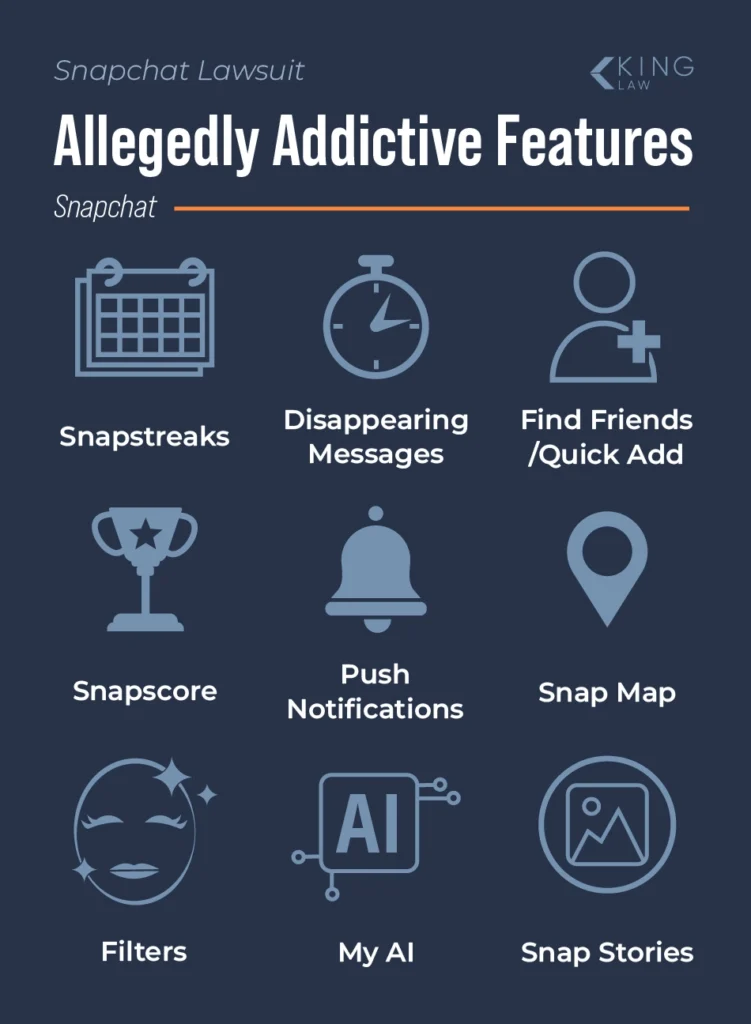
Snapchat lawsuits often focus on the app’s specific features and how its design may encourage compulsive use or is likely to expose minors to harms. Possibly problematic features identified in Snapchat lawsuits are:
- Snapstreaks
- Snapscore
- Disappearing messages
- Quick Add (since rebranded to Find Friends)
- Push notifications are a common feature on mobile apps, but the lawsuits argue that Snapchat’s are unusually aggressive, hiding the context of alerts and trying to generate a sense of urgency in the user, including during hours in which the user would likely be asleep.
- Filters and face lens
- Snap Map GPS feature
- The Stories feature.
- My AI, Snapchat’s integrated LLM chatbot
These features, along with more typical ones, like “endless scrolling,” form the basis of the addiction claims. Minors may be more prone to addiction and especially vulnerable to these compulsion loops. These features form the basis of the “defective design” claims against Snapchat. That is to say, the features were implemented successfully as planned, but the underlying design theory is unsafe for its intended consumers.
Snapstreaks
Snapstreaks tracks the number of consecutive days a user has interacted with another user on the app and warns the user if the streak is about to expire and reset to zero. Text chats, group chats, and re-sending images do not count towards a Snapstreak. Lawsuits argue that the feature promotes compulsive use.
Snapscore
Snapscore is a public numerical metric representing the user’s total volume of activity on the app. Like Snapstreaks, simple text chatting does not contribute to the user’s Snapscore, but Snapscore points are never lost, only gained. Returning users are granted bonus points when they return after an absence. Lawsuits argue that the feature gamifies social status and encourages relapses in usage.
Disappearing Messages
Although not a branded feature, disappearing messages are cited in multiple lawsuits. Some plaintiffs say time-limited messages allow illegal activity and sexual predators to operate on the platform, leaving little evidence behind. The complaints also argue that disappearing messages encourage users to compulsively check the app to make sure they haven’t missed anything.
Quick Add/Find Friends
Quick Add (since rebranded to Find Friends) is Snapchat’s friend-recommendation system. Plaintiffs argue that the algorithm pushed unvetted recommendations on minors, exposing them to potential dangerous connections. Snap has since changed the feature to make minors invisible to adult accounts unless they share a minimum number of mutual friends.
Push Notifications
Push notifications are a common feature on mobile apps, but the lawsuits argue that Snapchat’s are unusually aggressive, hiding the context of alerts and trying to generate a sense of urgency in the user, including during hours in which the user would likely be asleep or in school.
Filters and Face Lens
Filters and face lens have long been one of Snapchat’s most popular features. Lawsuits argue that beautification filters can trigger body dysmorphia in teens, a concern shared by Snap employees, according to an investigative report. The feature was also the subject of a $35 million class action lawsuit for violating the Illinois Biometric Information Privacy Act.
Snap Map
Snap Map is a GPS feature that tracks and displays the user’s physical location. Lawsuits allege that the feature has been used by stalkers to locate teens in person and by drug dealers who use it to advertise. Additionally, plaintiffs argue that the feature allows teens to see when they’re being excluded from an activity, leading to distress. While this feature defaults to “off,” lawsuits claim the app repeatedly prompts users to turn it on, creating FOMO (fear of missing out).
Snapchat Stories
The Stories feature allows users to post time-limited photos or videos that disappear after 24 hours. Complaints allege that the feature encourages compulsive checking of the app. Additionally, the user who posted a Story sees a list of who viewed it, potentially leading to anxiety over social status or rejection.
My AI
My AI, Snapchat’s integrated LLM chatbot introduced in 2023, is a feature that lawsuits allege can expose teens to inappropriate content, dubious suggestions, and emotional co-dependency.
How Might Snapchat Affect Teen Mental Health?
Researchers have observed both positive and negative effects on teen mental health from social media platforms like Snapchat. Many teens use apps like Snapchat to stay in contact with friends and find people with similar interests or identities. A majority of adolescents report, for example, that social media makes them feel more accepted.
On the other hand, a longitudinal study found that adolescents who spend more than three hours a day on social media were around twice as likely to experience poor mental health, including depression and anxiety. With negative outcomes correlating to time spent on social media, features that encourage compulsive use have become key considerations in lawsuits against companies like Snap.
Why Are Teens More Vulnerable to Snapchat Addiction Claims?
Teens undergo a maturation process during adolescence that tends to result in greater sensitivity to reward, social rejection, peer validation, and feedback, traits that are often exploited by platforms like Snapchat. Researchers have proposed a “dual-system model” of the teenage brain in which the teen’s reward seeking system is fully developed while their inhibitory functions are still in the process of maturing.
According to research, during this period, starting around age 11 and lasting into their 20s, individuals are more likely to detach from their family, seek novelty, and experiment with adult activities. This developmental gap forms an important consideration in the lawsuits against Snapchat, which has features that gamify social visibility, status, peer validation, and immediate feedback. Teens, on average, are less capable of resisting these compulsion loops than adults.
What Evidence Is Needed For a Snapchat Lawsuit?
A strong Snapchat lawsuit can present evidence both that the teen suffered harm related to using the app and records of Snapchat usage. The exact evidence required may vary from case to case, but will often include elements like:
- Medical records
- Therapy records
- School records
- Screenshots (chats, Quick Add recommendations, push notifications)
- Time logs of when notifications were received
- Reports of bullying
- Reports of sextortion
- Reports of drug solicitation
- Parental observations
- Witness statements
Families should avoid deleting messages, company correspondence, and other digital artifacts that could serve as evidence until they have consulted with an attorney.
Who Can File a Snapchat Lawsuit?
Adults who suffered harm while using Snapchat when they were teens or the parents of minors who have been similarly harmed may be able to file a Snapchat lawsuit. Criteria may include:
- Using Snapchat three or more hours a day on average
- A diagnosed mental health disorder, addiction, or eating disorder
- A decline in school performance
- Experiencing sexual exploitation on the app
- Experiencing cyberbullying on the app
An experienced attorney can evaluate your prospective case before you formally file a lawsuit.
Can Parents File a Snapchat Lawsuit for Their Child?
Parents can file Snapchat lawsuits on behalf of their children if their child is still a minor or incapacitated. Parents may also file wrongful death lawsuits against Snapchat if they believe their child’s death was the result of harms related to the app. Parents with concerns should document their child’s Snapchat usage, the features used, complaints of bullying or sexual solicitations, and any self-harming behaviors. Parents should consult with an attorney to determine whether they can sue on their child’s behalf.
How Can I File a Lawsuit Against Snapchat?
Filing a teen addiction lawsuit against Snapchat is a process involving multiple steps. While not required, it is generally advisable to work with an attorney to maximize your chances of success. With that in mind, the process will look something like this:
- Consult with an attorney with experience in social media addiction cases.
- Work with your attorney to gather evidence and build your case.
- File your case within your jurisdiction’s statute of limitations.
- Share evidence with the defense and attempt to negotiate a settlement.
- If a settlement cannot be reached, go to trial.
The MDL against Snapchat is still awaiting additional bellwether trials, so be aware it may take some time for your case to resolve.
How Long Do Families Have to File a Snapchat Lawsuit?
Snapchat lawsuits need to be filed within your jurisdiction’s statute of limitations. Statutes of limitations vary from state to state, depending on the type of claim, when the injury was discovered, and the age at which you were injured. Cases involving minors often have different statutes of limitations than cases involving adults. For example, some states have recently temporarily suspended statutes of limitations for cases involving the sexual abuse of minors.
Because filing deadlines can be quite complex, it is best to speak to an attorney soon after you discover your injury to make sure you preserve your legal right to compensation.
What Are the Snapchat Lawsuit Settlement and Payout Amounts?
Snapchat lawsuits are still in progress, so no precedent has yet been set for payout amounts. A recent social media addiction jury verdict involving Meta (Instagram) and Google awarded the plaintiff $3 million in damages, along with $3 million in punitive damages for malicious conduct on the part of the companies, though this case may not be predictive of future Snapchat verdicts or settlements.
In January of 2026, Snap Inc. chose to settle with that same plaintiff (known by the initials K.G.M.). However, the terms and dollar amount of the settlement were confidential.
Compensation in individual cases typically varies depending on the severity of the injuries, the age of the victim, the quality of the evidence, whether the case is settled out of court or through trial, and a variety of other factors.
King Law Is Investigating Snapchat Lawsuits for Teen Mental Health Injuries
King Law is currently reviewing social media childhood addiction claims against Snapchat and other social media companies. If you or your child experienced anxiety, depression, self-harm, suicidal ideation, body dysmorphia, cyberbullying, or sextortion as a result of Snapchat, contact our office to understand your legal options. Our experienced attorneys have decades of experience holding large corporations accountable for product defects and negligence, and offer free consultations to help you determine if you or your child’s experience qualifies for legal action.
Contact King Law for a Free Snapchat Lawsuit Consultation
If you suffered from an addiction to Snapchat as a teen, or are the parent of a teen experiencing emotional distress from using Snapchat, you may have grounds to file a civil suit. Call King Law at (585) 496-2648 or complete the form on this page to get started today. Our experienced lawyers work on a contingency basis, so there is no upfront cost to pursuing your claim.
Frequently Asked Questions (FAQs)
Yes, there are multiple lawsuits against Snapchat, including a federal MDL for social media addiction, a state-level consolidated litigation in California, and individual lawsuits filed by some state attorneys general.
There are several class action lawsuits against Snapchat, including for AI-video scraping, biometric privacy violations, and investor fraud. However, social media addiction cases are being handled as an MDL, not as a class action.
Snapchat addiction lawsuits are in different phases, depending on the court venue. To date, most are in their early stages, and there have not been mass settlements.
Parents of minors and some young adults can file a lawsuit alleging mental health harms from using Snapchat.
Payout precedents have not been set for Snapchat lawsuits, as a structured settlement has not occurred.
Yes. Your attorney can walk you through the process of drafting your paperwork. Your attorney will need to draft and submit a legal complaint to the proper venue.
There is currently no Snapchat lawsuit payout date. Most claims will take a year or more to resolve.
You can file a Snapchat lawsuit by working with an attorney to draft your complaint, which will then be submitted to the appropriate court.
There is currently no settlement date, although expectations are that a comprehensive resolution will likely be reached. Snap chose to settle with at least one plaintiff in a broader social media trial.
Sources List
The following sources were used to write this article.
- The Associated Press. “Snap Sued over Rape of Minor Who Connected to Adult Attacker on Snapchat.” AP News, 24 June 2026.
- BBC News. “Snap Settles Teen Social Media Addiction Lawsuit before Trial.” BBC News, 2026.
- Breuning, Loretta G. “The Dopamine Seeking-Reward Loop.” Psychology Today, 28 Feb. 2018.
- Cheng, Cecilia, et al. “Heterogeneity of Prevalence of Social Media Addiction across Multiple Classification Schemes: Latent Profile Analysis.” Journal of Medical Internet Research, 2019.
- Florida Office of the Attorney General. “Attorney General James Uthmeier Takes Legal Action against Snapchat.” My Florida Legal, 22 Apr. 2025.
- Hogg, Ryan. “Snapchat’s Disappearing Message Function Helped Teenagers Obtain Fentanyl with Deadly Consequences, Lawsuit Argues.” Business Insider, 23 Oct. 2022.
- Kansas Attorney General’s Office. “Kobach Sues Snapchat for Deceptive Practices That Harm Children.” Kansas Attorney General’s Office, 23 Sept. 2025.
- Kuss, Daria J., and Mark D. Griffiths. “Online Social Networking and Addiction—A Review of the Psychological Literature.” International Journal of Environmental Research and Public Health, 2011.
- Moretta, Tania, and Elisa Wegmann. “Toward the Classification of Social Media Use Disorder.” Addictive Behaviors Reports, 2025.
- National Center for Biotechnology Information. “Social Media and Youth Mental Health: The U.S. Surgeon General’s Advisory.” NCBI Bookshelf, 2023.
- Nevada Attorney General’s Office. “Attorney General Ford Wins Major Court Victory as Nevada Supreme Court Clears Path for Snapchat Trial over Harms to Children.” Nevada Attorney General’s Office, 23 Feb. 2026.
- New Mexico Department of Justice. “Attorney General Raúl Torrez Files Lawsuit against Snap, Inc. to Protect Children from Sextortion, Sexual Exploitation, and Other Harms.” New Mexico Department of Justice, 5 Sept. 2024.
- NPR. “Why Teens Are Impulsive, Addiction-Prone and Should Protect Their Brains.” NPR, 15 Apr. 2016.
- Santa Clara Law Digital Commons. “LW v. Snap.” Santa Clara Law Digital Commons, 2022.
- Snapchat. “How Do Streaks Work and When Do They Expire?” Snapchat Support.
- Snapchat. “What Is a Snapscore?” Snapchat Support.
- Texas Attorney General’s Office. “Attorney General Paxton Sues Snapchat for Deceiving Parents, Endangering Texas Kids by Exposing Them to Addictive Features, and Serving as a Breeding Ground for Obscene Conduct.” Texas Attorney General, 11 Feb. 2026.
- The Bureau of Investigative Journalism. “‘I’m Begging You’: What Snapchat Knew about Addicted Users.” The Bureau of Investigative Journalism, 3 Dec. 2025.
- U.S. Department of Health and Human Services. “Social Media and Youth Mental Health: The U.S. Surgeon General’s Advisory.” U.S. Department of Health and Human Services, 2023.
- U.S. Judicial Panel on Multidistrict Litigation. “In Re: Social Media Adolescent Addiction/Personal Injury Products Liability Litigation, MDL No. 3047 Transfer Order.” Judicial Panel on Multidistrict Litigation, 2 June 2025.
- Utah Department of Commerce. “Utah Sues Snapchat for Unleashing Experimental AI Technology on Young Users While Misrepresenting the Safety of the Platform.” Utah Department of Commerce, 30 June 2025.
- World Happiness Report. “Social Media Is Harming Adolescents at a Scale Large Enough to Cause Changes at the Population Level.” World Happiness Report 2026, 2026.