

Spinal Cord Stimulator Lead Migration Symptoms (2026)
Complete the form below to see if you qualify for a Spinal Cord Stimulator Lawsuit

Lead migration is one of the most common complications of having a spinal cord stimulator implant. Lead migration occurs when the leads (the wires that deliver electrical impulses) move from their original placement. Symptoms of lead migration generally include a loss of pain relief or new and unusual sensations.
People whose SCS leads have migrated may not know something is wrong. They may simply have the feeling that something is “off” or “not quite right.” They may also think their SCS is properly functioning because the incision site looks normal or the device may turn and or charge properly. However, if lead migration occurs, the patient is not receiving the intended therapy.
This page will explain what spinal cord stimulator lead migration is, the symptoms of lead migration, how common it is, why it happens, how to fix it, and how it can affect patients. It will also summarize actions patients can take if the migration may be due to how the spinal cord stimulator was made.
About the Spinal Cord Stimulator Lead Migration Symptoms
What Is Spinal Cord Stimulator Lead Migration?
Common Spinal Cord Stimulator Lead Migration Symptoms
What Does Lead Migration Feel Like?
Is Loss of Pain Relief the Main Sign of SCS Lead Migration?
Can Lead Migration Cause New Pain or Neurological Symptoms?
When Do Spinal Cord Stimulator Lead Migration Symptoms Usually Appear?
How Common Is Spinal Cord Stimulator Lead Migration?
How Doctors Diagnose SCS Lead Migration
How Lead Migration Is Different From Other SCS Complications
What Should You Do If You Think Your SCS Lead Moved?
Can Reprogramming Fix Spinal Cord Stimulator Lead Migration?
When Is Surgery Needed for SCS Lead Migration?
Can Spinal Cord Stimulator Lead Migration Be Prevented?
How Serious Is Spinal Cord Stimulator Lead Migration?
Can You Sue for Spinal Cord Stimulator Lead Migration?
Evidence That May Matter in a Spinal Cord Stimulator Lead Migration Case
Talk to a Spinal Cord Stimulator Lawyer About Lead Migration Symptoms
What Is Spinal Cord Stimulator Lead Migration?
Spinal cord lead migration occurs when implanted electrodes shift out of their intended position. These leads deliver electrical impulses to the dorsal columns in the spinal cord
Over time, the forces exerted by the patient’s body, whether through motion or tissue movement, may overwhelm the lead’s anchoring mechanism, causing it to move from the original anchoring site.
An SCS with a wandering lead may be less effective at reducing pain or even become a source of pain or other unpleasant sensations. When lead migration happens, the SCS may need to be recalibrated or, in more severe cases, be surgically revised or removed.
Common Spinal Cord Stimulator Lead Migration Symptoms
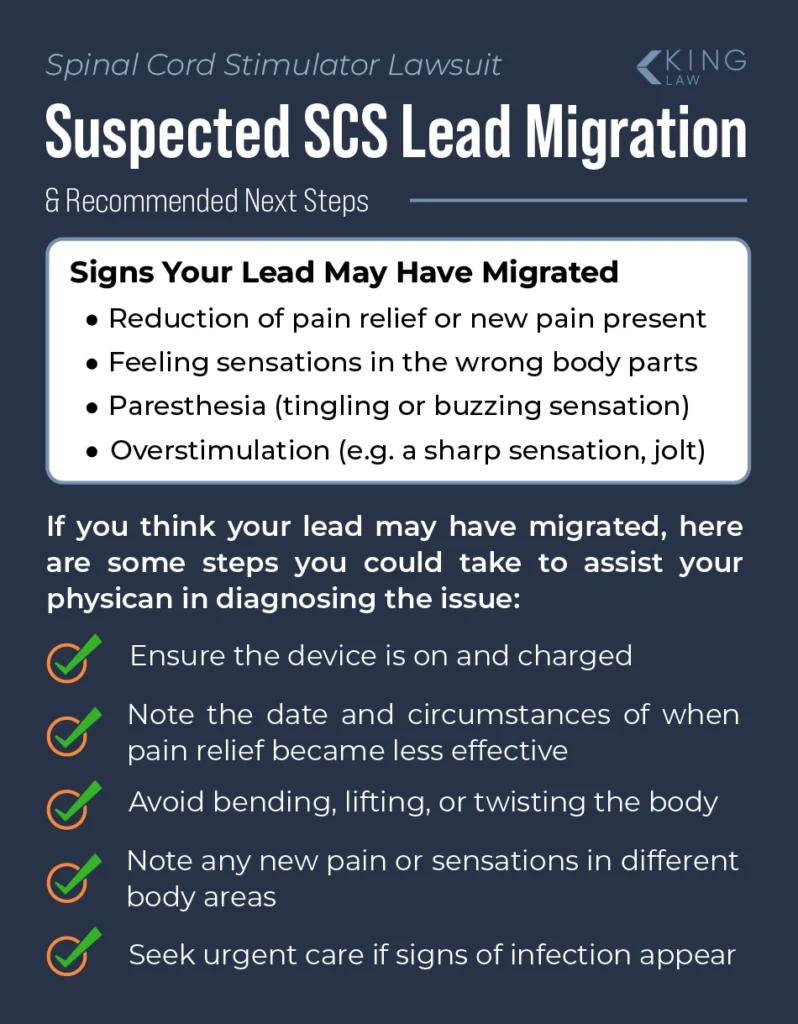
Most spinal cord stimulator lead migration symptoms involve a change in pain relief or the presence of unwanted sensations after the device had previously functioned as intended. Most patients with symptomatic SCS lead migration report a drop in pain relief. This decrease may be sudden or gradual and partial or complete.
Symptoms of spinal cord stimulator lead migration include:
- A reduction in previous levels of pain relief
- Paresthesia (a tingling or buzzing sensation)
- Overstimulation (e.g., a sharp sensation or jolt)
- New pain or “nerve-like” sensation
- Symptoms in distant areas like the arms and hands
The exact symptoms a patient experiences depend on
What Does Lead Migration Feel Like?
Lead migration may feel different depending on how far the electrodes have moved off target and in which direction. Lead migration may feel like the device is missing its target or inappropriately targeting a new area. For example, sensations once felt in the leg may be felt in the abdomen or hips.
The most common sensation, however, is the SCS becoming less effective at suppressing pain sensation over time. Not every case of lead migration is obvious. Due to studies focusing on symptomatic patients, little data is currently available on the rates of asymptomatic lead migration, although it has been observed.
Is Loss of Pain Relief the Main Sign of SCS Lead Migration?
Yes, the loss of pain relief is the most common sign of SCS lead migration. When the SCS leads migrate from the anchor site, the treatment is not delivered to the target area, often causing a relapse in pain or new pain. Lead migration may present with secondary symptoms as well, but most patients will experience a loss of therapeutic efficacy if lead migration occurs.
Many researchers have studied patients who have experienced lead migration and a decrease in pain relief. For example, in a case study called ReviEnsion of an Eight-lead Boston Scientific® Spinal Cord Stimulator With Epidural Migration: A Case Report, a 60-year-old patient with severe pain in his left ankle experienced a 70% reduction in pain during his SCS trial and got a permanent device implanted two weeks later. However, lead migration eventually led to a complete loss of therapeutic pain relief, requiring revision surgery.
Can Lead Migration Cause New Pain or Neurological Symptoms?
Though less common than loss of pain relief, lead migration can cause new pain or other neurological symptoms, particularly if the leads migrate to specific regions associated with these symptoms.
Paresthesia–a buzzing sensation–is the most common secondary symptom. When the lead is off-target, it may cause the patient to experience a buzzing sensation in a different area. In more extreme cases, the leads can cause painful symptoms by delivering electrical current to other nerves or by physically compressing nerves.
When Do Spinal Cord Stimulator Lead Migration Symptoms Usually Appear?
Lead migration can occur at any time, but clinically significant migration is more likely to occur
- The trial period. Lead migration is relatively likely to occur here because the leads aren’t anchored into the muscle tissue and instead are typically held in place by medical tape and skin friction. One imaging study found clinically significant lead migration (greater than 10mm) in 74% of trial patients. Lead migrations that occur during the trial period are generally not considered a safety concern; however, they may result in a false negative with regard to pain control.
- The postoperative period (around 6-8 weeks). During the first several weeks following the implantation, leads may be more likely to migrate before the body’s tissue can encapsulate the system. Typically, patients will be instructed to avoid certain motions or vigorous activity during this period to minimize the stress on the anchors.
- The long-term window (months to years). Though less common, lead migration can occur long after implantation. Late lead migrations have highly variable causes, ranging from high impacts to mild aggravations with the subcutaneous battery (leading to pain) to hardware issues.
As lead migration can happen at any time, patients should always report any noticeable reduction in pain relief coverage or unusual or unexpected sensations to their doctors.
Why Do SCS Leads Migrate?
Spinal cord stimulator leads are physical hardware and may migrate when subjected to forces greater than their anchoring can bear. These forces can be acute (a fall or very strenuous activity) or occur cumulatively over time. Both mechanical stress and the quality and stability of the anchoring system influence the risk of lead migration. Mechanical forces may come from patient motions, tissue composition, device placement, or unexpected impacts. Anchoring factors may include surgical implantation methods used, the material used, and the type of lead used.
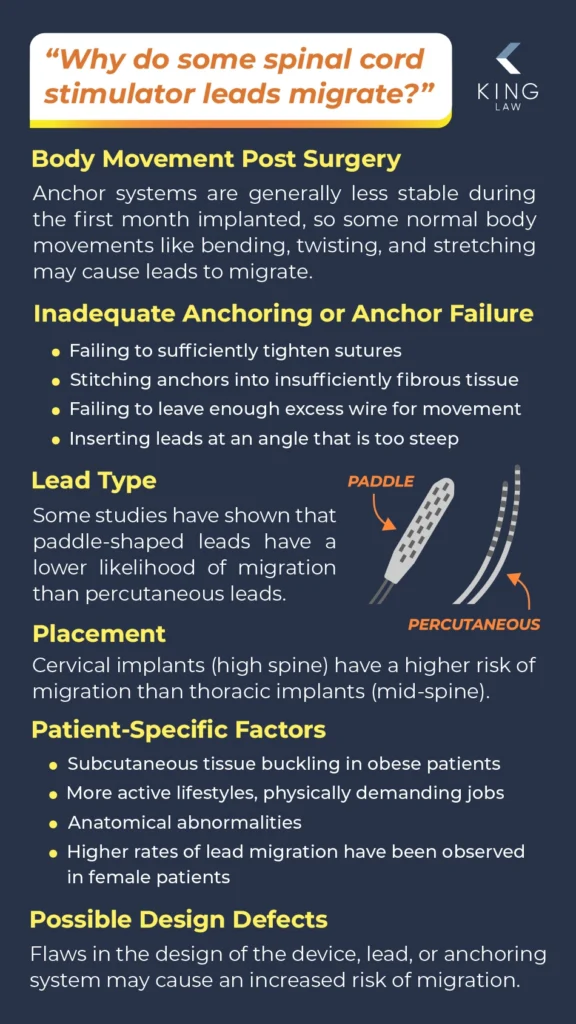
Body Movement After Surgery
Normal body movements like twisting, bending, and stretching exert force on SCS leads. While anchoring systems are designed to endure these everyday motions, the leads are generally less stable during the first month or so after implantation. Patients will typically be advised to avoid certain motions during this critical period.
Inadequate Anchoring or Anchor Failure
Anchoring techniques often rely on suturing implanted leads to soft tissues or fascia. There are multiple potential points of failure in this process, such as failing to tighten the sutures sufficiently, stitching the anchors into insufficiently fibrous tissue, failing to leave enough excess wire for shock absorption, or inserting the leads at too steep an angle. Any of these factors can make SCS leads more prone to migration.
Lead Type and Placement Location
The type of lead and its placement location can also affect the likelihood of lead migration. Some studies have shown that paddle-shaped leads have a lower migration rate than cylindrical, percutaneous leads (4.3% vs. 7.2%). However, paddle-shaped leads may come with a higher risk of infection (5% vs. 3.3%) and, if they do migrate, often require more complex revision surgery.
The location of the implant also influences lead migration rates, with cervical implants significantly more likely to experience lead migration than thoracic implants.
Patient Factors
Patient-related factors can also increase the chances of clinically significant lead migration. The buckling of subcutaneous tissue in obese patients can increase the stress on leads. Likewise, patients with higher activity levels will exert more force on their implants. Higher rates of lead migration have also been observed in female patients. Anatomical abnormalities may also be a factor for some patients.
How Common Is Spinal Cord Stimulator Lead Migration?
Spinal cord stimulator lead migration is common, with radiographically visible migration (meaning the migration can be seen in imaging). Such lead migration can be seen in as many as 78% of patients, however many of these people do not experience symptoms or loss of pain relief. Clinically significant lead migration (where patients experience issues) is much less common, with a pooled incidence rate of 9.97%.
Lead migrations with loss of pain coverage often require a revision surgery. For example, a retrospective study found that when lead migration occurs and pain coverage is lost, 96% of patients require surgery to address the issue.
| Type of Migration | What It Means |
| Radiographic migration | Lead movement seen on imaging, even if the patient still has relief |
| Clinically significant migration | Lead movement that causes loss of coverage, new symptoms, or need for reprogramming/revision |
| Revision-level migration | Migration severe enough that surgery may be needed |
A lead migration of at least 10 mm to 20 mm is considered clinically significant. Lead wires may migrate smaller distances, and the patient can still experience adequate pain relief.
How Doctors Diagnose SCS Lead Migration
Doctors have several tools for diagnosing SCS lead migration, though the process almost always begins with the patient reporting a loss of pain relief. The next step will typically be to check the device. If the issue does not appear to be settings- or battery-related, the physician may call for imaging to look for lead migration.
Device Check
While loss of pain coverage is the most common symptom of lead migration, lead migration is not the only reason a patient may lose pain coverage. The device may, for example, have a dead battery, be in the wrong mode, or have been incorrectly programmed. If all device diagnostics are in the clear, the physician may suspect lead migration and order imaging.
X-Rays
X-rays are usually sufficient to diagnose lead migration. Your doctor will order a new X-ray of your back or neck and compare it to the one that was taken after your implantation. Techniques like vertebral counting are used to measure how far the leads have moved since they were implanted.
CT or Fluoroscopy
In more complex cases, your doctor may order a CT scan or fluoroscopy to get a sense of how the leads move when you bend or twist. This can be particularly useful in cases where the symptoms are only present while in certain ranges of motion or if a lead fracture is suspected.
How Lead Migration Is Different From Other SCS Complications
Lead migration is not the only SCS complication that can result in a loss of pain coverage or other symptoms. Spinal cord stimulator batteries can fail, leads can fracture, the device may be programmed incorrectly, or it may have a problem with hardware or software. At the same time, the underlying pain condition may change, or scar tissue changes may affect the efficacy of the therapy.
| Problem | Common Clue |
| Lead migration | Pain relief changes or paresthesia |
| Lead fracture | Sudden or erratic loss of stimulation, high impedance on device check |
| Battery issue | The device may not charge or power properly |
| Infection | Redness, swelling, fever, drainage, worsening incision pain |
| Programming issue | Symptoms may improve after reprogramming |
| Pain progression | Imaging may show leads are still in place, and device diagnostics show that it is working correctly |
While some of these symptoms overlap with lead migration, imaging can help a doctor understand the cause of the patient’s symptoms.
What Should You Do If You Think Your SCS Lead Moved?
If you are experiencing a loss of pain relief coverage, you may wonder if your spinal cord stimulator leads have moved. There are several steps you can take to rule out simpler causes or make it easier for your physician to diagnose the problem. Here’s what you should do:
- Check that the device is on and charged
- Write down when the pain coverage became noticeably less effective
- Note any sensations in new areas
- Avoid “BLT” movements: bending, lifting, or twisting
- Contact the implanting provider to schedule a telemetry session
- Seek urgent care if you have any symptoms of an infection, such as fever, wound drainage, or sudden weakness, or any severe neurological symptoms
Avoid trying to manipulate the device or the leads yourself.
Can Reprogramming Fix Spinal Cord Stimulator Lead Migration?
Reprogramming a spinal cord stimulator can fix lead migration so long as the leads haven’t moved too far off target. Spinal cord stimulator leads have multiple electrodes that are programmed to activate in clusters. In cases of minor lead migration under 10 mm, a technician may be able to reprogram the device to activate a different cluster of electrodes closer to the nerve or change the waveform or amplitude.
Once the leads have moved farther than 10 mm (1.17 vertebral levels), reprogramming may be ineffective. Around 96% of clinically significant lead migrations do eventually require a surgical intervention, but reprogramming can be a durable solution for radiographic, asymptomatic migrations.
When Is Surgery Needed for SCS Lead Migration?
Surgery is needed for SCS lead migration if the device no longer offers adequate pain relief, even after reprogramming. Surgical correction may become more urgent if the leads are causing new pain or an infection. The migration threshold for surgical revision is around 10 mm or 1.17 vertebral levels. Possible surgical corrections include:
- Repositioning the leads
- Replacing the leads and/or converting to more stable paddle leads
- Re-anchoring the leads
- Adding strain-relief loops and slack in the wires
In more extreme cases, or at the patient’s request, the SCS device may also be removed (explanted).
Can Spinal Cord Stimulator Lead Migration Be Prevented?
Spinal cord lead migration cannot always be prevented, but proper implantation, patient compliance, and modern developments can reduce the likelihood that the patient will experience clinically significant lead migration. This includes surgical techniques and materials, activity restrictions, and follow-ups. Essentially, each of these preventative steps addresses the causes described earlier in the article.
Surgical Prevention
Surgical prevention includes techniques and materials that make the leads more resilient to physical stress. Factors that can influence lead migration include:
- Insertion sites and angles
- Type of lead (percutaneous vs. paddle)
- The use of strain relief loops
- Anchoring techniques, including novel approaches
- Anticipating caudal (downward) drift
Be sure that your physician has a good understanding of your activity levels so the surgical team can take them into account.
Patient Activity Restrictions
SCS leads are especially vulnerable to migration during the first several weeks after implantation. You will likely receive guidance that looks something like this:
- Avoid raising your arms above your head.
- Avoid twisting, bending, or stretching at the waist.
- Avoid sudden movements.
- Avoid lifting items heavier than five pounds.
- Avoid unnecessary car trips.
Limiting these activities allows scar tissue to settle and the anchors to become more stable. Make sure to follow your physician’s specific instructions for SCS implantation aftercare.
Follow-Up Imaging and Programming
Follow-up imaging can catch smaller radiographic migrations and early movement before symptoms appear. Catching these movements can allow technicians to make programming changes to improve pain coverage long before revisions need to be considered.
How Serious Is Spinal Cord Stimulator Lead Migration?
Spinal cord stimulator lead migration is a serious but typically non-life-threatening complication that can affect pain relief. Less commonly, it can lead to additional discomfort from shocks, spasms, or paresthesia. Tissue or nerve damage from lead migration is rare and often due to acute mechanical compression of the spinal cord or cauda equina. In most cases, lead migration can be corrected with a surgical revision or removal of the SCS device. However, the SCS explantation surgery carries risks, including infections or drainage issues.
Can You Sue for Spinal Cord Stimulator Lead Migration?
While lead migration is a well-known complication of SCS therapy, you may be able to file a lawsuit if the migration can be linked to a device defect, improper implantation, defective anchoring, failure to warn of known risks, or poor follow-up practices.
Because SCS devices have been classified by the FDA as Class III medical devices, they are subject to federal preemption. That means attorneys have to understand how FDA regulations may not apply to a patient’s lawsuit. An experienced medical device lawyer experienced in SCS lawsuits can evaluate your case to determine the strength of your claim.
Evidence That May Matter in a Spinal Cord Stimulator Lead Migration Case
Evidence that could matter in a spinal cord stimulator lead migration case includes various medical records, personal pain tracking logs, and telemetry reports. This includes items like:
- SCS implant records
- Device model and manufacturer (including: Boston Scientific, Abbott Laboratories/St. Jude, Nevro, and Medtronic)
- Initial lead placement images
- Follow-up X-rays
- Device interrogation reports
- Reprogramming attempts
- Revision surgery notes
- Medical bills
- Pain journals or symptom timeline
- Records showing missed work or reduced function
All of these items can help establish a timeline of events and interventions, which can then be compared with known hardware issues. An experienced attorney can help evaluate any available evidence you have and help you track down other legally relevant evidence.
Talk to a Spinal Cord Stimulator Lawyer About Lead Migration Symptoms
King Law is currently investigating claims by patients who have experienced loss of pain relief, new pain, paresthesia, or a revision surgery following implantation with a spinal cord stimulator. If you want more information on filing a spinal cord stimulator lawsuit, contact us today by calling (585) 460-2016 or submitting a form through this site for a free consultation with no obligation.
Frequently Asked Questions (FAQs)
The most common symptom of spinal cord stimulator lead migration is a reduction in the effectiveness of the device.
Yes, lead migration can cause your SCS therapy to fail or become less effective.
Your SCS leads may have migrated too far from the painful area to effectively block your pain.
Yes, lead migration can result in a stimulating feeling in a different part of your body.
Though less common than loss of pain relief, SCS migration can cause new nerve pain.
Lead migration is very common during SCS trials, but is not usually clinically significant.
Spinal cord stimulator leads are actually the most likely to move shortly after surgery, becoming more stable several weeks after surgery.
Common imaging techniques like X-rays and CT scans can diagnose SCS lead migration.
Yes, an X-ray will generally show spinal cord stimulator lead migration, but it may not always show complex cases or minimal migration.
Reprogramming can fix minor spinal cord stimulator lead migrations, though surgical revisions may eventually be necessary.
Leads that migrate over 10 mm to 20 mm off target often require revision surgery.
SCS lead migration is rarely dangerous, but can cause the therapy to fail.
In rare cases, lead migration may cause numbness or weakness if the leads compress a nerve.
Bending and twisting can cause SCS lead migration, especially during the first 12 weeks after implantation.
Radiographically visible lead migration is common. Lead migration with a loss of effectiveness occurs in around 10% of patients.
Yes, paddle leads are more stable than percutaneous leads, but they often require more complex revisions if they migrate.
Yes, obesity can raise the risk of SCS lead migration.
Lead migration-related tissue and nerve damage is exceptionally rare, affecting fewer than 0.3% of cases.
List of Sources Used in This Article
King Law adheres to strict editorial standards when writing content for this site. Here is a list of sources for this article.
Abraham, Michael E., et al. “Risk Factors Associated with Lead Migration Requiring Revision in Dorsal Root Ganglion Stimulation.” World Neurosurgery, vol. 128, Aug. 2019, pp. e1076–e1082.
American Society of Regional Anesthesia and Pain Medicine. “Complications of Spinal Cord Stimulator Implantation.” ASRA Pain Medicine News, 7 Aug. 2019.
Bendersky, Damián, and Claudio Yampolsky. “Is Spinal Cord Stimulation Safe? A Review of Its Complications.” World Neurosurgery, vol. 82, no. 6, Dec. 2014, pp. 1359–1368.
Cleveland Clinic. “Pain and the Brain: What Is the Gate Control Theory?” Cleveland Clinic Health Essentials, 21 Sept. 2022.
El Hadwe, Suhail, et al. “Cylindrical vs Paddle Leads in Spinal Cord Stimulation for the Long-Term Treatment of Chronic Pain: A Systematic Review and Meta-Analysis.” Neuromodulation: Technology at the Neural Interface, 2025.
International Pain and Spine Intervention Society. “Spinal Cord Stimulator Trial Lead Migration.” FactFinders for Patient Safety, June 2021.
Kim, Samuel H., et al. “Reoperation Rates and Risk Factors after Spinal Cord Stimulation Revision Surgery.” Stereotactic and Functional Neurosurgery, vol. 103, no. 1, 2025, pp. 24–34.
Miniato, Mohammed, and Krishna Shah. “Spinal Cord Stimulator Migration and Malfunction in the Setting of Upper Extremity Complex Regional Pain Syndrome: A Case Report.” Pain Medicine Case Reports, vol. 7, no. 3, May 2023, pp. 113–115.
Mullins, Cormac F. “A Response to ‘Migration of Epidural Leads During Spinal Cord Stimulator Trials’.” Journal of Pain Research, vol. 16, 2023, pp. 151–152.
Raphael, Jon H., et al. “A Cadaveric and In Vitro Controlled Comparative Investigation of Percutaneous Spinal Cord Stimulator Lead Anchoring.” Neuromodulation: Technology at the Neural Interface, vol. 12, no. 4, 2009.
“Revision of an Eight-Lead Boston Scientific Spinal Cord Stimulator with Epidural Migration: A Case Report.” Cureus, 20 Nov. 2025.
“Spinal Cord Stimulation Lead Migration: Diagnosis, Prevention, and Management.” Pain Physician.
Song, William H. C., et al. “Early Epidural Lead Migration in Spinal Cord Stimulator Trials.” Interventional Pain Medicine, 2024.
Supreme Court of the United States. “Riegel v. Medtronic, Inc., 552 U.S. 312.” Justia U.S. Supreme Court Center, 20 Feb. 2008.
UW Health. “Home Care after Spinal Cord Stimulator (SCS) Implant.” UW Health Patient and Family Education.
Vlachou, Christina, et al. “Spinal Cord Stimulation: Mechanisms of Action, Indications, Types, Complications.” National Library of Medicine, 2025.
Walsh, Joseph P., et al. “Mitigating Spinal Cord Stimulator Lead Migration Complications in Minimally Invasive Spine Surgery: Technical Note.” Cureus, vol. 14, no. 3, Mar. 2022, article e23343.
West, Tyler, et al. “Incidence of Lead Migration with Loss of Efficacy or Paresthesia Coverage after Spinal Cord Stimulator Implantation: Systematic Review and Proportional Meta-Analysis of Prospective Studies and Randomized Clinical Trials.” Neuromodulation: Technology at the Neural Interface, vol. 26, no. 5, July 2023, pp. 917–927.