

Boston Scientific Spinal Cord Stimulator Removal and Recovery
Complete the form below to see if you qualify for a Spinal Cord Stimulator Lawsuit

Boston Scientific spinal cord stimulators (SCS) can be removed, though the complexity of the removal procedure and recovery time may vary from patient to patient. Removal of a Boston Scientific SCS device, which is called explantation, is a surgical procedure that involves removing various parts of the device, including the pulse generator, accompanying battery, or device leads. Depending on the device and the type of leads used, minimally invasive surgery may be an option. Many patients recover within 1 to 4 weeks of the procedure.
Key Takeaways for Boston Scientific Spinal Cord Stimulator Removal
- A Boston Scientific spinal cord stimulator can be surgically removed.
- The type of procedure depends on the device being removed and the type of leads connected to the device.
- Battery-only removal, lead revision, and complete system removal are different procedures.
- Paddle-lead removal generally involves more extensive surgery than percutaneous-lead removal.
- Removing the battery does not automatically establish MRI eligibility when leads remain.
- The Infinion CX recall concerns unused lead kits and does not direct routine removal of implanted devices.
About Boston Scientific Spinal Cord Stimulator Removal and Recovery
When Is Removal of a Boston Scientific Spinal Cord Stimulator Considered?
What Will Be Removed From My Boston Scientific System?
How Is a Boston Scientific Spinal Cord Stimulator Removed?
Will Removal Allow Me to Have an MRI?
Boston Scientific Device Recalls and Removal
What Is Recovery Like After Boston Scientific Spinal Cord Stimulator Removal?
What Should I Document Before and After Removal?
Contact Robert King Law Firm For a Free Case Review
When Is Removal of a Boston Scientific Spinal Cord Stimulator Considered?
Removal of a Boston Scientific spinal cord stimulator may be called for if the device malfunctions, needs adjustments, ceases to be effective, or is thought to be causing unwanted side effects. The most common reason for removing an SCS is inadequate pain relief. Less commonly, lead failure, infections, and pain around implant sites may influence the decision to remove Boston Scientific SCS.
Persistent Pain or Loss of Pain Relief
Boston Scientific SCS devices are primarily used for pain relief. When the devices provide inadequate pain relief, even after programming adjustments, removal of the device may be warranted. Inadequate pain control is cited as the top reason for removing SCS devices. For example, in a retrospective review of
Example of Explant (Removal) of Spectra Wavewriter SCS Due to Persistent Pain
A MAUDE Adverse Event Report dated July 31, 2025, describes an incident in which a patient had their Boston Scientific Spectra Wavewriter SCS, model number SC-1160, explanted due to inadequate pain relief. MAUDE (Manufacturer and User Facility Device Experience) is the FDA’s database of reports involving medical devices that may have caused or contributed to an adverse event.
Lead Failure, Infection, or Pain Around the Implant
Less common reasons for removing SCS devices include lead failure, infections related to the surgical or implant sites, and pain around the implant sites. The Boston Scientific manual reported that 4.4% of implanted patients reported infections, 4% reported lead breakage, and 1.8% reported pain over the implant. Depending on the component involved, a targeted revision or a full explant may be called for instead.
Examples of Explant (Removal) of Alpha WaveWriter Prime SCS Due to Lead Failure
A
What Will Be Removed From My Boston Scientific System?
The term “spinal cord stimulator removal” can refer to different types of operations that involve removing multiple parts of a Boston Scientific SCS. These operations can range from replacing the battery due to pain or charging issues, to replacing the leads, to completely explanting (removing) the SCS system. The complexity of the operation can vary depending on whether percutaneous or paddle leads were used.
| Procedure discussed | What changes | What to clarify with the surgeon |
|---|---|---|
| Generator-only removal | The implanted battery/pulse generator is removed. | Will any leads remain? Will I be able to get MRIs? |
| Generator replacement | The generator is exchanged. | Which components will be reused? |
| Lead revision or replacement | A lead is repositioned or exchanged. | How can I reduce the need for future revisions? |
| Complete system removal | The plan includes the generator and implanted leads. | How will any retained fragments be documented? |
Why Your Lead Type May Matter More Than the Product Name
Knowing the name of your product, such as whether you have a Boston Scientific Precision or WaveWriter device, may not be as important as the type of lead you have been implanted with. Paddle leads, while more stable than cylindrical percutaneous leads, typically require more complex surgery and longer recovery times. Certain devices, like the Infinion CX, are only compatible with one type of lead, however.
How Is a Boston Scientific Spinal Cord Stimulator Removed?
Removing a Boston Scientific Spinal Cord Stimulator involves accessing some or all of the implanted hardware. The method of removal therefore depends on what is being removed, whether components are being replaced, and any patient-specific complications such as surgical history that need to be considered. These operations have varying levels of complexity and risk of complications.
Removing Percutaneous Leads
Percutaneous leads are thin, cylindrical wires and electrodes that are typically inserted through a needle. Their small profile typically allows them to be extracted through a small incision. Boston Scientific percutaneous leads include:
- Avista MRI Lead Percutaneous Leads
- Infinion 16 Percutaneous Leads
- Linear Percutaneous Leads
Typically, removing percutaneous leads takes around an hour under general anesthesia.
Removing Paddle Leads and Working Around Scar Tissue
Removing paddle leads requires more complex and open surgery. When surgeons install a paddle array, they perform a procedure called a laminectomy, which removes bone to create an opening for the device. Removal, therefore, requires the dissection of complex scar tissue and, potentially, a new or adjacent laminectomy. Boston Scientific’s paddle lead models include:
- 2×8 Surgical Paddle Lead
- CoverEdge Paddle Lead line
While the rate of complications from paddle lead removal is fairly low, they are higher than with percutaneous lead removal.
Can Leads or Fragments Be Left Behind?
Though not common, leads or lead fragments may be left behind during a removal surgery. Lead fracture rates vary depending on the model. You should ask for an explicit postoperative inventory of removed and retained components as a reference for any future complications or contraindications. For example, some retained components may prevent patients from getting safe MRI clearance.
Will Removal Allow Me to Have an MRI?
Whether removal will allow you to have an MRI depends on the system, the components being removed, and whether any fragments remain afterwards. Upon initial implant, Boston Scientific spinal cord stimulators have the following MRI compatibility:
- Precision Plus: Not MRI compatible
- Precision Novi: Not MRI compatible
- Precision Montage MRI: Full-body compatible
- Spectra WaveWriter: Head-only
- WaveWriter Alpha: Full-body compatible
However, even the full-body compatible devices like the WaveWriter Alpha, are technically MRI-conditional, meaning specific procedures and conditions must be met to ensure compatibility. In this case, removing only one component of the system could actually make the patient ineligible for an MRI. Full removal of a SCS system may allow you to get an MRI so long as lead fragments do not remain or other complicating factors are not present. To confirm safety, have your providers consult the device manual and relevant imaging.
Boston Scientific Device Recalls and Removal
The FDA issued a Class I recall, its most serious type, of unused Boston Scientific Infinion CX leads on September 3, 2026. The recall applies to models SC-2317-50 and SC-2317-70. The FDA reported 1,081 serious injuries associated with the issue as of May 27, 2026. Boston Scientific, in a recommendation letter from June, warned that the lead body was prone to experiencing mechanical stress at anchor sites, possibly resulting in lead fractures or high impedance, which can signal hardware failure.
Does the Infinion CX Recall Mean My Implant Must Be Removed?
The Infinion CX recall does not mean your implant must be removed. The recall does not apply to leads that are already implanted. However, patients and providers should be aware of the issues associated with these models and maintain routine follow-up appointments. If your Infinion CX SCS starts having problems, you should talk to your doctor immediately.
What Is Recovery Like After Boston Scientific Spinal Cord Stimulator Removal?
Recovery after a Boston Scientific spinal cord stimulator removal varies depending on the complexity of the surgery, the type of lead being removed, and the patient’s overall condition. According to patient guidance from Boston Scientific, initial implantation surgery typically has a 2- to 4-week recovery period.
Patients typically spend one night in the hospital for observation and, if there are no issues, are discharged the following day. While you are hospitalized, medical staff will monitor your vitals and look for signs of complications like hematoma or cerebrospinal fluid leak. Patients will generally recover from incision pain and discomfort before being ready for unrestricted activity.
Going Home and Returning to Daily Activities
When you’re ready to go home, make sure you have the following information from your provider prior to discharge:
- Wound care plan for your incision
- Follow-up appointment schedule
- Activity limitations
- Pain management plan
Recovery timelines will vary from patient to patient. Your doctor can advise on when you should return to work and whether or not you have any physical restrictions, including those on lifting. A post-operative check-up can clear you for more intense activity.
What Risks Should I Discuss Before Surgery?
Explantations carry some risk of complications, which should be discussed with your medical providers. For example, in a 2023 retrospective study of 131 paddle-electrode explantation or explantation/reimplantation operations in 106 patients, major complications occurred in 3.8% of operations, and 18.3% of patients experienced any type of complication. These complications were not specific to Boston Scientific devices. Potential adverse events include:
- Infections
- Spinal fluid leak
- Hematoma or bleeding
- Nerve injury
- Retained lead fragments
- Paralysis
Infections and bleeding are more common complications than nerve injuries or paralysis. Your provider should offer you guidance on symptoms to watch for while you recover. Patients should monitor themselves for possible signs of post-surgical complications, including new leg weakness, loss of bladder or bowel control, or rapidly worsening neurological symptoms. These symptoms may require immediate medical intervention.
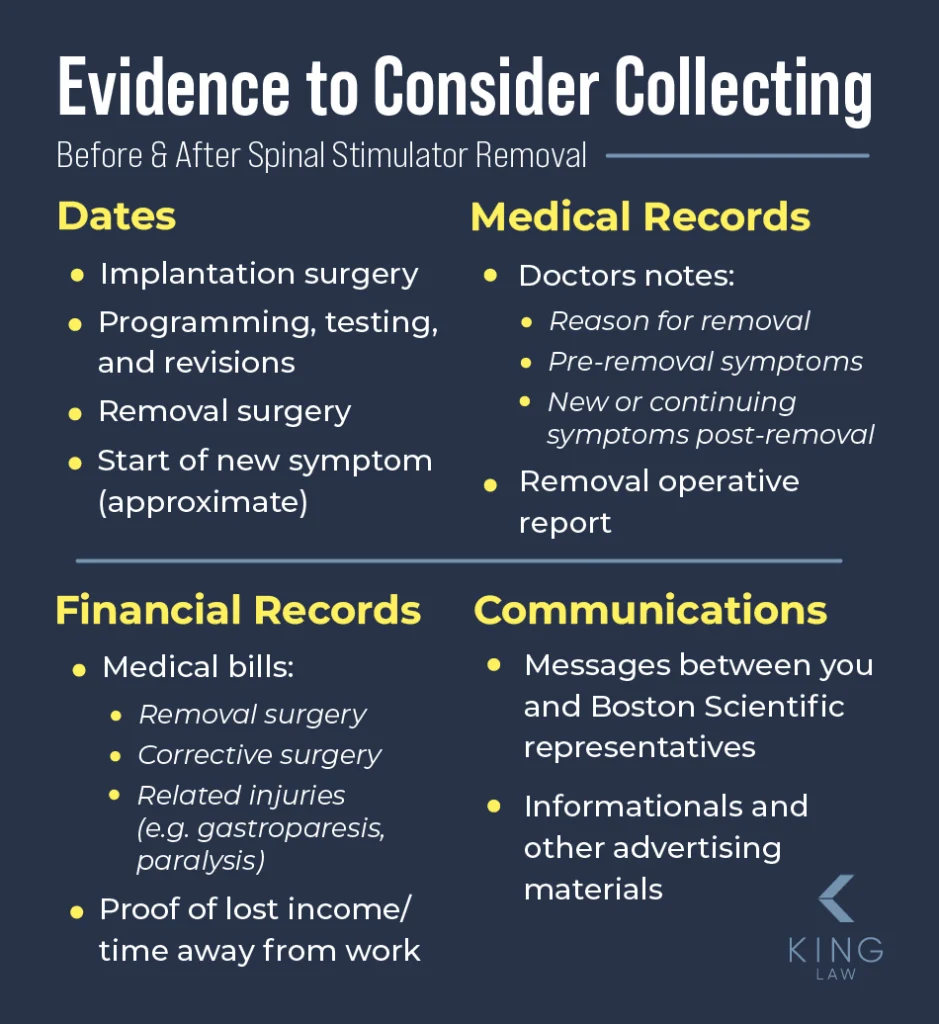
What Should I Document Before and After Removal?
Keeping a thorough record of your SCS device’s implantation, programming, adjustment, and removal can help you resolve any related medical or legal issues that arise down the road. Documentation to retain includes:
- Implant card and original implant report identifying Boston Scientific components.
- Implantation, revision, and removal dates.
- Symptoms and the clinician’s documented reason for removal.
- Programming records, device testing, imaging, and relevant infection testing.
- Removal operative report identifying what came out and anything retained.
- Follow-up records describing continuing symptoms and additional treatment.
- Related medical bills and time away from work.
Evidence arrangements should be coordinated through the professionals handling the device. Boston Scientific’s specific device labeling and instructions are also useful to retain, though these can often be found online and are not patient specific. Collecting the information will be important if the patient chooses to file a Boston Scientific SCS lawsuit in the future.
Contact Robert King Law Firm For a Free Case Review
King Law is currently investigating injuries related to Boston Scientific spinal cord stimulators. If you’ve suffered an SCS injury, contact our experienced legal team today for a free case evaluation at (585) 270-8882, or by filling out a form on this site. Our attorneys are reviewing spinal cord stimulator lawsuits involving a range of injuries. We can help you understand if you may have grounds for a legal claim.
Frequently Asked Questions (FAQs)
Sources Used to Write This Article
- Boston Scientific. “After Your SCS Procedure.” Boston Scientific, n.d.
- Boston Scientific. “Infinion CX 16-Contact Lead.” Boston Scientific, n.d.
- Boston Scientific. “ImageReady MRI Full Body Guidelines for WaveWriter Alpha and Alpha Prime.” Boston Scientific, n.d.
- Boston Scientific. “MRI and Medical Procedures.” Boston Scientific, n.d.
- Boston Scientific. “Percutaneous Leads.” Boston Scientific, n.d.
- Boston Scientific. “Precision™ Spinal Cord Stimulator System Clinician Manual: Directions for Use.” U.S. Food and Drug Administration, n.d.
- Boston Scientific. “Surgical Leads: Directions for Use.” Boston Scientific, n.d.
- Dupré, Derrick A., et al. “Spinal Cord Stimulator Explantation: Motives for Removal of Surgically Placed Paddle Systems.” Pain Practice, vol. 18, no. 4, 2018, pp. 500–504.
- Johns Hopkins Medicine. “Spinal Cord Stimulator Removal: Q&A with a Neurosurgeon.” Johns Hopkins Medicine, n.d.
- King Law. “Spinal Cord Stimulator Removal Complications.” Robert King Law Firm, n.d.
- Kuparinen, Xenia, et al. “Explantation and Simultaneous Explantation-Reimplantation of Spinal Cord Stimulation Paddle Electrodes: Complication Rate and Predisposing Factors.” Neurosurgery Practice, September 2023.
- U.S. Food and Drug Administration. “Spinal Cord Stimulator Recall: Boston Scientific Removes Infinion CX Lead.” FDA, 3 Sept. 2026.
- Wahezi, Sayed E., et al. “Spinal Cord Stimulation Explantation and Chronic Pain: A Systematic Review and Technology Recommendations.” Journal of Pain Research, March, 18, 2025.