

Boston Scientific Spinal Cord Stimulator Problems
Complete the form below to see if you qualify for a Spinal Cord Stimulator Lawsuit

Patients have reported problems with Boston Scientific spinal cord stimulators, including unwanted shocks, unpredictable stimulation, charging difficulties, lead movement or breakage, battery overheating, and implant-site complications. Problems may be related to the implantation surgery, device malfunctions, device hardware or software issues, programming difficulties, or the patient’s underlying condition. Sometimes, these problems can be corrected through device reprogramming. However, some patients have their Boston Scientific spinal cord stimulators removed (explanted) or have a revision surgery to address the issues.
About Boston Scientific Spinal Cord Stimulator Problems
What Problems Can Happen With a Boston Scientific Spinal Cord Stimulator?
MAUDE Database Reports Related to Boston Scientific Spinal Cord Stimulators
Why Is My Boston Scientific Spinal Cord Stimulator No Longer Relieving Pain?
Why Does My Boston Scientific Stimulator Sometimes Shock and Burn Me?
Boston Scientific Charging, Battery, and Remote-Control Problems
Which Boston Scientific Device Problems Have Led to Recalls?
Can Boston Scientific Stimulator Problems Affect an MRI?
What Happens If Reprogramming Does Not Fix the Problem?
King Law Is Investigating Boston Scientific Spinal Cord Stimulator Problems
Contact Robert King Law Firm for a Free Case Review
What Problems Can Happen With a Boston Scientific Spinal Cord Stimulator?
Several problems may occur with a Boston Scientific spinal cord stimulator device. Some symptoms may signal a serious underlying complication associated with the Boston Scientific spinal cord stimulator implant or surgery. Patients should notify their doctors about any new, worsening, or worrying changes in their physical or sensory abilities.
Boston Scientific’s mySCS™ App and the Freelink™ Remote Control can help patients understand some possible issues and the potential causes of those issues. However, these tools should not replace a doctor’s evaluation in all cases. If a patient cannot troubleshoot device issues on their own, a qualified doctor can review symptoms and decide on the best course of action.
The table below presents some common issues patients experience with their Boston Scientific spinal cord stimulators, some possible causes of those problems, and information patients can provide to their care team (if the patient cannot resolve the issues by themselves). By documenting symptoms, warnings on the app or remote control, when the symptoms occur, and other information for their doctors, most patients can work toward resolution of their issues.
| Problem the user notices | Possible explanation | Other useful information for your care team |
|---|---|---|
| Pain relief fades or disappears | Therapy interruption, programming issue, lead problem, or change in the pain condition | When relief changed, whether it was sudden, and recent programming visits |
| Shocks, jolts, or stimulation in a new area | Changed stimulation delivery or a lead or connection problem | Where and when it happens and whether it follows movement, charging, or a setting change |
| Charging takes too long or never finishes | Charger is not aligned properly, the charging system does not have enough airflow, or there is a system or battery problem | Battery indicators, charging duration, heat, where you were when you were charging, and displayed messages |
| Stimulation briefly switches off and back on during charging | A reset issue documented for specific WaveWriter Alpha generators | Generator model, serial number, and software-update history |
| Controller communication error | Controller out-of-range or used during charging | Error message and whether it occurs outside charging sessions |
| Persistent pain, redness, or swelling around the implant | Local irritation, tissue reaction, infection, or another implant-site complication | Symptom timeline, progression, fever, and any treatment received |
Please note that if you are experiencing severe symptoms, including new or worsening leg weakness, difficulty walking, new bladder or bowel problems, fever, or sharp, increasing pain at the implant site, seek medical attention immediately. Any sudden or concerning neurological symptoms should be addressed by a doctor immediately.
MAUDE Database Reports Related to Boston Scientific Spinal Cord Stimulators
The FDA maintains the Manufacturer and User Facility Device Experience (MAUDE) Database. The MAUDE database archives reports made to the FDA about medical devices. These reports can be submitted by mandated reporters (e.g., manufacturers, importers, and device user facilities) and voluntary reporters, including healthcare professionals and patients.
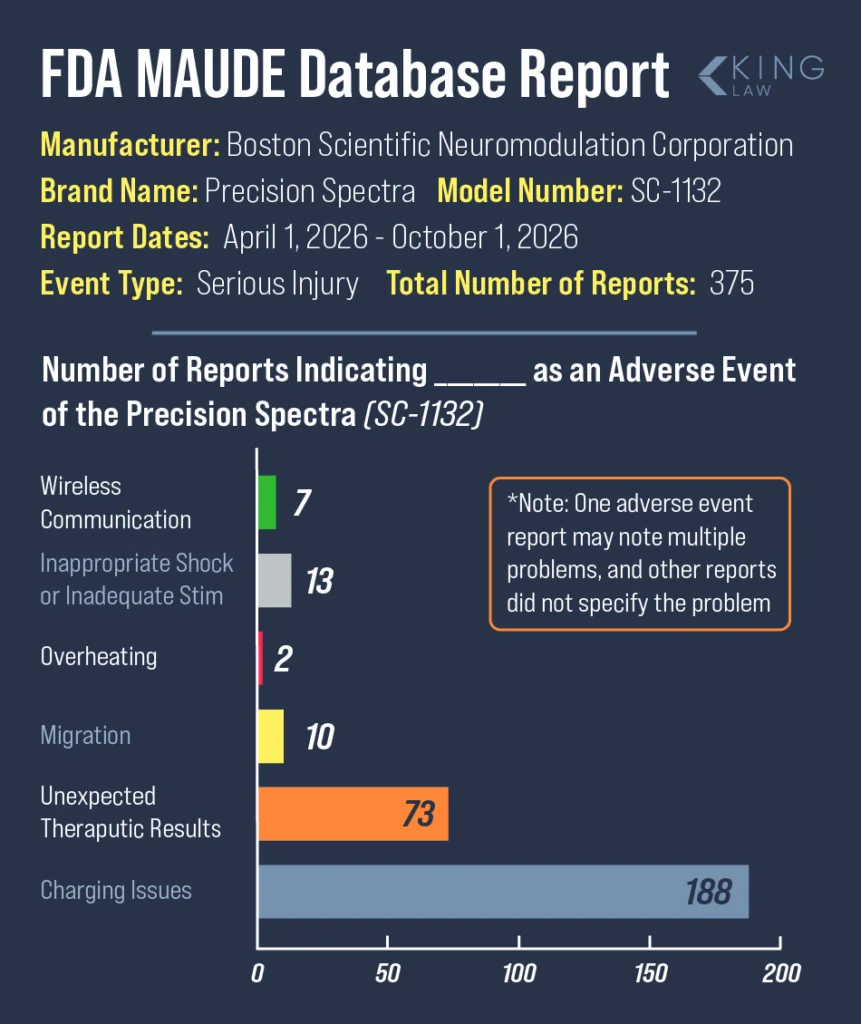
Spinal cord stimulators made by Boston Scientific are included in these reports. For example, between April 1, 2026, and October 1, 2026, 375 reports of serious injuries were submitted by people who had Boston Scientific’s Precision Spectra spinal cord stimulators implanted. Of those reports, 13 listed inappropriate shocks or inadequate stimulation, 2 listed overheating, 10 listed migration, and 73 listed unexpected therapeutic results.
Why Is My Boston Scientific Spinal Cord Stimulator No Longer Relieving Pain?
Some Boston Scientific spinal cord stimulator patients have reported that their devices no longer deliver electrical stimulation therapy or that the therapy the devices provide no longer relieves their pain.
Leads That Move Out of Position
The leads in a Boston Scientific spinal cord stimulator are placed in specific locations to deliver electrical stimulation and help relieve pain. Sometimes, these leads can move out of position. Most of the time, the migration is minor and does not affect treatment. However, sometimes the leads migrate enough to affect the intended treatment. When that happens, the patient may not receive stimulation at the appropriate levels or where it is needed and experience other symptoms of SCS lead migration. Clinicians can use imaging studies and other tests to determine if a lead moved out of position.
Lead migration may require surgery to reposition or change the leads and put them in the correct position. However, this surgery is not always successful, and sometimes multiple surgeries are required to move or replace the leads or remove the device entirely (i.e., explant).
Many patients with Boston Scientific spinal cord stimulators have experienced lead migration resulting in loss of efficacy. In some cases, the patient or physician reports that event to the FDA, and the FDA generates a MAUDE report. Below is an example of a MAUDE report about lead migration from a Boston Scientific spinal cord stimulator.
Example of MAUDE Report Citing Inadequate Pain Relief
| Maude Report # | 3006630150-2026-03630 |
|---|---|
| Boston Scientific SCS Model | WaveWriter Alpha 16™ |
| Adverse Event | Lead migration and inadequate pain relief |
| Date of Report | 8/4/2026 |
| Outcome | Device removal (explantation) |
Broken Leads, Connection Problems, and High Impedance
A damaged lead or connection issue can prevent the Boston Scientific spinal cord stimulator from delivering stimulation when and where you need it. One or more leads may disconnect from the device, so stimulation signals cannot reach the correct areas. For example, in September 2026, leads for Boston Scientific’s Infinion CX spinal cord stimulator were recalled due to a higher risk of breaking or high impedance (electrical resistance). According to the recall, as of May 27, 2026, Boston Scientific has reported 1,081 serious injuries related to high impedance measurements or lead fractures. If a patient is experiencing symptoms of lead fractures or high impedance, a patient’s care team can order tests or imaging studies to determine if the leads broke or migrated or if there are other issues.
Here is another MAUDE report from a patient who experienced lead fracture with their Boston Scientific spinal cord stimulator.
| Maude Report # | 3006630150-2026-00598 |
|---|---|
| Boston Scientific SCS Model | Linear™ Percutaneous Leads |
| Adverse Event | Lead fracture, resulting in inadequate stimulation |
| Date of Report | 5/11/2026 |
| Outcome | Revision surgery to replace leads |
Why Does My Boston Scientific Stimulator Sometimes Shock and Burn Me?
Boston Scientific’s spinal cord stimulators may cause unwanted shocking or burning sensations, jolts, or stimulation in an unexpected or unintended area. These problems may be due to lead migration, lead breakage, connection issues, reactive or scar tissue around the implant, or battery pain or other issues. To diagnose these problems, patients should talk to their doctor about when the burning or shocking sensations started, the location of the sensations, and the circumstances surrounding the sensations.
If patients experience persistent pain, burning sensations, warmth, redness, swelling, numbness, or other concerning changes or sensations related to their Boston Scientific spinal cord stimulator, they should contact their doctor for an evaluation.
Boston Scientific Charging, Battery, and Remote-Control Problems
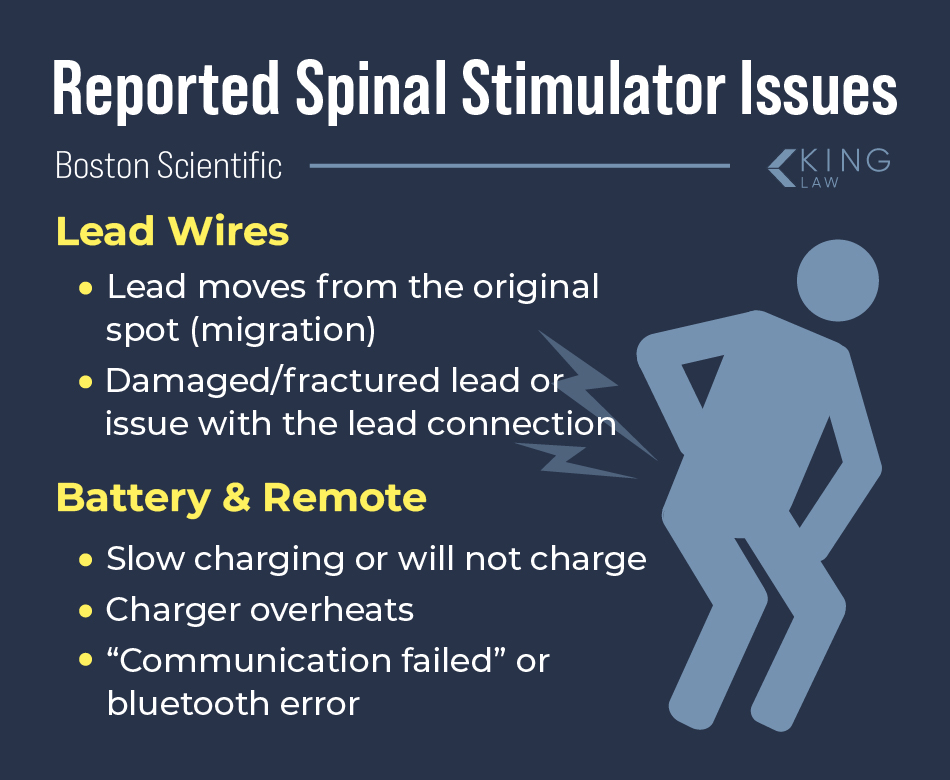
Several Boston Scientific spinal cord stimulators require charging, such as the WaveWriter Alpha, WaveWriter Alpha Prime, Precision Spectra, Precision Montage, Spectra WaveWriter, and Precision Montage MRI models. Users must follow the device-specific instructions for charging, using the remote control, and battery care. Improper use/positioning, lack of ventilation, or device issues result in patient problems with charging Boston Scientific spinal cord stimulators or result in the device or battery shocking, burning, or overheating.
The Stimulator Will Not Charge or Takes Too Long to Charge
Batteries and chargers need to have proper airflow and placement during charging. According to Boston Scientific, the spinal cord stimulator patient should not be lying down, have their back pressed up on a couch or chair, or be covered in a blanket during charging, as this
The Charger Gets Hot or Charging Stops
The charger may warm up or get hot during charging due to a battery issue, improper airflow, or pressure (e.g., the patient’s back is pressed against something). However, patients should consult their doctors about heat, warmth, skin injury, pain, or interruptions during charging. Patients should pause charging their device and talk to their physician if they experience pain, heat, or other concerning sensations that began or got worse when they started charging their Boston Scientific spinal cord stimulator.
The Remote Shows “Communication Failed” or a Bluetooth Error
If a patient sees the “Communication Failed” error or a Bluetooth error message, their Freelink™ Remote Control or mySCS™ GO Therapy Controller may be too far away from the implant. Boston Scientific recommends moving the controller closer to the spinal cord stimulator implant and retrying or reconnecting. Please note that a remote will not work or communicate with the implant while either is charging.
Which Boston Scientific Device Problems Have Led to Recalls?
Boston Scientific has recalled several of its spinal cord stimulator devices and accessories. These recalls include the 2024 recall of some WaveWriter Alpha spinal cord stimulator devices and a 2026 recall of the Infinion CX spinal cord stimulator leads.
WaveWriter Alpha Resets During Charging — 2024 Correction
On July 17, 2024, Boston Scientific issued a Class 2 recall of its Wavewriter Alpha 16 IPG Kit (Material Number M365SC12160) and Wavewriter Alpha 32 IPG Kit (Material Number M365SC12320). According to the recall notice, a software issue with these models could increase the risk of the devices resetting and stopping stimulation delivery while charging. Boston Scientific issued a firmware update that it says should reduce or eliminate this concern with these models.
Infinion CX Lead Damage — 2026 Recall
On September 3, 2026, the FDA published a recall of two Infinion CX lead kits (Model Number SC-2317-50 and SC-2317-70), which are part of Boston Scientific’s spinal cord stimulator systems. According to the notice, a design issue with the Infinion CX leads increases the risk of mechanical stress at the anchor site, fracture, high impedance, and potential loss of stimulation. The recall only affected kits that had not been implanted, and there was no recommendation to have implanted leads removed from patients.
The notice indicates that Boston Scientific sent out a letter to providers (its customers) on June 17, 2026, about this and, as of May 27, 2026, noted that over 1,000 injuries and 0 deaths “had been associated with this issue.” The notice did not require or ask providers to remove Infinion CX leads from Boston Scientific spinal cord stimulator systems already implanted in patients.
How to Find Out Whether a Notice Applies to Your Device
To see whether a notice or recall applies to your device, locate your implant card or surgical report, or contact the clinic that implanted your Boston Scientific spinal cord stimulator system. The generator and leads have different names, model numbers, and other identifiers, so you will need to find the information for each. The FDA’s website lists model numbers and other device-specific details in recalls. Your physician can help you locate details about your Boston Scientific spinal cord stimulator components and check if they are part of an advisory notice or recall.
Can Boston Scientific Stimulator Problems Affect an MRI?
Not all Boston Scientific spinal cord stimulators are compatible with MRI machines. Some SCS devices need to have an MRI mode switched on before a patient can safely have an MRI. For example, Boston Scientific notes that Precision Plus and Precision Novi spinal cord stimulators are not MRI-compatible, regardless of what mode they are in. However, the company says WaveWriter Alpha and Precision Montage MRI are conditionally compatible with a full-body MRI if the devices are put into the correct setting.
Some Boston Scientific spinal cord stimulator patients have experienced problems switching their devices in or out of MRI mode. Patients should work with their doctors and scan technicians to make sure the device is compatible with an MRI or another imaging study before proceeding.
What Happens If Reprogramming Does Not Fix the Problem?
Reprogramming a Boston Scientific spinal cord stimulator system will not always fix device-related problems. Patients should first talk to their surgical team and treating physician about any problems they experience with their Boston Scientific spinal cord stimulator system. Their medical team can perform tests and evaluations to determine the likely cause, such as a broken lead, a lead that moved out of place, battery problems, or reactive or scar tissue. A doctor may use the following information to help diagnose and treat issues with a Boston Scientific spinal cord stimulator system:
- Implant card and generator or lead model information
- Timeline of symptoms or device performance changes
- Notes about error messages on the controller
- Dates of reprogramming, software updates, and other corrective actions
- Reports or imaging associated with revision or removal of Boston Scientific spinal cord stimulator
How the doctor addresses the issue with a Boston Scientific spinal cord stimulator depends on the underlying cause.
King Law Is Investigating Boston Scientific Spinal Cord Stimulator Problems
Robert King Law Firm is reviewing potential claims involving Boston Scientific spinal cord stimulators. We can help you gather your medical records, device information, and symptom timeline to understand what happened and whether your Boston Scientific spinal cord stimulator may be the cause. Our team can help you determine if you might qualify to file a spinal cord stimulator lawsuit against Boston Scientific.
Contact Robert King Law Firm for a Free Case Review
Our SCS lawyers are actively pursuing cases against manufacturers, and we are ready to help you explore filing a claim. If you are experiencing problems with your Boston Scientific spinal cord stimulator system, contact Robert King Law Firm today by dialing (585) 496-2648 or filling out an online form. Our intake specialists are available to answer your questions and help you understand what is needed to file an SCS lawsuit. We help patients understand their legal options after experiencing issues with an SCS device.
Frequently Asked Questions (FAQs)
Sources
- Boston Scientific. “Charging Your SCS System.” Boston Scientific.
- Boston Scientific. “Important Medical Device Information – Effects Associated with Rechargeable Spinal Cord Stimulation (SCS) Implantable Pulse Generator (IPG) Resets.” 17 July 2024.
- Boston Scientific. “MRI and Medical Procedures.” Boston Scientific.
- Boston Scientific. “Spinal Cord Stimulator Device Support.” Boston Scientific.
- Dombovy-Johnson, Marissa L., Ryan S. D’Souza, Chris Thuc Ha, and Jonathan M. Hagedorn. “Incidence and Risk Factors for Spinal Cord Stimulator Lead Migration With or Without Loss of Efficacy: A Retrospective Review of 91 Consecutive Thoracic Lead Implants.” Neuromodulation: Technology at the Neural Interface, vol. 25, no. 5, 2022, pp. 731–737. doi:10.1111/ner.13487.
- Igwe, Nwadi, Anna Green, Seung J. Lee, and Kanchana Gattu. “Revision of an Eight-lead Boston Scientific® Spinal Cord Stimulator With Epidural Migration: A Case Report.” Cureus, vol. 17, no. 11, 2025, e97316. doi:10.7759/cureus.97316.
- Rauck, Richard L., et al. “Long-term Safety of Spinal Cord Stimulation Systems in a Prospective, Global Registry of Patients with Chronic Pain.” Pain Management, vol. 13, no. 2, 2023, pp. 115–127. doi:10.2217/pmt-2022-0091.
- University Hospital Southampton NHS Foundation Trust. “Spinal Cord Stimulator Implantation Aftercare Advice.” Patient Information Factsheet, version 1, Mar. 2026.
- U.S. Food and Drug Administration. “Class 2 Device Recall WAVEWRITER ALPHA 16 IPG KIT, WAVEWRITER ALPHA 32 IPG KIT.” Recall no. Z-2617-2024, 14 Aug. 2024.
- U.S. Food and Drug Administration. “MAUDE Adverse Event Report: Boston Scientific Neuromodulation Corporation Linear ST; Stimulator, Spinal-Cord, Totally Implanted for Pain Relief.” MDR Report Key 24210666, Report No. 3006630150-2026-00598, 2026.
- U.S. Food and Drug Administration. “MAUDE Adverse Event Report: Boston Scientific Neuromodulation Corporation WaveWriter Alpha 16; Stimulator, Spinal-Cord, Totally Implanted for Pain Relief.” MDR Report Key 25340309, Report No. 3006630150-2026-03630, 2026.
- U.S. Food and Drug Administration. “Spinal Cord Stimulator Recall: Boston Scientific Removes Infinion CX Lead.” 2026.
- U.S. Food and Drug Administration. Spinal Cord Stimulator System: Information for Patients. Boston Scientific Neuromodulation Corporation, document no. 97035804-01, rev. A.