

Olympus Scope Recalls, Warnings, and Investigations
Complete the form below to see if you qualify for a Olympus Scope Lawsuit

Olympus Corporation makes many of the endoscopic devices used in the United States and around the world. Scopes and accessories made by the company have also been subject to recalls, warning letters from the FDA, and government investigations. Olympus’ manufacturing facilities and processes have been cited by the FDA for violations, and the U.S. Department of Justice has investigated the company for failing to report adverse events as required by FDA regulations. Additionally, the FDA has issued import alerts for some Olympus endoscopes and accessories.
This page covers the recalls, warning letters, and investigations involving the U.S. government and Olympus Corporation. It also discusses how these actions may be related to civil lawsuits filed by people alleging injuries from Olympus’ products.
About the Olympus Scopes Lawsuit:
Which Olympus Devices Are Involved in Lawsuits, Safety Alerts, and Recalls?
Urgent Medical Correction About Olympus Scopes
DOJ Fine: TJF-Q180V Duodenoscope Superbug Infections
FDA Import Alerts on Olympus Devices
FDA Warning Letters About Olympus Scopes
How These Actions Are Related to Olympus Scope Infection Lawsuits
Which Olympus Devices Are Involved in Lawsuits, Safety Alerts, and Recalls?
The Olympus lawsuits involve several different models of endoscopes and accessories. Some of these models have been the subject of FDA recalls and field safety notices, with adverse events reported between 2012 and 2025. These devices and their accessories have been associated with multiple reported deaths and hundreds of adverse event reports. Below are the Olympus medical devices that have been named in lawsuits, recalls, or warning letters. For more information, this article provides insights from our lead attorney about bacterial infections and Olympus scopes. Some of the Olympus devices included in these actions include:
- TJF-Q190V, TJF-Q290V, and TJF-Q170V duodenoscopes
- MAJ-891 forceps/irrigation plug
- ViziShot 2 FLEX
- TJF-Q180V duodenoscope
In addition to these recalls, various components of Olympus’ scopes have been subject to recalls or cited in warning letters from the FDA.
Urgent Medical Correction About Olympus Scopes
Urgent Medical Correction: TJF-Q190V, TJF-Q290V, and TJF-Q170V Duodenoscopes
The 2020 successor to the TJF-Q180V, the Olympus TJF-Q190V (EVIS EXERA III), along with two additional Olympus duodenoscopes, the TJF-Q290V (EVIS LUCERA Elite), and TJF-Q170V (170-series duodenoscope), are also named in the lawsuits. These devices had two major issues:
- The MAJ-2315 disposable distal cover used by the scope devices was prone to detaching during procedures, a situation that could cause internal lacerations or block airways.
- The duodenoscope had an increased infection risk, especially if the Olympus duodenoscopes were not cleaned shortly after the procedure.
Olympus released updated cleaning protocols that recommended examining the devices for biological material under 10x magnification in 2025, after its duodenoscopes were linked to 2 more deaths and 5 injuries.
Olympus Scope Recalls
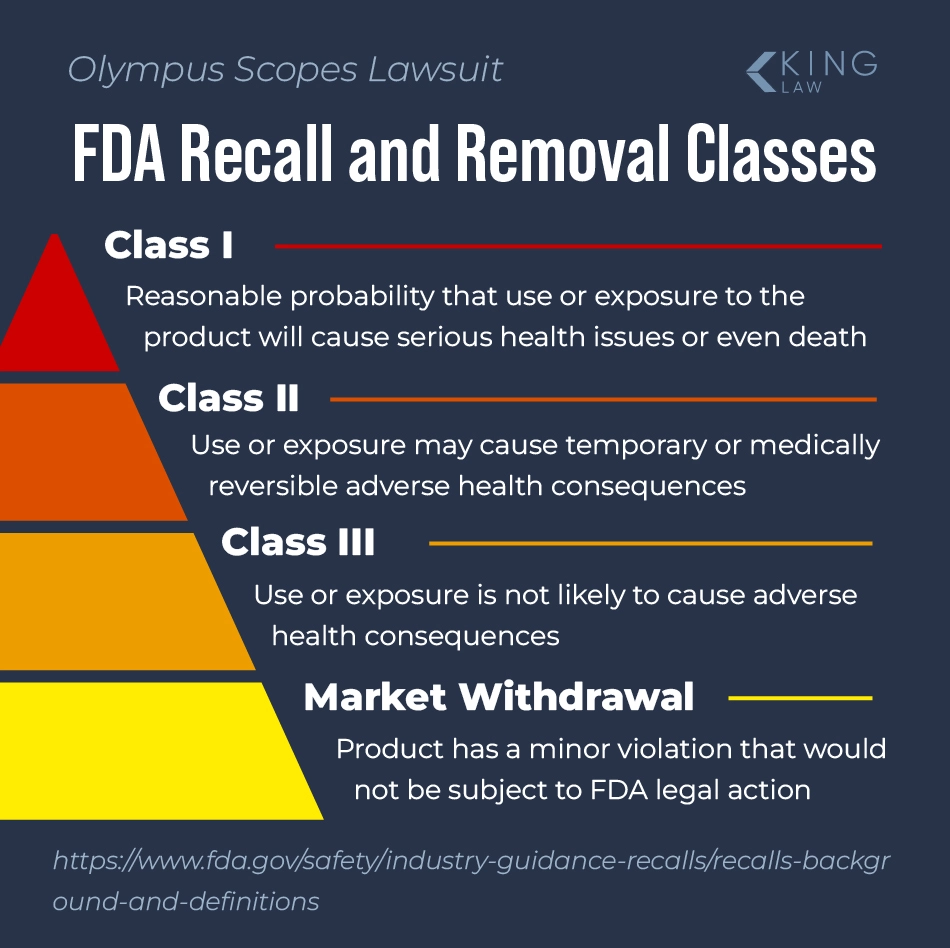
A third-party index of FDA data reports 145 recall events involving Olympus Corporation of the Americas between 2015 and October 2026. These recalls include nine Class I recalls, the most severe level of recall. However, that figure includes devices other than scopes, including surgical instruments and equipment. Additionally, Olympus’ manufacturing entities may be involved in more recalls. The sections below highlight some of the Class I recalls involving Olympus scopes and accessories.
Class I Recall
A situation in which there is a reasonable probability that the use of or exposure to a violative product will cause serious adverse health consequences or death.
Class I Recall: MAJ-891 Forceps/Irrigation Plug (Class I Recall)
Some accessories would continue to be a safety concern with Olympus endoscopes, including the MAJ-891 Forceps/Irrigation Plug, which was subject to an FDA Class I recall in 2025 after being linked to 120 injuries and one death. The reusable Olympus endoscope accessory is being pulled from the market as it can provide an excellent breeding ground for deadly bacteria when not properly disassembled.
Class I Recall: ViziShot 2 FLEX
Another Olympus endoscope accessory named in lawsuits is the ViziShot 2 FLEX. The ViziShot 2 is a biopsy needle accessory used in bronchoscopies. A batch of the needles shipped before May 2025 had a defect that can potentially cause components to break off or detach mid-procedure, leading to tissue damage or blockages and a recall. One patient death has been reported from such a malfunction.
In January 2026, the FDA expanded this recall to include all lots of ViziShot 2 FLEX (19G) EBUS -TBNA needles.
Class I Recall: Bronchoscopes and Endobronchial Combustion Risk
The FDA issued a Class I recall on 19 models of Olympus bronchoscopes in June 2023 due to combustion risks. The recall includes 15,586 devices distributed between January 20, 1999, and May 3, 2023, including these models:
- BF-PE2
- BF-TE2
- BF-P60
- BF-1T60
- BF-MP60
- BF-XT40
- BF-1T150
- BF-P150
- BF-Q170
- BF-XT160
- BF-Q180-AC
- BF-P180
- BF-1T180
- BF-1TQ180
- BF-Q180
- BF-1TH190
- BF-H190
- BF-Q190
- BF-XT190
At the time the recall was issued, Olympus Corporation of the Americas had reported three patient injuries (including one patient death). Voluntary label updates made by Olympus in October 2025 advise surgical teams to monitor oxygen concentrations before firing a laser and taking other precautions.
Other FDA Recalls and Notices Involving Olympus Scopes
Olympus scopes and their associated accessories have been the subject of multiple recalls and safety notices and communications. Here is a list of some of those actions. Some of these recalls include the scopes themselves, and others involve additional parts that are used as complementary equipment during patient procedures.
| Date | Device or Product |
|---|---|
| June 5, 2026 | MAJ-2315 single-use distal cover (Class II) |
| February 12, 2026 | MAJ-1443 suction valve, MAJ-1444 air/water valve, OER-Pro and OER-Elite (Class II) |
| January 2026 notification | Olympus cystoscope outer sheath (Class II) |
| November 11, 2025 | Olympus urological resection sheaths (Class II) |
| September 2025 communication | Olympus bronchoscopes (Class I) |
| October 14, 2025 | TJF-Q190V duodenovideoscope (Class II) |
| September 25, 2023 | URF-P6 and URF-P6R ureteroscopes (Class II) |
| October 12, 2023 | Multiple Olympus bronchoscopes (Class I) |
| June 8, 2023 | Multiple Olympus bronchoscopes (Class I) |
| April 18, 2023 | MAJ-2315 single-use distal cover (Class II) |
| November 2, 2021 | TJF-Q180V duodenovideoscope (Class II) |
DOJ Fine: TJF-Q180V Duodenoscope Superbug Infections
The Olympus TJF-Q180V duodenoscope, trade name EVIS EXERA II, was designed to be a reusable scope for ERCPs. The scope had a critical design flaw in its closed elevator channel mechanism. The feature, which was billed as being easier to clean, ended up providing a trap for fluids. This fluid buildup allowed drug-resistant bacteria to collect in the device and infect some patients.
The TJF-Q180V, introduced in 2010, would soon be linked to superbug infection outbreaks, eventually leading to a recall and redesign. Olympus and one of its senior executives would end up pleading guilty to failing to report adverse events, resulting in an $80 million fine for the company and $5,000,000 in criminal forfeiture issued in December 2018. The redesign, which utilized disposable endcaps, was prone to dislodging during use, leading to lacerations and burns.
What Did the Department of Justice Case Against Olympus Establish?
The 2018 Department of Justice case against Olympus ended in a guilty plea, with the company admitting it failed to file adverse event reports with the FDA following documented infections in Europe. The Pseudomonas aeruginosa and Escherichia coli outbreaks occurred after patients were treated with Olympus’s TJF-Q180V duodenoscope.
Olympus was fined $80 million. The senior official overseeing the division, Hisao Yabe, also pleaded guilty and was sentenced to one year’s probation and a $5,000 fee. The case underscored the importance of timely regulatory reporting and post-market surveillance obligations.
FDA Import Alerts on Olympus Devices
The FDA issues import alerts to “protect consumers against products with a history of known violations.” The FDA has taken this action against Olympus for violations in its scope-manufacturing processes. Two recent, important alerts are summarized below.
2026 Import Alert Expansion
On October 20, 2026, the FDA expanded a 2021 import alert issued for certain devices made by Olympus. Import Alert 89-04 was accompanied by a summary titled “Update: Import Alert for Certain Olympus Medical Devices Manufactured in Japan – Letter to Health Care Providers” and focused on certain types of devices, including ureterorenoscopes, bronchoscopes, laparoscopes, automated endoscope reprocessors, ingestible telemetric gastrointestinal capsule imaging systems, and enteroscopes. This alert prevents new shipments of some devices from entering the U.S. while instructing physicians to “continue using them [the listed devices] if they are not experiencing any problems with the devices.”
2025 Import Alert of 58 Olympus Devices
On June 24, 2025, the FDA issued an import alert on 58 Olympus devices, giving the agency the authority to prevent future shipments of those devices from entering the United States. Olympus Medical Systems Corporation is headquartered in Japan. The alert cited ongoing quality system violations at Aizu, its manufacturing site. Devices identified include models of:
- Bronchoscopes
- Laparoscopes
- Automated endoscope reprocessors
- Ureterorenoscopes
The import alert also contained a warning to providers currently using those Olympus devices to strictly follow reprocessing procedures for reusable scopes.
FDA Warning Letters About Olympus Scopes
Between 2018 and November 2026, the FDA issued at least five warning letters to Olympus Corporation. According to the FDA, warning letters identify “the concern(s), such as poor manufacturing practices, problems with claims for what a product can do, or incorrect directions for use.” The FDA has issued these letters to Olympus Corporation and its subsidiaries following various government inspections of the company’s facilities. Here is a record of warning letters issued to Olympus Corporation:
- October 7, 2026: The FDA identified widespread quality-system violations involving Olympus manufacturing facilities in Japan, Germany, and the United States. Findings included deficiencies in design controls, complaint investigations, corrective actions, supplier oversight, and manufacturing processes.
- March 15, 2023: The FDA cited Olympus Medical Systems Corporation’s Hinode facility for violations involving endoscope accessories, including disposable distal covers and suction valves. The findings involved design validation, complaint handling, and manufacturing quality controls.
- December 12, 2022: The FDA cited Olympus Medical Systems Corporation’s Hachioji facility for violations involving gastrointestinal and surgical endoscopes, including failures to properly report certain device malfunctions and adverse events.
- November 2, 2022: The FDA cited Aizu Olympus for quality-system violations involving endoscopes and automated endoscope reprocessors, including deficiencies in manufacturing processes and quality controls.
- March 9, 2018: The FDA issued warning letters to Olympus and two other duodenoscope manufacturers for failing to provide required postmarket surveillance data needed to evaluate infection risks associated with reprocessed duodenoscopes.
Olympus and its subsidiaries also received several warning letters prior to 2018, including at least three warning letters related to the reprocessing of its duodenoscopes. Read our in-depth analysis of the October 2026 warning letter sent to Olympus about its scope manufacturing facilities and possible related injuries.
How These Actions Are Related to Olympus Scope Infection Lawsuits
Recalls, warning letters, and government actions are separate from civil lawsuits filed by patients alleging injuries. FDA and government actions do not initiate lawsuits filed by consumers. These actions are regulatory or criminal in nature and do not result in civil proceedings. However, information uncovered during government investigations or documented in regulatory actions may be relevant to those lawsuits. For example, an attorney may point to a recall involving an endoscope as evidence that the device in question may have posed a risk to patients. These recalls and safety notices may also be used to point to violations in Olympus’ manufacturing plants and how such violations may have put patients at risk. It is up to plaintiffs’ attorneys to argue how these actions may be relevant to civil lawsuits and support patient complaints. Our attorneys are working on these cases and collecting evidence in pursuit of holding Olympus liable for our clients’ injuries.
King Law Is Representing Plaintiffs in Olympus Scope Cases
If you developed a serious infection after having a procedure with an Olympus scope, our attorney can review your case. We will work with you to understand the specific circumstances surrounding your illness and whether or not you are eligible to pursue a claim with our law firm. Contact us for a free, no-obligation case evaluation at (585) 496-2648. We can help you understand your legal options for filing an Olympus scope lawsuit.