

About the October 2026 FDA Warning Letter Sent to Olympus Corporation
Complete the form below to see if you qualify for a Olympus Scope Lawsuit

On October 20, 2026, the FDA published a Warning Letter it sent to Olympus Corporation, which is a top producer of endoscopes used in the U.S. This is not the first warning letter Olympus has received from the FDA. This new letter describes dozens of regulatory violations at six Olympus facilities. The cited violations involve Olympus’ quality control and management processes, including how the company designs, tests, makes, and monitors its products.
The FDA identified violations involving devices associated with thousands of complaints, including reports of serious injuries and deaths. Some of the affected products have also been recalled. Olympus has been asked to respond to the FDA Warning Letter within 15 business days of receiving it. The FDA’s letter is dated October 7, 2026, but it is unclear whether that is the date Olympus received it.
In this article, we will explore this warning letter’s contents, former warning letters, Olympus devices that may be affected, and potential risk to patients. Olympus faces dozens of lawsuits claiming its scopes and accessories may increase the risk of infection. This article will also discuss how the warning letter may impact those lawsuits.
About the October 2026 FDA Warning Letter:
Warning Letter Says Olympus Had Significant Violations
Olympus Endoscopes and Accessories Cited in FDA Letter
How Could Olympus’ Violations Possibly Put Patients at Risk?
Does This Warning Letter Mean There Will Be Recalls?
Prior FDA Warning Letters for Olympus Corporation and Its Affiliates
How the Warning Letter Could Influence the Olympus Scope Litigation
Contact King Law About Olympus Scope Injuries and Associated Lawsuits
Warning Letter Says Olympus Had Significant Violations
The October 2026 FDA Warning Letter sent to Olympus identified significant violations regarding quality control processes at six of its facilities. These violations included serious gaps in how the facilities monitored for defects, responded to and tracked complaints, and addressed known manufacturing issues. Some of these violations appeared to result in patient injury and death or increase the risk of patients being injured or dying because of problems with scopes and accessories made by Olympus.
Summary of Violations in Warning Letter Sent to Olympus
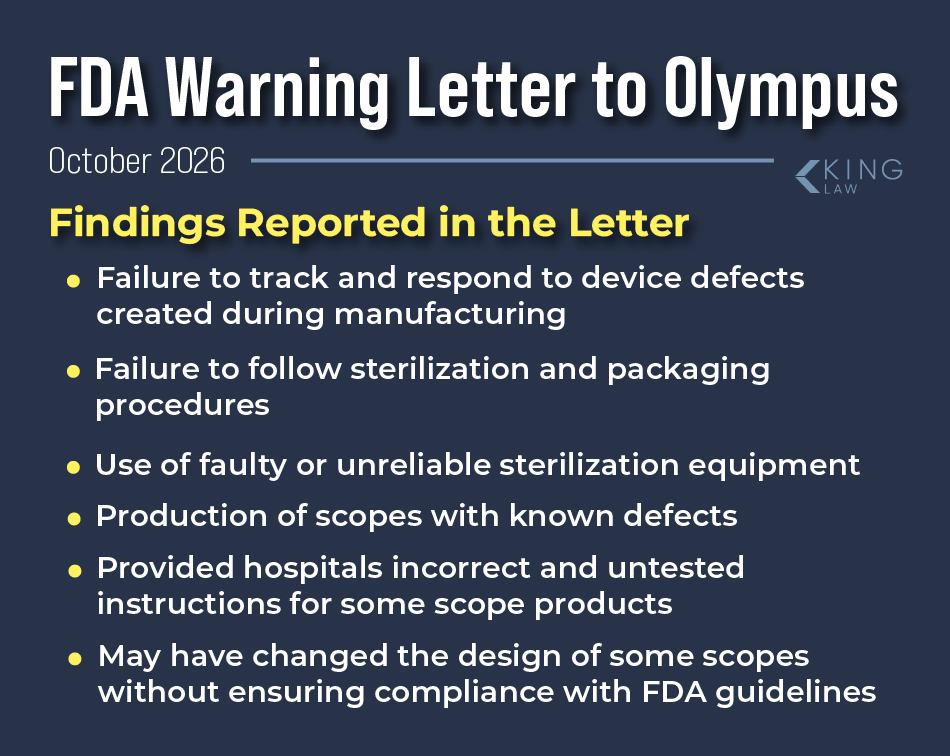
Here are some of the findings noted in the FDA Warning Letter:
- Olympus facilities were not tracking and responding to device defects created during the manufacturing process. Because of this, devices with known defects or devices that were not properly tested for defects were being sold to medical professionals and used on patients.
- Several Olympus facilities did not follow procedures to ensure they properly sterilized the equipment used to make scopes, accessories, and endoscopic devices.
- Olympus facilities were using faulty and unreliable equipment during the sterilization and packaging processes. The machines used were known to have problems creating a tight enough seal at the right temperature to ensure the devices and packaging were sterile.
- Several machines at Olympus factories produced scopes and accessories with known defects, including jagged edges that could harm patients and faulty wiring that could cause overheating during patient procedures.
- Olympus gave hospitals incorrect and untested instructions for how to use some of its products. As a result, hospitals may have used Olympus scopes with other machines and accessories that are incompatible with the scope, resulting in injury and possibly even death.
- Olympus changed the design of some scopes, including the Evis Exera series, without ensuring the changes complied with the FDA’s safety and use guidelines. As a result, some Evis Exera devices were put on the market with defects or untested qualities.
The FDA has asked Olympus to take actions to correct these violations. The FDA had already notified Olympus of some of these violations, with the understanding that Olympus would address them. According to the letter, Olympus either did not address some of them at all or did not address them as it should have.
What Are FDA Letters?
The FDA issues four types of letters to drug, device, and biologic producers that sell products in the U.S.—General FDA Warning Letters, Tobacco Retail Warning Letters, Drug Marketing and Advertising Warning Letters, and Warning Letter Close-Outs. An FDA warning letter notifies a company that an inspection or investigation identified violations of FDA regulations. Violations could include issues such as failing to properly investigate or report adverse events or issues in the manufacturing or quality control processes used to make FDA-approved drugs, biologics, or devices.
The FDA also issues letters addressing drug marketing violations and close-out letters when previously identified violations have been adequately corrected. Warning letters are not the same as recalls. A recall involves correcting or removing a potentially unsafe or defective product. Most recalls are initiated voluntarily by manufacturers.
Olympus Endoscopes and Accessories Cited in FDA Letter
The FDA Warning Letter names several Olympus devices that are or may be affected by the regulatory violations. Those devices include the following:
- UHI-4 Insufflation Unit
- Sphincterotome
- Continuous Flow Cystoscope (model WA22810A)
- BF-1TH190 bronchoscope
- Evis Exera Video Imaging System
- 0.2 μm Water Filter (Part MAJ-2318) (used in OER-Elite and OER-Mini Reprocessors)
- Single Use Reloadable Clip Applicator
- Endoscope Reprocessor
- Evis Exera III Duodenovideoscopes
- Vizishot 2 FLEX (19G)
- Vizishot 2 Flex 19G needle [laser cut hypotube (LCH)]
- MAJ 210 single-use biopsy valves
- HX-610 EZ Clip (hemostasis clip)
- MAJ-1555
- MAJ-2315
- MAJ-209
- MAJ-287
- Vizishot II NA-U401SX-4022
- Video telescope (model WA50042A)
- Single Use 3-Lumen Sphincterotome
- Thunderbeat 5 mm Front-actuated Grip Type S
- ESG PK Cutting Forceps (model PK-CF0533)
- Powerseal vessel sealing device
- Evis Exera III Bronchovideoscopes
- Evis Exera III Video System Center
- Evis X1 Video System Center
The FDA also identified serious issues with the equipment and processes used to sterilize and seal devices and components. The FDA also expressed concern about Olympus’ process for identifying and appropriately responding to problems with its devices and components. The FDA’s findings raise concerns that Olympus distributed devices and components despite unresolved defects, performance problems, or deficiencies in its quality control processes.
How Could Olympus’ Violations Possibly Put Patients at Risk?
The FDA Warning Letter warned that the violations can and, in many cases, have put patients at risk of injury or death. Here are a few examples:
- A pressure-sensor failure defect in the UHI-4 Insufflation Unit caused too much CO2 to be put into patients, resulting in death, cardiac arrest, a suspected gas embolism, and other injuries.
- Manufacturing errors in the sphincterotome led to deformed wires that can cause unintended tissue damage.
- A defect in the Continuous Flow Cystoscope (model WA22810A) increased the risk of the device overheating and the sheath falling off, which can burn and injure the patient.
- Medical providers were incorrectly told the BF-1TH190 bronchoscope was compatible with special laser systems, increasing the risk of it malfunctioning and burning patients.
- Dust and other particles interfered with image quality when doctors used the Evis Exera Video Imaging Systems.
- The 0.2 μm Water Filter (Part MAJ-2318) (used in OER-Elite and OER-Mini Reprocessors for cleaning) was not properly tested to ensure it was assembled correctly, working as intended, and that the filter lasted as long as physicians were told it would.
- Components used to make Olympus scopes and accessories were not properly sterilized or cleaned, allowing bacteria and particles to contaminate those scopes and accessories.
- Olympus facilities lacked reliable methods for disinfecting, sterilizing, and sealing scopes and accessories.
- Olympus did not take corrective action for over 2 years after receiving reports of a patient death and 210 complaints about the Evis Exera III Bronchovideoscope.
- Olympus lacks proper procedures to ensure its Evis Exera systems meet FDA-approved design and safety specifications, meaning defectively manufactured devices may enter the market and put patients at risk.
The FDA Warning Letter also notes that Olympus received thousands of complaints for various devices and components, including adverse event reports that involved patient death or serious injury. The FDA says Olympus failed to monitor, respond to, and report these complaints within the required timeframe. This failure has continued to put patients at unnecessary risk of injury and death.
Does This Warning Letter Mean There Will Be Recalls?
Some regulatory violations from the Warning Letter have led to prior recalls and safety notices for Olympus products. For example, Olympus received over 1,900 complaints about its Thunderbeat 5 mm Front-actuated Grip Type S from September 2021 to September 2024. These complaints involved serious and reportable patient injuries and device failures. Olympus began investigating this in October 2023 and canceled its Health Hazard Evaluation in January 2024, even though the issue remained unresolved. In November 2024, Olympus issued a field safety notice and recalled the affected product.
The Warning Letter indicates other violations that led to at least four past or ongoing recalls of other Olympus products. The FDA also cited multiple instances where Olympus failed to take corrective action when it should have. Olympus had promised to take corrective action for some of these violations. However, the Warning Letter notes several instances where Olympus has not followed through on this promise.
Prior FDA Warning Letters for Olympus Corporation and Its Affiliates
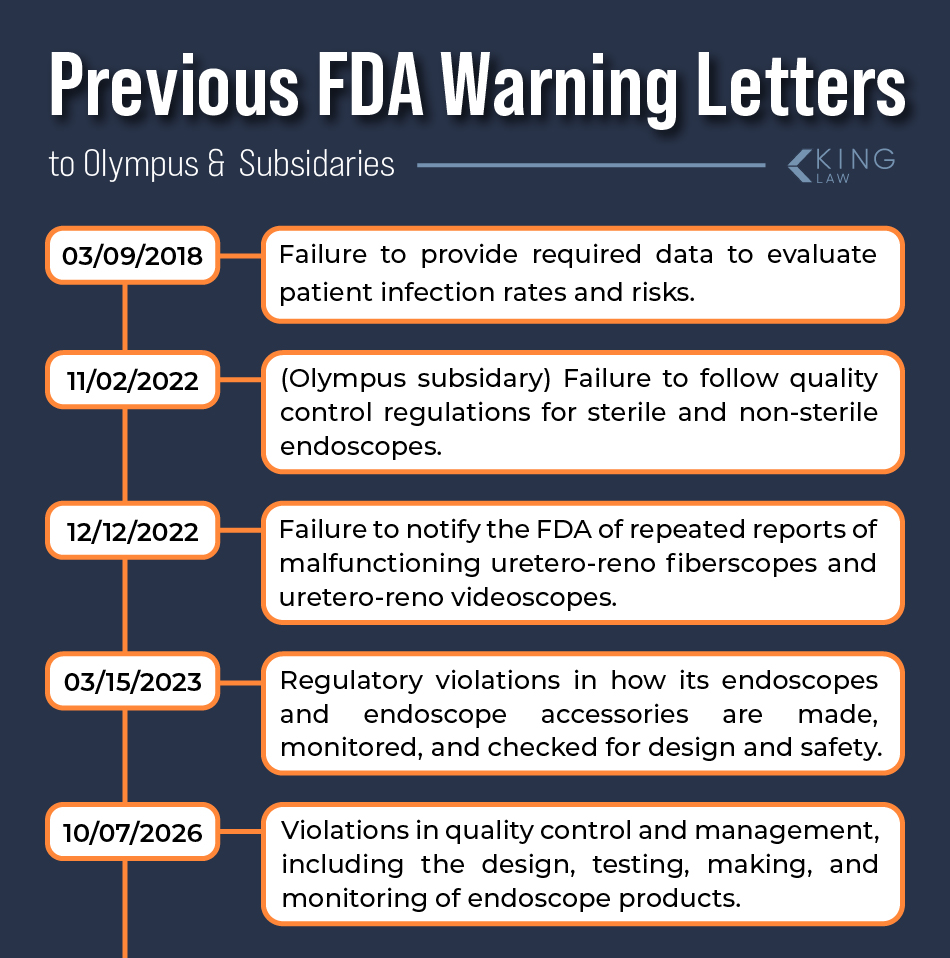
The FDA has sent several Warning Letters to Olympus and its subsidiaries in the past:
- March 15, 2023: Olympus received a Warning Letter identifying regulatory violations in how its endoscopes and endoscope accessories are made, monitored, and checked for design and safety specifications. The Warning Letter noted that Olympus failed to respond to over 200 complaints about the distal cover on its endoscopes.
- December 12, 2022: The FDA sent a Warning Letter to Olympus because Olympus failed to notify the FDA about repeated reports that its Uretero-Reno Fiberscope and Uretero-Reno Videoscope malfunctioned.
- November 2, 2022: Olympus’ subsidiary received a Warning Letter for failing to follow quality control regulations to ensure its sterile and non-sterile Endoscopes and Automated Endoscope Reprocessors met safety and design specifications.
- March 9, 2018: FDA sent Warning Letters to Olympus and two other companies that manufacture duodenoscopes for failure to provide required data to evaluate patient infection rates and risks.
Some of the matters addressed in past Warning Letters have since been resolved. However, as the October 2026 Warning Letter found, some violations are ongoing.
How the Warning Letter Could Influence the Olympus Scope Litigation
Currently, people alleging serious injuries related to Olympus’ endoscopes are pursuing individual lawsuits in state and federal court. According to the FDA warning letter, some of the cited violations may have contributed to serious injuries or deaths. Further, the FDA says complaints about the company’s devices were not adequately addressed or investigated by Olympus.
The FDA’s investigation could result in additional actions, investigations, or charges against Olympus. Any such proceedings would be separate from civil lawsuits filed by patients alleging injuries from Olympus scopes. However, this letter cites a number of violations of FDA regulations that have potentially led to serious injuries. The letter also highlights possible manufacturing and design flaws with some Olympus endoscopic devices and accessories. These violations could be used as evidence in civil lawsuits.
Plaintiffs’ lawyers could use information about violations as evidence that Olympus was negligent and put patients at an unnecessary risk. This letter and other information about the associated violations could be very important in civil lawsuits. Whether or not these findings are relevant or admissible in a particular lawsuit will depend on the products involved, the alleged injuries, and other factors.
Contact King Law About Olympus Scope Injuries and Associated Lawsuits
King Law is closely tracking the Olympus scopes litigation and representing clients alleging injuries related to the company’s colonoscope, duodenoscopes, and bronchoscopes. If you or a family member suffered a serious illness or injury after an endoscopic procedure, we want to hear from you. We can advise on your possible legal options, eligibility, and how our firm can support you as this litigation evolves. Reach out to our law firm today by calling (585) 496-2648 or submitting an online contact form.