

Can Bronchoscopies Cause Bacterial Infections? [2026 Update]
Complete the form below to see if you qualify for a Olympus Scope Lawsuit

Bronchoscopies may be used to diagnose or treat diseases involving the lungs and airways. Bronchoscopies can lead to bacterial infections, but the risk is relatively low. However, some patients do experience bacterial infections after a bronchoscopy, and some of these infections can cause serious health issues.
The risk of being diagnosed with a bronchoscopy-related infection may be increased by factors such as contaminated bronchoscopes, cross-contamination of a scope or accessories, medical errors, procedural complications, or the patient’s health. If a bronchoscope-related infection is determined to be caused by a hospital’s mistake or a contaminated bronchoscope, the patient may file a lawsuit to seek compensation.
About the Bronchoscopy Bacterial Infection Lawsuit:
What Is a Bronchoscopy and How Does It Work?
Can Bronchoscopies Cause Bacterial Infections?
What Is the Difference Between an Exogenous and Endogenous Bronchoscopy Infection?
What Is the Risk of Infection After a Bronchoscopy?
Can a Bronchoscopy Cause Pneumonia?
What Bacteria Are Linked To Bronchoscopy Infections?
Who Is Most at Risk for Infection After a Bronchoscopy?
What Are the Symptoms of Infection After a Bronchoscopy?
How Are Bronchoscopy Infections Diagnosed?
How Common Is Bronchoscope Contamination and Cross-Contamination?
Can Bronchoscopy Equipment Spread Bacteria Between Patients?
Are Reusable Bronchoscopes More Likely to Cause Infection Than Single-Use Bronchoscopes?
When Should You Seek Medical Attention After a Bronchoscopy?
King Law Is Investigating Bronchoscopy Bacterial Infection Cases
Contact a Bronchoscopy Infection Lawyer Today
What Is a Bronchoscopy and How Does It Work?
A bronchoscopy is when your doctors use a medical device to examine your lungs and airways. A bronchoscope is a medical device that is a tube with a camera. A bronchoscope is typically used to view, biopsy, cauterize, or remove tissue from the lungs and airways.
The tube is called a bronchoscope or endoscope, and it can be rigid or flexible. A bronchoscopy might be performed to diagnose cancer or a disease of the lungs or air passages. A doctor might also use a bronchoscope to take a sample of unhealthy tissue or locate a concerning mass that showed up on an X-ray. A medical team may also use a bronchoscope to find and cauterize (seal or remove) growths or bleeding tissue.
Can Bronchoscopies Cause Bacterial Infections?
As with any medical procedure, bronchoscopies carry the risk of a post-procedure infection. There are several reasons someone may experience a bacterial infection after the procedure.
Bronchoscopies may lead to bacterial infections due to factors like:
- Contaminated bronchoscopes
Cross-contamination from the hospital room or medical team - Spread of bacteria from one part of the body to the patient’s lungs
Not all pathogens that enter the body lead to a bacterial infection. However, a patient’s individual health circumstances and the type of bacteria that enters the body can determine whether or not a patient develops a serious infection.
How Do Bacterial Infections Occur After a Bronchoscopy?
Bacterial infections after a bronchoscopy may occur for several different reasons, including:
- Cross-contamination between patients due to an unsterile or defective scope
- Transfer of the patient’s bacteria from their mouth to their lung cavity
- Reprocessing mistakes between bronchoscopies
- Improperly sterilized procedure room
- Using nonsterile water during the procedure
Hospitals can help reduce the risks of infections after bronchoscopies by following all reprocessing guidelines when cleaning the scopes and following best practices for hygiene in a medical setting.
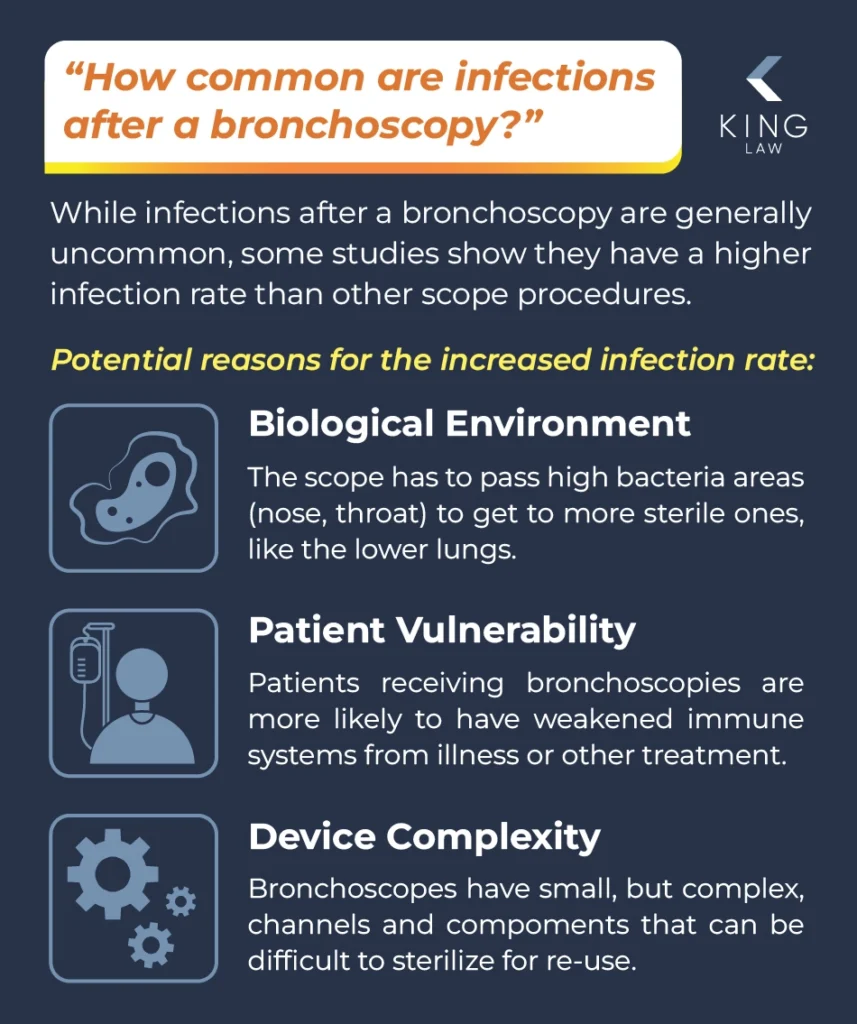
How Common Are Infections After Bronchoscopy?
Infections after bronchoscopy are uncommon. However, depending on circumstances, bronchoscopies can have higher infection rates than some other endoscopic procedures, such as an upper GI endoscopy. For example, the rate of infections is estimated to be between
- The biological environment. A bronchoscope passes through highly colonized regions like the nose and throat into relatively sterile ones like the lower lungs.
- Patient vulnerability. Bronchoscopy patients tend to be sicker than colonoscopy patients, who may just be getting a routine screening.
- Device complexity. Bronchoscopes are relatively complex endoscopes with narrow components that some research has shown are more difficult to sterilize.
The device complexity and reprocessing difficulties are key factors in the bronchoscopy lawsuits involving infection claims and medical device liability.
What Is the Difference Between an Exogenous and Endogenous Bronchoscopy Infection?
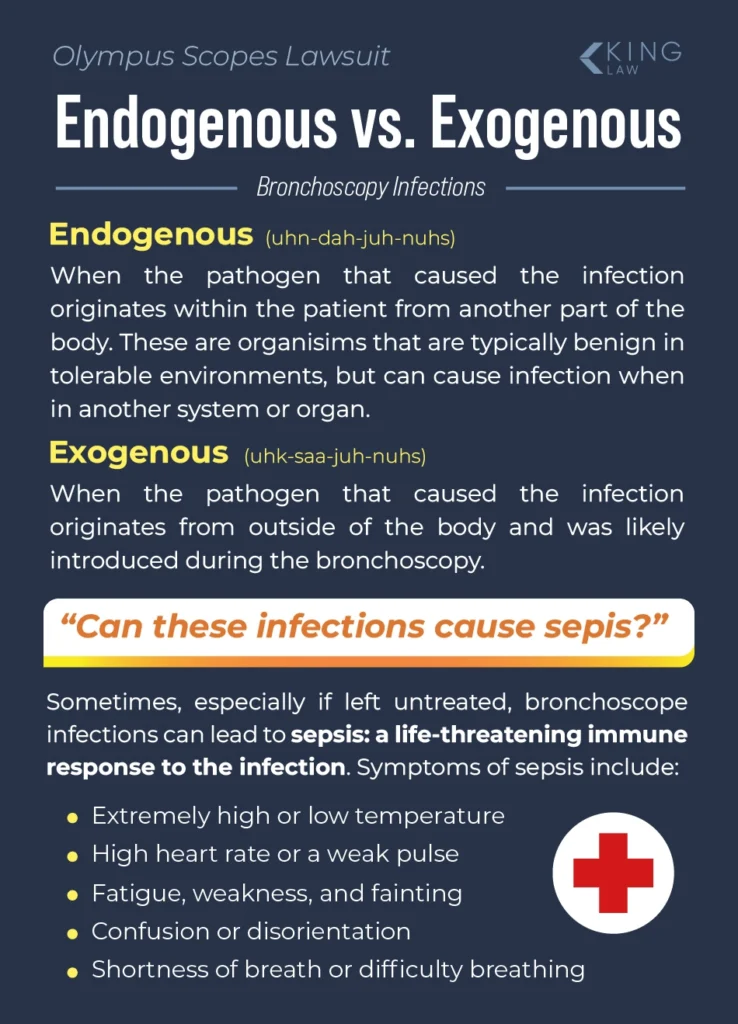
A bronchoscopy can cause a bacterial infection through endogenous or exogenous means. An endogenous infection involves bacteria already present in the patient. An exogenous infection introduces bacteria from outside of the patient’s body. While either type of infection can potentially be grounds for a lawsuit, endogenous infections could be the result of medical negligence or malpractice.
Endogenous Bronchoscopy Infections
The pathogens in endogenous bronchoscopy infections originate within the patient’s own body. In these cases, bacteria may be transmitted from one part of the body, where it is relatively harmless, to a more vulnerable part of the body (from the mouth to the lungs, for example). Patients with the following diseases may be more vulnerable to endogenous bronchoscopy infections:
- Airway obstructions like COPD
- Lung cancer
- Tracheobronchial stenosis
- Emphysema
- Poor baseline lung functioning
In other words, if endogenous infections are the result of wrongdoing or negligence on the part of medical staff, it is more likely to be medical malpractice than product liability.
Exogenous Bronchoscopy Infections
Some of the infections cited in bronchoscopy lawsuits are exogenous infections. That means a pathogen was allegedly introduced into their body during the bronchoscopy procedure. In some cases, these infections could be the result of contaminated endoscopes.
According to lawsuits filed by patients, infections introduced by reusable endoscopes may point to a design defect, manufacturing defects, infection-control failures, or insufficient sterilization. Reusable endoscope contamination, including bronchoscopes, is a well-documented and researched phenomenon, often involving particular types of bacteria.
What Is the Risk of Infection After a Bronchoscopy?
Overall, the risk of developing an infection after a bronchoscopy is relatively low. However, factors that can increase the risk of a bronchoscopy-related infection include:
- A bronchoscope is used in the ICU.
- The bronchoscope procedure is complex or invasive.
- The patient has cancer or a compromised immune system.
- The bronchoscope has not been properly sterilized.
- The bronchoscope is defective.
Patients should talk to their doctor about their personal risk of a bronchoscopy-related infection.
Can a Bronchoscopy Cause Pneumonia?
Patients who have a bronchoscopy do have a risk of contracting a lung infection after their procedure. Therefore, pneumonia is a possible post-procedure complication of having a bronchoscopy. According to a study called “Prospective study of fever and pneumonia after flexible fiberoptic bronchoscopy in older people,” there is a pneumonia incidence rate of 6.7% for patients under 70 who undergo a fiberoptic bronchoscopy (a bronchoscopy with an endoscope). People over age 70 had a 4.2% incidence rate of pneumonia. These results are from a single study, but they highlight the possible risk of pneumonia after bronchoscopy.
What Bacteria Are Linked To Bronchoscopy Infections?
Bacterial infections are among the adverse events linked to bronchoscopies, and may involve one of many disease-causing pathogens. Some of these organisms are benign when in environments that can tolerate or restrain their growth, but dangerous when they enter more sterile or sensitive environments.
Organisms that can cause bronchoscopy-related infections include:
- Pseudomonas aeruginosa (exogenous): One of the most common pathogens seen in endoscopic outbreaks. It tends to thrive in moist environments, including within the channels of a bronchoscope.
- Klebsiella pneumoniae (exogenous): Known for its Carbapenem Resistant Enterobacteriaceae (CRE) strains, which resist antibiotics of last resort. It is commonly found in the human intestines or respiratory tract where it is relatively harmless, but can colonize endoscopes and be transferred between patients.
- Serratia marcescens (exogenous): A bacterium that can be introduced through contaminated water during scope reprocessing.
- Nontuberculous Mycobacteria (exogenous): Another bacterium that can be introduced through contaminated water.
- Streptococcus pneumoniae (endogenous): A bacterium commonly found in the upper respiratory tract that can cause disease if pushed into the lungs.
- Staphylococcus aureus (endogenous): Frequently found in nasal passages and on the skin, but capable of causing disease when in the lungs.
- Haemophilus influenzae (endogenous): A bacterium commonly found in the throat that can cause opportunistic infections in the lungs.
Infections resulting from bacteria that are usually exogenous rather than endogenous in origin are often an important piece of evidence that may imply product liability from a legal standpoint.
Can a Bronchoscopy Infection Lead to Sepsis?
In some cases, a bronchoscopy infection can lead to sepsis, a severe, life-threatening immune response to an infection. Older patients, immunocompromised patients, recently hospitalized patients, and patients with comorbidities are at the highest risk of developing sepsis after a bronchoscopy. Symptoms of sepsis, which tend to come on quickly, include:
- Fever and chills
- High heart rate or weak pulse
- Clammy skin
- Shortness of breath
- Confusion or disorientation
- Extreme pain or discomfort
Sepsis often requires emergency medical intervention to treat not only the bacterial infection, but the immune response that, if left untreated, can attack and damage organs. Patients who develop sepsis may sue for more serious damages due to the economic, physical, and psychological impacts of the condition.
Who Is Most at Risk for Infection After a Bronchoscopy?
Anyone may develop an infection after a bronchoscopy. However, people who may have a higher risk of developing a bronchoscope-related infection include:
- Someone with COPD or lung disease.
- Someone who is older or has a compromised immune system.
- Someone who has cancer or an airway tumor.
- A patient with an obstructed airway may require more invasive treatments during the bronchoscopy.
Having lung or breathing challenges, a weakened immune system, or a complex bronchoscopy procedure may increase a person’s risk of developing an infection.
What Are the Symptoms of Infection After a Bronchoscopy?
Some of the symptoms of an infection after a bronchoscopy include:
- Fever (temperature above 101°F)
- Persistent or worsening cough (especially if the cough produces phlegm or blood)
- Shortness of breath
- Chest tightness or pain
- Fatigue
- Rapid or unusually shallow breathing
- Confusion or other cognitive changes
Note: The above symptoms may indicate an infection or sepsis related to an infection.
Anything that is concerning to the patient or seems out of the ordinary should be reported to the patient’s medical team right away. Some of the early signs of an infection after a bronchoscopy may mimic the normal recovery symptoms. However, bronchoscope-related infections can progress rapidly and become severe or life-threatening with little warning, if sepsis is involved. The best practice is to contact a doctor to discuss symptoms as they arise, so the patient can get treatment when needed.
Is Fever After Bronchoscopy Normal?
It is not uncommon for bronchoscopy patients to experience post-procedure symptoms, including a mild, short-lived fever. These benign fevers tend to occur immediately after the procedure and resolve within 24 hours. If the fever lasts longer than that, or exceeds 101°F, it may be a symptom of an infection, especially if it presents alongside symptoms like chest pain and purulent sputum.
How Are Bronchoscopy Infections Diagnosed?
If a patient has symptoms of an infection, a doctor may perform testing to understand what is making the patient sick. Doctors may use several different methods to diagnose a bronchoscopy-related infection, such as:
- Serum procalcitonin
- Polymerase Chain Reaction (PCR) testing
- Bronchoalveolar lavage (BAL) cultures
- Metagenomic Next-Generation Sequencing (mNGS)
- Blood tests
Doctors may use other tests to determine whether a patient has an infection after a bronchoscopy. Some tests may be more appropriate than others, given the patient’s health and the type of infection they may have.
How Common Is Bronchoscope Contamination and Cross-Contamination?
Researchers have found that it is relatively uncommon for infections to occur because of bronchoscope contamination and cross-contamination. However, some studies have suggested that bronchoscope-related infections may occur more often than previously thought. For example, one literature review study suggested that the cross-contamination rate for reusable flexible bronchoscopes was about 8.69%. However, contamination on a bronchoscope does not mean a patient will develop an infection. It simply means there is a risk of a patient developing an infection.
Can Bronchoscopy Equipment Spread Bacteria Between Patients?
Contaminated bronchoscopes can spread bacteria between patients if the scopes are not cleaned (reprocessed) properly or are unable to be reprocessed properly because of an alleged design flaw. For example, one infection outbreak was related to a loose biopsy port cap in a bronchoscope.
Some studies have suggested that reusable scopes have a higher risk of contamination because they can house bacteria from one patient and transmit them to another. For example, the Olympus BFQ180 Bronchoscope was part of a Class 2 Device Recall because it was “associated with a higher rate of patient infections than other comparable OMSC bronchoscopes.”
Are Reusable Bronchoscopes More Likely to Cause Infection Than Single-Use Bronchoscopes?
Early studies on single-use bronchoscopes suggest they are significantly less likely to cause an infection than reusable bronchoscopes. Single-use bronchoscopes eliminate one infection vector entirely: patient-to-patient transmission.
For example, one 2023 study of 14,228 cases found that patients treated with a single-use device had a 3.6% 30-day hospital readmission rate compared to 7.7% for reusable bronchoscopes. However, some of these readmissions were not due to infection. Many endoscopic devices are effectively hybrids, with some reusable and disposable components. Quality control and effectiveness in single-use devices have been major factors in the adoption of single-use endoscopes.
When Should You Seek Medical Attention After a Bronchoscopy?
You should seek medical attention if you develop any of the following signs after a bronchoscopy:
- Fever or abnormally low temperature
- Difficulty breathing
- Chest pain
- Nausea
- Fatigue
- Significant or sudden breathing or heart rate changes
- Other symptoms that are new or worsen after the procedure
Patients should talk to the healthcare team about any new, different, or worsening symptoms after a bronchoscopy. These changes may be a sign of a bronchoscope-related infection or complication.
What Should You Do If You Develop an Infection After a Bronchoscopy?
If you develop an infection within 30 days of bronchoscopy, you should first prioritize your health and safety, after which you can consider your legal options. Recommended steps to take are:
- Seek medical attention, especially if you have symptoms of a serious infection.
- Ask for medical records related to the bronchoscopy and infection, including diagnoses, culture results, discharge papers, prescriptions, and bronchoscopy records.
- Create a timeline of events.
- Consult an attorney if your infection was serious.
Taking these steps will help preserve your legal right to compensation if your infection was the result of a product defect or malpractice.
King Law Is Investigating Bronchoscopy Bacterial Infection Cases
King Law is investigating potential lawsuits from patients who developed an infection after having a bronchoscopy performed. Our team has extensive experience handling complex claims involving medical devices, including lawsuits filed about Olympus scopes. We have the resources to assess your possible bronchoscope infection claim and protect your legal rights.
Contact a Bronchoscopy Infection Lawyer Today
If you developed an infection after a bronchoscopy and are interested in discussing your legal options, call (585) 496-2648. We can also be reached by filling out this form. Our intake specialists are ready to help you set up a consultation with one of our seasoned attorneys. We do not charge upfront costs to hire or meet with us, and we provide free case evaluations. Click here for more information on how King Law handles Olympus scope cases.
Frequently Asked Questions (FAQs)
Some patient groups, like the elderly or immunocompromised patients, may be at a higher risk of infection.
List of Sources Used in This Article
King Law uses rigorous editorial standards when creating articles for our site. Here is a list of sources we used to create this article.
- Centers for Disease Control and Prevention. “About Sepsis.” CDC, updated 18 Sept. 2024, www.cdc.gov/sepsis/about/index.html.
- Choi, Hyo-Jin, et al. “Post-Bronchoscopy Infections: A Review of Incidence, Risk Factors, and Prevention Strategies.” Clinical Endoscopy, vol. 53, no. 2, 2020, pp. 135–144.
- EOSCU. “Endoscopy and Infection Risk.” EOSCU Blog, 2024.
- Giacomini, Maria, et al. “Infectious Complications Following Bronchoscopy: Current Evidence and Future Directions.” Respiratory Medicine, 2020.
- Healthy Kaiser Permanente. “Bronchoscopy: What to Expect at Home.” Kaiser Permanente Health Encyclopedia, accessed 1 June 2026.
- Kovaleva, Julia, et al. “Endoscope Microbiology and Infection Prevention.” American Journal of Infection Control, vol. 43, no. 5, 2015, pp. 452–462.
- Mayo Clinic Staff. “Bronchoscopy.” Mayo Clinic, 7 Mar. 2023.
- Mayo Clinic Staff. “Sepsis.” Mayo Clinic, updated 24 Apr. 2025.
- MedlinePlus. “Pneumonia in Adults.” U.S. National Library of Medicine, updated 2025.
- MedlinePlus. “Bronchoscopy.” U.S. National Library of Medicine, updated 2024.
- Muscarella, Lawrence F. “Risk of Transmission of Carbapenem-Resistant Enterobacteriaceae and Related ‘Superbugs’ During Gastrointestinal Endoscopy.” Chest, vol. 144, no. 3, 2013, pp. 988–995.
- Muscarella, Lawrence F. “Infections Associated with Bronchoscopes and Endoscopes: A Review.” Chest, vol. 147, no. 4, 2015, pp. 1141–1151.
- Ofstead, Cori L., et al. “Biofilm Formation and Contamination in Flexible Endoscopes and Implications for Patient Safety.” Pathogens, vol. 6, no. 4, 2017.
- Papavasileiou, Vasileios, et al. “The Risk Factors for Post-Bronchoscopy Respiratory Infection in Lung Cancer Patients—A Retrospective Case-Control Study from a Center in Greece.” Diagnostics, vol. 15, no. 9, 2025.
- Petersen, Brett T., et al. “Multicenter Study of Bacterial Transmission Associated with Endoscopy Equipment.” New England Journal of Medicine, vol. 348, no. 3, 2003, pp. 214–220.
- U.S. Food and Drug Administration. “Olympus Bronchoscope Recall Due to Reprocessing Concerns.” FDA Medical Device Recall Database, 2021.
- Wang, Yifan, et al. “Healthcare-Associated Infections Related to Endoscopic Procedures: An Updated Review.” Infection and Drug Resistance, 2022.
- Zhang, Rui, et al. “Infections Associated with Flexible Endoscopes: Epidemiology, Prevention, and Future Directions.” Microorganisms, vol. 11, no. 4, 2023.
- Zhou, Xin, et al. “Recent Advances in Bronchoscopy-Associated Infection Prevention and Surveillance.” Journal of Clinical Medicine, 2025.