
Complete the form below to tell us about your case

DWI Lawyers in Rochester and Western NY
Our Defense Attorneys Represent Individuals Charged With Driving Under the Influence
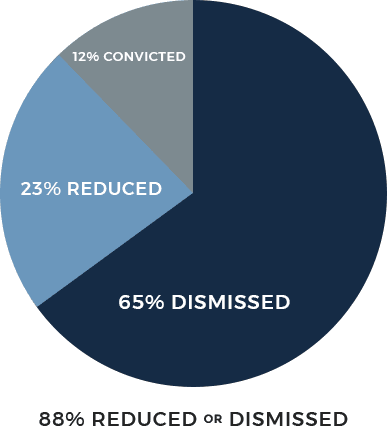
If you are facing driving while intoxicated charges in Rochester or Western New York, the DWI attorneys at King are ready to defend your case. Our team of defense has a proven record of having DWI charges against our clients reduced or dismissed. Many people in Rochester and surrounding areas are arrested for driving under the influence of drugs or alcohol. However, not everyone arrested for a DWI or DUI is guilty of their specific charges. In an attempt to reduce alcohol- and drug-related accidents, local law enforcement has been known to wrongfully accuse or over-charge individuals with DWI and DWAI offenses. A conviction of driving while intoxicated (DWI) is very serious, and you may lose your license, face jail time, and be subjected to fines.
A DWI conviction can impact all aspects of your life, including your job, family, and future well-being. If you have been charged with DWI in Rochester, Western New York, or the Finger Lakes, talk to a DWI attorney at King Law. We can help build your case and work to minimize the impacts to your life.
Types of DWI Cases We Defend In Rochester and Western New York
In New York, there are several charges you can face if you are suspected of driving under the influence of drugs or alcohol. The charges will be based on a number of factors, including what substance you are accused of using, who is in the car with you, the age of your passengers, and other factors. Each charge comes with its own potential legal consequences.
The attorneys at King Law represent people charged with:
- Driving while intoxicated (DWI)
- Aggravated driving while intoxicated (Aggravated DWI)
- Driving while ability impaired by alcohol (DWAI/Alcohol)
- Driving while ability impaired by a single drug other than alcohol (DWAI/Drug)
- Driving while ability impaired by a combined influence of drugs or alcohol (DWAI/Combination)
- Chemical test refusal
- Violations of the “Zero Tolerance” law (drivers under the age of 21)
We support clients throughout Rochester and the Finger Lakes who have been charged with any of the above traffic offenses. Contact our office for immediate support. Enlisting the help of a DWI lawyer soon after your arrest can help you better fight the charges against you.
What Are the Elements of a DWI Charge?
In order to convict someone of intoxicated driving in New York, prosecutors have to prove three things. They have to prove that someone was operating a motor vehicle while under the influence of drugs or alcohol. They also need to prove that the person was operating a vehicle on a public road/highway. They have to prove that the person was not able to act as reasonable or prudent driver. At King Law, we vigorously explore each of these elements to look for weaknesses in the prosecution’s case. We also closely examine the circumstances of field sobriety tests and chemical tests to ensure our client’s rights were not violated.
What Are the Penalties for DWI in New York?
If you are tried and convicted for driving under the influence, you will likely face multiple penalties. While the circumstances of each case will vary, it is always recommended that you work with a lawyer after an arrest. Here are the current penalties for those convicted of driving under the influence in New York.
First-Offense DWI in New York
Most first-time offenders can experience the following penalties (though there are exceptions for those driving with minors in the car or those with a suspended license):
- License revoked for at least 6 months
- $500 to $1,000 in fines
- Up to 1 year in prison
Second-Offense DWI in New York
People who are convicted of a second DWI offense in New York can face the following penalties:
- $1,000 to $5,000 in fines
- License revoked for at least 1 year
- Up to 4 years in prison
An interlock ignition device may also be required to be installed in your vehicle.
Third-Offense DWI in New York
- $2,000 to $10,000 in fines
- License revoked for at least 1 year
- Up to 7 years in prison
Additionally, an interlock ignition device may be required, as well as alcohol assessment and up to 60 days of mandatory community service.
DWI Accidents in New York
If your arrest was the result of an accident, you could be charged with additional crimes on top of your DWI offense. In the event that an accident resulted in a death, for example, you may be charged with vehicular manslaughter.
How Does New York State Define Different Types of DWI Offenses?
New York State law (Section 1192-Operating a motor vehicle while under the influence of alcohol or drugs) says that no one can legally operate a vehicle if they are impaired by drugs or alcohol. However, there is a range of what is considered “impaired,” and state laws delineate the different types of violations of its traffic laws. There are seven types of violations of this law, which are listed in the table below.
| Offense | Description |
|---|---|
| Driving While Intoxicated (DWI) | .08 Blood Alcohol Content (BAC) or higher, or other evidence of intoxication. For drivers of commercial motor vehicles: .04 BAC or other evidence of intoxication |
| Aggravated Driving While Intoxicated (Aggravated DWI) | .18 BAC or higher |
| Driving While Ability Impaired by Alcohol (DWAI/Alcohol) | More than .05 BAC but less than .07 BAC, or other evidence of impairment |
| Driving While Ability Impaired by a Single Drug other than Alcohol (DWAI/Drug) | Impairment by a single drug other than alcohol |
| Driving While Ability Impaired by a Combined Influence of Drugs or Alcohol (DWAI/Combination) | Impairment caused by the combined influence of drugs or alcohol |
| Chemical Test Refusal | A driver who refuses to take a chemical test, normally a test of breath, blood, or urine |
| Zero Tolerance Law | A driver who is less than 21 years of age and who drives with a .02 BAC to .07 BAC violates the Zero Tolerance Law |
Source: New York State Department of Motor Vehicles
Should You Take A DWI Breath Test?
A breathalyzer test (chemical test) can provide evidence in a criminal case. So why should you consider taking the test? You should consider taking the test because doing so can affect your ability to remain a licensed driver.
If you are arrested for DWI, and the proper protocol is followed, your license will most likely be suspended at arraignment. If you have taken a breath test, your attorney can apply for a hardship license, and you may be eligible for a conditional license 30 days following arraignment. A conditional license allows you to drive to and from work, school, probation, the DMV, medical treatment, your child’s school, your child’s daycare provider, and 3 hours of free time per week.
If you refuse the test, you will not be eligible for a conditional license. You will be granted a hearing by the Department of Motor Vehicles, where it will be determined whether you refused and the proper protocol was used. If so, your license is suspended for one year, and you will not be able to drive during that time.
There are certain times when you should not take a breath test:
If you have received two or more Driving While Intoxicated convictions in the past 25 years
There was an accident or injury
If you are convicted of a third DWI, you will likely face significant jail time. In addition, there could be lifelong impacts on your ability to get a license to drive a motor vehicle.
Common Questions About the DWI Laws in New York
New York State’s laws about driving under the influence of drugs or alcohol are complex. Here are some of the most frequent questions we receive from clients and their families after someone is arrested for a DWI.
Can the Police Search Your Car During a DWI Traffic Stop?
In some cases, the police can search your car if they pull you over for suspected drunk driving or driving while on certain drugs. However, in most cases, you have to be violating a traffic law for them to be able to stop you. If they make a lawful DWI arrest, they may be able to search the car for evidence. If your car is towed or impounded, they may perform what is called “an inventory search.” If there are drugs, accessories, or alcohol containers in plain view, the police can search your vehicle. Learn more about when police officers are legally allowed to search your vehicle.
Can You Be Arrested for Driving While Impaired for Taking Prescription Medicine?
Yes, the police can arrest you for driving while ability impaired by drugs (known as DWAI-Drug) for taking medicine prescribed by a doctor. However, taking that medication must have impaired your ability to drive. If your ability to drive was compromised, it does not clear you of blame, even if a doctor prescribed that medication. Under NYS law, the term “drug” includes those controlled substances listed in Section 3306 of the Public Health Law, which includes more than one hundred prescription medications. However, the prosecution must prove that you were under the influence of the controlled substance (whether prescribed or otherwise) and that the controlled substance impaired your ability to drive the motor vehicle.
Can You Be Arrested for DWI Even If You Weren’t Driving?
In some cases, you can be arrested for DWI or DUI even if the police did not see you operating a motor vehicle. These cases are complex, but our attorneys are ready to fight them. Read more about how people who were not seen driving can still face a DWI charge.
Is a DWI a Misdemeanor or a Felony in New York?
Depending on the circumstances of someone’s DWI arrest, they could be found guilty of an infraction, a misdemeanor, or a felony. For example, someone found guilty of two DWI or DWAI-Drug offenses within 10 years will have a felony conviction on their record. If someone is found to be operating a vehicle while under the influence of drugs or alcohol and they have a minor in the car, they will be charged with a felony under Leandra’s Law. Someone found guilty of their first DWAI will have an infraction, and this information will not go on their criminal record.
What is the Difference Between Aggravated DWI and Regular DWI in New York?
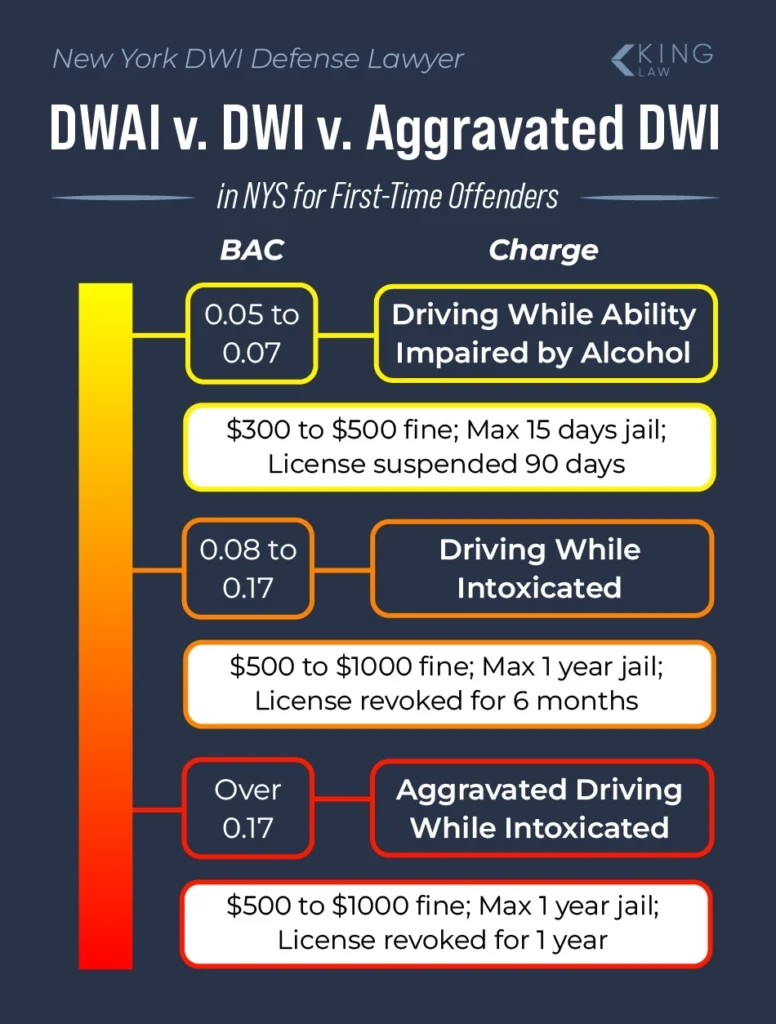
In New York, the difference between being charged with the misdemeanor of Aggravated DWI or a “regular” DWI is simply what your blood alcohol content is. To be charged with Aggravated DWI, you must be alleged to have a BAC of .18 or greater. Being charged with DWI in violation of NY VTL 1192(2) requires an alleged BAC of between 0.08 and 0.17.
The significant distinction in being charged with Aggravated DWI is a higher fine and a longer license revocation period. Aggravated DWI carries a minimum fine of $1,000 and a minimum revocation of 12 months. DWI carries a minimum fine of $500 and a license revocation of 6 months. Both are considered criminal convictions and require the installation of an ignition interlock device.
How Our Attorneys Will Defend You Against DWI Charges in New York
As former prosecutors, our team of experienced DWI lawyers understand how to defend the charges you are facing. When you choose King Law to represent your case, we will build on the following possible defenses:
- We can argue that the prosecutors cannot prove that our client’s conduct meets the threshold for “operation.” If our client was parked or the vehicle was not on or moving, it can be difficult for prosecutors to build a case.
- We will defend against illegal stops. Police cannot pull someone over if that person has not broken any laws. We will defend against unlawful stops and arrests.
- We will defend clients where the police had no probably cause to arrest. Field breathalyzer tests and field sobriety tests are often inaccurate and inadequate.
- We will review body cam footage to argue that the charges do not match the conduct. Our attorneys will uncover when body cam footage does not match written reports or statements given by law enforcement.
King Law Case Results in 2026: DWI Charges Against Our Client Dismissed
The Arrest
One of our recent clients was charged with DWI in Yates County, New York. During the police investigation, the officer quickly made the interaction confrontational. Our client offered to walk home and was denied the opportunity. Our client declined to participate in field sobriety tests and refused to give a breath sample. In some ways, these choices limited the amount of evidence that was available. Therefore, the prosecution needed to rely on other police observations, such as claiming our client had bloodshot and watery eyes, slurred speech, and impaired motor coordination.
The Trial
At trial, during cross-examination, we successfully obtained admissions that these “observations” were not documented in arrest reports and were not consistent with the officer’s body camera. In fact, the bodycam videos showed our client had good balance and coordination. Due to these inconsistencies and others, we attacked the officer’s credibility. We highlighted on-camera discussions between the arresting officer and assisting officer where they themselves were unsure of whether to arrest our client or not. We argued that if they were unsure about the arrest when they made it, there must be reasonable doubt now.
The Outcome
| The Outcome: Dismissal of DWI Charges |
| The court had the jury consider driving while intoxicated (DWI) and driving while ability impaired by alcohol (DWAI) during their deliberations. The jury deliberated for approximately 30 minutes before unanimously finding our client NOT GUILTY of both charges. |
Working To Help You Beat Your DWI Charges In Rochester and Beyond
New York State’s DWI laws are complex, and King Law recommends that you not try to navigate the legal process alone. Our defense lawyers are ready to rigorously defend your rights and advocate for a reduction in charges or dismissal.
Whether this is your first DWI arrest, you are underage, or you are facing a charge as a repeat offender, you deserve to work with an experienced litigator. Our firm can evaluate your case and all necessary evidence, police reports, witness statements, and breath or blood test findings. Our defense attorneys are ready to aggressively defend the charges against you.
FAQs
CASE RESULTS
OUR RESULTS SPEAK FOR THEMSELVES.
Criminal Sale of Controlled Substance
Result - Dismissed
Rape in the First Degree
Result - Dismissed
Pedestrian Accident
Settlement - $105,000