

Rhode Island Private School Sexual Abuse Lawsuit
Complete the form below to tell us about your case

Survivors of childhood sex abuse can file civil lawsuits against private schools and other institutions that they allege failed to protect them. A bill signed into law by Governor Dan McKee opened a retroactive filing window from July 1, 2026, to June 30, 2028. During that time, people who were abused as children at their schools will be able to file a lawsuit, regardless of when that abuse happened.
Rhode Island abuse survivors can file civil lawsuits against perpetrators, institutions, administrators, or any individual who allegedly enabled or concealed their abuse, even if the statute of limitations on their case had previously expired.
This page will discuss how the new Rhode Island law affects survivors’ legal rights and options, which private schools are implicated in abuse, why schools may be held legally responsible, and how to file a sexual assault lawsuit against a private educational institution in Rhode Island.
About the Rhode Island Private School Sexual Abuse Lawsuit
About Sexual Abuse in Rhode Island Private Schools
How Common Is Sexual Abuse in Rhode Island Private Schools?
Which Rhode Island Private Schools Have a History of Sexual Abuse?
Who Are Normally the Perpetrators of Sexual Abuse at Schools?
Who Are Normally the Victims of Sexual Abuse at the Schools?
How Does Sexual Abuse in Schools Normally Happen?
Who Can Be Held Responsible in a Private School Sexual Abuse Lawsuit in Rhode Island?
Who Can File a Rhode Island Private School Sexual Abuse Lawsuit?
How Can I File a Rhode Island Private School Sexual Abuse Lawsuit?
Is There a Deadline to File a Sexual Abuse Lawsuit Against the Private School?
How Much Money Can I Receive If I Choose to Pursue a Lawsuit?
King Law Is Actively Investigating Rhode Island Private School Sexual Abuse Claims
Contact Robert King Law Firm For a Free (and Confidential) Case Review
About Sexual Abuse in Rhode Island Private Schools
Sexual abuse in Rhode Island private schools can include anything from direct sexual assault, to grooming and harassment that occurred on campus, during school trips, in dormitories, or through private communications. Perpetrators in these cases may be staff, contractors, or other students. Crucially, the abuse occurred in a context in which the private school had the responsibility to protect the child from harm or, if harm occurred, to take appropriate action to address it. Plaintiffs in some Rhode Island private school sexual abuse lawsuits allege that the institutions prioritized their own reputation over protecting their students, allowing abusers to continue abusing minors.
How Abuse Could Happen in Rhode Island Private Schools
Private schools are not governed by the same regulations as public schools.
This means that the internal affairs of private schools are often not disclosed to the public. Investigations by journalists and lawsuits filed against some private schools in Rhode Island have alleged that concerns about reputation and enrollment contributed to the mishandling of sexual abuse allegations in certain cases.
How Common Is Sexual Abuse in Rhode Island Private Schools?
Sexual abuse in schools is believed to be extremely underreported. However, some state, federal, and independent agencies do investigate sexual abuse in schools. There is no state-level database tracking sexual abuse within Rhode Island private schools, and the exact rate of such incidents is unknown.
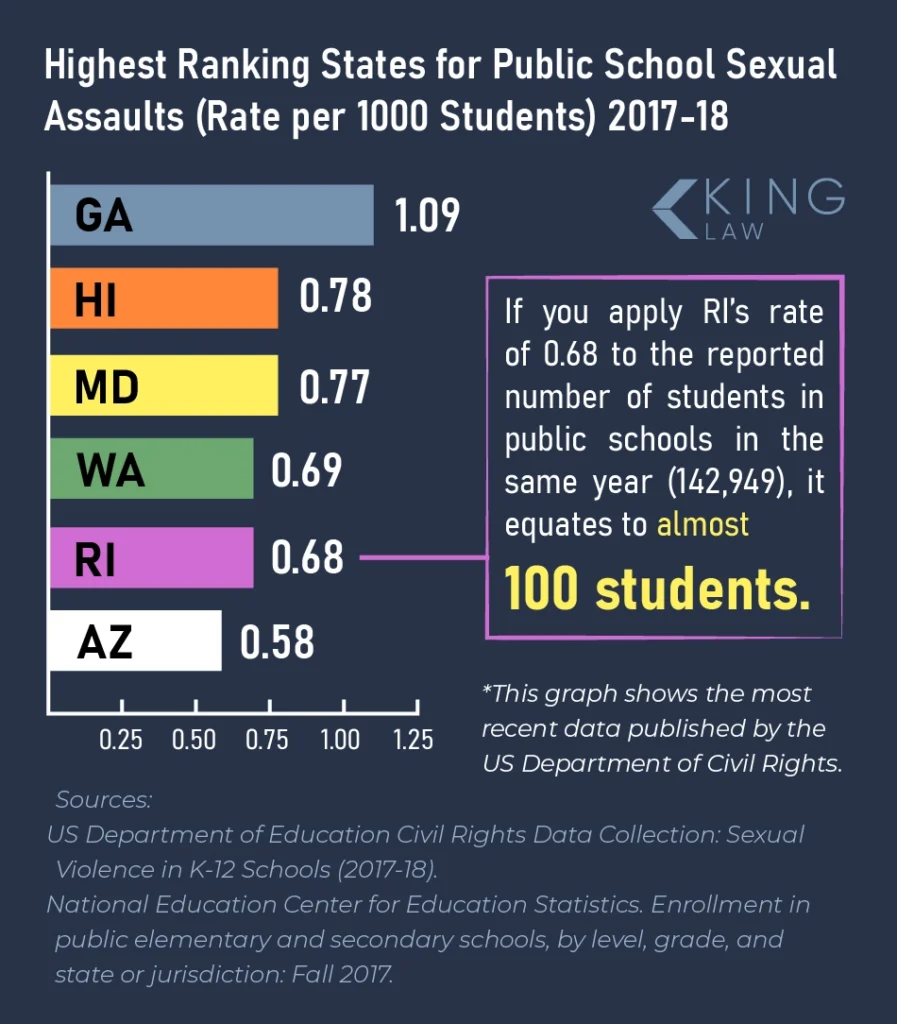
However, the U.S. Department of Education Office for Civil Rights does collect data related to sexual assaults in public schools. As of 2026, the last comprehensive report was updated in 2022 and contained data for the 2017-2018 school year. According to the
For data regarding private schools, the Rhode Island attorney general conducted an investigation into private Catholic schools. In March 2026, Rhode Island Attorney General Peter Neronha released the results of the investigation into the Roman Catholic Diocese of Providence. The investigation found that at least 300 victims reported abuse involving clergy, dating back to 1950, including in private Catholic schools. There have also been several high-profile cases involving specific Rhode Island private schools like St. George’s School, Portsmouth Abbey School, and Rocky Hill Country Day School.
Other publicly available data can be taken from a national 2022 study on educator misconduct. That study found that 11.7% of 6,632 participants surveyed reported having experienced at least one form of sexual misconduct during Grades K-12, with 11% reporting sexual comments and the remainder reporting other forms of sexual abuse. It did not, however, distinguish between public and private schools.
Which Rhode Island Private Schools Have a History of Sexual Abuse?
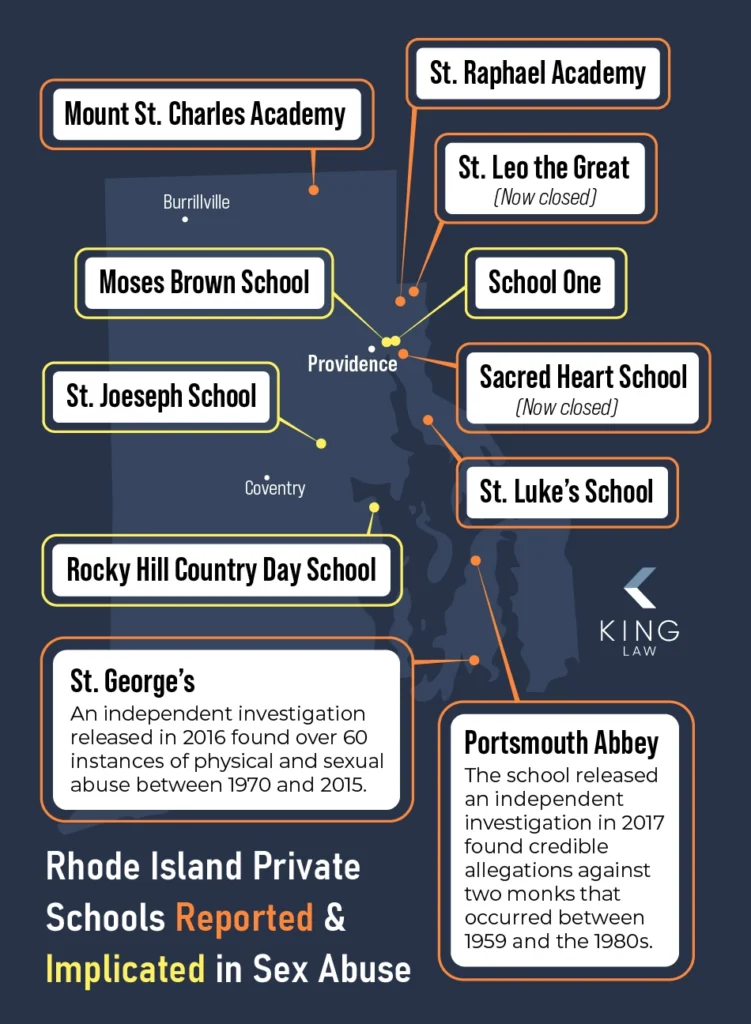
Multiple Rhode Island private schools have faced allegations of institutionalized sexual abuse, with documented cases dating back as far as the 1950s. Some of the private Rhode Island schools facing accusations of institutional sexual assault include:
- St. George’s School
- Portsmouth Abbey School
- Catholic Schools supported by the Diocese of Providence
State-level investigations, formal reports, and investigative journalists have found that some private schools have a culture of secrecy and reputation preservation that discouraged or even punished disclosures of sexual abuse. Among the most prominent cases so far have been St. George’s School and Portsmouth Abbey School, though they are not the only institutions named in Rhode Island sexual abuse lawsuits.
St. George’s School
St. George’s School is a co-ed boarding and day school in Middletown. The school released the results of an independent investigation in 2016 that found over 60 instances of physical and sexual abuse at the school between 1970 and 2015, involving at least 51 students. Around 31 of the reports were made by female students against athletic trainer Alphonse Gibbs. The report claims he engaged in sexual misconduct with girls in every class from the Class of 1976 to the Class of 1982. Gibbs was eventually fired for sexual misconduct. Five other faculty or staff were also named:
- William Lydgate, an English teacher (1968-1970)
- Timothy Tefft, an English teacher (1971)
- Rev. Howard White, an associate chaplain, teacher, and coach (1971-1974)
- Franklin Coleman, a music teacher (1980-1988)
- Susan Goddard, a nurse (1976-1998)
Additionally, the report found 9 credible instances of student-on-student sexual assaults in the 1970s and 1980s.
In August 2016, 30 alumni, including Anne Scott, reached a confidential settlement with St. George’s. Scott, who was abused by Gibbs, claims that she tried to file a lawsuit in her twenties, but was aggressively targeted by the school at the time.
Portsmouth Abbey School
Portsmouth Abbey, a private Catholic school owned and operated by Benedictine Monks, contracted its own independent investigation shortly after St. George’s. The school released the results in August 2017. The 15-page report (Report to the Board of Regents of the Portsmouth Abbey School) found credible allegations of sexual abuse against two monks: Father Bede Gorman and Father Geoffrey Chase.
The incidents happened between 1959 and the early 1980s. The report also found complaints against the monks from the 1970s that were never referred to legal authorities. More recently, a sexual abuse case filed by an anonymous female victim in 2020 alleged that humanities teacher Michael Bowen Smith had groomed her from age 15 and engaged in sexual acts with her between 2012 and 2014. The case, Jane Doe v. Order of Saint Benedict, was ruled to be time-barred in 2024 and dismissed.
Barrington Christian Academy
Barrington Christian Academy (BCA) is the only K-12 Christian college-preparatory school in Rhode Island. In August of 2026, a teacher and coach at Barrington Christian Academy in Rhode Island was indicted on federal charges related to sexual crimes against a minor and impersonating a member of the FBI. Sean Cassidy, 53, of Pawtucket, Rhode Island, is facing charges of coercion and enticement of a minor. Although this is a criminal case, a civil lawsuit could follow if it is found that school administrators or personnel knew anything about the relationship between Cassidy and the fourteen-year-old girl or other possible victims. It is not uncommon for school districts to face civil lawsuits alleging cover-ups or mishandling of reports or other information related to improper conduct by district staff.
Catholic Schools Operated by or Affiliated With the Diocese of Providence
The Roman Catholic Diocese of Providence has, itself, been the subject of sexual abuse allegations going back to 1950. Many of these incidents are described in the March 2026 Attorney General’s report on sexual abuse within the Diocese.
The report identified at least 300 individuals who were victimized as minors between 1950 and 2019, along with 75 credibly accused clergy members. The report did not disambiguate claims involving abuse in schools run by the Diocese from those that happened in other settings, and cases involving ongoing abuse frequently occurred in multiple Catholic institutional contexts. The report does document Rhode Island Catholic private schools as access points for predators, and specific complaints name schools like Our Lady of Mercy in East Greenwich.
According to the report (Report on Child Sexual Abuse in the Diocese of Providence), here are the private Catholic schools in Rhode Island with reported clergy abuse during the reporting period:
- Mount Saint Charles Academy, Woonsocket (middle and high school)
- St. Raphael Academy, Pawtucket (high school)
- St. Joseph’s School, West Warwick (pre-k, elementary, and middle)
- Sacred Heart School, West Warwick (pre-k, elementary, and middle)
- St. Joseph’s School, Woonsocket (elementary and middle)
- St. Leo the Great School, Pawtucket (elementary and middle)
- St. Luke’s School, Barrington (pre-k, elementary, and middle)
Other Rhode Island Private Schools Implicated in Sex Abuse
Other Rhode Island private schools have also been named in childhood sexual abuse lawsuits and complaints. These include:
- Rocky Hill Country Day School. In 2016, three female alumni accused a former male faculty member of sexually abusing them at the secular coed private school in the 1970s.
- Moses Brown School. A 2020 independent investigation found five former school employees engaged in sexual activity with students between 1950 and the early 2000s.
- School One. During a 2016 regional Boston Globe investigation, School One disclosed an incident from the 1990s where a part-time teacher entered into a sexual relationship with a student.
- St. Raphael Academy. A private prep school named in the Attorney General’s report. It operates independently of the Diocese of Providence.
As survivors come forward and file lawsuits during Rhode Island’s revival window, it is possible that other private educational entities are named in sexual abuse lawsuits.
Who Are Normally the Perpetrators of Sexual Abuse at Schools?
Perpetrators of sexual abuse at schools may be teachers, coaches, clergy members, supporting staff, or other students. A 2023 study of sexual misconduct in K-12 schools found that:
- 63% of perpetrators were academic teachers
- 20% of perpetrators were coaches or gym teachers
- 85% of perpetrators were male
- 29% used special attention (favoritism, mentorship) to groom their victims
While student-on-student abuse is an issue in private schools as well, staff offenders may use their authority, access, and positions of trust to groom their underage victims. Screening faculty through background checks often fails to catch predators. Some research has shown that most perpetrators have clean records at the time they obtain their jobs.
Who Are Normally the Victims of Sexual Abuse at the Schools?
Victims of childhood sexual abuse at private schools are typically students. Sometimes those students are athletes, participants in religious programs, or receiving tutoring. Children of any age or gender may be the target of sexual abuse, but most frequently targeted in schools are:
- Children between the ages of 14 and 17
- Students who show deference to authority or people-pleasing characteristics
- Children who are “isolated” due to a family crisis
While children with the above characteristics may be more frequently targeted, students with other characteristics make up a substantial number of victims. This makes it important to take claims of abuse seriously, regardless of the victim’s demographic characteristics or personality.
How Does Sexual Abuse in Schools Normally Happen?
School-based sexual abuse is often an ongoing process rather than a single, acute event. A Training Guide for Administrators and Educators on Addressing Adult Sexual Misconduct describes school-based sexual exploitation as typically unfolding in three distinct phases:
- Trolling and testing. This is a screening process through which the offender tests physical and emotional boundaries and tries to identify a vulnerable target. Motive, typically, is not clear at this stage.
- Grooming. The offender will then attempt to create a personal relationship with the target, possibly offering gifts, giving special attention, or disclosing inappropriate (but not necessarily sexual) information. The perpetrator may also begin to try to isolate the child socially from family, peers, or other personnel.
- Exploitation and threats. The final phase typically involves more overtly abusive behaviors, including sexual contact, threats, intimidation, and manipulation. These behaviors attempt to maintain access to the victim and discourage them from reporting the abuse.
Abuse may be more likely to continue when administrators ignore complaints and fail to follow through on investigating and referring credible ones to legal authorities.
Who Can Be Held Responsible in a Private School Sexual Abuse Lawsuit in Rhode Island?
A civil private school sexual abuse lawsuit in Rhode Island may involve defendants beyond the individual who perpetrated the abuse. In fact, a civil sexual abuse lawsuit can be filed even if the perpetrator is deceased. The following possible defendants may be held responsible:
- The direct perpetrator(s)
- The private school or school corporation
- School administrators and governing-board members
- A religious order, parish, church, or diocese that runs the school
- Contractors, vendors, or outside programs
- Third-party entities responsible for hiring, supervision, or student safety
Institutions may be liable in cases where they were aware of the abuse (or should reasonably have known about it) and failed to take reasonable actions to protect the student. For example, claims against institutions may involve negligent hiring, retention, training, or reporting practices, or active concealment of allegations.
Who Can File a Rhode Island Private School Sexual Abuse Lawsuit?
Until June 30, 2028, anyone who alleges they were sexually abused as a student of a Rhode Island private school may be able to file a claim, regardless of when that abuse occurred. This includes individuals who were sexually abused by:
- Faculty
- Supporting staff or contractors at the school
- Clergy or religious order members associated with the school
- Another student
Having your claim evaluated by an attorney can give you a sense of whether your claim is a good fit for a Rhode Island private school sexual abuse lawsuit and, importantly, whether your case may qualify for the revival window that opened on July 1, 2026, and runs through June 30, 2028. During this time, survivors will be able to file lawsuits even if their case had previously been time-barred.
How Can I File a Rhode Island Private School Sexual Abuse Lawsuit?
You can start the filing process for a Rhode Island private school sexual abuse lawsuit by first having your claim evaluated by a law firm with experience in institutional sexual abuse cases. This will help determine if your claim is a good fit for the revival window and give you the option to hire representation that can help you through every stage of the lawsuit. These stages are:
- A confidential, no obligation consultation.
- Identifying defendants, dates, witnesses, and available records.
- Investigating employment files, complaints, school policies, insurance coverage, and prior allegations.
- Determine which individuals and institutions may be legally responsible.
- File a civil complaint within relevant deadlines.
- Proceed through discovery, settlement negotiations, or trial.
Note that you can begin the process without perfect recollection of events or documentation. Experienced law firms like the Robert King Law Firm will assist you in gathering evidence and records to support your claim.
Is There a Deadline to File a Sexual Abuse Lawsuit Against the Private School?
The deadline to file a sexual abuse lawsuit against a private school in Rhode Island may vary depending on the specific circumstances of your case and your age. As of June 2026, the deadlines are as follows:
- 35 years from your 18th birthday, or your 53rd birthday
- Seven years from the date that you discover, or reasonably should have discovered, the connection between your abuse and resulting injuries.
However, from July 1, 2026, to June 30, 2028, the statute of limitations is suspended on private school sexual abuse lawsuits. This includes cases previously considered, or even officially ruled to be, time-barred. After June 30, 2028, these cases will most likely become time-barred again, so be sure to seek a consultation quickly to ensure you don’t miss any critical deadlines.
How Much Money Can I Receive If I Choose to Pursue a Lawsuit?
So far, there have not been any major public settlements in the Rhode Island private school lawsuits. There have, however, been multiple sexual abuse settlements with institutions in Rhode Island, including the Diocese of Providence. There have been two major settlements with the Diocese of Providence on public record so far:
Compensation in institutional abuse cases often varies substantially based on:
- The extent of the abuse and resulting injuries
- The survivor’s age at the time
- Medical and counseling expenses
- Lost income or reduced earning capacity
- The behavior of the institution
- The strength of available evidence
- Whether or not punitive damages are awarded
A consultation with an experienced sexual abuse attorney can help set expectations for your case.
King Law Is Actively Investigating Rhode Island Private School Sexual Abuse Claims
King Law is currently investigating claims of sexual abuse in Rhode Island private schools, including boarding schools, Catholic schools, and religious academies. Our trauma-informed partners have decades of experience investigating historical records and prior complaints in states like Rhode Island, as well as aligning case filings with new developments like the revival window opened by Annie’s Bill. Our attorneys work on a contingency basis, so there are no upfront costs to pursuing your case.
Contact Robert King Law Firm For a Free (and Confidential) Case Review
If you are a survivor of childhood sexual abuse that occurred at school or a school event in Rhode Island, contact King Law today by dialing (585) 496-2648 or submitting a form on this site to schedule a free case review with no obligations. Our experienced team offers free case reviews and will confidentially help build your case before the Rhode Island revival window closes.