

Ohio Water Contamination Lawsuit [2026 Update]
See if You Qualify

People harmed by water pollution in Ohio have filed lawsuits against the companies responsible for contaminating their drinking water supplies. Ohio’s waterways have served as hubs for commerce, transportation, and population growth for hundreds of years. However, this development has come at a price. Decades of industrial output and military operations have contributed to water contamination throughout the region.
Hazards ranging from oil spills to PFAS contamination have affected Ohio’s water. Consumers statewide have begun to suffer from multiple illnesses and injuries from this contamination. Many are now fighting back by filing lawsuits against the parties responsible for polluting Ohio’s water supplies.
Ohio Water Contamination Lawsuit Overview
Historically, much of Ohio’s economy has been driven by the state’s proximity to water. Lake Erie and the Ohio River make up significant portions of the state’s northern and southern borders, and the state is also lined with major water routes like the Cuyahoga and Maumee Rivers. Ohio is the home of General Electric, Goodyear Tire, Procter & Gamble, and multiple other manufacturers and producers. Unfortunately, this development has caused water contamination statewide in conjunction with agriculture, the military, and other polluters.
In recent years, Ohio has begun various initiatives to address significant water contamination. However, despite these efforts, many water supplies have already been contaminated. A number of lawsuits have been filed in Ohio targeting producers who have contributed contamination—including cancer-causing PFAS—to the state’s water. King Law is committed to helping those affected by Ohio’s water contamination to seek justice and compensation for their losses.
Timeline of Water Contamination in Ohio | 2026 Update
August 2025: The City of Loveland, Ohio, has received $1.3 million dollars to address PFAS contamination in its public water supplies. Three public water supplies tested positive for PFAS above allowable levels in 2023. The funding, which comes in the form of a forgivable loan from the state, is to be used for removal and future prevention of PFAS contamination. Around 13,000 residents in Loveland and surrounding areas get their drinking water from the city.
July 2025: Citing a spike in PFAS levels in the Ohio River, U.S. Rep. Morgan McGarvey has asked the EPA to take action. Rep. McGarvey sent a letter to EPA Administrator Lee Zeldin, asking him to reconsider regulations for PFAS levels in drinking water supplies throughout the country. Although McGarvey represents Kentucky, the Ohio River presents a natural border between Ohio and Kentucky. PFAS originating from Ohio businesses can travel great distances from their source and contaminate water supplies along the way.
May 2025: Bipartisan legislation is introduced in the Ohio Legislature to replace all lead water service lines within the next 15 years. The bill, called the “Lead Line Replacement Act,” aims to remove lead from Ohio residents’ water supplies.
April 2025: The U.S. EPA announced a new PFAS Action Plan, which seeks (among other efforts) to implement a PFAS testing strategy under the Toxic Substances Control Act (TSCA), ramp up development of testing methods, and use the Safe Drinking Water Act (SDWA) to investigate and address immediate PFAS threats.
January 2025: An executive order issued by Donald Trump aims to roll back the EPA’s proposed PFAS guidelines restricts all proposed limits from going into effect.
April 2024: The EPA sets its first enforceable set of drinking water limits for PFAS. Many states, Ohio included, are now required to install new filtration systems to remove these toxins from drinking water. However, the cost of these systems places considerable pressure on affected states.
March 2024: Ohio officially begins its AFFF takeback program, which seeks to collect, remove, and safely destroy PFAS-containing firefighting foam that was once a substantial contributor to pollution statewide.
February 2024: Dayton, Ohio, announces a new $11 million plan to combat PFAS in the city’s drinking water.
About the Ohio Water Contamination Lawsuit
Ohio Water Contamination Lawsuit Overview
Timeline of Water Contamination in Ohio | 2026 Update
Sources of Water Contamination in Ohio
Ohio’s Regulations for Drinking Water
Contaminants Found in Ohio Drinking Water
Health Risks and Symptoms Linked to Drinking Water in Ohio
Eligibility Criteria for the Ohio Water Contamination Lawsuit
Ohio Water Contamination Settlement and Payout Amounts
How to File an Ohio Water Contamination Lawsuit
Statute of Limitations for Ohio Water Contamination Claims
Sources of Water Contamination in Ohio
There are many potential contributors to water contamination throughout Ohio. These sources include large agricultural producers, manufacturers, outdated lead plumbing, the state’s mining industry, and urban pollution. Everything from lead to chloroform, trihalomethanes (THMs), and arsenic have appeared in the state’s water. In many cases, these pollutants have appeared in drinking water at unsafe levels. For example, the contaminated Cuyahoga River in the Cleveland area has caught fire multiple times in the city’s history. Such events have led to significant efforts to further purify and sanitize Ohio’s water.
Despite these efforts, threats persist. Pesticides used in Ohio’s significant agricultural activities can easily permeate ground- and surface water through runoff. Ohio also continues to deal with a significant amount of lead plumbing, which creates ample opportunities for the toxin to enter water. Many municipalities are making conscious efforts to remove lead piping. Legislation has been introduced at the state level to phase out lead piping entirely.
The pervasive use of PFAS (“forever chemicals”) in Ohio’s water has made this contaminant of particular concern. Countless sample tests of public water systems have revealed PFAS, with multiple samples showing concentrations in excess of the EPA’s Maximum Contaminant Level (MCL). PFAS have polluted water supplies around airports, military installations and certain industrial areas because of their use in firefighting foams and other consumer products
Water Contamination From Military Installations
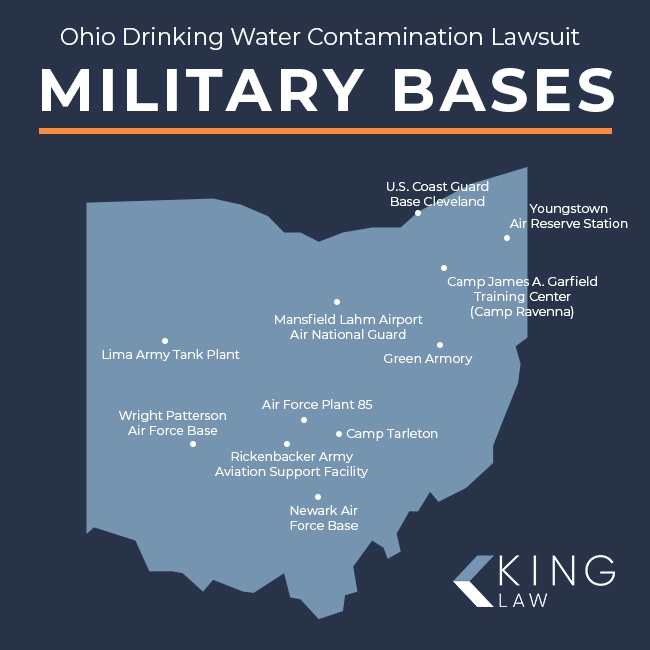
Ohio is home to many military facilities. Each of these might contribute contaminants to local water supplies. Military areas within the state include:
- Wright-Patterson Air Force Base
- U.S. Coast Guard Base Cleveland
- Youngstown Air Reserve Station
- Camp James A. Garfield Training Center (Camp Ravenna)
- Green Armory (North Canton)
- Mansfield Lahm Airport (Air National Guard Base)
- Lima Army Tank Plant
- Gentile Air Force Base (Kettering)
- Newark Air Force Base
- Air Force Plant 85 (Columbus)
- Rickenbacker Army Aviation Support Facility (Columbus)
- Camp Tarleton (Fairfield County)
The pervasive use of aqueous film-forming foam (AFFF) and other PFAS-containing materials on bases creates water contamination risks around these areas. In some cases, PFAS have been detected in the water around military bases in alarming quantities. A sampling of these results over the years includes:
- Wright-Patterson AFB: 4.8 ppt (PFOA), 7.8 – 12.4 ppt (PFOS)
- Gentile AFB: 34 ppt (PFOA), 146 ppt (PFOS)
- Newark AFB: 221 ppt (PFOA), 435 ppt (PFOS)
- Youngstown Air Reserve Base: 11,000 ppt (PFOA), 54,000 ppt (PFOS)
The EPA has established 4 ppt as the maximum contaminant level for both PFOA and PFOS. However, those levels do not go into effect until 2031. The high levels of PFAS surrounding these facilities is concerning and pose significant danger to residents.
Ohio’s Regulations for Drinking Water
All Ohio water must follow standards set in the Federal Safe Drinking Water Act (FSDWA), the Clean Water Act, and other federal and state regulations. Ohio conducts regular quality checks and water sanitation to provide consumers with drinking water that meets acceptable standards.
As further concerns regarding water quality—notably PFAS contamination—have arisen, the state has implemented new initiatives to help combat these challenges. Since 2019, the state has supported its own PFAS Action Plan to aid in the fight. The actions in this plan seek to reduce Ohioans’ exposure to these dangerous chemicals by identifying sources of contamination, sampling water for the presence of PFAS, and providing appropriate funding to mitigate the issue.
Both federal and state legislation have attempted to reduce the amount of PFAS in consumer products. Other regulations seek to increase monitoring of water sources and implement other safeguards. Despite these, PFAS and other contaminants continue to threaten Ohio residents. Many safe drinking water regulations are out of date and slow to change. Many new technologies are extremely expensive. The fight for safer water throughout Ohio (and other states) remains an ongoing battle.
Ohio Water Contamination Map
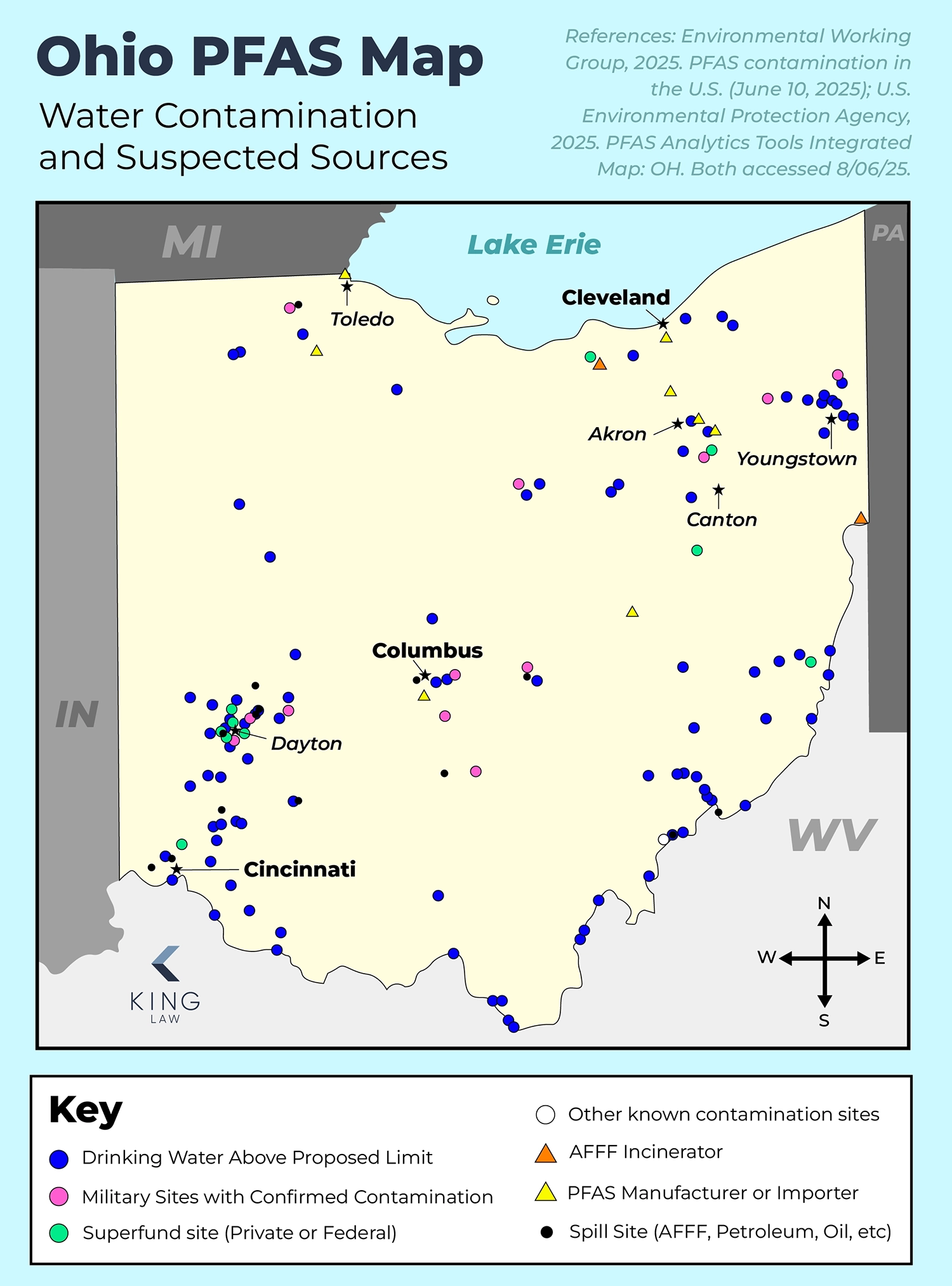
Curious about where PFAS and other chemicals have been detected in Ohio’s drinking water? Check out the map below. Multiple jurisdictions have reported contamination. Many of these reports occur around military bases, in areas where aqueous film-forming foam (AFFF) has been used, or in areas where PFAS-containing materials are known to be manufactured or used. Although the presence of PFAS sometimes falls below the EPA’s MCL, the chemicals remain a clear threat to consumers.
Contaminants Found in Ohio Drinking Water
Ohio’s water, regardless of its source, is likely to contain contaminants of some form. For example, Ohio’s aging water pipes may be made with lead, which can leach out of pipes and into water supplies. Human-made chemicals, such as PFAS, might appear in the water following atmospheric contamination, improper disposal, spills, or unsafe handling. Even small concentrations of many of these contaminants may pose health risks to consumers.
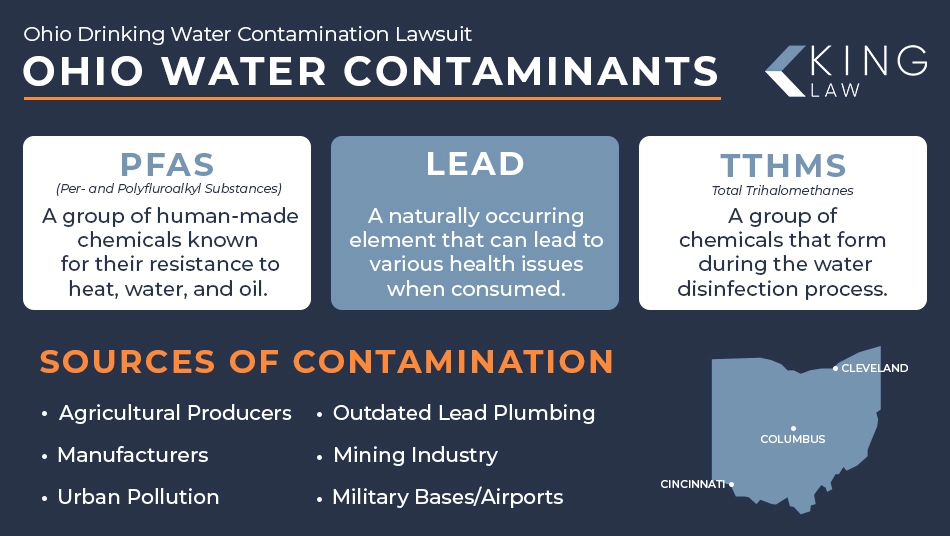
Per- and Polyfluoroalkyl Substances (PFAS)
PFAS (per- and polyfluoroalkyl substances) are found in many water supplies in Ohio. However, the more common moniker of these contaminants is “forever chemicals.” That says a lot about the threat they pose. For many years, these chemicals were used in things like non-stick cookware, plastic packaging, carpets and upholstery, firefighting foam used at military bases, and even cosmetics. These chemicals are extremely durable and very hard to break down. This makes them excellent preservatives and protectants. Unfortunately, that durability also makes them dangerous.
PFAS—which has a variety of subtypes like PFOA, PFOS, etc.—can enter the human body in microscopic form through our drinking water. However, PFAS are extremely difficult to break down. Over time, they can build up in your system and cause multiple health risks, notably various cancers, organ damage, and immune system disorders. In Ohio, water supplies in the Dayton area may have been contaminated by the American CARCO property in Montgomery County’s Harrison Township. Groundwater samples from the site tested positive for PFOS in 2019. PFOS from this plant have infiltrated groundwater supplies and are threatening the City of Dayton’s Miami Wellfield.
Lead
Lead is a naturally occurring substance. However, it’s dangerous to humans who are consistently or overly exposed to it. This metal was once pervasively used in everyday household items from pencils to paint, and notably, as plumbing. Unfortunately, the lead within pipes could begin to corrode over time, causing minuscule flecks to enter a home’s water supply. This lead can pose significant health issues to consumers.
The push to limit or remove this metal from everyday use is ongoing. In 2024, the EPA took additional actions to lower lead in drinking water and changed lead action levels. However, the extent to which lead items permeated our everyday lives in the past has made this a long undertaking. New lead pipes have been banned in the U.S. since the 1980s. However, many states, including Ohio, continue to work to remove old pipes from public water systems. In 2025, legislation was introduced at the state level to mandate the removal of all pipes within the next 15 years. The legislation, called the “Lead Line Replacement Act” is moving through the Ohio House of Representatives but still needs approval in the Senate and by the governor.
Total Trihalomethanes (TTHMs)
TTHMs actually form as byproducts from chemicals (like chlorine) used in the water disinfection process in Ohio and other states. While chemicals are important parts of the process of creating safe water, they must be filtered out before they reach the consumer. Otherwise, the THM byproducts may enter the consumer’s water. Trihalomethanes can increase the consumer’s risk of bladder cancer, liver, kidney and intestinal tumors, cardiovascular problems or reproductive issues. According to the EWG, approximately 1,040 water utilities in Ohio have reported the presence of TTHMs that exceed the EPA’s safe limit of 80 parts per billion (ppb). These water utilities serve approximately 10 million people throughout Ohio. This makes the presence of TTHMs a significant threat.
Current Water Quality in Ohio
Although Ohio’s water quality must meet minimum standards, concerns remain. PFAS has been detected above normal levels throughout the state, notably in the state’s southwest (near greater Cincinnati), around military installations, and near major cities. Five counties—Greene, Morgan, Richland, Seneca, and Trumbull—have further reported the presence of PFAS above the EPA’s health advisory levels. Approximately 600,000 – 740,000+ lead-based water lines remain throughout the state. These threats alone continue to pose significant risks to Ohio consumers.
Water Treatment Efforts in Ohio
In line with federal and state regulations, public water treatment efforts in Ohio must meet certain standards. Different localities use various methods and systems to treat their water. All are designed to purify water to comply with regulations.
The state has made efforts to reduce the presence of lead and PFAS within its public water supplies. The state’s PFAS action plan has been in place since at least 2019, and is now in its second iteration. The plan includes guidelines for local water treatment facilities to remove these contaminants. Not only has Ohio banned AFFF firefighting foams since 2022, but it has also implemented a comprehensive takeback program to help reclaim remaining supplies of this PFAS-containing material. Beyond that, the state allocates funding—including money from settlements received in lawsuits against PFAS contaminators—toward PFAS cleanup, removal, and disposal.
Health Risks and Symptoms Linked to Drinking Water in Ohio
Despite the ongoing efforts to combat contaminants like lead and PFAS in Ohio’s water, the battle will take time. For many, the help has come too late. Years of drinking contaminated water can eventually cause multiple health issues. Some issues linked to consuming drinking water with PFAS include:
- Birth defects
- Bladder cancer
- Breast cancer
- Changes in liver enzymes
- Decreased vaccine effectiveness
- Hodgkin’s and non-Hodgkin lymphoma
- Leukemia
- Lowered immune response
- Multiple-myeloma
- Kidney cancer
- Liver cancer
- Pancreatic cancer
- Prostate cancer
- Reproductive issues
- Testicular cancer
- Thyroid cancer
- Thyroid disease
- Ulcerative colitis
The threats posed by lead also include various illnesses:
- Kidney damage
- Seizures
- Brain damage
- Nervous system damage
- Hypertension
- Anemia
- Reproductive issues
Acute lead poisoning is a deadly condition in the right circumstances. Consuming water with any amount of lead might increase your risk of this condition.
Many people who believe they have suffered harm as a result of drinking contaminated water in the state have begun to file lawsuits seeking compensation for their losses. If you believe you are one of those affected by Ohio’s water contamination, you may have legal recourse.
Eligibility Criteria for the Ohio Water Contamination Lawsuit
Those who wish to file an Ohio water contamination lawsuit must meet the following criteria.
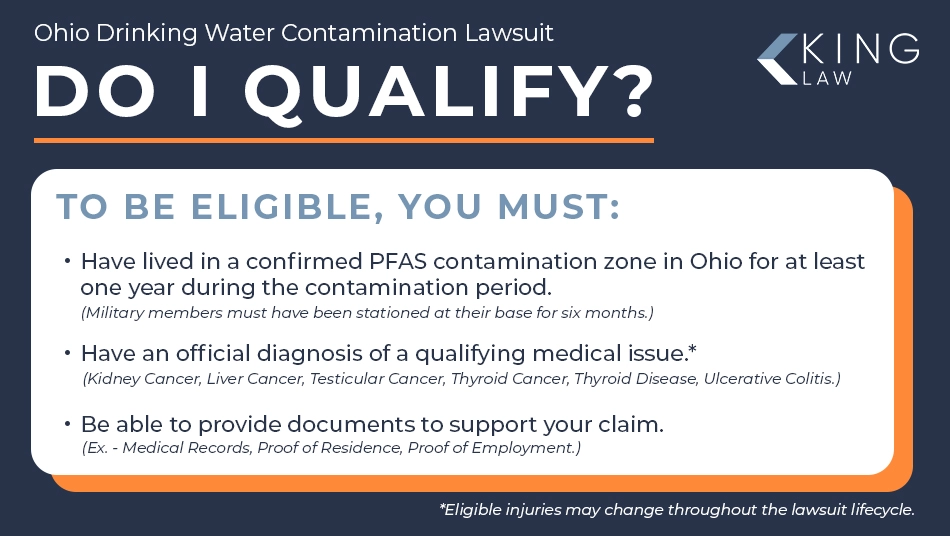
- Duration of Exposure: Affected individuals must have lived or worked in Ohio for at least one year during the identified contamination period. If you were stationed at a military base, you must have been there for at least 6 months.
- Specific Diagnoses: King Law is currently accepting water contamination claims from those diagnosed with the following conditions:
- Kidney cancer
- Liver cancer
- Testicular cancer
- Thyroid cancer
- Thyroid disease
- Ulcerative colitis
- Supporting Documents: You are required to provide several forms of documentation to support your claim. These include medical records proving your diagnosis and proof of residence or employment in Ohio. Proof of residence may include utility bills, lease agreements, and employment records. For those who believe that their claims arose from exposure on or near military installations, records of service may also help.
Each of these factors will help build a strong claim. King Law’s experienced attorneys will provide expert guidance to help you navigate the complexities of the legal process.
Ohio Water Contamination Settlement and Payout Amounts
Settlements in the Ohio water contamination lawsuit typically range from $30,000 to $300,000. However, various factors can influence your final settlement amount. These may include the extent of the illness sustained. Also, the longer you lived or worked in a contaminated area, the stronger your case might be. Your age might also play a role, as a younger person with a severe illness might receive a higher settlement due to the long-term financial needs they face.
The process of reaching a settlement usually involves several months and multiple steps. The stronger your supporting evidence, the better your likelihood of your claim succeeding. Keep in mind, if the case does not settle, it will eventually go to trial. There is a likelihood that you might receive more from a trial than from a negotiated settlement. However, you also run the risk of receiving nothing as a result of the trial. Skilled legal guidance from a team of experts will help you determine the best course for your case.
How to File an Ohio Water Contamination Lawsuit
Filing a water contamination lawsuit as an Ohio resident involves a structured process. It requires specific evidence, documentation for the court and adherence to legal guidelines. A simplified guide is as follows:
- Initial Consultation: You’ll meet with an attorney team who is experienced with environmental laws and water contamination cases. They will help you determine whether your claim is valid and then explain the rest of the process for you.
- Evidence Gathering: Your attorney’s team will instruct you on further evidence you need to gather to support your claim. This may include medical records, proof of residence or employment in Ohio, military records, environmental reports, and other evidence of water contamination in your area.
- Legal Filing: Your attorney will draft and file the appropriate legal documents. They will create a complaint that outlines your allegations of water contamination and explains the damages you seek. A statute of limitations applies to filing most water contamination lawsuits. In Ohio, it’s typically two years from the diagnosis or discovery of injury.
- Pre-Trial Procedures: You or your attorney will participate in pre-trial procedures. These may include discovery—where both sides exchange evidence—depositions and questionings to gather more information.
- Settlement Negotiations: Many cases settle before trial. Your attorney will negotiate with the defendants in your case to achieve compensation for your losses.
- Trial: If your case does not settle, you will proceed to trial. Your attorney will present your case to a judge or jury. They will then decide the outcome of the case and determine your award.
By working with an attorney who understands lawsuits against PFAS manufacturers, you’ll increase your likelihood of a successful case.
Evidence to Support Your OH Water Contamination Claim:
Your Ohio water contamination lawsuit will need to be supported by evidence. This evidence may include many of the documents you used to prove you qualify for your claim, such as proof of residence, medical records and military records. Other evidence may include:
- Proof of water contamination in or near the areas where you lived or worked at the time of your exposure. This may include environmental reports or water contamination notices.
- Expert testimonies linking water contaminants to your illness or injury.
- Personal statements explaining the impact your injuries or illness have had on you and your family.
- Financial statements, medical bills, and other receipts outlining the cost burden you’ve sustained.
Strong evidence will help you support your case. It will also help your attorney gain a clear picture of your unique circumstances. They will therefore be able to more appropriately argue your case.
Statute of Limitations for Ohio Water Contamination Claims
You should act quickly once you’re diagnosed with an illness or injury you believe is related to Ohio’s water contamination. Most lawsuits are subject to a two-year statute of limitations. This statute restricts the amount of time you have to file your claim. For example, if you were diagnosed on January 1, 2025, you likely have until January 1, 2027, to file your case. However, it’s generally recommended that you file as soon as possible after diagnosis. Varying other statutes and restrictions on filing may apply. There are also circumstances that can extend how long you have to file. An experienced attorney can help you understand your filing options for filing a PFAS lawsuit.
Ohio Water Contamination Lawyers
If you are an Ohio resident who believes you were harmed by contaminated water, King Law is ready to help. With expertise in civilian, municipal and military cases, and PFAS contamination, we are ready and willing to help you fight for the compensation you deserve. Contact us today for a free consultation to learn more about whether you qualify for a case.
Frequently Asked Questions (FAQs)
Learn more about water contamination in Ohio with answers to these frequently asked questions:
Ohio’s drinking water complies with safety standards required by law. However, many contaminants—such as PFAS—may not be adequately removed during filtration. Many contaminants—like lead—may also enter the water after filtration.
Yes, multiple toxins have been found in Ohio’s water supply, including lead and PFAS chemicals. PFAS in particular has become a particular concern in recent years. While Ohio is making efforts to remove the sources of PFAS contamination and install additional filtration systems, additional concerns remain.
Yes, many people are choosing to file lawsuits in Ohio as a result of harm caused by contaminated water. Their lawsuits aim to compel those who have caused water contamination to provide compensation for medical bills, lost income, and pain and suffering.
Water contamination in Ohio might result from a number of factors. For example, improper disposal by PFAS importers or manufacturers may cause harmful chemicals to enter groundwater and waterways. Likewise, military bases were at one time pervasive users of PFAS chemicals, notably AFFF firefighting foam. This material directly harms those who use it in their line of work. It can also significantly penetrate and contaminate the local environment and groundwater.
Yes, most people have approximately two years from the date they were diagnosed with an illness to file a water contamination lawsuit in Ohio. Statutes and legal requirements can vary, however. Consult a lawyer as soon as possible to ensure you still qualify for a claim.
Water contamination in Ohio can cause a variety of illnesses. For example, PFAS in water may lead to higher risks of various cancers, thyroid illness, kidney disease, liver cancer, and ulcerative colitis. Lead, likewise, is well-known as a carcinogen and cause of neurological damage.
Your water contamination claim will need evidence. At a minimum, you will need to supply medical records, proof of residence, and costs associated with your diagnosis.
The legal process in Ohio will take at least several months and involve several steps. First will come an initial consultation, evidence gathering and legal filings. Your lawyer will then negotiate with the defendants in the case to try to achieve an appropriate settlement. If no settlement is reached, the case will go to trial.
If you believe you were affected by water contamination, it is important to take action. Your ability to file a lawsuit may be restricted by a statute of limitations, and you do not want to wait too long to file. Your lawyer will help determine if you qualify for a lawsuit and guide you through the process.
Many water contamination lawsuits reach a financial settlement before going to trial. However, the compensation you receive may vary based on factors like your age and the extent of your illness or injury. Most cases settle for between $30,000 and $300,000. However, no settlement is guaranteed.
Yes, PFAS has been found in Ohio’s water, in many cases far in excess of safe levels recommended by the U.S. EPA. PFAS is a particular concern around the state’s many military bases, where the chemicals have been used for many years.
The state has begun initiatives to combat PFAS contamination. This includes updating aging water sanitation infrastructure to remove these contaminants. The State has established a PFAS Task Force charged with researching, recommending, and implementing solutions to help remove these contaminants.
The process of filing a water contamination lawsuit in Ohio is often a complicated process. However, by working with an expert lawyer, like the experienced attorneys at King Law, you can receive skilled guidance on filing your claim and negotiating for appropriate compensation.