

Key Highway Shipyard Mesothelioma Lawsuit & Asbestos Claims [2026 Update]
Complete the form below to see if you qualify for a Mesothelioma Lawsuit

Workers at Key Highway Shipyard repaired, serviced, and jumbosized commercial and military vessels in Baltimore, Maryland. Former Bethlehem Steel Key Highway Shipyard workers are developing mesothelioma, and many of them believe asbestos exposure at the Key Highway Shipyard is to blame. They and their loved ones are filing lawsuits to hold asbestos product manufacturers accountable for not warning them about the dangers of asbestos.
Mesothelioma can take up to 40 years or more to develop after someone was exposed to asbestos. As a result, people who worked at Key Highway Shipyard may not be diagnosed with mesothelioma until long after they left the shipyard. Despite this latency period, mesothelioma patients still have the right to pursue a lawsuit and compensation.
About the Key Highway Shipyard Mesothelioma Lawsuit:
Key Highway Shipyard Asbestos Litigation News and Updates
About Asbestos Exposure at the Key Highway Shipyard
History of the Key Highway Shipyard in Baltimore, MD
When Did the Key Highway Shipyard Contain Asbestos Materials?
How Was Asbestos Material Used at the Key Highway Shipyard?
How Were Key Highway Shipyard Workers Exposed to Asbestos?
Which Key Highway Shipyard Workers Had the Highest Rate of Asbestos Exposure?
Notable Key Highway Shipyard Asbestos Lawsuits & Litigation Developments
Who Were the Key Highway Shipyard Asbestos Product Manufacturers and Contractors?
Who Can File a Key Highway Shipyard Mesothelioma Lawsuit?
What Evidence Do You Need to File a Key Highway Shipyard Mesothelioma Lawsuit?
How Do I File a Key Highway Shipyard Mesothelioma Lawsuit?
How Long Does a Key Highway Shipyard Mesothelioma Case Normally Take?
What Is the Deadline to File a Key Highway Shipyard Mesothelioma Lawsuit?
How Much Is a Key Highway Shipyard Mesothelioma Lawsuit Worth?
King Law Is Investigating Key Highway Shipyard Mesothelioma Claims
Contact a Key Highway Shipyard Asbestos Exposure Attorney Today
Key Highway Shipyard Asbestos Litigation News and Updates
Key Highway Shipyard workers have filed lawsuits against companies that made asbestos-containing products used at the yard. Some of these legal complaints accuse the companies of not telling Key Highway Shipyard workers that asbestos in their products can cause mesothelioma.
January 30, 2008: Key Highway Shipyard Supplier Pays Asbestos Settlement to Man with Mesothelioma
A former helper who removed valves and took them to other locations at the Key Highway Shipyard filed a lawsuit (John Crane Inc. v. Linkus (2010)) against asbestos-product manufacturers. The man says he was exposed to asbestos from the insulation around the valves used at the shipyard. The man said he would also clean up asbestos-containing debris in machine shops at the shipyard and put in asbestos-containing wicking in the valves. The court affirmed that the man developed mesothelioma likely due to the asbestos he was exposed to at the shipyard. The man’s family secured a mesothelioma settlement.
July 1, 1997: Families Request Asbestos Settlement From Manufacturer Who Supplied Asbestos-Containing Products to Key Highway
The families of several men who worked at Key Highway Shipyard sued Raymark Industries, accusing the company of failing to tell workers that asbestos could cause cancer (Claude A. Harper v. Alltite Gaskets, et al., and Shetterly v. Raymark Industries, Incorporated). The men all developed an asbestos-related disease, including mesothelioma, after years of asbestos exposure. For example, the men worked around, with, or cut asbestos-containing blankets or cloth used at the shipyard. According to court documents, asbestos dust would allegedly roam in the air and be inhaled by workers.
April 27, 1995: Court Affirms Asbestos Verdict in Favor of Families Affected by Mesothelioma, Cancers Tied to Key Highway Shipyard
The family of an outside machinist who worked at Key Highway Shipyard from 1941 to 1982 won compensation after the machinist died of mesothelioma. The lawsuit (ACandS, Inc. v. Asner) claims that the man was exposed to asbestos-containing insulation that was “mixed, cut, and applied” at the shipyard. The machinist’s wife sued, claiming the companies should have told them that asbestos was dangerous.
April 27, 1995: Former Key Highway Iron Worker’s Family Wins Mesothelioma Compensation
A man developed mesothelioma after working at Key Highway Shipyard, owned by Bethlehem Steel, from 1941 to 1982. He was employed as an ironworker erector, and he says he was exposed to asbestos at the shipyard. He filed a lawsuit against Eagle Picher Industries (Eagle-Picher Industries, Inc. v. Balbos). He died of mesothelioma in 1984, and his sister took over the lawsuit as the personal representative of his estate. The jury agreed that the asbestos companies being sued were at fault for not warning the man that the products he was working with could cause cancer.
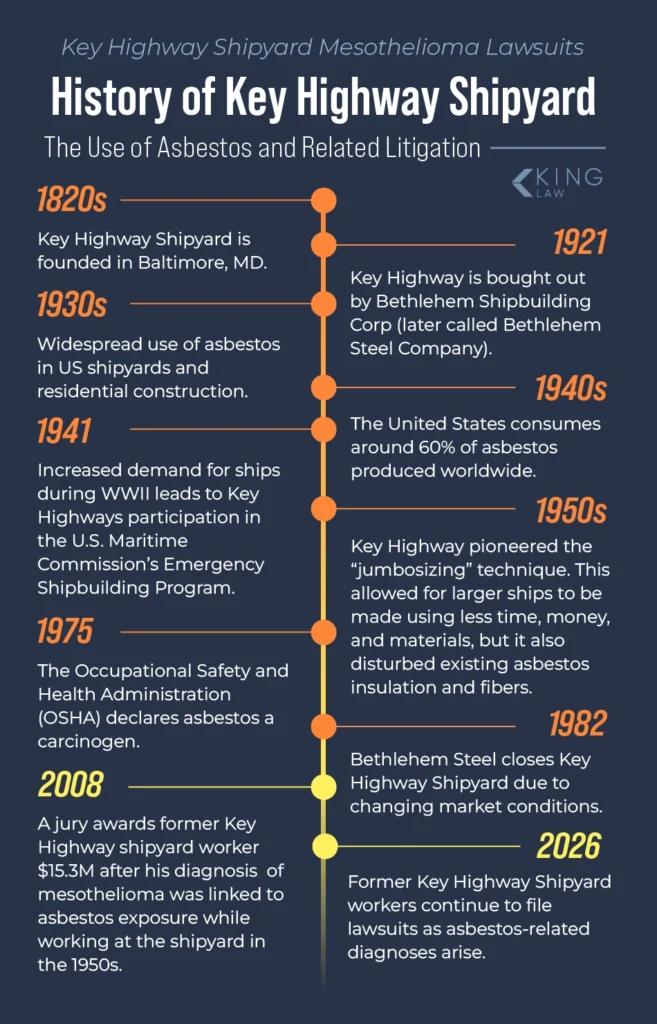
1982: Key Highway Shipyard closes down and is decommissioned. For decades, the Bethlehem Steel Key Highway Shipyard extended half a mile up Baltimore’s coastline.
1921: Bethlehem Steel acquires Key Highway Shipyard. The Key Highway yards repaired more than 2,500 ships during WWII and produced Liberty and Victory ships for the war effort.
1820s: Key Highway Shipyard is founded in Baltimore by the Skinner family. Over the next several decades, the family would create a 35-acre shipping complex at Key Highway.
About Asbestos Exposure at the Key Highway Shipyard
Key Highway Shipyard was a major player in wartime ship repair and conversion during the Civil War, World War I, and World War II. According to legal complaints and public reports, asbestos-containing materials were used at the yard during the 1900s, and many workers may not have had or used personal protective equipment.
Key Highway Shipyard workers may not have been told that asbestos in the products they used may increase their chances of developing mesothelioma. Because of this, people who worked at the Key Highway yard may have been exposed to asbestos fibers that they or nearby workers released into the air during overhauls, jumbosizing, or repair efforts.
Where Was the Key Highway Shipyard Located?
The Key Highway yard was located near
Key Highway Shipyard Workers and Unique Asbestos Risks
Several practices used at Key Highway Shipyards may have presented unique asbestos exposure circumstances. Here are some of the characteristics of the shipyards that may have exposed Key Highway workers to asbestos:
- Jumbosizing: To expedite ship production, a process called jumbosizing was used at some Key Highway sites. This process involved cutting apart existing ships and inserting materials to extend the ships. This process involved modifying existing ships, which may have disturbed asbestos and made fibers airborne.
- WWII repair volume: Workers at Key Highway Shipyards repaired more than 2,500 ships during WWII. Repairing ships meant that workers had to cut, remove, and repair materials that contained asbestos.
- Bethlehem Steel ownership: Bethlehem Steel used asbestos products in many aspects of shipbuilding. The company heavily relied on asbestos products at certain periods in the 1900s.
- Confined spaces in the inner harbor: Baltimore’s Inner Harbor had limited space to conduct shipyard operations. Key Highway Shipyards sprawled a half of a mile of coastline, but there were multiple operations in that area. Workers often performed duties in very tight spaces.
History of the Key Highway Shipyard in Baltimore, MD
Key Highway yard is also known as the upper yard, the Bethlehem Steel Key Highway yard, and the Baltimore Key Highway yard. The yard was founded in the 1820s and expanded to become a pivotal part of Naval shipbuilding and repair in the 1900s.
Bethlehem Steel purchased the Key Highway yard in the 1920s, and, in combination with another Baltimore-based yard, the two Key Highway yards “repaired over 2,500 ships during [World War II].” Asbestos was commonly used (and sometimes required) in naval operations during the 1900s. As a result, asbestos-containing products may have been a staple of the Key Highway yard.
Early Operations and Growth (1820s–1921)
Key Highway Shipyard was established by the Skinner brothers in the 1820s along Baltimore’s waterfront. The shipyard was called the upper yard, and it was located by Federal Hill. Key Highway yard expanded during and after the Civil War, and it grew to become a major ship service and repair site. The upper yard also had a graving dock where ships could be brought in and serviced below the waterline.
Bethlehem Steel Ownership and World War II Ship Repairs (1921–1945)
Bethlehem Steel purchased the Key Highway and nearby Fort McHenry shipyards in the 1920s. During World War II, Key Highway Shipyard was instrumental in converting and repairing thousands of ships. At this time, asbestos was widely used for its ability to insulate against heat and fire.
Post-War Repairs, “Jumbosizing,” and Closure (1950s–1982)
Key Highway Shipyard “pioneered” a technique called jumbosizing, where the shipyard workers would cut ships in half and insert larger midsections. This process allowed the Navy to commission larger ships without having to spend time and money building one from scratch. However, these types of significant repairs may have also disturbed existing insulation and other asbestos-containing materials on the ships. Key Highway Shipyard closed in 1982.
When Did the Key Highway Shipyard Contain Asbestos Materials?
Key Highway Shipyard may have used asbestos during the 1930s until the 1980s, because those are the times when asbestos use was widespread. In some cases, the
As such, Key Highway Shipyard may have used asbestos-containing products, including insulation, gaskets, valves, and fireproofing materials. Moreover, since Key Highway Shipyard repaired existing vessels, workers may have encountered legacy asbestos-containing materials on ships that came to their docks.
How Was Asbestos Material Used at the Key Highway Shipyard?
Asbestos material may have been used at Key Highway Shipyard because it was required by the U.S. Navy and could resist heat and fire. Workers at Key Highway Shipyard may have been exposed to asbestos while installing, removing, repairing, or overhauling products. Materials used at Key Highway Shipyards that may have contained asbestos include:
- Adhesives
- Boilers and HVAC materials
- Cement
- Decking
- Gaskets
- Insulation
- Mechanical braking components
- Metal sheet paneling
- Personal protective gear
- Pipe lagging
- Pumps
- Rope
- Turbines
Asbestos in Ship Insulation and Fireproofing
Asbestos-containing products were often used to fireproof and insulate ship compartments and components. For example, pipe coverings and insulation blocks were made or coated with asbestos, and steam lines were wrapped with asbestos-containing insulation. Key Highway Shipyard workers may have been exposed to asbestos when they cut, scraped, applied, removed, installed, serviced, or cleaned these asbestos-containing materials.
Boilers, Turbines, and Engine Components
Asbestos-based products may have been used in boilers, turbines, and engine components at Key Highway Shipyard. These components were in environments with high heat and fire, and asbestos products may have been preferred because of their ability to withstand those extreme conditions. However, Key Highway Shipyard workers who serviced, installed, took out, overhauled, repaired, or operated those systems may have exposed themselves or others to asbestos fibers.
Asbestos Gaskets, Packing, and Valve-Lining Rope
Key Highway Shipyard may also have used gaskets, packing, valve-lining rope, cloth, flanges, and other materials containing asbestos. Asbestos was a common feature in insulating components like valves and gaskets because of its resistance to high temperatures and fire. One study found that removing gaskets may produce high levels of asbestos fibers.
Asbestos-Containing Paneling and Interior Materials
Asbestos-containing paneling, insulation, and other materials may have been used in the interior of ships and shoreside buildings at Key Highway Shipyard. For example, the ceiling or floor tiles or panels may have had asbestos in them, and asbestos may have been in the insulation in the walls and around electrical components. Key Highway Shipyard workers who were in and around these areas may have breathed in free asbestos fibers during ship overhauls, jumbosizing efforts, or maintenance work.
Other Asbestos-Containing Materials at the Shipyard
Asbestos may have been found in other materials and places at Key Highway Shipyard. For example, a former shipyard worker described carrying around asbestos-containing cloth that he would kneel on to protect his body from the heat. Public reports also suggest that some shipyard workers would patch their uniforms with asbestos-based cloth. Asbestos may have also been found in cement, sealants, thermal wraps, brake and friction components, and adhesives.
How Were Key Highway Shipyard Workers Exposed to Asbestos?
Key Highway Shipyard workers may have been exposed to asbestos in the following ways:
- Handling and removing asbestos materials
- Bystander exposure from coworkers disturbing asbestos-containing materials
- Installing and servicing asbestos-containing products
- Scraping, mixing, cutting, and applying asbestos insulation
- Cleaning areas with asbestos dust
- Working in confined spaces where asbestos dust could build up
Family members of Key Highway Shipyard workers may have been exposed to asbestos dust that was carried home on their loved one’s clothes. Some people have developed mesothelioma from second-hand asbestos exposure.
Which Key Highway Shipyard Workers Had the Highest Rate of Asbestos Exposure?
Many types of Key Highway Shipyard workers may have been exposed to asbestos. The workers who may have been most at risk include people who worked directly with asbestos-containing materials, like insulation workers and pipe laggers. However, workers who did not work with asbestos may still have breathed in fibers in the air or on surfaces at Key Highway Shipyard.
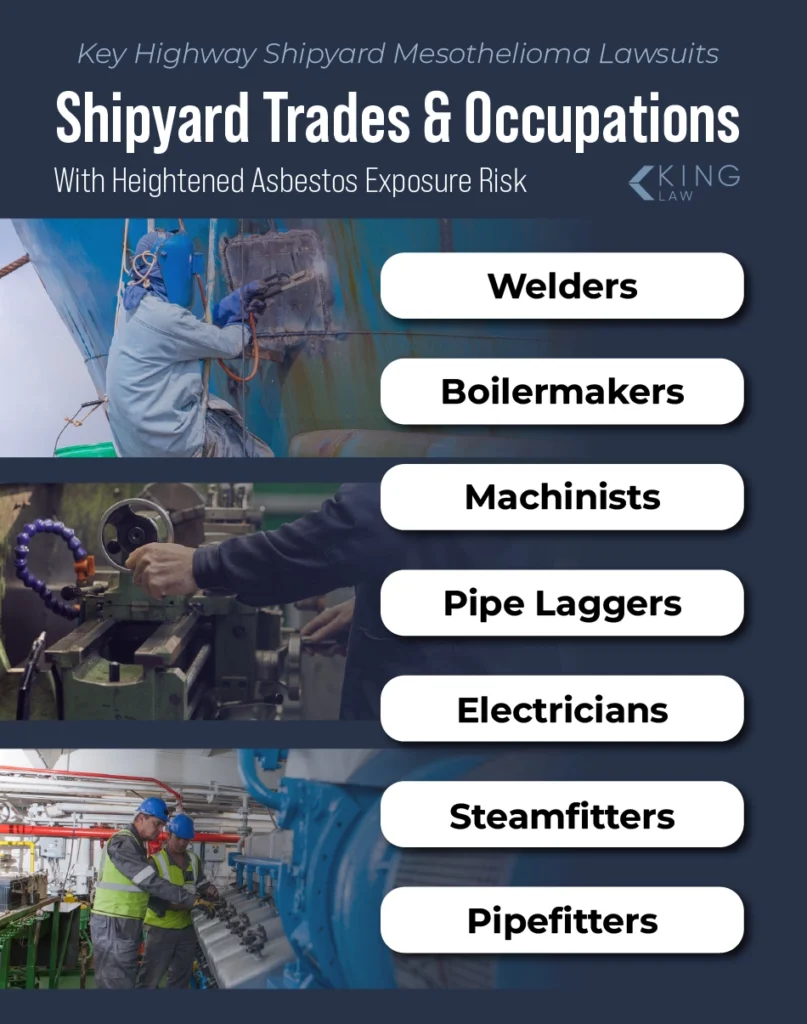
Some of the jobs with the highest rates of asbestos exposure at Key Highway Shipyard include:
- Boilerworkers
- Construction and structural workers
- Engine room workers
- Electrical workers
- Machinists and valve specialists
- Pipefitters
- Pipe laggers and insulators
- Riggers
- Steamfitters
- Welders
Machinists and Valve Specialists
Machinists and valve specialists at Key Highway Shipyard may have worked with asbestos-containing packing, gaskets, and rope used in valves and pumps. Cutting, removing, mixing, and applying these materials may have released asbestos fibers into the work environment.
Pipefitters and Steamfitters
Pipefitters and steamfitters at Key Highway Shipyard may have worked directly with flanges, steam lines, and fittings that contained or were insulated with asbestos. For example, these components may have been coated with asbestos-based insulation or sealed with asbestos-based packing or gaskets.
Pipe Laggers and Insulators
Pipe laggers and insulators may have had the highest risk of exposure to asbestos at the Key Highway Shipyard. These workers may have mixed, cut, scraped, applied, wrapped, removed, or installed asbestos-containing insulation and thermal coverings throughout the shipyard.
Electricians and Electrical Helpers
Electricians and electrical helpers may have come into contact with asbestos insulation in the walls and electrical panels throughout Key Highway Shipyard. People in these roles may have also breathed in asbestos fibers that were disturbed by others at the workplace, such as contractors who were cutting into asbestos-containing paneling or boards.
Welders, Riggers, and Structural Workers
Welders, riggers, and structural workers at Key Highway Shipyard may have worked near asbestos insulation removal or installation efforts during overhauls, rigging, and jumbosizing. They may have also been called in to work on aging or deteriorating ships that were being overhauled, where asbestos fibers were in the environment.
Boiler Technicians and Engine Room Workers
People who worked in boiler rooms, engine rooms, and other high-heat areas at Key Highway Shipyard may have been exposed to asbestos. They may have encountered asbestos from insulation, fireproofing material, and other products that were being repaired, removed, installed, or updated.
Notable Key Highway Shipyard Asbestos Lawsuits & Litigation Developments
Many lawsuits have been filed against the companies that made asbestos-containing products used at Key Highway Shipyard. Some of these lawsuits highlight different types of asbestos products that were used at Key Highway Shipyard. They also show how attorneys may help workers and surviving family members try to overcome challenges that may arise during these lawsuits.
The cases referenced below show how courts have linked asbestos exposure at Key Highway Shipyard to mesothelioma diagnoses.
Valve-Lining Rope Exposure: Linkus v. John Crane Inc.
A machinist who worked at Key Highway Shipyard developed mesothelioma and filed a lawsuit against the companies that made the asbestos-containing products he worked with. According to his legal complaint, he says he was exposed to asbestos in the valve rope and packing he used. His attorney argued that the manufacturers should have warned the machinist and others that asbestos in the valve rope, packing, and other products could cause cancer, mesothelioma, or another disease. A jury agreed with him, and the man won a mesothelioma settlement.
Pipe Insulation Exposure: Armstrong and Eagle-Picher Cases
Former Key Highway Shipyard workers who worked with Kaylo asbestos insulation blocks and coverings used in engine rooms, boiler rooms, and elsewhere developed mesothelioma and sued. Some of the workers also assisted pipe fitters and worked as ironworkers and erectors, which involved asbestos exposure. Several workers and their families won settlements against the companies that made the contaminated insulation and other products used at Key Highway Shipyard.
Micarta Paneling Exposure: Murphy v. Hopeman Brothers
A man developed mesothelioma after working with Micarta paneling when he was an electrical helper at Key Highway Shipyard. He sued several companies that made asbestos products used at Key Highway Shipyard and another shipyard near Baltimore.
Product Identification Challenges in Shipyard Cases
Identifying which products someone was exposed to at Key Highway Shipyard and which companies made them can be challenging. Many asbestos-product manufacturers have filed for bankruptcy protection, been purchased by other companies, rebranded, or gone out of business.
Reputable mesothelioma lawyers have robust internal databases of asbestos exposure sources from shipyards, Naval operations, manufacturing hubs, and other areas. They can use these resources to determine a wide range of potential asbestos-containing products that the mesothelioma patient may have been exposed to at Key Highway Shipyard.
Federal vs. State Jurisdiction Issues in Shipyard Litigation
Mesothelioma lawsuits involving Key Highway Shipyard workers may be filed in state or federal court. It depends on several factors, including where the exposure occurred and where the allegedly at-fault asbestos-product manufacturer is headquartered or does business.
Having a strong and experienced attorney can help former Key Highway Shipyard workers protect their legal rights to mesothelioma settlements regardless of where the case is filed.
Who Were the Key Highway Shipyard Asbestos Product Manufacturers and Contractors?
Here are some examples of asbestos manufacturers that have been sued by former Key Highway Shipyard workers:
- ACandS
- Anchor Packing
- Celotex
- Eagle-Picher
- Hopeman Brothers
- John Crane
- Johns-Manville
- Owens-Illinois (now Owens Corning)
- Pittsburgh Corning
- Porter-Hayden
- Raybestos (Raymark)
- Unibestos
Asbestos exposure claims may be brought against many companies that made products that the Key Highway Shipyard worker may have been exposed to. An experienced lawyer can establish which companies were responsible for your exposure and how much liability each company should assume.
Who Can File a Key Highway Shipyard Mesothelioma Lawsuit?
King Law’s criteria for filing a mesothelioma lawsuit include the following:
- The person worked at the Key Highway Shipyard and later developed mesothelioma.
- The person may have developed mesothelioma from asbestos fibers brought home on their loved one’s Key Highway Shipyard work clothes.
- The person lost a loved one to mesothelioma that was allegedly caused by asbestos exposure from Key Highway Shipyard.
You may still be able to file a Key Highway Shipyard asbestos lawsuit even if your situation is different than the above. Reach out to our office to discuss your legal rights.
Can Family Members File a Mesothelioma Claim for Secondhand Asbestos Exposure?
Yes, family members may be able to file a mesothelioma claim if they believe they were exposed to asbestos that their loved one brought home from the Key Highway Shipyard. Some scientific studies have suggested that take-home asbestos exposure may be associated with increased chances of developing an asbestos-related disease.
What Evidence Do You Need to File a Key Highway Shipyard Mesothelioma Lawsuit?
Evidence that mesothelioma patients and their loved ones can use to support their Key Highway Shipyard claim includes:
- Documentation showing you were diagnosed with mesothelioma
- Records showing that you worked at Key Highway Shipyard as a full-time, part-time, temporary, or contract-based worker
- Jobsite or union records to show where you worked and in what roles
- Social Security earnings statements
- Testimony from coworkers or former supervisors
- Job description of your role at Key Highway Shipyard
- Evidence to show what asbestos-containing products you worked with
Attorneys can help patients locate key documentation and identify brand names of asbestos products used at Key Highway Shipyard. Someone may still be able to start the legal process and file a lawsuit even if they do not know the names of all the asbestos-containing products they may have used at Key Highway Shipyard.
How Do I File a Key Highway Shipyard Mesothelioma Lawsuit?
Here are some of the steps to filing a Key Highway Shipyard mesothelioma lawsuit:
- Schedule a free case evaluation with a reputable mesothelioma law firm, such as King Law.
- Help your attorney identify and request records proving that you worked at Key Highway Shipyard and were diagnosed with mesothelioma.
- Your attorney uses your documentation to determine what asbestos-containing products you may have been exposed to.
- Your lawyer prepares and files a lawsuit or asbestos trust fund claim against the companies that made the asbestos-containing products.
- Your legal team attempts to secure an out-of-court settlement from the company that made asbestos products used at Key Highway Shipyard.
- Your attorney takes your Key Highway Shipyard asbestos exposure lawsuit to trial if settlement discussions are unsuccessful.
Attorneys can help mesothelioma patients through all stages of the asbestos cases involving exposure from Key Highway Shipyard. They can also pursue multiple types of asbestos claims, including VA disability benefits, asbestos trust fund claims, and personal injury or mesothelioma wrongful death lawsuits.
How Long Does a Key Highway Shipyard Mesothelioma Case Normally Take?
Key Highway Shipyard mesothelioma cases can take months or a year or more to resolve. The length of the mesothelioma claims process depends on the strength of the person’s claims, how many companies are being sued, what type of claim is being brought, the complexity of the case, and other factors. Our lawyers work with each client to ensure the case progresses efficiently and is balanced with the pursuit of fair compensation.
What Is the Deadline to File a Key Highway Shipyard Mesothelioma Lawsuit?
The deadline to file a Key Highway Shipyard mesothelioma lawsuit depends on the applicable law, the type of claim (wrongful death, personal injury, or trust fund claim), and other factors. It is a good idea to talk to an attorney about what your deadlines are in your situation and how you can take steps to meet those.
How Much Is a Key Highway Shipyard Mesothelioma Lawsuit Worth?
Key Highway Shipyard mesothelioma settlements are tailored to each claimant’s situation. Some of the compensation that may be available include:
- Medical expenses
- Mesothelioma-related in-home care or modifications
- Lost income or earning capacity
- Pain and suffering
- Wrongful death damages (e.g., funeral and burial expenses, loss of relationship, and loss of support)
In some situations, the court may also approve punitive damages to punish asbestos-product manufacturers for particularly egregious conduct. A seasoned asbestos lawyer can help you estimate what your potential payout could be for a mesothelioma claim involving Key Highway Shipyard.
King Law Is Investigating Key Highway Shipyard Mesothelioma Claims
King Law is actively investigating mesothelioma claims being brought by people who believe they were exposed to asbestos at Key Highway Shipyard. We have a strong suite of resources to help us develop strong legal claims for mesothelioma patients.
Our team has vast experience fighting for patients who worked at military and commercial shipyards where asbestos-containing products were used. We are committed to helping mesothelioma patients who worked at Key Highway Shipyard pursue compensation.
Contact a Key Highway Shipyard Asbestos Exposure Attorney Today
Contact our office today by calling (585) 496-2648 or filling out an online form. If you believe you were exposed to asbestos at Key Highway Shipyard, we may be able to help you secure a fair settlement. We provide free case evaluations, and we take all mesothelioma cases on contingency, so you do not have to pay us upfront legal fees.