

Robert King Law Firm Is at the Forefront of the Olympus Scopes Litigation
Complete the form below to see if you qualify for a Olympus Scope Lawsuit

Robert King Law Firm is actively involved in Olympus scope infection cases nationwide. Our firm has evaluated hundreds of Olympus infection lawsuits while building up extensive operational knowledge of the medical and regulatory factors critical for this litigation.
Our investigation and evaluation process has placed our firm as a leader in the Olympus Scopes litigation. We represent our clients through every stage of the litigation process, from consultation to resolution, utilizing our strategic partnership with a co-counsel firm when appropriate.
When you choose King Law to represent your Olympus scope claim, you can leverage our extensive knowledge base and experience with medical device litigation.
About the Olympus Scope Litigation:
King Law Has Evaluated a Significant Number of Olympus Scope Infection Claims
Our Firm Has Developed Deep Knowledge of Olympus Scope Procedures and Infection Risks
King Law Closely Tracks FDA Safety Communications, Recalls, and Olympus Litigation Developments
What Makes King Law Different From Large Intake-Based Mass Tort Firms?
King Law Remains Directly Involved in Every Olympus Scope Case It Accepts
The Olympus Scope Litigation Involves Complex Medical and Scientific Issues
Get a Free Consultation with an Olympus Scope Attorney at Robert King Law Firm
King Law Has Evaluated a Significant Number of Olympus Scope Infection Claims
King Law has been actively reviewing and analyzing cases related to several types of Olympus scope devices, including cases with allegations of infections and injuries from device defects. Olympus represents around 70% of the U.S. endoscope market and has been the subject of multiple FDA actions concerning device safety and quality control, making it the focus of our efforts.
During our preliminary investigations and interviews with more than 200 patients from across the country who claim to have experienced serious infections after receiving an endoscopic procedure, around 16% of those individuals entered into an attorney-client relationship with our firm. We only accept cases that we believe will have a strong, factual basis in court.
Why King Law Thinks There Will Be Substantially More Olympus Scope Lawsuits
Due to ongoing infection and reprocessing challenges involving Olympus scopes and their widespread usage, we anticipate more such cases in the near future.
From our early investigations, we anticipate a client base with the following diagnosed injuries or outcomes:
- Sepsis – 45%
- Required hospitalization without sepsis – 22%
- Required blood transfusions – 6%
Additionally, some individuals required surgeries to treat complications arising from their infections. Other patients suffered long-term health issues or death as a result of their endoscopic infection. Among the prospective clients our firm has interviewed, 71% of individuals have experienced an infection after a routine colonoscopy. However, these are not population-wide infection statistics.
While screening colonoscopies have relatively low rates of infection per endoscopic procedure, the sheer volume of colonoscopies performed in the U.S. each year means many people experience post-procedural infections. For example, some people may develop sepsis from a post-colonoscopy infection.
We have also spoken to patients who experienced infections after undergoing endoscopic retrograde cholangiopancreatography (ERCP), pouchoscopies, and other endoscopic procedures.
Our Firm Has Developed Deep Knowledge of Olympus Scope Procedures and Infection Risks
Our preliminary investigations and research have allowed King Law to build an extensive knowledge base on Olympus scope procedures and possible infection risks. We have learned that even when some Olympus scopes and accessories are reprocessed according to manufacturer guidelines, they may not be free of all pathogens. This can be problematic for a reusable medical device.
For example, one multi-site study found that 71% of endoscopes tested positive for microbial growth, even after following reprocessing protocols. Although not all pathogens pose a serious threat to human health, some of the microbes left on the device could put patients at risk of uncommon but potentially serious infections.
We have learned that these reprocessing challenges may be the result of choices in scope design, such as narrow channels and moisture-trapping components, like elevator chambers, fixed caps, or forceps. These channels and components may allow bacteria to form chemically resistant biofilms.
Knowledge Gained on the Types of Procedures That May Use Contaminated Scopes
King Law has been working to understand what types of endoscopic procedures may put patients at risk of contracting an infection. Endoscopes are used in a variety of procedures. Any time a medical device enters the body, it could lead to an infection if that device is not properly processed or reprocessed.
Here are some of the procedures where Olympus scopes are used and where improper reprocessing could put patients at risk of an infection:
- ERCP procedures: This procedure has some of the highest rates of infection among endoscopic procedures. This could be due to the complexity of the duodenoscope design and the vulnerability of the biliary system to certain types of infection.
- Bronchoscopies: Due to the narrow channels on bronchoscopes and having to pass through the bacteria-rich respiratory tract, patients undergoing this procedure could develop an infection.
- Colonoscopies: While having a relatively low risk per procedure, colonoscopies are a common source of infections due to the high volume of screening procedures performed. Operative colonoscopies, additionally, typically carry a higher risk of infection.
- Gastroscopies: This procedure typically uses a relatively simple endoscope, but it can allow bacteria from the mouth to enter other places in the body.
Our evaluations have required our firm to become familiar with medical literature on scope reprocessing, as well as the history of infection outbreaks involving Olympus devices like the TJF-Q180V duodenoscope and the regulatory movement away from reusable components. King Law also takes pains to distinguish between cases involving procedural complications and those related to the device itself.
King Law Closely Tracks FDA Safety Communications, Recalls, and Olympus Litigation Developments
King Law has closely tracked FDA safety communications and recalls involving Olympus devices, along with developments in litigation against the company. These regulatory actions will likely be core pieces of evidence in the lawsuits against Olympus, demonstrating that design-related infection risks have been formally observed and acknowledged. Among the FDA actions we have been tracking are:
- Safety warnings
- Class 1 and Class 2 recall notices on Olympus devices.
- Infection outbreak investigations
- Litigation against Olympus and company personnel
- Import alerts
- MAUDE adverse event reports
- Reprocessing recommendations and evaluations
These FDA actions, along with corroborating scientific literature, lead our firm to believe there is cause for concern over the safety of Olympus scopes. In our opinion, this information could support allegations that Olympus failed to adequately address or warn about infection-related risks while keeping its scopes on the market.
Olympus Scope Safety Concerns Have Been the Subject of National Attention
Olympus scope safety issues have been the subject of national attention for over a decade, beginning with the 2012 outbreak at the Erasmus Medical Center in the Netherlands. Olympus also subsequently failed to file an adverse event report in the U.S. about that outbreak.
Outbreaks soon followed in California, Washington, and Illinois at hospitals that had used the same Olympus duodenoscope, the TJF-Q180V. These events were tracked not only by regulatory agencies and medical researchers, but also by mainstream media.
These outbreaks were only the beginning. Multiple Olympus devices would come under scrutiny over the next 14 years. This culminated in a 2025 FDA import alert on many Olympus devices manufactured at its Aizo facility, including:
- Ureterorenoscopes
- Bronchoscopes
- Laparoscopes
- Automated endoscope reprocessors
An FDA import alert is a serious enforcement action taken against devices and companies with known violations. Such an alert imposes a Detention Without Physical Examination (DWPE) sanction on the named products, limiting their sale and distribution within the U.S. without costly private, third-party testing of shipments.
What Makes King Law Different From Large Intake-Based Mass Tort Firms?
Robert King Law Firm is a national law firm that works directly on the cases we accept, including those involving Olympus scope infections. This means that, rather than screening and then referring your case to a larger firm, we remain actively involved at every stage of the litigation. In practice, here is how we handle Olympus scope cases:
- King Law actively reviews cases and continuously engages with clients.
- Clients can communicate with King Law staff at any point to get an update on their case.
- While King Law may enter a strategic partnership with a co-counsel with specific knowledge of this case type, we will not sell client information to another entity. King Law will remain the client’s point of contact.
- King Law directly examines evidence, including medical records.
King Law is not a marketing agency and does not make commissions by referring clients to third parties. Instead, we work with each client on a contingency basis and collect a percentage of any compensation they receive in settlements or court judgments. That means we do not take fees for Olympus scope cases up front. We only take payment if our client receives a payout.
King Law Remains Directly Involved in Every Olympus Scope Case It Accepts
King Law is a client-facing law firm that stays directly involved in every Olympus scopes case we accept. We will be the client’s point of contact throughout the process. We do use co-counsel, which is common in complex litigation involving large, global companies like Olympus. This simply means that we work with another law firm that also focuses on these cases. That means our Olympus clients have a small, focused team of attorneys working on their behalf.
King Law is using co-counsel for Olympus scope lawsuits because these lawsuits benefit from multiple attorneys with experience and knowledge of medical device litigation, as well as access to multidistrict litigation (MDL) infrastructure. However, this is a strategic partnership, not a hand-off of our clients to a third party. It allows our firm to offer personalized support to our clients while tapping additional resources to fight for a favorable outcome.
How King Law Helps People File Olympus Scope Lawsuits
King Law provides individualized support to our clients through every step of the Olympus scope litigation process. This begins with a free and honest assessment of their prospective case. Not every post-endoscopic infection can be allegedly tied to a device defect.
If King Law accepts the case, we will provide extensive support, helping our clients gather medical, financial, scientific, and regulatory records to serve as evidence in the case. We’ll also monitor broader developments in the possible Olympus scopes MDL and draft necessary documentation to file the claim within applicable deadlines. And finally, we will represent our clients during negotiations with the defense and in court should the case go to trial.
The Olympus Scope Litigation Involves Complex Medical and Scientific Issues
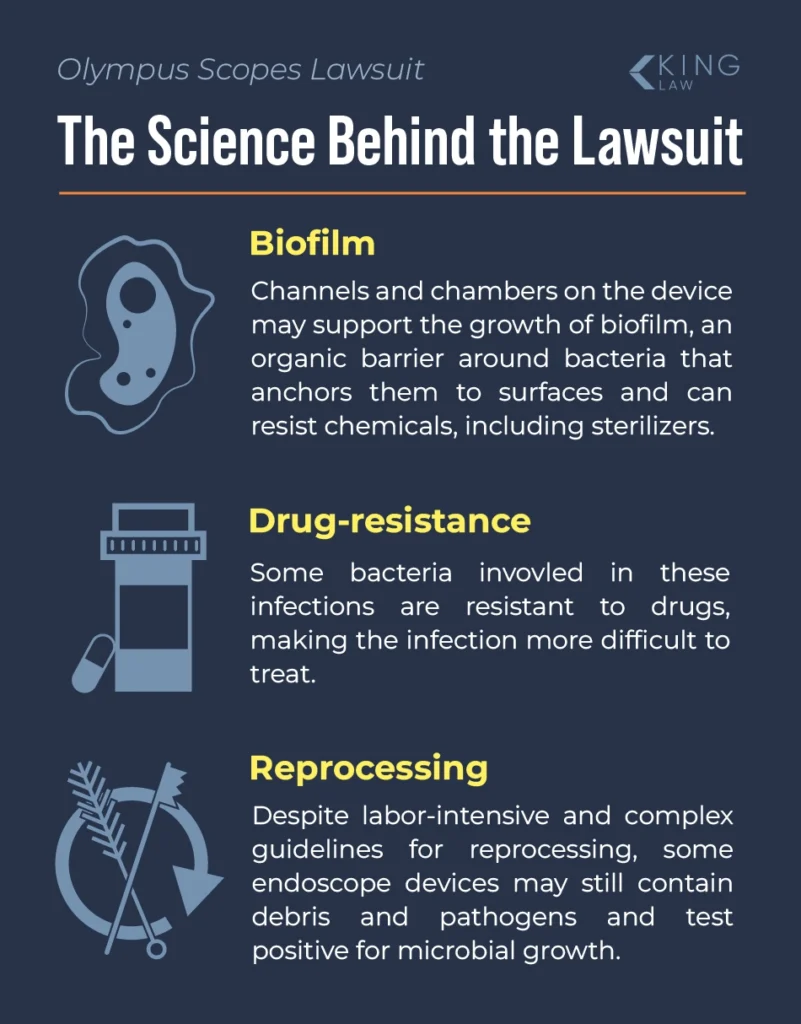
Endoscope infection litigation against Olympus involves complex medical and scientific issues that require not just the knowledge that endoscopes can be an infection vector, but also why the design of the devices may increase infection risks. Research has found that endoscopic infections may be more common than commonly assumed. Some important concepts to understand about various endoscope lawsuits include:
- Device channels and chambers can be conducive to the growth of biofilm.
- Biofilm is an organic barrier created by some strains of bacteria to anchor them to surfaces and resist chemical attacks, including common sterilizing agents.
- Some of the bacteria involved in these infections are drug-resistant.
- While infections tend to present with symptoms within a few days of the procedure, incubation periods may be as long as 30 days.
- Reprocessing guidelines are labor-intensive, complex, and evolving.
- Mechanical brushing by hand under magnification is a critical component of reprocessing, but it may not remove all debris or pathogens.
- Some endoscope devices and accessories test positive for microbial growth even after proper reprocessing.
King Law uses this information to evaluate and build our cases. We will continue to collect medical literature and company information to build our cases.
Why It Is Important for Attorneys to Understand the Science of These Cases
Understanding the science involved in Olympus scopes infection cases allows attorneys to build stronger cases. The presence of an infection after an endoscopic procedure alone is not sufficient to implicate the device manufacturer or rule out provider liability or medical malpractice. Lawyers who understand the science can use that information to track down information about the devices that were used, as well as pertinent institutional records, to build a case that can withstand common tactics used by the defense to avoid liability.
Get a Free Consultation with an Olympus Scope Attorney at Robert King Law Firm
If you or a family member has been diagnosed with an infection after undergoing an endoscopic procedure, contact King Law for a free case evaluation through this site or by calling (585) 496-2648. We can help you understand if you may have a viable lawsuit against Olympus Corporation.