

Gerber Baby Food Lawsuit – September 2026 Update
People are filing lawsuits against Gerber Products Company, alleging its baby foods contained heavy metals, raising the risk of developmental issues in babies and children. Plaintiffs in these lawsuits allege that some Gerber products exposed their children to toxins, leading to significant brain injuries and diagnoses such as autism spectrum disorder (ASD) and attention deficit hyperactivity disorder (ADHD). Many of these lawsuits have been consolidated into a multidistrict litigation called In re: Baby Food Products Liability Litigation (MDL 3101. Parents and guardians continue to file lawsuits against Gerber as they realize contaminants in baby and toddler foods may have affected brain development in their children.
Gerber Lawsuit 2026 Updates
September 1, 2026: More Lawsuits Filed About Gerber Baby Food, Other Brands
According to the JPML, the MDL against Gerber and other baby food brands has increased by five, bringing the new total to 483. This MDL continues to gain momentum as more parents file lawsuits about the heavy metal content of their babies’ food and how it might impact their babies’ development.
August 3, 2026: MDL Against Gerber and Other Baby Food Brands Grows
Five more lawsuits about the heavy metal content of baby food made by commercial brands, including Gerber, have joined the federal MDL. As of August 3, 2026, the federal baby food MDL has grown to 478 lawsuits.
July 1, 2026: Gerber and Other Baby Food Manufacturers Face More Lawsuits in MDL
23 more lawsuits have been consolidated in the federal MDL against Gerber and other companies that make commercial baby food products. The new case count for the baby food product liability MDL is 473 pending claims, as of July 1, 2026.
June 9, 2026: Mother Files Lawsuit Against Gerber and Others Alleging ASD from Baby Foods
A mother has filed a lawsuit on behalf of her minor child (E.G.) alleging that Gerber and other companies sold foods that allegedly contained unsafe levels of lead and arsenic. The legal complaint lists different Gerber products, including food jars, teethers, crackers, and cereal. The mother says her six-year-old child has been diagnosed with autism spectrum disorder (ASD), and alleges that heavy metals in Gerber’s and other companies’ foods contributed to that diagnosis. She also alleges Gerber was aware of the heavy metal content and associated risks but did not take action. She is seeking compensatory and punitive damages.
June 1, 2026: Heavy Metal Lawsuits Against Gerber, Other Commercial Baby Food Manufacturers Increases
As of June 1, 2026, 48 more lawsuits have joined the multidistrict litigation against Gerber and other baby food manufacturers. There are now 450 pending claims in the consolidated heavy metal baby food litigation.
June 1, 2026: Report Finds Some Gerber Baby Food Pouches Have More Than 50 Microplastic Particles in Each Gram
Greenpeace International tested the microplastic levels of Gerber’s baby food yogurt pouches. According to the organization’s report, the Gerber pouches tested had up to 54 microplastic particles in each gram of food in the pouch. Based on this finding, each of the pouches tested may have had up to 5,000 microplastic particles in total.
May 1, 2026: Gerber Asks for Baby Food Lawsuits To Be Dismissed
As of May 1, 2026, there are 402 active lawsuits in the federal litigation against Gerber and other baby food manufacturers. However, Gerber and the other defendants listed in these lawsuits have asked Judge Corley to dismiss all claims related to heavy metals in their baby foods causing autism. The defendants have asked for a hearing on July 9. 2026, regarding the request.
April 1, 2026: Gerber, Other Baby Food Brands Face Over 400 Legal Claims Alleging Heavy Metals Led to Autism, ADHD
Gerber and many other commercial baby food manufacturers face at least 402 active lawsuits against them in a pending multidistrict litigation. Some of these lawsuits accuse Gerber of failing to inform parents that some of its baby food products contained heavy metals, such as lead, mercury, and arsenic. Some parents and advocates believe that heavy metals in baby foods sold by Gerber may cause children to develop autism and other neurodevelopmental disorders. The MDL is accepting new qualifying claims from parents who believe their children were harmed by heavy metals in Gerber baby food.
March 12, 2026: Another Family Sues Gerber Over Heavy Metals in Baby Food
A mother has filed a lawsuit against Gerber and one other baby food brand because she believes the heavy metals in their products harmed her baby. According to the short-form complaint filed on March 12, 2026, some of the Gerber products her baby ate include first-stage jars of apples, bananas, peas, peaches, and pears. Her baby also consumed Gerber’s second-stage jars of the same flavors. This lawsuit was filed individually in the Northern District of Illinois and is in the process of being transferred into the consolidated multidistrict litigation.
February 27, 2026: Judge Excludes Most Experts’ Testimony in Baby Food Litigation
Many parents allege that heavy metals in Gerber and other baby foods caused their children to develop autism or ADHD. Some of those lawsuits are centralized in a federal litigation (an MDL). After hearing testimonies in December 2025, the judge overseeing that MDL chose to exclude testimony from all but one of the plaintiffs’ experts. Judge Corley ruled that the experts could not provide direct evidence that lead and arsenic in the specific defendants’ foods could cause autism or ADHD in children. Lacking direct scientific studies, the judge granted defendants’ motions to exclude all but one expert, Dr. Shapiro. Whether or not lawsuits against Gerber and other companies will move forward will be determined.
February 19, 2026: Consumers Continue to Navigate Gerber Biscuit Recall as Number of Heavy Metal Lawsuits Grows
In January, Gerber recalled batches of its arrowroot biscuits due to concerns that foreign materials may have been present in the flour used to make them. The recall is ongoing, and Gerber has said it no longer gets flour from that supplier. Meanwhile, Gerber is named in lawsuits that claim its baby food products contain heavy metals that may have caused babies’ neurodevelopmental harm. As of February 2, 2026, there are 389 heavy metal lawsuits pending against Gerber and other commercial baby food manufacturers. Parents who gave Gerber baby food to their children with autism when they were infants may be eligible to file a claim against Gerber. They are encouraged to contact an attorney to identify and protect their legal rights.
February 3, 2026: Vermont Lawmakers Create Bill That Would Increase Transparency About Heavy Metals in Gerber, Other Baby Food Products
Vermont lawmakers have introduced a bill that would help limit the heavy metals in commercial baby foods, like Gerber. Under the law, Gerber and other companies would be required to conduct monthly tests of the heavy metals in their baby food products. The proposed law also states that, if a baby food’s heavy metal content is over the FDA’s maximum guidelines, the food cannot not be sold in Vermont. The proposed Vermont law would also require Gerber and other manufacturers to include a scannable QR code that takes parents to publicly-available heavy metal testing results for that product. A Congressional Committee in Vermont held a meeting that discussed the proposed law on February 26, 2026. Parents have filed lawsuits against Gerber and other baby food companies, accusing them of failing to warn parents of the presence and risk of heavy metals in their products.
February 3, 2026: Gerber Arrowroot Biscuits Recalled Because They Might Have Plastic or Paper in Them
On January 28, 2026, Gerber recalled several lots of its arrowroot biscuits after finding out that the products may contain paper or plastic that could pose choking hazards and result in injury. According to public reports, the arrowroot provider notified Gerber of the potential risk, and Gerber initiated the recall afterward. The arrowroot biscuits being recalled are 5.5-ounce packages that have best-by dates between October and December 2026. On January 28, 2026, the FDA issued an official recall that lists the lot numbers of the recalled arrowroot biscuits. Gerber is also facing lawsuits because parents believe its baby food contains heavy metals that may cause children to develop autism, ADHD, and other disorders.
January 30, 2026: Florida Mother Sues Gerber, Claims Heavy Metals Harmed Her Baby’s Neurodevelopment
A mother of a child with autism spectrum disorder has filed a legal claim against Gerber and other baby food manufacturers. Her lawsuit accuses Gerber and other brands of selling baby food products contaminated with lead, mercury, and other heavy metals. The legal complaint also claims that Gerber should have informed parents that its baby food products may contain these heavy metals. According to her legal filing, she believes that the heavy metals in Gerber’s baby food products contributed to her baby developing autism spectrum disorder. She and many other parents who have filed contaminated baby food lawsuits against Gerber have consolidated their cases into an active group claim (called an MDL) in federal court.
January 9, 2026: Florida Publishes Heavy Metal Test Results for Commercial Infant Formula, Gerber Litigation Continues
Gerber is facing lawsuits after public reports suggested that its commercial baby foods contained unsafe and concerning amounts of heavy metals. Those public reports have encouraged state and federal action to limit heavy metal contamination in baby foods and infant formulas. Florida has launched the Healthy Florida First initiative, which tested 24 commercial infant formula products for heavy metals. Florida reported elevated levels of certain heavy metals compared to screening benchmarks. Heavy metals in foods fed to babies and toddlers are a continued concern for many parents, as these metals can cause developmental issues in children.
January 5, 2026: More Parents File Lawsuits Against Gerber as Expert Discovery Concludes
As of January 5, 2026, there are 389 active lawsuits against Gerber and other baby food companies. These lawsuits are part of a consolidated litigation representing families who say heavy metals in Gerber’s and others’ foods caused their children to develop autism, ADHD, and other neurological issues. In December of 2025, the judge overseeing these lawsuits concluded four days of hearings for expert witnesses in the baby food lawsuits. Decisions regarding these hearings are pending. Parents and guardians who think heavy metals in Gerber’s foods may have harmed their child can still speak with an attorney to discuss eligibility for joining this lawsuit.
December 15, 2025: Expert Hearing Held in Gerber Autism Lawsuit, Parties Await Judge’s Decision
Hundreds of parents are part of a multidistrict litigation against Gerber and other baby food makers for marketing and selling baby foods with heavy metal contamination. Parents believe the heavy metal content in Gerber’s food should have been reduced and that they should have been told about the levels in foods. They think their children developed autism and other neurological disorders because of the neurotoxins in Gerber’s baby food. In recent hearings for the group baby food lawsuit, the parties (lawyers) presented arguments about which experts they believe should be included in the Gerber baby food multidistrict litigation. In the coming weeks, the parties should receive an order from the judge about this matter.
December 1, 2025: Advocates Continue to Sound Alarm Over Heavy Metals, Other Contaminants in Gerber Products
Advocates and parents have called out Gerber’s baby foods because the products contain lead, mercury, and other heavy metals. Scientific research shows that lead, mercury, arsenic, and cadmium can harm babies, children, and even adults. People who filed lawsuits allege that levels of heavy metals in some of Gerber’s foods led to developmental issues in children. Babies are at higher risk because their blood-brain barrier is not yet closed, and their bodies and brains are still developing. Parents are suing Gerber because it did not warn them about the baby food’s heavy metal contamination. Advocacy groups are also concerned about the levels of pesticides in some baby foods and infant formula. These findings are part of a growing body of evidence that Gerber and other manufacturers did not take adequate steps to keep toxins out of baby foods or warn parents about the risks associated with toxins.
November 17, 2025: Attorneys Prepare for Expert Hearings in Gerber Baby Food Litigation
Attorneys for plaintiffs and attorneys for Gerber are preparing for expert hearings in the group baby food litigation. The hearings will take place Monday, December 8 through Monday, December 12, 2025. These hearings are called Daubert hearings, which take place before the actual trials start. During these hearings, the judge decides what experts and information can be presented to juries during trials. These hearings will be crucial to the outcomes of the hundreds of plaintiffs in the Gerber baby food group lawsuit. Plaintiffs’ attorneys will be preparing their experts and looking to discredit Gerber’s experts on factual grounds.
November 3, 2025: Gerber Required to Make Baby Food Safer, Test for Heavy Metals in Illinois
Illinois enacted legislation that would require Gerber and other commercial baby food companies to test for heavy metals. Illinois’ lawmakers took this step after discovering that Gerber was among several trusted brands that were selling baby food products with “astronomical” levels of lead, arsenic, cadmium, and mercury. Parents are suing Gerber because they believe their children ate contaminated baby foods and developed autism, ADHD, and other neurodevelopmental disorders.
October 22, 2025: Number of Baby Food Lawsuits Against Gerber Continues to Increase
Many parents who fed their children Gerber’s baby and toddler foods were unaware that some products had heavy metals present, possibly at unsafe quantities. Metals like cadmium, lead, arsenic, and mercury are tied to developmental disorders like ADHD and autism. Testing has also revealed these metals are found in some of Gerber’s foods. There are currently 225 active federal lawsuits against Gerber and other popular baby food makers. These lawsuits have been filed by parents whose children have developed cognitive disorders. These lawsuits allege Gerber should be more transparent and diligent about the presence of contaminants in its baby foods.
October 2, 2025: Plaintiffs’ Lawyers Say Gerber Gave Bad Data to Expert Witnesses
Gerber is listed as a defendant in the baby food group litigation. Currently, expert witnesses are being interviewed on both sides. Lawyers representing plaintiffs (parents who have filed baby food lawsuits on behalf of their children) say that Gerber shared bad data with the plaintiffs’ expert witnesses, while using revised data in its own expert reports. Lawyers submitted a joint statement to Judge Jacqueline Scott Corley, highlighting Gerber’s tactics. Gerber is facing hundreds of lawsuits alleging that heavy metals in its foods caused developmental issues in children.
September 16, 2025: Parties Submit Status Statement in Heavy Metal Lawsuit Against Gerber
The parties involved in the lawsuit against Gerber and other commercial baby food manufacturers have submitted a joint status statement ahead of a court conference. In the statement, the plaintiffs signaled that they have nine experts who will testify at the causation hearings in December. The plaintiffs’ attorneys are diligently gathering evidence to prove that the heavy metals in Gerber and other brands of baby food products have harmed the developing brains of infants and small children. More parents are filing lawsuits to seek compensation for the losses they have experienced after their children ate contaminated baby food products.
September 2, 2025: Gerber Called to Answer for Heavy Metal Content in its Baby Food, Over 200 Lawsuits and Counting
Gerber is one of a handful of commercial baby food manufacturers that are being sued in federal court over the heavy metal content in its products. There are 210 lawsuits in the multidistrict litigation against Gerber and other companies and more cases are being added monthly. Public reports have shed light on the “astronomical” levels of heavy metals in baby food parents have been feeding their children for years. Many people believe, based on scientific evidence, that this contamination has caused their children to develop autism, ADHD, and other neurodevelopmental disorders. They are filing lawsuits for answers and compensation.
August 26, 2025: Texas Attorney General Investigates Heavy Metals in Gerber’s Baby Foods
Texas Attorney General Ken Paxton is investigating Gerber and other baby food manufacturers for deceiving parents about the safety of their products. Paxton made this move after a previous congressional report showed that Gerber may have sold baby food products with concerning levels of heavy metals like lead, arsenic, and mercury. These neurotoxins are associated with developmental delays, autism spectrum disorder, and ADHD. Parents are also suing Gerber and other commercial baby food manufacturers because their children ate these products and developed neurodevelopmental disorders.
August 19, 2025: As Gerber Photo Contest Draws Close, More Parents File Heavy Metal Lawsuits
Gerber has announced that it will review photo submissions and choose the next Gerber baby in 2026. Traditions like these have created a sense of community and trust in the Gerber brand. However, Gerber is under fire for not keeping heavy metals out of its baby food products. Dozens of parents believe the heavy metal content in baby food caused their children to develop autism. This had led to a federal group lawsuit against Gerber, which many parents have joined after their children received life-changing diagnoses.
August 6, 2025: Number of Baby Food Lawsuits Filed Against Gerber and Others Increases by 22%
There is an active litigation for children harmed by heavy metals in Gerber’s baby and toddler foods. That group litigation grew by 41 cases between July and August. These lawsuits have been filed by parents who say heavy metals in Gerber’s and other companies’ foods led their children to develop autism, ADHD, and other developmental disorders. Concerned parents can still explore filing a lawsuit on behalf of their child, if that child consumed certain Gerber products.
July 18, 2025: 24 More Cases Join Federal Group Claim Against Gerber and Other Baby Food Makers
There are now 180 cases pending in the active and growing litigation against Gerber and other commercial baby food manufacturers. These lawsuits say Gerber did not properly warn parents about what was in the products they sold. Recent studies have shown that children with autism have higher heavy metal content in their baby teeth than their peers without autism, suggesting an environmental or dietary link. As more parents learn about the heavy metals like arsenic, lead, and mercury in their babies’ foods, they are speaking out about their concerns.
July 2, 2025: Gerber Brand Is Nearly 100 Years Old, Faces Dozens of Claims Over Heavy Metal-Autism Link
The Gerber brand began in 1928 after Dorothy Gerber started making homemade foods for her baby. Gerber is now a household name, trusted by American families. However, a 2021 Congressional Report shows that this trust has been breached because Gerber has sold baby foods with “astronomical” levels of heavy metals. Parents are suing Gerber and Nestle because they believe their children were poisoned by these toxins.
June 17, 2025: Gerber Settles Misleading Advertising Cases as More Parents File Contaminated Baby Food Lawsuits
Gerber faces multiple lawsuits against it. One is a recently settled class action lawsuit filed by parents who believe Gerber misled them about the Good Start Gentle formula’s ability to prevent allergies. There is also an active group claim against Gerber over the heavy metals in its baby foods. Parents believe these neurotoxins, which include lead and mercury, caused their babies to develop autism, ADHD, and other brain disorders. These lawsuits underscore Gerber’s inadequate measures to protect babies and inform parents.
June 2, 2025: Gerber Recalls Teething Sticks Due to Choking Hazard
Gerber will stop selling GERBER® SOOTHE N CHEW® TEETHING STICKS and has recalled all batches on the market. Post-market reports have shown that these teething chews may be a choking hazard. While Gerber manages this recall, it is also responding to lawsuits stemming from reports that some of Gerber’s baby foods have high amounts of heavy metals in them. Parents are suing because their babies ate Gerber’s baby food and developed neurological conditions like autism spectrum disorder and ADHD.
May 6, 2025: Judge in Gerber Baby Food Lawsuits Sets Filing Deadline
Parents who believe heavy metals in Gerber’s baby and toddler foods led to their children’s autism diagnosis can join the baby food MDL by filing directly in federal court. However, starting November 21, 2025, parents wishing to join the multidistrict litigation will have to file in their respective states and then have their cases transferred to federal court. Both avenues are valid ways to file lawsuits, but direct filing can make the legal process easier. Parents who believe they have a case against Gerber should talk to an attorney to explore the direct filing option.
April 23, 2025: Some Gerber Baby Foods Exceed California’s Lead Levels for Baby Foods
Recent independent testing conducted by Reuters has found that some baby and toddler foods made by Gerber exceed lead safety guidelines set by California agencies. California has determined that babies and children should consume fewer than .5 micrograms of lead per day. However, some Gerber foods exceed that amount in a single serving, including Gerber’s 2nd Foods pureed carrots. The FDA has set lead guidance at 2.2 micrograms per day for children. However, if babies consume multiple servings of foods with lead, they can easily exceed that limit. Lead has been found to be dangerous to child development at any amount. For this reason, many parents have already filed lawsuits against Gerber after their children experienced developmental disorders.
April 4, 2025: Lawsuits Filed Against Gerber Baby Foods Will Move Forward
Parents who allege that toxic metals in Gerber’s baby foods led to their children’s autism or ADHD diagnoses can proceed with their lawsuits. In an order, Judge Jacqueline Scott Corley denied a motion to dismiss filed by Gerber. This means that the group lawsuit against Gerber and other manufacturers will proceed. Parents are pursuing justice and compensation from Gerber for their children’s injuries.
April 1, 2025: New Process for Parents to Turn In Fact Sheets Electronically and Request to Be Child’s Guardian in Gerber Lawsuit
Two important developments occurred in the heavy metal lawsuit against Gerber. The judge is helping the parties choose a program where parents, affected young people, and concerned adults can turn in their fact sheets electronically. During the Gerber MDL, a fact sheet is used to tell the court important information about them, their children who ate Gerber’s food, how the baby food harmed them, and other case-related details. Many people find that being able to turn in the fact sheets through a standardized online portal is much easier than traditional methods. The judge also gave a way for parents, guardians, and concerned adults to ask to be a child’s legal representative or GAL during the Gerber lawsuit. A GAL would stand in the infant’s shoes during the lawsuit by making important decisions—with the help of their attorney—signing documents, and answering questions during the case.
March 27, 2025: Gerber Will Publish Heavy Metal Testing Results for Many of Its Baby Foods
A new California law requires baby food manufacturers like Gerber to add a QR code to its labels so consumers can view the heavy metal content in the product. While California only requires companies to do this for products sold in California, Gerber has said it will add this to goods sold nationwide. Consumers can also visit Gerber’s website to check the heavy metal levels in different products.
March 5, 2025: More Lawsuits Filed Against Gerber and Other Baby Food Makers
Gerber is a defendant in the group lawsuit against baby food manufacturers about toxic metals in their foods. From February to March 2025, nine additional lawsuits joined this litigation, meaning there are 101 active lawsuits against Gerber and other manufacturers. This litigation continues to move forward. In a case management conference held last week, Judge Jaqueline Scott Corley pursued an aggressive agenda for this litigation. The conference tackled issues such as plaintiff fact sheets, product testing results, sub-manufacturer subpoenas, and other important issues. Parents who fed their children Gerber products and whose children were later diagnosed with autism can still pursue legal action as part of this litigation.
February 12, 2025: Indiana Mom Files Lawsuit Against Gerber After Her Child’s Neurological Diagnosis
Miranda Hernandez has filed a lawsuit against Gerber and other baby food manufacturers. In her lawsuit, she says her child, who is a minor, developed autism spectrum disorder after consuming baby foods made by Gerber. Her lawsuit alleges that some of these foods had dangerously high levels of heavy metals, which are known to cause developmental issues in children. She said Gerber did not properly warn families or disclose information about toxic heavy metals in its products. She is suing for multiple damages for her and her child’s many losses. She filed this lawsuit as part of the group lawsuit against baby food manufacturers, which parents can still join on behalf of their children.
January 8, 2025: FDA Issues New Guidance on Lead Levels in Baby and Toddler Foods
On January 7, 2025, the FDA updated action levels for the amount of lead that should be in Gerber and other baby foods. In an industry guidance document, the FDA set varying guidance for different types of foods intended for children under two. The new guidance sets limits as follows: 10 parts per billion (ppb) for fruits, most vegetables, mixed purees, yogurts, puddings, and single-ingredient meats; 20 ppb for single-ingredient root vegetables; and 20 ppb for dry infant cereals. The restrictions set forth in this guidance are all voluntary, meaning baby food manufacturers can choose whether or not to adhere to them. This means babies and toddlers will likely still be exposed to lead, for which there is no safe ingestion level. Parents will continue to file lawsuits after their children develop autism and other conditions.
December 26, 2024: Gerber Does Not Share What Heavy Metals It Tests Baby Foods For
On an FAQ page on Gerber’s website, the company tells consumers it has rigorous testing standards and that it tests baby foods for heavy metals at ISO-certified labs. However, Gerber does not disclose what heavy metals it tests for in their baby and toddler foods. Not disclosing this information is part of a broader pattern in how baby food companies do not disclose important information to consumers. Parents cannot be sure what heavy metals may be present in the babies’ foods, because Gerber and other companies do not share information on specific tests and the amounts of heavy metals in baby foods. This lack of transparency has led many parents to file lawsuits against Gerber, alleging that high amounts of heavy metals have caused developmental disabilities like autism in their children.
December 23, 2024: More Lawsuits Filed Against Geber and Other Baby Food Manufacturers
The baby food multidistrict lawsuit is continuing to grow as more people allege that contaminants in baby and toddler food products may have led to developmental diagnoses in their children. As of December, there are 75 pending lawsuits against Gerber and other manufacturers in MDL 3101, which is the consolidated federal lawsuit about contaminated baby food. It is expected that many more parents and guardians will file lawsuits against baby food manufacturers throughout 2025.
November 5, 2024: Joint Statement Filed in Baby Food Products Liability MDL
A Joint Statement has been filed in the Baby Food Products Liability MDL. The statement comes ahead of the case management conference scheduled for November 7, 2024. According to the court document, each party made a preservation statement, and discovery dates were set. Expert reports are due in December and January, with 702 motions expected to start in April 2025.
October 31, 2024: Number of Cases in the Baby Food Products Liability MDL Grows to 52
The number of cases in MDL#: 3101 – In Re: Baby Food Products Liability Litigation has grown to 52. The litigation is in its early stages, with additional cases expected to be added in the coming weeks and months.
September 30, 2024: Investigation Finds 95% of Baby Food Products Contain Toxic Heavy Metals
A study published by Healthy Babies Bright Futures found that 95% of baby food products tested contained dangerous toxic heavy metals, including arsenic, lead, cadmium, and mercury. Heavy metals are neurotoxins. Some studies report associations between higher metal exposures and neurodevelopmental outcomes. The defendants in the litigation, like Gerber, dispute these claims. Whether or not heavy metal exposure from baby foods causes developmental disorders is at the heart of this litigation.
September 16, 2024: FDA Issues Target Dates for Final Guidance on Toxic Metals in Baby Food Products
As part of its “Closer to Zero” campaign, the U.S. Food and Drug Administration announced target dates for final guidance on toxic metals in baby food products. The regulatory agency announced a December 2024 target date for final guidance on lead in baby food and draft guidance for arsenic.
September 1, 2024: State Cases Progressing Towards Trial
While the federal MDL pending in the Northern District of California is in its early stages, with parties gathering and exchanging information, some state court lawsuits have progressed significantly. Trials in these cases are expected to begin in January 2025 and should give some indication of how similar lawsuits may be resolved.
About the Gerber Baby Food Lawsuit:
About the Gerber Baby Food Lawsuit
Gerber Baby Food Insights From the 2021 Congressional Report
Heavy Metals Found in Gerber Baby Food
Gerber Baby Food Products With Metals
Research Linking Autism to Gerber Baby Food
Gerber’s Response to Heavy Metal Baby Food Allegations
U.S. Government’s Response to Toxic Metals in Baby Food
Who Qualifies for the Gerber Baby Food Lawsuit?
Evidence to Gather for a Gerber Baby Food Lawsuit
Damages You Can Recover in the Gerber Baby Food Lawsuit
How to File a Gerber Baby Food Lawsuit
Gerber Baby Food Settlement Amounts
Deadline to File a Gerber Baby Food Lawsuit
About the Gerber Baby Food Lawsuit
Parents nationwide have filed lawsuits on behalf of their children, alleging that popular baby food products made by Gerber contained heavy metals like arsenic, lead, cadmium, and mercury. Exposure to these metals at certain levels has been associated with a higher risk of neurodevelopmental disorders, including autism and ADHD. Gerber, one of the leading manufacturers of baby food products in the U.S., has been named in these lawsuits. Court documents allege the company failed to warn consumers about the risks associated with their products and was negligent.
A congressional report released by a U.S. House of Representatives Subcommittee on February 4, 2021, found high levels of heavy metals in commercial baby foods from Gerber and other manufacturers. The report raised public health concerns about the neurological impacts of these toxins on infants and toddlers. Gerber denies they are responsible for these contaminations, attributing the presence of these heavy metals to natural sources in soil and water.
Parents of children diagnosed with autism after eating Gerber baby foods are encouraged to consult with an attorney well-versed in product liability to determine their legal options. As research continues to shed light on the danger of heavy metals in baby foods, parents should stay informed on product safety and seek advice from a pediatrician on how to mitigate risks.
Gerber Baby Food Insights From the 2021 Congressional Report
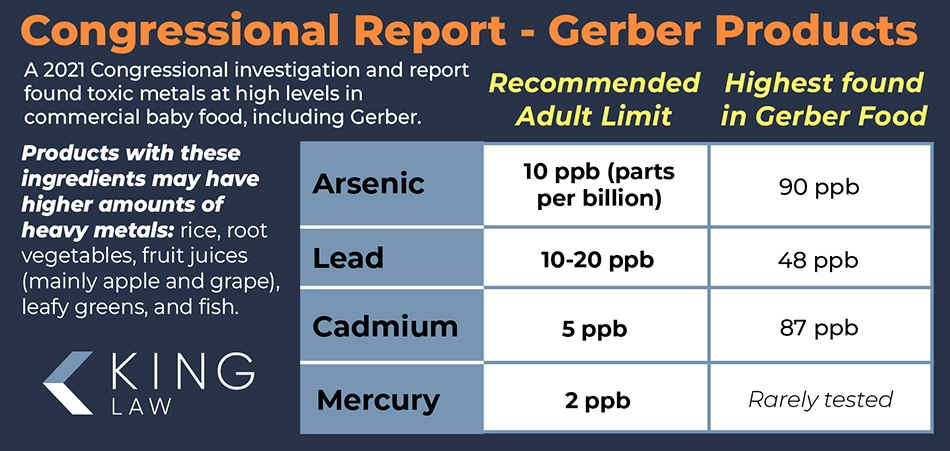
According to the 2021 congressional report, internal testing submitted by Gerber found toxic metals in their commercial baby food products. However, it is believed that even these amounts may be a substantial underestimation of the actual toxic metal levels in these products since Gerber primarily tested raw ingredients rather than the finished item.
Toxic Metal Levels Found in Gerber Baby Food Products
Some Gerber products designed for babies and children were found to contain high levels of heavy metals and other toxins. Gerber products that contained contaminants include juices, purees, pouches, cereals, and teething biscuits. Many of these products had levels that were higher than guidance levels for foods designed for adults. Some of the contaminants found in Gerber baby and toddler foods include:
- Arsenic: 67 batches of rice flour tested had over 90 parts per billion (ppb) of inorganic arsenic.
- Lead: Some ingredients tested as high as 48 ppb; many contained over 20 ppb of lead.
- Cadmium: 75% of Gerber carrots contained cadmium levels in excess of 5 ppb, with some as high as 87 ppb.
- Mercury: Despite its toxicity, Gerber admitted to rarely testing its baby food for mercury.
The testing found that toxic metals exceeded internal safety thresholds in some cases, including the amount of arsenic in its rice flour products. The findings led to demands for stricter regulations and highlighted the need for comprehensive testing at all production stages to protect the health of infants and children.
Heavy Metals Found in Gerber Baby Food
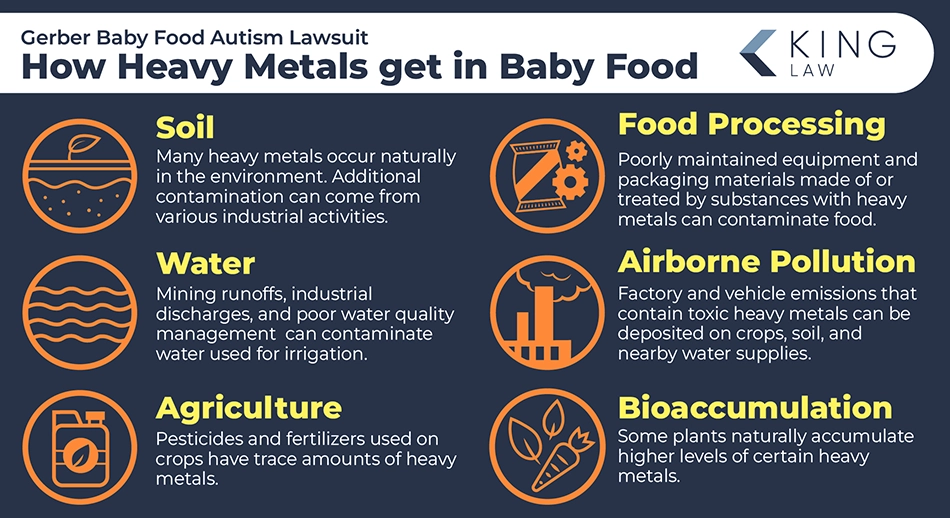
In multiple studies, including a 2021 congressional report, heavy metals have been identified in baby foods. These metals occur naturally in the environment but can also be increased by human activities. Some metals are absorbed by plants from soil and water, while other metals may be introduced during the manufacturing process. Heavy metals are known to cause a number of developmental and behavioral disorders, particularly when consumed by young children and infants.
Heavy metals identified in Gerber baby food products:
- Arsenic
- Lead
- Cadmium
- Mercury
At the request of a Congressional subcommittee, Gerber provided records of internal testing of its baby and toddler products for heavy metals. The company acknowledged the possibly problematic amounts of arsenic, lead, and cadmium in their products and has made claims to implement measures to minimize these levels. The company does not regularly test for mercury despite its potentially harmful effects.
Arsenic
According to the Department of Health and Human Services’ Agency for Toxic Substances and Disease Registry (ATSDR), arsenic poses significant risks to human health, especially to babies and young children. Potential side effects of arsenic exposure include respiratory and gastrointestinal issues, damage to the central nervous system, and a negative impact on cognitive development in children.
Studies about arsenic in baby food:
- Healthy Babies Bright Futures: A 2019 study by Healthy Babies Bright Futures found that 95% of baby foods tested contained toxic heavy metals, including arsenic and lead. Arsenic alone was found in 73% of baby foods and was particularly prevalent in rice-based foods because they absorb 10x more arsenic compared to other types of grains.
- Consumer Reports: A 2023 Consumer Reports study found that while arsenic levels in baby food are decreasing, the overall risk remains significant. The study also found that while arsenic levels may have dropped in some products, other heavy metal levels increased. For instance, in the Gerber Chicken Rice Dinner tested by the advocacy group, the amount of arsenic detected decreased by 22%, but lead was now detected.
Many of Gerber’s baby foods contain products that are known to have arsenic, including rice, apples, grapes, and root vegetables. In addition to rice-based products, parents should research apple and grape juices, which may exceed recommended arsenic limits, and root vegetables that were grown in contaminated soil.
Lead
Lead exposure is harmful to everyone, particularly children under the age of six. According to the Centers for Disease Control and Prevention (CDC), lead may be more dangerous to young children because they are still developing. Even small doses of lead can cause developmental delays and cognitive impairment. In some instances, the effect may be permanent.
The 2019 Healthy Babies Bright Futures study detected lead in 94% of baby foods they tested. Lead levels exceeding the FDA-proposed action levels were detected in fruit juices, root vegetables, and teething biscuits. As with arsenic, the 2023 Consumer Reports study found improvements in lead levels in some baby food products but cautions that there is still a significant risk to infants. Some juices, for instance, still exceed the 10 ppb action level proposed by the FDA.
Cadmium
In the 2019 Healthy Babies Bright Futures study, cadmium was detected in 75% of baby foods tested. The study also found that 15% of the products tested contained cadmium levels that were concerning to experts in the field.
Although the 2023 Consumer Reports study saw a decrease in cadmium levels in some products, the risk of harm was not eliminated. Sweet potatoes and carrots were of particular concern. Cadmium is often absorbed by root vegetables grown in contaminated soil.
Mercury
According to the 2019 Healthy Babies Bright Futures study, mercury was detected in 32% of the foods tested. Exposure to mercury can have a devastating effect on humans, particularly infants and young children. Mercury poisoning may cause loss of peripheral vision, impairment of speech and hearing, and muscle weakness.
The 2021 Congressional Report indicated that, as an industry, baby food companies rarely test for mercury. Rice plants, fish purees, and juices frequently contain mercury because of contaminated soil or aquatic environments.
Gerber Baby Food Products With Metals
When tested, some Gerber baby food products were found to contain toxic metals, including arsenic, lead, cadmium, and mercury.
Gerber Baby Food Products Containing Arsenic
Some baby and toddler foods manufactured by Gerber were found to have levels of arsenic. Some Gerber products with high levels of arsenic include:
- Rice Single Grain Cereal: 106 parts per billion (ppb)
- MultiGrain Cereal – Sitter 2nd Foods: 37 ppb
- Oatmeal Single Grain Cereal: 26.9 ppb
- Barley Single Grain Cereal- Supported Sitter 1st Foods: 10.6 ppb
- Whole Wheat Whole Grain Cereal – Sitter 2nd Foods: 40.6 ppb
- Variety Pack Juices from Concentrate – White Grape: 9.9 ppb
- Chicken Rice Dinner – Sitter 2nd Foods: 19.1 ppb
- Puffs Banana Cereal Snack – Crawler 8+ months: 44.5 ppb
- Teether Wheels – Apple Harvest – Crawlers: 51.5 ppb
Gerber Baby Food Products Containing Lead
Many baby and toddler foods manufactured by Gerber were found to have lead. Some Gerber products with allegedly high levels of lead include:
- Diced Carrots Veggie Pick-Ups™: 11.8 ppb
- Carrot – Sitter 2nd food: 9.4 ppb
- Carrot – Supported Sitter 1st Foods: 11 ppb
- Sweet Potato Supported Sitter 1st Foods Tub: 20.3 ppb
- Sweet Potato – Sitter 2nd Food: 29.3 ppb
- Sweet Potato – Supported Sitter 1st Foods: 14.6 ppb
- Variety Pack Juices from Concentrate – White Grape: 11.1 ppb
- Puffs Banana Cereal Snack – Crawler 8+ months: 9.2 ppb
- Fruit & Veggie Melts – Truly Tropical Blend – Freeze Dried Fruit & Vegetable Snack – Crawler, 8+ months: 12.2 ppb
- Arrowroot Biscuits – Crawler 10+ months: 12.5 ppb
Gerber Baby Food Products Containing Cadmium
Many baby and toddler foods manufactured by Gerber were found to have levels of cadmium. Some Gerber products with allegedly high levels of cadmium include:
- Rice Single Grain Cereal: 11.1 ppb
- Oatmeal Single Grain Cereal: 13 ppb
- Barley Single Grain Cereal- Supported Sitter 1st Foods: 13.7 ppb
- Whole Wheat Whole Grain Cereal – Sitter 2nd Foods: 50.8 ppb
- Diced Carrots Veggie Pick-Ups™: 27.7 ppb
- Carrot – Sitter 2nd food: 31.4 ppb
- Carrot – Supported Sitter 1st Foods: 42.2 ppb
- Organic Mango Apple Carrot Kale – Sitter 2nd foods: 11.4 ppb
- Carrot Pear Blackberry – Sitter 2nd Foods: 18.2 ppb
- Mashed Potatoes & Gravy with Roasted Chicken and a Side of Carrots – Toddler: 17.5 ppb
- Fruit & Veggie Melts – Truly Tropical Blend – Freeze Dried Fruit & Vegetable Snack – Crawler, 8+ months: 26.8 ppb
- Arrowroot Biscuits – Crawler 10+ months: 25.9 ppb
The amounts were detected when tested in the 2019 Healthy Babies Bright Future study. It is important to note that although mercury was detected in Gerber products, the company rarely tests for the toxic metal.
Research Linking Autism to Gerber Baby Food
There have been multiple studies linking heavy metal exposure to an increased risk of autism. Infants and young children are particularly vulnerable to the harmful effects of metal toxicity because their brains are still developing. Babies and children also eat more food in proportion to their body weight than adults, leading to increased exposure to contaminants.
Association Between Heavy Metals Exposure and Child Autistic Disorder
A 2023 study entitled “Association between heavy metals exposure (cadmium, lead, arsenic, mercury) and child autistic disorder: a systematic review and meta-analysis” found a significant association between environmental exposure to heavy metals and autism in children.
Published in Frontiers in Pediatrics, the authors, Mengmeng Ding, Shanshan Shi, Shuyan Qie, Jinglu Li, and Xiaoming Xi, found that concentrations of cadmium (Cd), lead (Pb), arsenic (As), and mercury (Hg) were higher in individuals with autism spectrum disorder compared to those in the control group. The study also discussed potential sources of exposure, including environmental pollution, industrial processes, and consumption of contaminated food and water.
Investigating the Role of Food Pollutants in Autism Spectrum Disorder
A study published in Naunyn-Schmiedeberg’s Archives of Pharmacology explored the link between food pollutants and an increased risk of autism spectrum disorder.
The research, “Investigating the role of food pollutants in autism spectrum disorder: a comprehensive review,” authored by Zahra Shamsipour Nehzomi and Kobra Shirani in October 2024, noted that there were higher levels of toxic metals, such as lead, mercury, and cadmium, in individuals with autism. These metals were commonly found in contaminated food, potentially caused by pesticides and food additives.
Toxic Heavy Metal Content of Infant and Toddler Foods and Evaluation of United States Policy
A 2022 study published in Frontiers in Nutrition and authored by Emily C. Bair sought to evaluate U.S. policies to safeguard against heavy metal exposure and discuss what is known about the potential harm. The study, “A Narrative Review of Toxic Heavy Metal Content of Infant and Toddler Foods and Evaluation of United States Policy,” determined that there are significant gaps in public understanding and a lack of consistent protocols by the U.S. government to prevent or limit exposure.
Association of Autism With Toxic Metals
A 2021 study published in Pharmacology Biochemistry and Behavior found that elevated levels of toxic metals are associated with autism spectrum disorder (ASD). In “Association of autism with toxic metals: A systematic review of case-control studies,” authors Cecilia N. Amadi, Chinna N. Orish, Chiara Frazzoli, and Orish E. Orisakwe explore the relationship between ASD and exposure to certain heavy metals, including cadmium, lead, and mercury. It was determined that higher levels of toxic metals were present in the hair samples, blood, and blood cells of children with ASD.
Gerber’s Response to Heavy Metal Baby Food Allegations
On April 9, 2021, Gerber publicly acknowledged the presence of heavy metals in their baby food products. The company noted that while it has industry-leading standards for testing for heavy metals, it remains committed to ensuring its products are safe and in accordance with FDA regulations.
Gerber also participated in discussions and collaborated with stakeholders to address concerns over the presence of heavy metals in baby food and is committed to helping develop industry-wide standards. They are a founding member of the Baby Food Council. While acknowledging the problem, the company still asserts that its baby food is safe and meets current regulatory standards.
U.S. Government’s Response to Toxic Metals in Baby Food
Several initiatives have been proposed to respond to growing concerns about the safety of baby food products in the United States. These legislative and regulatory actions would help to create industry-wide standards limiting the amount of heavy metals that can be present in baby food products.
State and Federal Regulations for Baby Foods
There are several federal and state-level actions intended to regulate heavy metals in baby food products. Those actions include:
- Baby Food Safety Act of 2024: This act was introduced by Senator Amy Klobuchar on May 9, 2024. If passed, it would establish limits on the amount of lead, cadmium, arsenic, and mercury that could be in baby food products in the U.S. It would also require baby food manufacturers to regularly test their products for heavy metal contamination.
- FDA’s Closer to Zero Initiative: This initiative was launched in 2021 to help limit the number of contaminants in food eaten by babies and young children. The phased approach includes research and analysis, regulation, and consultation.
- California’s AB-899: This bill was signed into law on October 10, 2023, by Governor Gavin Newsom. Beginning January 1, 2025, it requires monthly testing of baby food products in the state and mandates manufacturers to provide test results online.
Who Qualifies for the Gerber Baby Food Lawsuit?
In order to qualify for a Gerber baby food lawsuit, individuals must meet certain eligibility criteria. These criteria include that the child was born on or after January 1, 2007, and consumed one of the qualifying baby food products for at least six months. It also requires the diagnosis of autism or ADHD before age 14.
Eligibility criteria to file a Gerber baby food lawsuit with King Law:
- Age: The child must have been born on or after January 1, 2007.
- Diagnosis: The child must have been diagnosed with Autism before age 14.
- Product consumption: Must have proof the child consumed a qualifying baby food product for at least six months.
Qualifying baby food products include those manufactured by:
Children may have consumed Gerber baby food and products made by other manufacturers and still be eligible to file lawsuits.
Who Does Not Qualify For This Lawsuit?
While many children will qualify for a Gerber baby food autism lawsuit, there are some disqualifying factors.
Disqualifying factors:
- Born preterm (before 37 weeks)
- Weighed less than 5.5 pounds at birth
- Born before 2007
- Diagnosed with autism after age 14
- Consumed a qualifying baby food product for less than six months
- Involvement in related litigation
- Advanced age at conception
A diagnosis of another syndrome or condition may also disqualify a child from eligibility. If the mother had specific health or pregnancy complications, this could also affect eligibility. Concerned parents and guardians should speak with an attorney who is experienced in this type of litigation to determine eligibility.
Evidence to Gather for a Gerber Baby Food Lawsuit
Successful Gerber baby food lawsuits require the collection of evidence. This evidence can help substantiate your claim and strengthen your case. It is important to discuss your legal options with an attorney to ensure you gather the necessary documentation to prove your case.
Evidence to Collect for a Gerber Baby Food Lawsuit
If you choose to file a case against Gerber, you will need to collect evidence to prove that your child consumed specific Gerber products, received a specific diagnosis, and how that diagnosis has affected various areas of your lives. You will need to provide the following evidence as part of your lawsuit against Gerber:
- Medical records confirming an autism diagnosis
- Neurodevelopmental assessments
- Proof of purchase (receipts) of qualifying baby food products
- Bank statements
- Loyalty program records showing product purchase
- Product labels
- Marketing materials
- Growth charts
- Hair follicle or blood testing indicating the presence of toxic heavy metals
- Genetic records
- Witness statements
- Expert testimony
- Scientific studies and research
Damages You Can Recover in the Gerber Baby Food Lawsuit
Individuals who have been harmed as a result of toxic heavy metals in baby food products may be entitled to compensation. Compensation may include coverage for both economic and non-economic losses, such as medical expenses, lost wages, future healthcare treatment, and punitive damages. It is essential to consult with an attorney to determine the potential value of your or your child’s case.
Potential Recoverable Damages in a Gerber Baby Food Lawsuit
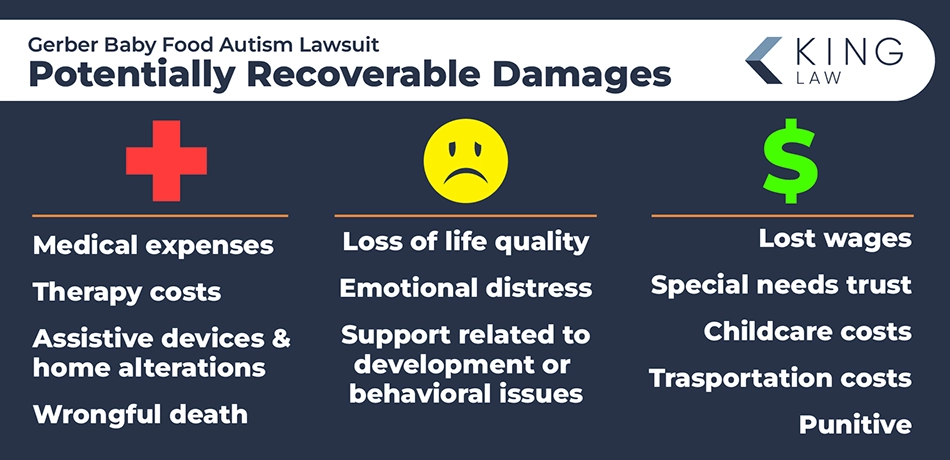
When you file a lawsuit, you may receive compensation for the many damages you or your child experienced. That compensation is intended to cover the following damages:
- Past and future medical expenses
- Therapy and rehabilitation costs
- Support for developmental or behavioral issues
- Emotional distress
- Lost wages and loss of future earning capacity
- Loss of quality of life
- Costs related to modifications to the home or assistive devices
- Transportation expenses and childcare costs
- Allocations for a special needs trust
- Wrongful death damages
- Punitive damages
How to File a Gerber Baby Food Lawsuit
There are several steps a person should follow to file a Gerber baby food autism lawsuit. The first step is consulting with a qualified lawyer. A lawyer, well-versed in product liability lawsuits, can help to ensure your child’s rights are protected and justice is served.
Steps to file a Gerber baby food lawsuit:
- Consult with an experienced attorney: The first step in a Gerber baby food autism lawsuit is consulting with an experienced attorney. An attorney can help to ensure you meet the necessary criteria to take legal action. It is important to consult with an attorney as early in the process as possible.
- Collect the necessary evidence: Once eligibility is confirmed, your attorney may ask you to collect certain evidence to help strengthen your claim. Necessary evidence may include your child’s medical records, receipts proving purchase, neurodevelopmental assessments, and expert opinions.
- File the legal complaint: After the evidence is collected, your attorney will file the claim in the appropriate venue. Prior to filing, your lawyer will ensure the case meets all eligibility requirements, including that it is filed within the statute of limitations.
Possible Gerber Baby Food Settlement Amounts
No global settlement has been announced. If settlements occur, amounts could vary widely depending on diagnosis severity, proof of exposure, and other factors. Potential settlements for Gerber baby food autism lawsuits could range between $400,000 and $1.5 million though this is estimate is speculative, and no amount is guaranteed. Settlements can depend on a number of factors, including the severity of the autism, past and future medical expenses, and the impact on their quality of life. Other factors include whether the injuries are permanent and if there is enough information to establish that the heavy metals in baby food were the cause of the child’s autism.
Parents of children born on or after January 1, 2007, who were diagnosed with autism before the age of 14 may be eligible for compensation and should consult with an experienced toxic exposure lawyer as soon as possible for case-specific estimates.
Deadline to File a Gerber Baby Food Lawsuit
The legal deadline to file a Gerber baby food lawsuit is state-specific and generally ranges from 1 to 6 years. Several factors may affect the statute of limitations or the amount of time you have to file a case, including the date of autism diagnosis and the discovery of the link between baby food and ASD.
Some exceptions may also apply, which may extend the amount of time you have to file, including whether the child is a minor and if new research has come out connecting heavy metal exposure from baby food products with autism. Aggrieved individuals are encouraged to consult with an attorney immediately after diagnosis to ensure the timely filing of their case.
Contact a Gerber Baby Food Lawyer
King Law has decades of experience handling complex litigation cases, including toxic exposure and product liability lawsuits. Parents of children diagnosed with autism as a result of eating contaminated baby food products are encouraged to contact King Law as soon as possible for a free consultation. The legal team will help you understand your rights and legal options. Let King Law pursue the compensation and justice you deserve.