

What Are the Signs of Infection After an ERCP?
Complete the form below to see if you qualify for a Olympus Scope Lawsuit

Endoscopic Retrograde Cholangiopancreatography (ERCP) is a specialized procedure used to diagnose and treat bile duct and pancreatic issues. The procedure can be done with a duodenoscope and does not require open surgery. However, ERCPs carry the risk of infections, some of which can be life-threatening.
Though uncommon, bacterial infections of the bile ducts can rapidly progress to sepsis if not promptly identified and treated. Patients who have undergone an ERCP procedure should watch for signs of infection. These symptoms include fever and abdominal pain, particularly in the first 48 hours. Patients should seek immediate medical attention if they have symptoms of infection.
Below, this page will cover symptoms commonly associated with post-ERCP infections, the risks of infection, and how those infections are treated.
About the ERCP Infection Symptoms
What Are the Signs of Infection After ERCP?
What Is Charcot’s Triad After ERCP?
What Is Reynolds’ Pentad and Why Is It Dangerous?
When Do Infection Symptoms Start After ERCP?
Why Do Infections Happen After ERCP?
How Common Are Infections After ERCP?
When Should You Seek Medical Attention After ERCP?
How Are Infections After ERCP Diagnosed?
How Are ERCP Infections Treated?
Can an ERCP Infection Lead to Sepsis?
King Law Is Investigating ERCP Infection Claims
Contact an ERCP Infection Lawyer Today
What Are the Signs of Infection After ERCP?
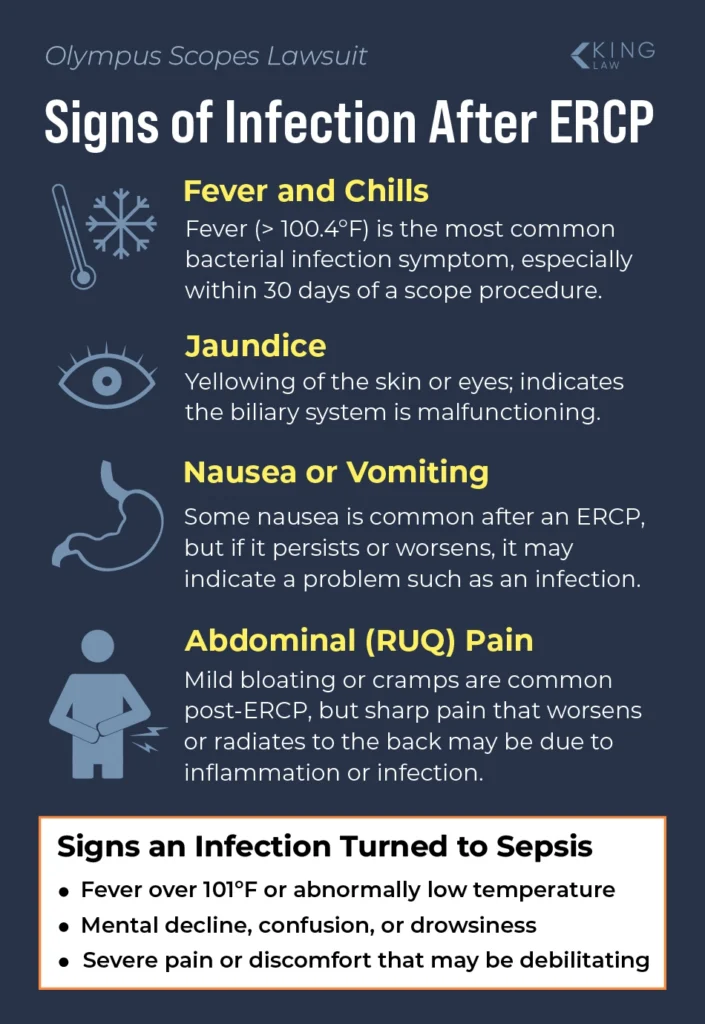
Signs of infection after undergoing an ERCP can encompass a variety of symptoms, including fevers, abdominal pain, chills, jaundice, nausea, vomiting, sepsis, confusion, rapid heartbeat, or low blood pressure. These symptoms may accompany cholangitis or bacteremia, which are infections of the bile duct system or bloodstream, respectively.
Fever and Chills After ERCP
Fever is the most common symptom of a bacterial infection like cholangitis or bacteremia. A
Abdominal Pain & Right Upper Quadrant (RUQ) Pain
A sharp or burning pain in the upper right abdominal area following an ERCP procedure can be a
Jaundice (Yellowing of Skin or Eyes)
Jaundice, which can cause yellowing of the skin or eyes, indicates a patient’s biliary system is not functioning correctly. Jaundice occurs when bilirubin, a byproduct of the breakdown of old red blood cells, builds up in the bloodstream. Among the causes of jaundice are bile duct blockages and biliary system infections, including ERCP infections. People showing symptoms of jaundice should seek immediate medical attention.
Nausea and Vomiting After ERCP
While some nausea is common after an ERCP, persistent or worsening nausea accompanied by vomiting may be a symptom of a more serious condition, including an infection. Nausea can be particularly concerning if it is accompanied by other symptoms (such as the ones above), the inability to keep liquids down, or vomiting material that resembles coffee grounds (coffee ground emesis), which can be a sign of internal bleeding.
Signs of Sepsis (Severe Infection After ERCP)
Sepsis is a severe, life-threatening reaction to an infection that can result in organ or tissue damage or even death. Sepsis can occur as a result of post-ERCP cholangitis or bacteremia. If left untreated, sepsis can lead to organ failure or even death. Patients and caretakers can monitor for symptoms of sepsis using the TIME criteria, which is an acronym for:
- Temperature: fever over 101°F or an abnormally low temperature
- Infection: signs of an infection, such as those listed above
- Mental decline: such as confusion and drowsiness
- Extremely ill: self-reported severe symptoms of pain, discomfort, or sense that something is seriously wrong
Patients should seek immediate medical assistance if they develop these symptoms.
What Is Charcot’s Triad After ERCP?
Charcot’s triad is a cluster of three symptoms traditionally used to diagnose acute cholangitis (infection of the bile ducts). It is named after Jean-Martin Charcot, a 19th-century French neurologist. ERCP patients are at risk of developing cholangitis in the weeks after the procedure. Charcot’s triad provides a useful way to assess warning signs that an infection is developing. The three components of Charcot’s triad are:
- Fever
- Right-upper-quadrant (RUQ) pain
- Jaundice
Charcot’s triad is reported in around 26.4% of patients with cholangitis. When present with additional symptoms outlined in Reynolds’ pentad (discussed below), it may indicate a more serious infection. The two guidelines are considered to be high specificity, and low sensitivity. For example, slightly more than 1 in 4 patients with cholangitis present with all three of Charcot’s triad (low sensitivity). However, over 95% of people who present with Charcot’s triad have cholangitis (high specificity), making it more effective as rule-in than rule-out criteria.
What Is Reynolds’ Pentad and Why Is It Dangerous?
Reynolds’ pentad adds two additional symptoms to Charcot’s triad to identify severe cases of cholangitis, though it is often considered a late-stage warning system due to its low-sensitivity, and high-specificity. The five symptoms of Reynold’s pentad are:
- Fever (from Charcot’s triad)
- Right-upper-quadrant pain (from Charcot’s triad)
- Jaundice (from Charcot’s triad)
- Altered mental state such as confusion, drowsiness, or sleepiness
- Sepsis (shock) or hypotension
As is the case with Charcots’ triad, if you have all five symptoms, there is a very high likelihood that you have severe cholangitis. However, most severe cases of cholangitis do not present with the full pentad. Instead, modern physicians tend to use Tokyo Guidelines 2018 (TG-18), which outlines three categories: systemic inflammation, cholestasis, and imaging. A definitive diagnosis requires one item from each of those three categories.
When Do Infection Symptoms Start After ERCP?
Infections can come on very quickly after an ERCP, often within 48 hours of the procedure. However, some patients develop symptoms weeks after a procedure. Often, patients are in a weakened state after a procedure, leaving them more susceptible to infections from contaminated scopes or tissue damaged during the procedure. The onset time for symptoms may vary depending on the type of infection.
Within the First 24 Hours
Bacteremia, or bloodstream infections, can develop almost immediately and will often present with symptoms like fever and chills within the first 24 hours. Pancreatitis also tends to present within a day of surgery, with symptoms including nausea, vomiting, and abdominal pain. Note that it is not unusual to feel some post-ERCP discomfort, gas, or bloating after the procedure, but severe pain or fever may be signs of a serious complication.
24–48 Hours After ERCP
Cholangitis (bile duct infections) tends to present with symptoms within the first two days. Patients with a cholangitis infection may present with fever, RUQ pain, or jaundice. While bacteremia can be serious, cholangitis is the leading cause of post-ERCP sepsis, making the first several days after ERCP an important period for monitoring.
Several Days to Weeks Later
After the first few days, the risk of a serious infection drops but remains elevated for around 30 days. Post-ERCP gallbladder infections (cholecystitis) tend to surface between the 5- and 10-day mark. Complications such as retained gallstones, stent blockages, or pyogenic liver abscess may present with symptoms like fever or RUQ within the first month and should be taken seriously.
Why Do Infections Happen After ERCP?
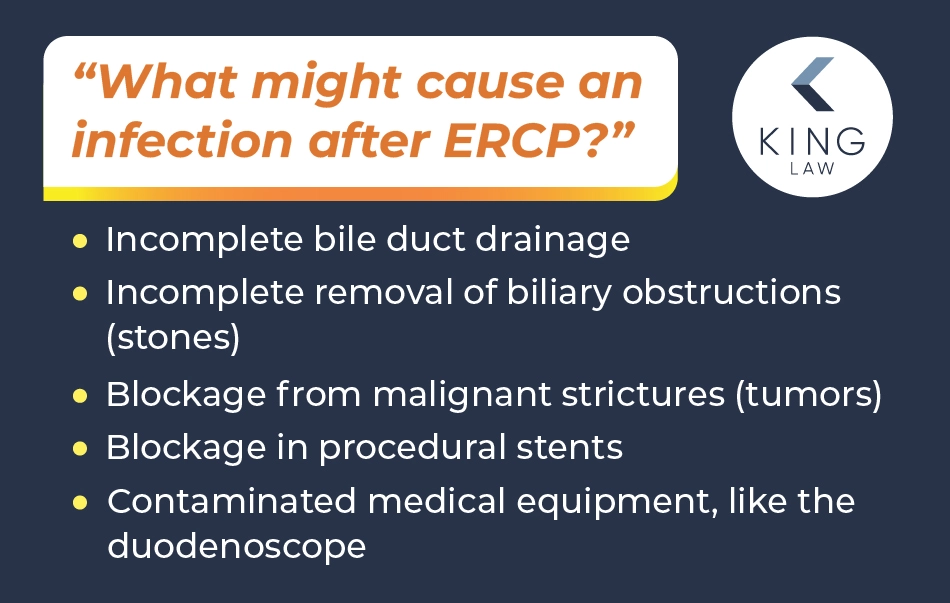
ERCP procedures can introduce foreign bacteria into bile ducts, which have their own simple microbiome. Physical structures like the sphincter of Oddi normally prevent intestinal fluid and bacteria from entering. However, an ERCP can introduce intestinal bacteria into the biliary system. When bile cannot drain adequately because of a stone, stricture, tumor, or blocked stent, it can lead to infection.
The ASGE (American Society for Gastrointestinal Endoscopy) identifies infections as a potential adverse event associated with ERCPs. Common direct causes of infection include:
- Incomplete drainage of the biliary duct. The ASGE considers this the most common cause of post-ERCP infections.
- Retained biliary obstructions. Incomplete removal of stones can interfere with the system’s natural processes.
- Blocked stents. Stents inserted during the procedure may themselves become blocked, causing similar issues to stones.
- Malignant strictures. Blockages caused by tumors within the biliary system.
Bacteria can be introduced from another area of the body or come from outside of the body, such as on a contaminated duodenoscope or other medical equipment. Duodenoscope sterility and post-processing procedures also play a role in ERCP infections.
How Common Are Infections After ERCP?
Infection rates after an ERCP procedure can range from 1.7% to 13.5%. The rates of infection are typically on the lower end, with various patient health factors influencing possible infection rates. While the vast majority of ERCP procedures do not result in infections, the rate of infection is high compared to most other endoscopic procedures. This is due to a combination of the nature of the biliary system, the complexity of the scopes used, the underlying conditions ERCPs are performed for, and possible ongoing challenges in reprocessing reusable scopes.
According to several studies, infection rates and complications after an ERCP include:
- Cholangitis
occurs in ~1.7% of cases . - Bacteremia detection varies depending on how aggressive the screening process is, but standard screening finds rates between 2% and 5%, or ~3.1% of cases.
- Cholecystitis is rare, occurring in just ~0.38% of cases, although the risk increases significantly with procedures that use metal stents.
- Pancreatitis is a relatively common adverse event, affecting around 9.7% of ERCP patients.
Not all of these infections will be life-threatening. However, they should be treated quickly to avoid any complications.
When Should You Seek Medical Attention After ERCP?
Patients who have undergone an ERCP procedure in the last 30 days should seek immediate emergency medical attention if they exhibit symptoms of high-concern. The American College of Gastroenterology suggests patients seek medical attention if they have any of the following symptoms:
- Fever
- Severe abdominal pain
- Vomiting
- Difficulty swallowing
- A crunching sensation under the skin
- Severe abdominal bloating
- Bleeding
These symptoms may indicate cholangitis, sepsis, or another serious condition. Patients should speak with their care team to understand if their symptoms require urgent evaluation in an emergency department.
How Are Infections After ERCP Diagnosed?
A high standard for diagnosing post-ERCP cholangitis is the Tokyo Guidelines 2018 (TG-18). TG-18 requires formal imaging as part of its diagnostic criteria and can catch cases that do not present with all of the symptoms of Charcot’s triad or Reynolds’ pentad. TG-18 diagnostic criteria outline three categories:
- Systemic inflammation: This category includes symptoms like a fever above 38°C or 100.4°F , elevated white blood cell count, or C-reactive protein.
- Cholestasis: This category includes symptoms like jaundice and abnormal liver enzymes.
- Imaging: Ultrasound, CT, or MRCP test results showing a blockage or biliary dilation. Typically, an ultrasound is taken first, followed by a CT scan if needed.
A suspected diagnosis requires one item from category 1 and one item from 2 or 3. A definitive diagnosis requires an item from all three categories.
How Are ERCP Infections Treated?
ERCP infections usually need immediate intervention, though the precise methodology may vary depending on the “Grade” of the disease, with Grade I being mild and Grade III being severe. Treatment regimens may look something like this:
- All diagnosed patients: fluid replacement, electrolyte compensation, and IV antibiotics (typically those effective against intestinal bacteria).
- Grade I: If unresponsive to the above, biliary tract drainage.
- Grade II: Early biliary tract drainage, blood/bile culture
- Grade III: Immediate biliary tract drainage, blood/bile culture, and organ supportive care
Once the patient is stabilized, additional procedures may be performed as necessary.
Can an ERCP Infection Lead to Sepsis?
Though uncommon, ERCP infections can lead to sepsis, which is the body’s potentially life-threatening response to an infection. Sepsis and septic shock are more common in high-risk patients, including the elderly. The mortality rate for patients with post-ERCP sepsis is estimated to be between 7.5% and 31%, depending on the severity of any obstructions, particularly malignant obstructions, in the biliary system. Sepsis can develop within hours to weeks and requires intensive care in severe cases.
King Law Is Investigating ERCP Infection Claims
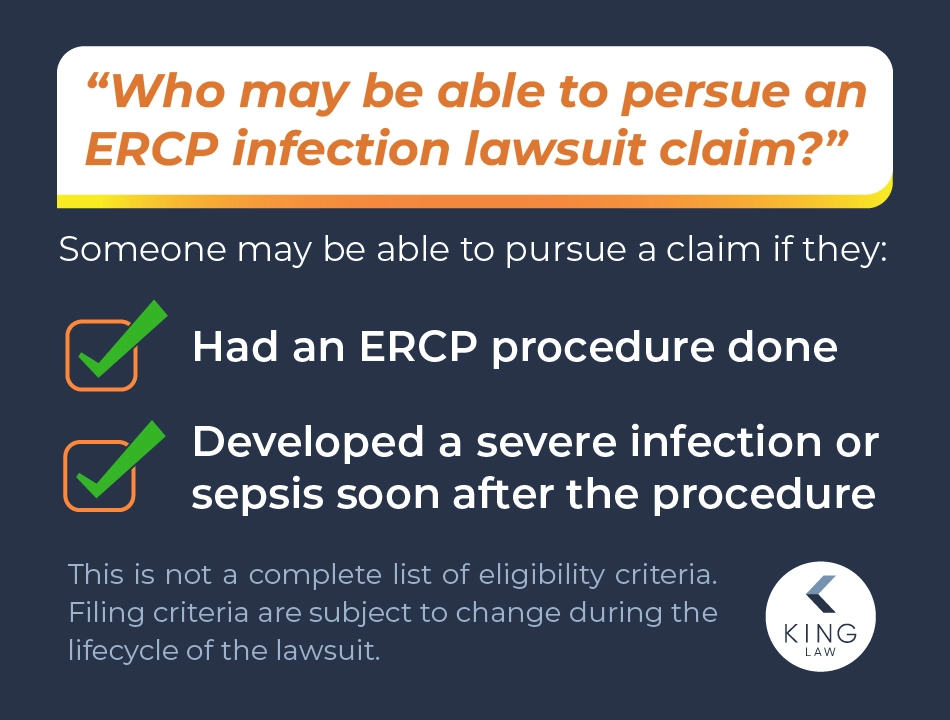
King Law is currently investigating infection claims related to ERCP procedures. Although post-ERCP infections can have many underlying causes, some infections are due to issues for which the endoscopic device manufacturer may be liable.
Patients may be able to file a claim against an endoscope device manufacturer if:
- The infection was caused by device contamination (e.g., a contaminated Olympus scope)
King Law provides free consultations with no obligation to continue with a lawsuit. We are here to help patients and their families understand their legal options.
Contact an ERCP Infection Lawyer Today
If you developed a serious infection after ERCP and believe it was caused by a contaminated scope or another preventable cause, you may have legal options. Contact King Law at (585) 496-2648 or complete the form on this page for a free consultation. Our experienced attorneys work on a contingency basis, so there’s no upfront cost to pursuing your claim. We can help you understand your legal options and whether or not you qualify to file a lawsuit related to a contaminated duodenoscope.
Frequently Asked Questions (FAQs)
List of Sources Used in This Article
King Law adheres to strict editorial standards when writing content for this site. Here is a list of sources for this article.
- American College of Gastroenterology. “ERCP: A Patient’s Guide.” American College of Gastroenterology, n.d.
- American Society for Gastrointestinal Endoscopy. “Adverse Events Associated with ERCP.” American Society for Gastrointestinal Endoscopy, 2017.
- Chandrasekhara, Vinay, et al. “Adverse Events Associated with ERCP.” Gastrointestinal Endoscopy, vol. 85, no. 1, 2017, pp. 32–47.
- Cleveland Clinic. “Adult Jaundice.” Cleveland Clinic, n.d.
- Cleveland Clinic. “Coffee Ground Emesis (Vomitus).” Cleveland Clinic, n.d.
- Cleveland Clinic. “Sepsis.” Cleveland Clinic, n.d.
- Cleveland Clinic. “Sphincter of Oddi Dysfunction.” Cleveland Clinic, n.d.
- Devière, Jacques, et al. “Septicemia after Endoscopic Retrograde Cholangiopancreatography.” Endoscopy, vol. 22, no. 2, 1990, pp. 72–75.
- Du, Mingmei, et al. “Post-ERCP Infection and Its Epidemiological and Clinical Characteristics in a Large Chinese Tertiary Hospital: A 4-Year Surveillance Study.” Antimicrobial Resistance & Infection Control, vol. 6, 2017, article 131.
- Gupta, Manav, et al. “A237 Incidence, Risk Factors, and Outcomes of Post-ERCP Cholangitis in Patients with Primary Sclerosing Cholangitis.” Journal of the Canadian Association of Gastroenterology, vol. 8, suppl. 1, 2025.
- Hudgi, Amit, et al. “Tokyo Guidelines (TG18) for Acute Cholangitis Provide Improved Specificity and Accuracy Compared to Fellow Assessment.” Cureus, vol. 14, no. 7, 2022, article e27527.
- Hutfless, Susan, et al. “Risk Factors for Infections after Endoscopic Retrograde Cholangiopancreatography (ERCP): A Retrospective Cohort Analysis of US Medicare Fee-for-Service Claims, 2015–2021.” BMJ Open, vol. 12, no. 9, 2022, article e065077.
- Kahaleh, Michel, and Firas H. Al-Kawas. “Prevention and Management of Post-Endoscopic Retrograde Cholangiopancreatography Complications.” Clinical Endoscopy, vol. 45, no. 3, 2012, pp. 305–312.
- Khan, Rehan, et al. “Post-ERCP Cholecystitis: Incidence, Characteristics, and Outcomes from a Prospective Multicenter Registry.” Gastrointestinal Endoscopy, 2024.
- Kiriyama, Seiki, et al. “Tokyo Guidelines 2018: Diagnostic Criteria and Severity Grading of Acute Cholangitis (with Videos).” Journal of Hepato-Biliary-Pancreatic Sciences, vol. 25, no. 1, 2018, pp. 17–30.
- Kwak, Min-Sun, et al. “Risk Factors of Post Endoscopic Retrograde Cholangiopancreatography Bacteremia.” Gut and Liver, vol. 7, no. 2, 2013, pp. 228–233.
- Mayo Clinic Staff. “Cholecystitis: Symptoms and Causes.” Mayo Clinic, n.d.
- Mayumi, Toshihiko, et al. “Tokyo Guidelines 2018: Management Bundles for Acute Cholangitis and Cholecystitis.” Journal of Hepato-Biliary-Pancreatic Sciences, vol. 25, no. 1, 2018, pp. 96–100.
- MedlinePlus. “Cholangitis.” MedlinePlus Medical Encyclopedia, U.S. National Library of Medicine, n.d.
- Nguyen, Lan T., et al. “Right Upper Quadrant Pain Following Endoscopic Retrograde Cholangiopancreatography.” Clinical Case Reports, vol. 10, no. 5, 2022.
- Penn Medicine. “Endoscopic Retrograde Cholangiopancreatography (ERCP).” Penn Medicine, n.d.
- Rumsey, Sarah, et al. “Diagnostic Accuracy of Charcot’s Triad: A Systematic Review.” ANZ Journal of Surgery, vol. 87, no. 4, 2017, pp. 232–238.
- ScienceDirect. “Charcot’s Triad.” ScienceDirect Topics, Elsevier, n.d.
- Szary, Nicholas M., and Firas H. Al-Kawas. “Complications of Endoscopic Retrograde Cholangiopancreatography: How to Avoid and Manage Them.” Gastroenterology & Hepatology, vol. 9, no. 8, 2013, pp. 496–504.
- Virgile, Jacques, and Mohammed H. Marathi. “Cholangitis.” StatPearls, StatPearls Publishing, n.d.
- Watanabe, Shunsuke, et al. “Bile Collected from the Normal Gallbladder of Patients during Surgery Is Not Sterile.” Cureus, vol. 14, no. 6, 2022, article e25681.
- Wikipedia contributors. “Jean-Martin Charcot.” Wikipedia, The Free Encyclopedia, Wikimedia Foundation, n.d.
- Yılmaz, Hakan, et al. “Predictors of Postendoscopic Retrograde Cholangiopancreatography-Associated Cholangitis: A Retrospective Cohort Study.” Turkish Journal of Medical Sciences, vol. 52, 2022.