

Boston Naval Shipyard Mesothelioma Lawsuit [2026 Update]
Complete the form below to see if you qualify for a Mesothelioma Lawsuit

The Boston Navy Yard built and repaired Navy ships in Charlestown, Massachusetts, from 1801 to 1974. According to public filings and lawsuits, asbestos-containing materials were used during shipbuilding, overhaul, and repairs at Boston Navy Yard during some operations.
After working at the Boston Navy Yard, some people have developed mesothelioma due to asbestos exposure. They, or their surviving loved ones, may have a legal claim against the companies that manufactured asbestos-containing products used at the Boston Navy Yard.
This page will discuss Boston Naval Shipyard mesothelioma lawsuits, including who might be eligible, high-risk occupations, where people might have encountered asbestos, and how to file a lawsuit after a mesothelioma diagnosis.
About the Boston Navy Yard Mesothelioma Lawsuit:
Boston Navy Yard Asbestos and Mesothelioma Lawsuit Updates
About the Boston Navy Yard in Charlestown, Massachusetts
Why Was Asbestos Used in the Boston Navy Yard and Its Repair Work?
What Asbestos Materials Were Used at the Boston Naval Shipyard/Charlestown Navy Yard?
How Were Boston Navy Yard Workers Exposed to Asbestos at the Shipyard?
Which Boston Naval Shipyard Workers Had the Highest Rate of Exposure?
Health Risks Linked to Boston Naval Shipyard Asbestos Exposure
Boston Naval Shipyard Remediation and Current Site Management
Who Can File a Boston Naval Shipyard Mesothelioma Lawsuit?
What Evidence Is Needed to File a Boston Naval Shipyard Mesothelioma Claim?
How Can I File a Boston Naval Shipyard Mesothelioma Claim?
How Long Does a Boston Navy Yard Mesothelioma Claim Take?
What Is the Deadline to File a Boston Naval Shipyard Mesothelioma Lawsuit?
How Much Money Can I Make From a Boston Naval Shipyard Mesothelioma Settlement?
King Law Is Investigating Boston Navy Yard Asbestos Claims
Contact a Boston Naval Shipyard Mesothelioma Attorney Today
Boston Navy Yard Asbestos and Mesothelioma Lawsuit Updates
Read about the legal complaints and public reports alleging asbestos was used at Boston Navy Yard. People who worked at the Boston Navy Yard have claimed that they were not told that asbestos could cause them to develop mesothelioma or other diseases. Family members of people who worked at Boston Navy Yard are also filing lawsuits because they believe they developed mesothelioma from asbestos brought home from the Boston Navy Yard.
2021: Woman Sues After Husband Dies of Mesothelioma, Claims Asbestos at Boston Naval Shipyard Is the Cause
A woman has sued several companies that manufactured asbestos-containing products used at Boston Naval Shipyard. She claims her husband developed mesothelioma because of asbestos he was exposed to when he worked as a heavy equipment operator at Boston Navy Yard in the 1960s. He was diagnosed with mesothelioma in 2018, and he passed away a month later. According to witnesses, the woman’s husband worked directly with asbestos-containing engine gaskets.
December 31, 2018: Couple Files Mesothelioma Lawsuit Against Companies that Supplied Asbestos Products to Boston Naval Shipyard
A man and his wife have sued over a dozen companies that produced asbestos-containing materials used at Boston Naval Shipyard. The man worked as a rigger at the Boston Navy Yard in the 1960s and 1970s and claims he was exposed to asbestos during that time. In the legal complaint, he says he was not warned that asbestos was dangerous or could cause mesothelioma.
December 15, 2015: Boston Marine Machinist Brings Mesothelioma Claim
A man who worked as a marine machinist for the United States Navy in the 1950s and 1960s has filed a lawsuit against dozens of companies that produced asbestos-containing products used at Boston Navy Yard. He claims that he was exposed to asbestos during his time in the service and through his employment in the private sector. In the legal complaint, he accuses the companies of failing to warn him that the asbestos in the products he worked with as a marine machinist could cause him to develop mesothelioma.
1974: Boston Navy Yard Is Transferred to the National Park Service and Becomes Part of Boston National Historic Park
The
About the Boston Navy Yard in Charlestown, Massachusetts
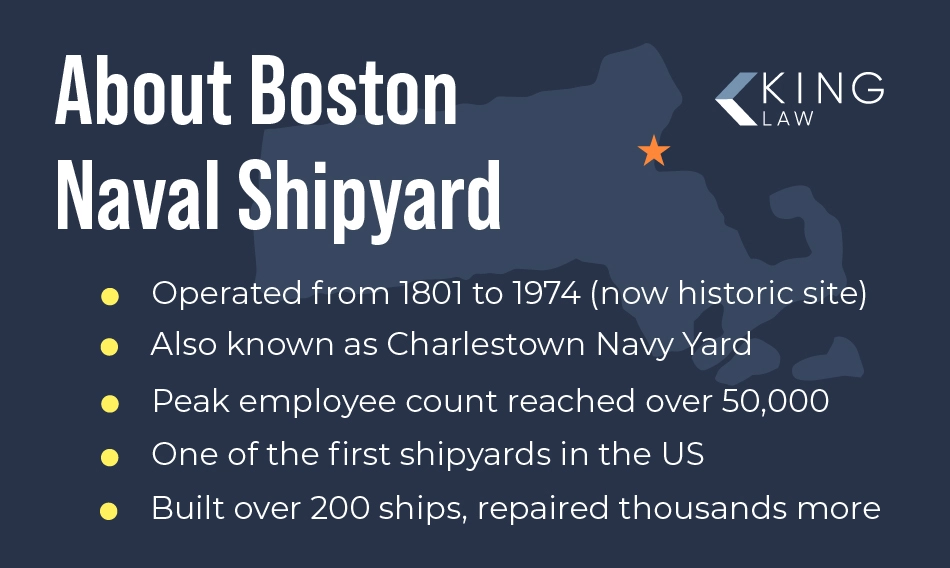
The Boston Naval Shipyard was founded in 1800 and is located in Charlestown, Massachusetts. Boston Naval Shipyard is also called Boston Navy Yard and Charlestown Navy Yard and is the home of the historic USS Constitution. At its peak in World War II, the Boston Naval Yard employed more than 50,000 people. The Boston Naval Yard was decommissioned in 1974 and is now managed by the National Park Service, where people can visit the yard and several of its historic ships.
The Boston Navy Yard completed wartime shipbuilding and repair efforts during conflicts such as World Wars I and II, the Civil War, the War of 1812, and the Spanish-American War. Workers at the Boston Navy Yard also upgraded ships during the Cold War. The Boston Navy Yard also contained living quarters for those in the Navy and Marines.
The Boston Navy Yard conducted the bulk of its shipbuilding and ship repair efforts during times when asbestos was used by the Navy. Asbestos was preferred over many other materials because of its superior resistance to heat and fire. As such, some people who worked at the Boston Navy Yard were likely exposed to asbestos. Asbestos exposure at shipyards was common, and many people have filed lawsuits against asbestos manufacturers.
What Are Boston Navy Yard Lawsuits About?
Former Boston Navy Yard workers and their families are filing lawsuits against asbestos manufacturers after receiving a mesothelioma diagnosis. These claims allege that companies that made asbestos products did not warn people about the dangers of asbestos exposure. Without warning, many workers did not protect themselves from asbestos, leading to serious injuries and wrongful death.
Why Was Asbestos Used in the Boston Navy Yard and Its Repair Work?
According to historical and government documents, asbestos was used in the Boston Navy Yard. Asbestos products were frequently used at shipyards because it was resistant to heat, fire, and chemical damage. As such, the Navy sometimes required or highly recommended that service members use asbestos-based materials in Naval operations.
For example, asbestos-insulated boilers, steam pipes, gaskets, valves, turbines, packing, and other equipment were used. Workers at the Boston Navy Yard may have encountered asbestos when operating, repairing, overhauling, servicing, replacing, installing, or renovating equipment. Asbestos may have also been found in on-site waste facilities or yards.
What Asbestos Materials Were Used at the Boston Naval Shipyard/Charlestown Navy Yard?
Using asbestos-containing materials was common practice when the Boston Navy Yard was constructing, repairing, renovating, and overhauling ships. Asbestos-containing materials could have been found in places such as the shipboard components, engine rooms, Chain Forge Building 105, and Building 109. Workers at the Boston Navy Yard may have disturbed asbestos when performing routine work. Asbestos fibers could have circulated in the ventilation system, collected on work surfaces, or gathered on workers’ clothing.
Shipboard Components and Engine-Room Materials
Asbestos-containing materials could have been found in many of the shipboard components and in the engine rooms. For example, according to the testimony of an engineering officer who was on a ship overhauled at the Boston Navy Yard, asbestos-containing insulation was used throughout the ship, as well as in gaskets, valves, packing, pipes, pipe covers, turbines, and other equipment.
For instance, people in charge of an overhaul or rip-out would disassemble a turbine and inspect it to see what needed to be repaired. During that process, the man said, asbestos dust would be released into the engine room. Many of the rooms on ships would have poor ventilation to keep heat, fire, and water out. So, asbestos dust released into the air could gather on surfaces and be disturbed again when people were in the room.
Chain Forge Building 105 and Transite Asbestos-Cement Siding
Chain Forge Building 105 was where the Navy manufactured strong anchor chains for ships. According to public reports, renovations to Chain Forge Building 105 included adding a second story with asbestos wall panels in 1943.
These corrugated asbestos wall panels or siding used on Building 105 were called Transite. Working on, installing, moving, replacing, or servicing Transite panels could disturb the asbestos fibers and release them into the air. People at Boston Navy Yard who were responsible for renovating or maintaining Building 105 may have been exposed to free asbestos fibers.
Building 109’s Asbestos Siding and Planned Remediation
According to a National Park Service document, Building 109 was a waterfront office that was constructed in the early 1940s around an electrical substation built in the early 1900s. According to that document, Building 109 was made with asbestos siding.
The building is now more than 70 years old, and the NPS proposed plans to take down Building 109 and replace it with an open structure for visitors and programs at Boston Navy Yard. Workers involved in renovation, demolition, or construction at Building 109 on the Boston Navy Yard may be at risk of coming into contact with asbestos in the existing siding or other materials.
Other Boston Navy Yard Building Materials and Fireproofing Products
Other structures, fireproofing components, and building materials at Boston Navy Yard may have contained asbestos. For example, the Naval and Marine living quarters at Boston Navy Yard may have had asbestos-containing materials, such as insulation, ceiling tiles, flooring, electrical panels, and piping.
Here are some of the job activities that may have exposed workers to asbestos at the Boston Navy Yard:
- Cutting
- Drilling
- Installing
- Renovating
- Repairing
- Scraping
If these activities were performed on asbestos-containing materials, asbestos fibers could be released into the air, allowing for inhalation or ingestion.
How Were Boston Navy Yard Workers Exposed to Asbestos at the Shipyard?
Asbestos was present in many materials used at shipyards. During much of the 1900s, asbestos use was prevalent because the material was resistant to heat and fire. People who worked in shipyards often worked in small spaces with limited ventilation. People who worked with asbestos-containing materials were exposed to asbestos while performing essential job duties and not wearing protective equipment.
Workers at Boston Navy Yard may have been exposed to asbestos that was released into the air during shipyard operations, including:
- Construction
- Repair
- Wrapping
- Cutting
- Demolition
- Standard operations
Those who may have been at the highest risk included those who worked directly with asbestos-containing insulation. However, there are reports of shipyard workers developing asbestos-related diseases even though they did not work directly with asbestos-containing materials.
Handling and Replacing Insulation, Lagging, and Steam-System Materials
Scientific and governmental reports have suggested that asbestos exposure was highest among those who worked with asbestos-containing insulation and lagging. For example, one gentleman who worked in the industry confirmed that asbestos dust would be created “during rip outs of old insulation for ship overhaul or reconversions.”
Situations where this might occur include inspecting and overhauling turbines, boilers, and steam pipes, since these pieces of equipment were often insulated with asbestos. A 1940s study also suggested that working as a pipe coverer was associated with asbestos exposure and an increased risk of asbestos-related diseases.
Confined Spaces and Poor Ventilation During Ship Repairs
Ship repairs at Boston Navy Yard may have involved disturbing asbestos-containing insulation and other materials. Statements made during a 1985 Senate Finance Subcommittee Hearing described how the Navy oversaw extensive shipbuilding and repair efforts from 1945 to 1949, when asbestos-containing insulation was sometimes required for Naval ships.
As suggested by the testimony of someone with experience of ship repairs at Boston Navy Yard, these repairs may have taken place in enclosed spaces such as boiler rooms and engine rooms. As a result, asbestos dust created from the heat, vibration, and activity during the repair may have released fibers into the air. Those fibers may have stayed in the room, exposing workers to high concentrations of asbestos, or circulated through the ship’s ventilation system.
Shipyard Shops, Trades, and Bystander Exposure
Shipyard shops at Boston Navy Yard may have also contained asbestos materials. So, tradespeople, maintenance staff, and others who worked at the Yard may have been exposed. For example, a National Park Service record indicates that a World War II-era addition to
Building 24 was first called the “Joiner’s Shop, Carpenter’s Work Shop, and Rigging Loft,“ and it became the shipyard workers’ headquarters in the late 1920s to the early 1930s. People who worked at or near this building at Boston Navy Yard may have been exposed to asbestos that they or someone else disturbed.
Take-Home Exposure to Family Members
Family members of those who worked at Boston Navy Yard may have also been exposed to asbestos fibers their loved ones brought home from the yard. People who worked at plants that made asbestos-containing insulation and cement have described how
Boston Navy Yard workers who cut, scraped, wrapped, repaired, installed, or removed asbestos–containing insulation may have also had asbestos dust on them that they carried home. Their children, spouses, and other close relatives who lived with them may have breathed in these take-home asbestos fibers from Boston Navy Yard.
Which Boston Naval Shipyard Workers Had the Highest Rate of Exposure?
Boston Navy Yard workers who may have had the highest rate of asbestos exposure may have been those who repeatedly and directly worked with asbestos-containing materials.
Workers in these roles may be involved in Boston Naval Shipyard lawsuits:
- Construction and demolition crews
- Engine and boiler rooms
- Maintenance staff
- Skilled tradesmen (e.g., pipefitters, welders, and electricians)
Engine-Room and Boiler-Space Workers
People who worked in the engine and boiler rooms at Boston Navy Yard may have been exposed to asbestos in the insulation, gaskets, valves, turbines, boilers, steam systems, and other components in those spaces. Asbestos-based products were commonly used in engine and boiler rooms in Naval ships and shipyards.
Skilled Trades and Shop Workers
Pipefitters, welders, boilermakers, electricians, plumbers, carpenters, insulators, and other skilled tradesmen and shop workers may have been exposed to asbestos at Boston Navy Yard.
For instance, pipefitters and welders at Boston Navy Yard may have used asbestos-containing insulation, gaskets, and pipe lagging. Carpenters, plumbers, and electricians may have encountered asbestos during construction, renovations, modernization efforts, and repairs.
Maintenance, Renovation, and Demolition Personnel
Maintenance staff, demolition crew, and renovation personnel may have also been exposed to asbestos at Boston Navy Yard. For example, renovation workers overhauling outdated buildings at the Boston Navy Yard may have breathed in asbestos from Transite siding and asbestos shingles. Maintenance crew who were tasked with cleaning out decommissioned ships at the Boston Navy Yard may have also been exposed to asbestos dust.
Health Risks Linked to Boston Naval Shipyard Asbestos Exposure
Asbestos is a known human carcinogen, and
- Asbestosis
- Lung cancer
- Malignant mesothelioma
- Pleural disease
Mesothelioma commonly affects the lining of the lungs (pleural mesothelioma), abdomen (peritoneal mesothelioma), testes (testicular mesothelioma), and heart (pericardial mesothelioma). It is an aggressive type of cancer that can take a decade or more to develop after the person is exposed to asbestos. Studies have shown that people who work on ships and in shipyards may be at an increased risk of developing mesothelioma.
Latency Period and Why Diagnoses Still Occur Today
Many asbestos-related diseases tend to develop a decade or longer after the person encounters asbestos. The gap between exposure and diagnosis is referred to as the latency period. For example, at least one study found that the latency period for mesothelioma may be 20 to 50 years.
Because of this long latency period, people who were exposed to asbestos at the Boston Navy Yard may not experience symptoms or be diagnosed with mesothelioma until long after they have left or retired from their position.
Boston Naval Shipyard Remediation and Current Site Management
The Boston Navy Yard closed down in 1974, and the site was given to the National Park Service. However, asbestos-containing materials may still have remained on the site, particularly in older structures. The National Park Service regularly evaluates the Boston Navy Yard to update and remediate the on-site buildings as needed.
National Park Service Management of Historic Structures
After the Boston Navy Yard closed down, some of it was declared historic and became part of the Boston National Historic Park. The National Park Service has taken actions to monitor and remediate asbestos to keep workers and the public safe at Boston Navy Yard. For example, in 2022, the National Park Service published a plan to modernize some Boston Naval Yard sites (including Building 109) by removing asbestos-containing materials and aging buildings and constructing a new visitor’s center.
Building 109 Demolition Planning and Asbestos Abatement
The National Park Service’s 2022 Environmental Assessment proposed that the government demolish Building 109 and replace it with amenities for visitors. Boston Navy Yard’s Building 109 has been described as “riddled with structural issues and hazardous materials.”
Building 109 was made with asbestos siding, and this material may release fibers into the air and environment if it is disturbed. The National Park Service’s plan includes a protocol to keep workers and others at Boston Navy Yard safe during demolitions and renovations.
Who Can File a Boston Naval Shipyard Mesothelioma Lawsuit?
Someone may qualify to file a mesothelioma lawsuit if they worked at the Boston Navy Yard and were diagnosed with mesothelioma. If the mesothelioma patient lived with someone who worked at Boston Navy Yard, they may also be eligible to request compensation based on take-home asbestos exposure from the yard. People whose parent, spouse, or other close relative died from mesothelioma after working at Boston Navy Yard may also be able to seek a mesothelioma wrongful death settlement.
What Evidence Is Needed to File a Boston Naval Shipyard Mesothelioma Claim?
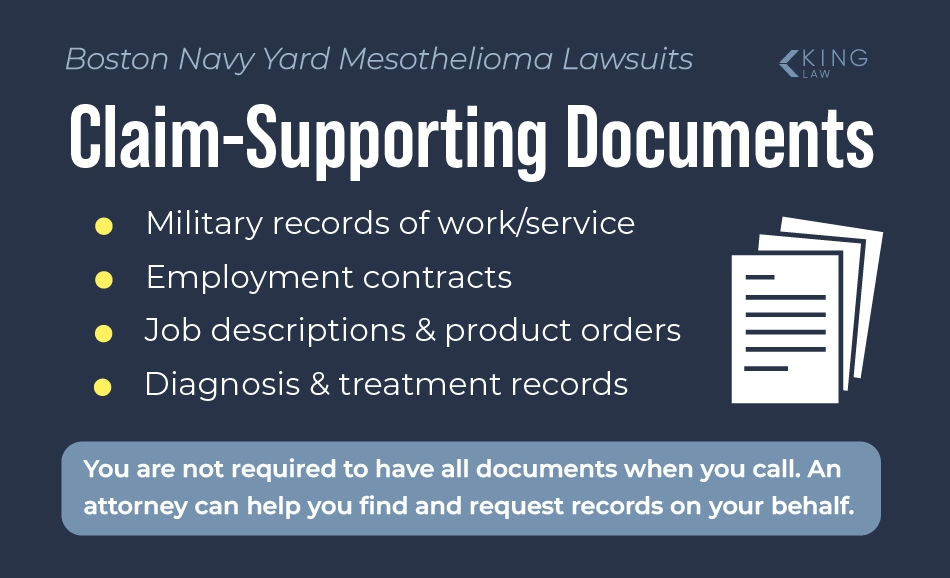
Evidence that a former Boston Navy Shipyard worker can use to prove their mesothelioma claim includes the following:
- Military records proving they worked or were stationed at Boston Navy Yard
- Employment history showing they worked at Boston Navy Yard (i.e., as a contractor, employee, or laborer)
- Evidence to prove they were exposed to asbestos or asbestos-containing products (e.g., job descriptions or testimony)
- Medical documentation showing they were diagnosed with mesothelioma or another asbestos-related disease
You do not have to have all of the required proof before you contact an attorney. A lawyer can help you identify and request records on your behalf. Many reputable mesothelioma attorneys have databases of asbestos exposure sources, including which products and locations are associated with asbestos. They can use this database to help discover potential sources of asbestos exposure in your situation.
How Can I File a Boston Naval Shipyard Mesothelioma Claim?
Here are some of the steps to file a mesothelioma claim involving asbestos exposure at Boston Navy Yard:
- Reach out to a qualified mesothelioma attorney to schedule a free case evaluation.
- Collaborate with your legal team to gather evidence to prove you worked at Boston Navy Yard, were diagnosed with mesothelioma, and may be entitled to compensation.
- Your attorney uses your information to identify asbestos exposure sources connected to your time at the Boston Navy Yard.
- Your attorney prepares and files a lawsuit, asbestos trust fund claim, or VA disability benefits request related to your work at the Boston Navy Yard.
- Your mesothelioma attorney tries to negotiate a fair compensation package to address your losses from asbestos exposure at the Boston Navy Yard.
Well-trained mesothelioma attorneys can help you navigate the steps in the legal process. For example, they can bring more than one type of mesothelioma case on your behalf, such as by filing an asbestos trust claim, a VA disability claim, and a personal injury lawsuit.
How Long Does a Boston Navy Yard Mesothelioma Claim Take?
Each mesothelioma lawsuit involving asbestos exposure at Boston Navy Yard moves at its own pace. So, some claims may take less time to resolve than others. Factors that may impact how long a mesothelioma claim takes include the number of companies being sued and the strength of the person’s mesothelioma claim.
What Is the Deadline to File a Boston Naval Shipyard Mesothelioma Lawsuit?
The deadline to file a Boston Navy Yard mesothelioma claim depends on the applicable state laws, the type of claim you want to file, and other factors. For example, you may be able to bring a VA disability claim at any time if your mesothelioma is from service-related asbestos exposure at the Boston Navy Yard.
However, you may have to file a personal injury lawsuit within a couple of years after you realize your mesothelioma diagnosis is related to your time at the Boston Navy Yard. Speaking to a reputable attorney is an effective way to discover what your deadlines are and how to meet them.
How Much Money Can I Make From a Boston Naval Shipyard Mesothelioma Settlement?
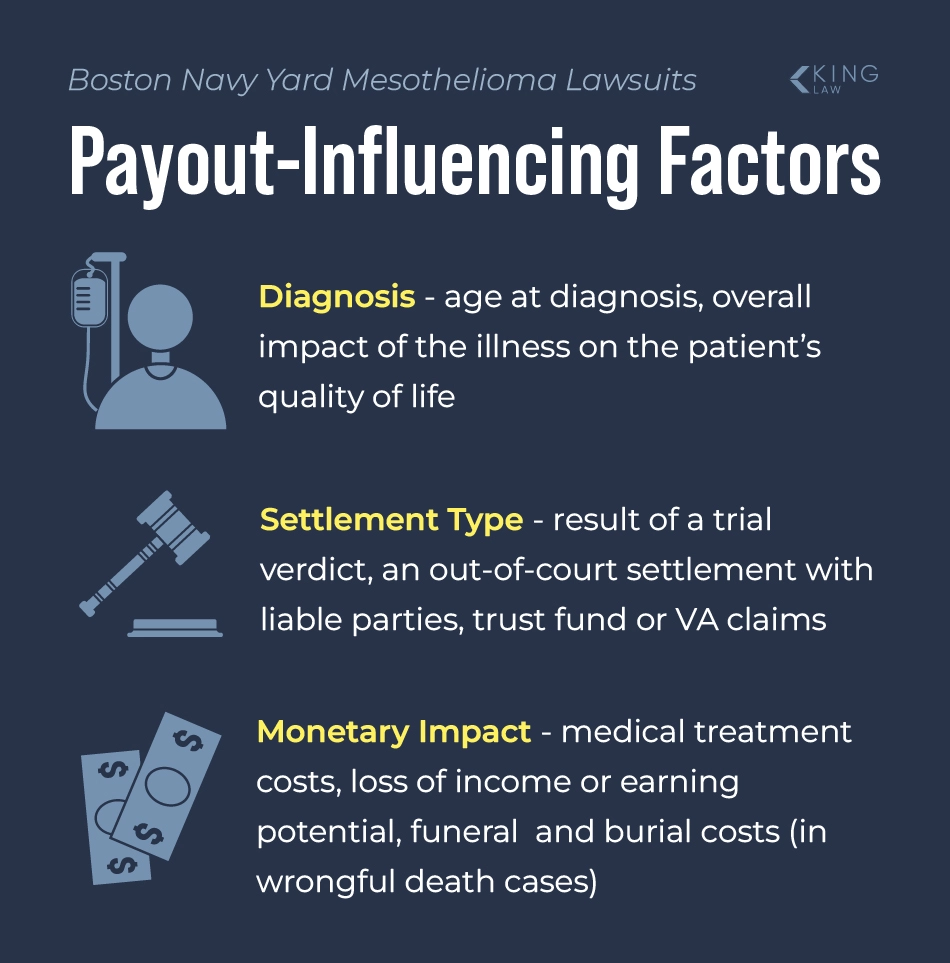
Payouts from Boston Navy Yard mesothelioma settlements are personalized based on the individual’s losses. The impact it has on their quality of life, their age at diagnosis, the strength of their case, and whether they bring their case on time are some factors that can affect how much they may receive in a mesothelioma settlement. Compensation may include six- or seven-figure recoveries in some cases, but each person will have different results depending on their case.
Many people who secure settlements for their Boston Navy Yard mesothelioma case may receive compensation for their medical expenses, loss of quality of life, pain and suffering, loss of earnings and earning potential, and other damages. An attorney can help you estimate what your mesothelioma settlement might be if you bring a claim based on asbestos exposure from the Boston Navy Yard.
King Law Is Investigating Boston Navy Yard Asbestos Claims
King Law is actively investigating mesothelioma claims being brought by people who believe they or their loved ones were exposed to asbestos from the Boston Navy Yard.
We have a robust network of resources to help us determine if you qualify for compensation and, if so, develop a strategy to fight for your potential settlement. We are committed to helping former Boston Navy Yard workers and their families hold asbestos-product manufacturers accountable for their misconduct. Contact a mesothelioma lawyer on our team to get important questions answered.
Contact a Boston Naval Shipyard Mesothelioma Attorney Today
Contact King Law today by dialing (585) 496-2648 or by filling out an online form to tell us about how you were impacted by asbestos exposure at Boston Navy Yard. Our intake specialists are here to guide you through the onboarding process and schedule an appointment with a seasoned mesothelioma attorney at our firm. Our attorneys can review your case, whether you are a Navy Veteran or a private-industry worker who spent time at Boston Naval Shipyard.
Frequently Asked Questions (FAQs)
The Boston Navy Yard mesothelioma lawsuits are alleging that asbestos product manufacturers did not warn Boston Navy Yard workers about the dangers of asbestos, leading to a mesothelioma diagnosis.
People are suing the companies that manufactured asbestos products used at the Boston Navy Yard. Some of the people filing these lawsuits say the asbestos companies did not warn them or their loved ones that asbestos was dangerous.
Companies that made asbestos-containing products used at the Boston Navy Yard are being sued in mesothelioma lawsuits.
One of the allegations in the Boston Naval Shipyard mesothelioma lawsuit is that the asbestos product manufacturers did not warn people that the asbestos in those products could cause mesothelioma.
Some workers at Boston Navy Yard may have been exposed to asbestos fibers released into the air from insulation, gaskets, valves, pipe lagging, asbestos cement, and other products. These fibers may have been disturbed during repairs, remodels, maintenance, demolitions, installations, or standard operations.
Asbestos products that may have been used at the Boston Navy Yard include gaskets, turbines, boilers, pipes, pipe lagging, insulation, asbestos cement, valves, ceiling tiles, and floor panels.
Proof you can use to support your Boston Naval Yard asbestos claim includes medical reports showing you were diagnosed with mesothelioma and service or employment records to prove you worked at the Boston Naval Yard.
It depends on your situation and the applicable state law. Talk to an attorney about what your deadlines are to file a mesothelioma claim based on asbestos exposure from the Boston Navy Yard.
It depends. Each Boston Navy Yard mesothelioma settlement is calculated on a case-by-case basis. An attorney can help you calculate your potential settlement.
An attorney can help you file a mesothelioma claim related to your time at the Boston Navy Yard.
It depends. Many mesothelioma attorneys do not charge upfront legal fees to handle Boston Navy Yard asbestos claims.
King Law is currently focused on representing individuals diagnosed with mesothelioma.
List of Sources Used in This Article
“Asbestos: Health Effects.” Agency for Toxic Substances and Disease Registry, U.S. Department of Health and Human Services, n.d.
“Asbestos Records – FOIA Reading Room.” Naval Sea Systems Command, U.S. Navy, n.d.
“Boston National Historical Park Planning Document.” National Park Service, n.d.
“Charlestown Navy Yard.” National Park Service, n.d.
“Charlestown Navy Yard Historic Resource Study.” National Park Service, n.d.
“Charlestown Navy Yard National Register Nomination Form.” Massachusetts Historical Commission, n.d.
“National Park Service Photo Gallery.” National Park Service, n.d.
“NPS Develops Environmental Assessment for Boston National Historical Park.” National Park Service, 21 June 2022.
“Mesothelioma.” National Center for Biotechnology Information, n.d.
“Study on Mesothelioma.” PubMed, U.S. National Library of Medicine, 1992.
“Mesothelioma Case Law.” Google Scholar, n.d.
“Pleural Mesothelioma.” Cleveland Clinic, n.d.
“Peritoneal Mesothelioma.” Cleveland Clinic, n.d.
“Qualified Products List (QPL-15342).” Naval Sea Systems Command, U.S. Navy, n.d.
“Senate Hearing on Asbestos Issues.” U.S. Senate Committee on Finance, 1986.
“Joint Appendix, Vol. I (No. 17-1104).” Supreme Court of the United States, 2018.
“USS Constitution Museum – Building 24.” USS Constitution Museum, n.d.
“U.S. Navy Records in Boston.” National Archives, n.d.
“Industrial Hygiene Study of Asbestos Exposure.” Fleischer, W. E., and P. Drinker, 1946.