

Parris Island Asbestos Lawsuit [2026 Update]
Complete the form below to see if you qualify for a Mesothelioma Lawsuit

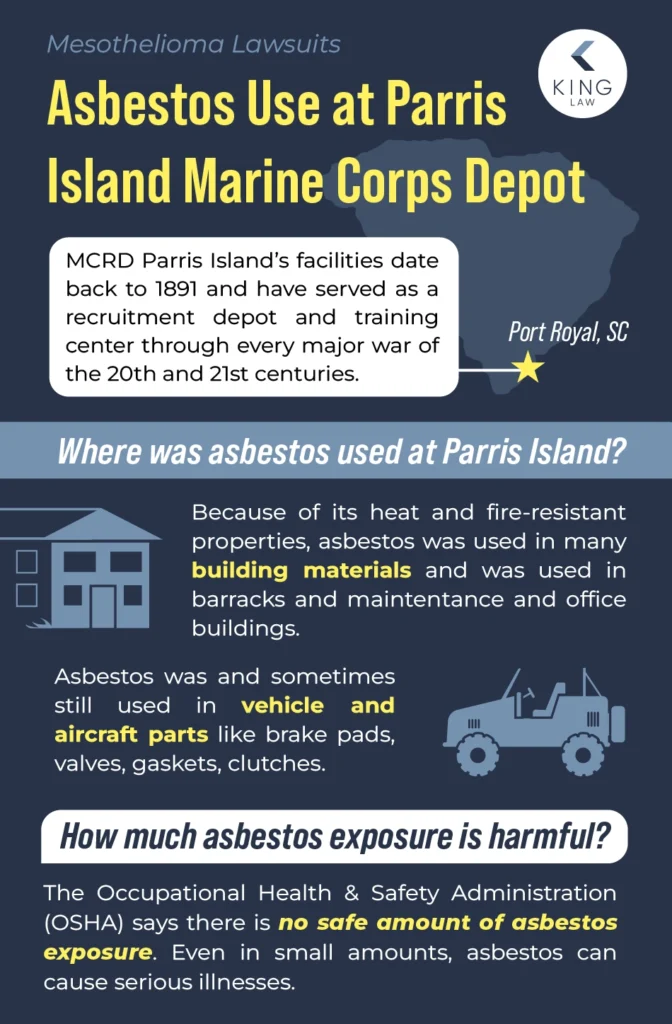
Parris Island Marine Corps Recruit Depot (MCRD Parris Island) has trained hundreds of thousands of Marines and prepared them for the line of duty. Many of those Marines were exposed to asbestos while training or serving at the installation.
Asbestos was used in the construction of the Parris Island Marine Corps Recruit Depot and vehicles used on the base. This means that many Marine recruits were likely exposed to the cancer-causing substance. Many Marines have developed mesothelioma due to asbestos exposure at military bases.
Some of these Marines choose to file lawsuits against the asbestos companies that made products used at Parris Island. This page will discuss sources of asbestos exposure at Parris Island and legal and compensation options for Marines and their families.
King Law is currently accepting asbestos exposure cases related to Parris Island Marine Depot.
About the Parris Island Asbestos Lawsuit:
Overview of Parris Island Marine Depot
History of Asbestos Use at MCRD Parris Island
Why Was Asbestos Used at Parris Island Marine Depot?
Common Areas of Asbestos Exposure at Parris Island Marine Depot
Who Was Exposed to Asbestos at Parris Island Marine Depot?
Health Effects from Asbestos Exposure at Parris Island Marine Depot
Who Can File a Parris Island Marine Depot Asbestos Lawsuit?
What Compensation Can Parris Island Marine Depot Asbestos Victims Recover?
How to File a Parris Island Marine Depot Asbestos or Mesothelioma Lawsuit
Is There a Deadline to File a Parris Island Marine Depot Asbestos Lawsuit?
Parris Island Marine Depot Asbestos and Mesothelioma Lawsuit Settlement Amounts
King Law Is Accepting Parris Island Marine Depot Asbestos Exposure Cases
Overview of Parris Island Marine Depot
Located in Port Royal, South Carolina, the Parris Island Marine Recruit Depot is a training facility run by the U.S. Marine Corps. The facility dates back to 1891. The district center, which is on the National Register of Historic Places, was built prior to World War I. The base was officially designated a Recruit Depot in 1915 and reached a peak training load of 24,242 in 1952 during the Korean War.
This boot camp facility remains in operation to this day, training around 20,000 recruits annually, mainly those from east of the Mississippi River. The island serves as a means to quickly isolate recruits from civilian life; civilian access to the island is limited.
Hundreds of thousands of Marine recruits have trained at Parris Island. Marines have been trained there to support every major war of the 20th and 21st centuries. According to the government website for the training depot, here is the number of troops trained at MCRD Parris Island:
- World War I – 41,000 recruits
- World War II – 205,000 recruits
- Korean War – 138,000 recruits
- Vietnam War – 250,000 recruits
- Operation Enduring Freedom (Afghanistan) and Operation Iraqi Freedom (Iraq) – 160,000 recruits
Recruits were also trained at Parris Island during Operation Desert Shield & Operation Desert Storm (Kuwait) and Operation Restore Hope (Somalia).
History of Asbestos Use at MCRD Parris Island
Asbestos is present at MCRD Parris Island mainly due to the age of the facility. It is well-documented that military bases built before 1980 contained asbestos. Early 20th-century construction frequently used asbestos for insulation and fireproofing. Roofing, flooring, pipes, and boiler rooms built prior to the 1980s often contain asbestos. According to military records and historical construction data, asbestos was used in buildings constructed by the military.
For the recruits coming through Parris Island, the presence of asbestos in barracks and other structures has presented the most risk. Because asbestos can also be found in great quantities in shipyards, vessels, maintenance and repair shops, and waste sites, recruits often faced exposure after they left boot camp.
Parris Island’s barracks, classrooms, boiler systems, and administrative buildings were built during the height of asbestos use. So, many Marines training at the depot were routinely near asbestos-containing materials.
Is Asbestos Still Present at Parris Island Marine Depot?
Though asbestos in new materials was largely phased out by the 1980s, legacy buildings and materials from earlier eras still present a risk. A 2007 government document, Depot Order 5090.0, noted the presence and danger of asbestos in many of Parris Island’s structures, requiring an asbestos assessment prior to any renovations or demolitions.
Legacy asbestos use can still expose troops, especially when they are living or working in older buildings that are renovated, repaired, or disturbed.
Why Was Asbestos Used at Parris Island Marine Depot?
While asbestos was also widely used in civilian construction during the same period, the heat and fire-resistant properties of asbestos lent themselves well to the needs of military bases, facilities, and vehicles. Weapon systems and related facilities faced high levels of heat-related stress and, at times, a greater risk of fire from attacks or accidents.
As a recruit training facility, Parris Island primarily utilized asbestos in its buildings and barracks.
Common Areas of Asbestos Exposure at Parris Island Marine Depot
Asbestos exposure can occur in a variety of enclosed environments commonly encountered in the military. Below are some of the areas a recruit at MCRD Parris Island may have been exposed to asbestos. Marine recruits typically only spend around 13 weeks at the base, undergoing a regimen that consists of physical conditioning, weapons training, and classroom instruction.
However, even small amounts of asbestos can cause cancer. For example, the Occupational Health & Safety Administration (OSHA) says there is no safe amount of asbestos exposure.
Barracks and Administrative Buildings
Most of the risk of exposure at MCRD Parris Island comes from the base’s buildings, many of which date back to the “Golden Age of Asbestos”. Legacy asbestos in military installations can affect troops. How much of a risk older buildings present depends on their condition, whether the buildings have undergone asbestos removal, and whether the asbestos is being disturbed, such as by maintenance staff.
A 2002 Government Accountability Office (GAO) report found that, at the time of the report, most recruit training barracks had significant deficiencies. The report states, “…in general, we observed that the Army’s, Navy’s, and Marine Corps’ Parris Island barracks were in the worst physical condition” of the facilities surveyed.
The report noted cooling problems in the barracks due to improperly sized equipment and ductwork, as well as officials reporting high rates of respiratory problems among recruits, likely arising from issues with the filtration systems. Inadequate ventilation was also cited as an issue with the barracks. Although the report did not name asbestos, deteriorating facilities may have exposed Marine trainees to asbestos.
Power Plants and Utility Systems
Parris Island recently replaced its 70-year steam plant with a new power plant. While recruits were unlikely to have interacted much with the island’s utility systems, personnel who serviced the system may have been at risk of asbestos exposure at the power plant.
Who Was Exposed to Asbestos at Parris Island Marine Depot
Civilians have limited access to Parris Island Marine Depot, so most of the individuals exposed to asbestos on the base are current or former Marines. Aging structures in poor states of repair (e.g., barracks and instructional facilities) may have exposed recruits to asbestos. Enlisted or civilian workers who performed maintenance on buildings and utility systems may also have been exposed to asbestos, particularly if they’d worked with the base’s pre-2019 steam plant.
Health Effects from Asbestos Exposure at Parris Island Marine Depot
Asbestos present at Parris Island Marine Depot carries the risk of serious health effects, including mesothelioma. Asbestos fibers, when shed, can cause long-term, repetitive damage to sensitive tissues. Asbestos irritates tissues, building up scar tissue over time. The lungs, in particular, are vulnerable to this kind of damage. This damage may manifest as diseases like:
- Mesothelioma
- Asbestosis
- Lung cancer
- Pleural disease
People with asbestos-related diseases often take decades to present with symptoms. However, individuals who believe they’ve been exposed to asbestos can work with their physicians to watch for early warning signs.
Who Can File a Parris Island Marine Depot Asbestos Lawsuit
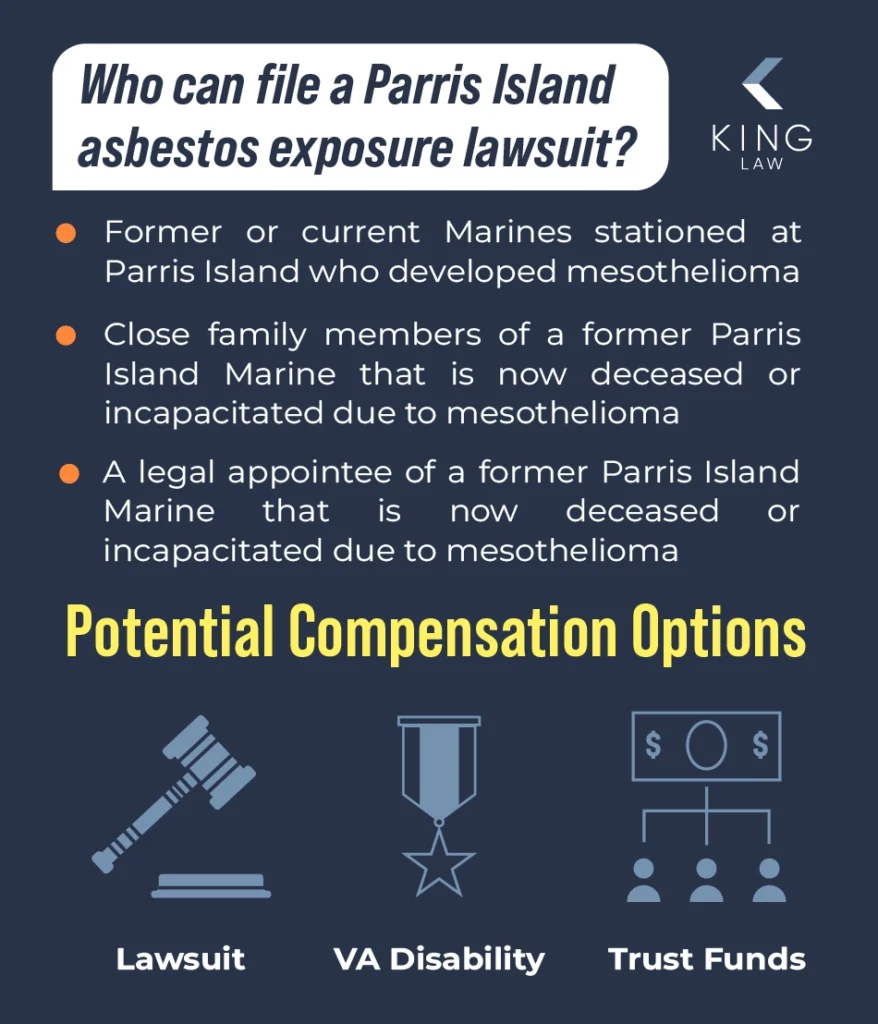
If you or a loved one spent time at Marine Corps Recruit Depot Parris Island and later developed mesothelioma, you can file a lawsuit against the asbestos companies responsible for the asbestos exposure. Under certain circumstances, family members can file a mesothelioma lawsuit on behalf of a loved one. In some cases, a trustee or head of an estate can also pursue compensation.
In some cases, patients can also pursue compensation through a mesothelioma trust fund claim.
What Compensation Can Parris Island Marine Depot Asbestos Victims Recover
Veterans who were exposed to asbestos at Parris Island and developed mesothelioma may be eligible for compensation in several forms. This may include one or more of the following:
- A personal injury lawsuit
- A wrongful death lawsuit following the loss of a loved one to mesothelioma
- An asbestos trust fund
- A VA disability claim
Compensation and settlements received for a mesothelioma claim can cover expenses like:
- Medical cost compensation
- Lost income
- Lost earning potential
- Pain and suffering
- Loss of companionship
Many asbestos lawsuits are settled out of court through negotiation or trust fund claims. In cases involving exposure while enlisted, victims may also file a claim with the VA, which can result in a change in disability status.
How to File a Parris Island Marine Depot Asbestos or Mesothelioma Lawsuit
It is important to act quickly after you receive an asbestos-related diagnosis. Filing deadlines can affect whether or not someone has a viable claim. Here are the steps to filing a Parris Island Base asbestos lawsuit:
- Consult with an attorney. Experienced attorneys can help set expectations and guide you through the process.
- Collect evidence and records. Medical and military records will play an important role in substantiating your claim. You’ll work with your attorney to obtain these records, along with any appropriate testimonies. You’ll also identify the asbestos products you were exposed to, along with any potential defendants.
- File a claim. Your attorney will help you file your claim in the jurisdiction most advantageous for your case.
- Engage in settlement negotiations or a trial. Your attorney will attempt to reach a settlement with the defendants. If an agreement cannot be reached, your case will go to trial.
Most Marine veterans can file a lawsuit or pursue a trust fund claim while simultaneously pursuing compensation from a VA claim.
Is There a Deadline to File a Parris Island Marine Depot Asbestos Lawsuit
Each state has its own deadline for filing an asbestos lawsuit, typically between 1 and 3 years from the date of diagnosis or death, though specific circumstances of your case could affect filing deadlines.
Although Parris Island Marine Depot is located in South Carolina, your case may not be filed within that state. Consult with your attorney to discuss where to file your case and what the deadlines are in that jurisdiction.
Parris Island Marine Depot Asbestos and Mesothelioma Lawsuit Settlement Amounts
Awards in asbestos cases can vary greatly depending on several factors, including the severity of your disease and which companies are responsible for your exposure.
King Law estimates a settlement range of $250,000 to $1,000,000+ per claimant. However, each case is unique, and there is no guaranteed settlement amount.
King Law Is Accepting Parris Island Marine Depot Asbestos Exposure Cases
King Law represents victims of occupational asbestos exposure nationwide, including veterans who were exposed during the course of duty. Our experienced attorneys investigate exposure histories and have access to extensive product databases that can help you identify defendants and maximize your compensation. We offer free consultations with no obligation to asbestos victims and their loved ones. We work on a contingency basis, so there are no upfront costs to pursuing your claim. Contact us about filing a mesothelioma lawsuit.
Contact a Parris Island Asbestos Lawyer Today
If you are looking for a lawyer to fight for your Parris Island Marine Depot asbestos claim, contact King Law today at (585) 496-2648 or through this website for a free, confidential consultation and case evaluation.