

Eastman Kodak Asbestos Lawsuit [2026 Update]
Complete the form below to see if you qualify for a Mesothelioma Lawsuit

Former Eastman Kodak employees and contractors are filing asbestos lawsuits because they developed asbestos-related diseases and cancers, including mesothelioma. Eastman Kodak’s facilities in Rochester and Gates, New York, were heavily contaminated with asbestos. Workers say they were not warned about the risks or provided with adequate protective gear.
This page shares information about Eastman Kodak’s asbestos use, which of its facilities were most likely to have asbestos, how workers encountered asbestos, and the health risks. This article also explains how to file an Eastman Kodak asbestos lawsuit, explores trends in mesothelioma settlements, and tracks updates on Eastman Kodak asbestos lawsuits. This page helps families understand exposure risks and compensation options.
About the Eastman Kodak Asbestos Lawsuit
Eastman Kodak Asbestos and Mesothelioma Lawsuit Updates
Eastman Kodak and Its History of Asbestos Use
Which Eastman Kodak Facilities Had Asbestos Exposure?
Which Eastman Kodak Jobs Were at the Highest Risk for Asbestos Exposure?
How Were Eastman Kodak Employees Exposed to Asbestos?
Health Risks Linked to Kodak Asbestos Exposure
Who Qualifies to File an Eastman Kodak Asbestos Lawsuit?
What Damages Can I Recover in an Eastman Kodak Asbestos Lawsuit?
How Can I File an Eastman Kodak Asbestos Lawsuit?
What Is the Deadline to File an Eastman Kodak Asbestos Lawsuit?
Estimated Eastman Kodak Asbestos Lawsuit Settlement Amounts
King Law Is Accepting Eastman Kodak Asbestos and Mesothelioma Claims
Contact an Eastman Kodak Asbestos and Mesothelioma Lawyer Today
Eastman Kodak Asbestos and Mesothelioma Lawsuit Updates
April 15, 2026: Kodak’s Stock up 96% In Last Year
Eastman Kodak has experienced a sharp increase in its stock value. The company’s stock is currently up 96% from this time last year. Although the company has faced financial uncertainties, including a bankruptcy in 2013, the company’s stock price is up. Kodak credits its renewed focus on GenZ products, as well as a focus on pharmaceutical products and a battery electrode partnership, for the rebound. Many workers at Kodak plants faced historical asbestos exposure. However, lawsuits related to diseases from the exposure at Kodak plants are typically not linked to Kodak and are instead linked to major asbestos product companies.
January 8, 2026: Kodak Transitions to Company-Funded Retirement Plan
Eastman Kodak employees have filed dozens of lawsuits and trust fund claims against companies that made asbestos-containing materials used at Kodak sites. Kodak employees and contractors developed mesothelioma and other asbestos-related diseases after being exposed to asbestos at Kodak. According to legal filings, these employees say they were not warned that asbestos was harmful or given sufficient protective equipment while working with asbestos-containing materials. Meanwhile, in early December 2025, Eastman Kodak began to transition away from its old pension program, instead implementing a $1 billion Kodak Retirement Income Plan for qualifying employees.
December 2, 2025: Kodak Shares Rise 36% in November
Between October and November of 2025, the share price of Eastman Kodak stock rose by 36%. Similarly, the company’s stock has risen by 55% this year. This news comes after strong Q3 earnings. After announcing concerns about operating costs and profits in August, the company appears to be on the upswing. The company has employed tens of thousands of Rochester-area residents over the last two centuries. However, many employees have developed mesothelioma from asbestos exposure at Kodak’s facilities. Patients and surviving family members have filed lawsuits against the companies who sold asbestos products to Kodak.
August 13, 2025: Eastman Kodak Warns Investors That Company Won’t Be Able to Make Debt Payments
During a meeting regarding its most-recent earnings report, Eastman Kodak told investors that it lacks funds to meet its current debts. The company said it will not meet $500 million in upcoming debt obligations. The company plans to stop payments to its retirement pension fund to cover the debts.
March 16, 2020: Widow Receives Compensation from Eastman Kodak After Her Husband Dies from Mesothelioma
Sandra Gimber received death benefits from Eastman Kodak after her husband died from mesothelioma. Her husband had worked at Eastman Kodak from 1967 to 1985 and was diagnosed with mesothelioma decades later. He died in November 2013. Sandra filed for death benefits to help her support herself and her family after the loss of her husband to mesothelioma.
November 20, 2019: Man Wins $8 Million Mesothelioma Settlement Because of Asbestos Exposure from Eastman Kodak
Wayne Meissner has won an $8 million mesothelioma verdict. Wayne worked as a civil engineer for Eastman Kodak in the 1960s and 1970s, and he was diagnosed with mesothelioma in 2018. He was responsible for overseeing the spraying of asbestos, and he was not given sufficient warnings about or protection from asbestos fibers. Wayne sued Ridge Construction, which Kodak had hired to provide in-house construction and renovation.
March 12, 2014: Eastman Kodak Agrees to Clean Up Rochester, Other Areas in New York
Eastman Kodak’s mammoth Business Park significantly contaminated Rochester, New York, and the Genesee River with toxins. After filing for bankruptcy, Eastman Kodak entered a settlement with the EPA and authorities to clean up these regions. The settlement included three separate agreements to address different remediation efforts, which may include removing several asbestos-ridden buildings.
January 19, 2012: Eastman Kodak Files for Bankruptcy
Eastman Kodak filed for Chapter 11 bankruptcy to help it manage its debts and declining profits. The company hopes that bankruptcy can help it reorganize its operations and balance sheets while it adjusts to the modern era of photography. Meanwhile, Eastman Kodak is also in negotiations with authorities over the widespread contamination it has caused. Former Kodak employees are also being diagnosed with mesothelioma at increased rates because of exposure to asbestos at Kodak’s facilities.
August 10, 2011: Asbestos Discovered at Eastman Kodak Demolition Site
Four Eastman Kodak buildings in Colorado were slated for demolition, but these efforts were stalled due to asbestos discoveries. These outdated buildings were riddled with asbestos in ceiling tiles, insulation, flooring, walls, pipes, and other components. Former Kodak workers and their loved ones are developing mesothelioma, lung cancer, asbestosis, and other asbestos-related diseases because of the asbestos fibers they breathed in at Kodak’s facilities.
June 26, 1988: Eastman Kodak Under Fire for Environmental Pollution in Rochester
A chemical emissions report showed that Eastman Kodak heavily contaminated the air and soil in Rochester with toxins, such as methane gas. Rochester residents living near Kodak Park are selling their homes to protect themselves and their family members from potential harm. Kodak’s buildings, warehouses, and manufacturing plants are also contaminated with asbestos. Being exposed to asbestos can cause mesothelioma decades later, even if a worker inhales only small amounts of fibers.
Eastman Kodak and Its History of Asbestos Use
The Eastman Kodak Company used asbestos in its Rochester, New York, plants since the early 1900s. Asbestos was heavily used in insulation, ceiling tiles, drywall, floor tiles, roofing, and film coating machines. Asbestos was also used in other Kodak operations, such as boilers, furnaces, powerhouses, wiring, and pipework.
Oftentimes, workers who encountered asbestos were not given adequate protective equipment to prevent them from inhaling and touching asbestos fibers. Some workers may not have been told they were working with asbestos.
Kodak may have started phasing out asbestos use in the 1970s when OSHA issued some regulations on workplace exposure to asbestos. However, many workers were exposed to asbestos through products used at Eastman Kodak’s facilities.
Which Eastman Kodak Facilities Had Asbestos Exposure?
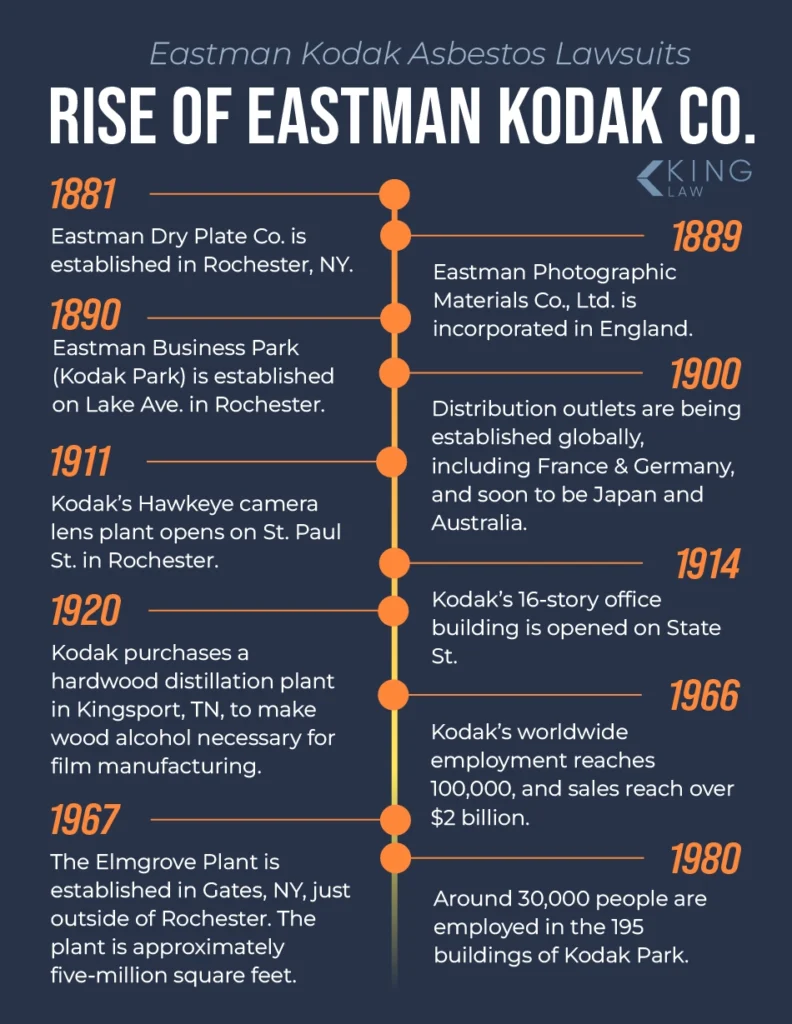
At its largest, the Eastman Kodak facility in Rochester spanned nearly 4 miles and included many buildings that had asbestos in them. The company had a large presence and was a defining industry in Western New York. The Eastman Business Park stretched from the City of Rochester to the Town of Greece. Eastman Kodak also had several other complexes throughout New York, which used asbestos-containing materials.
At the time, it was typical for builders to use asbestos-containing materials when constructing new facilities. Building, renovating, and repairing facilities were how many people were exposed to asbestos while working with Eastman Kodak.
The following Kodak locations had asbestos products on their premises:
- Kodak Park/Eastman Business Park (Greece, NY)
- Kodak Camera Works at State Street (Rochester, NY)
- Kodak Hawkeye Plant (Rochester, NY)
- Kodak Elmgrove Plant (Gates, NY)
People who worked at any of these locations may have been exposed to asbestos. The material was commonplace in new construction during the time these facilities were built.
Kodak Park (Eastman Business Park)
The complex at Kodak Park (also called the Eastman Business Park) sprawled about 20 million square feet and contained over 210 buildings. Buildings at the complex included a fire department, medical facilities, chemical and research labs, power generation plants, office space, training hubs, film and paper manufacturing facilities, and warehouses.
Asbestos was used to make the spaces resistant to fire and heat, both of which could jeopardize the fragile film-making operations. Workers in the power generation and coating departments were most at risk of disturbing and inhaling asbestos fibers.
Kodak Camera Works (State Street Headquarters)
In 1883, Kodak Camera Works
The maintenance and renovation crew were routinely exposed to asbestos fibers while working on the property. For example, they sanded or mixed drywall compounds containing asbestos. The workers directly breathed in asbestos fibers, which circulated throughout the buildings. Office, managerial, and clerical staff would also inhale asbestos released into the air when asbestos products were disturbed, even though they did not directly work with the material.
Kodak Hawkeye Plant (St. Paul Street)
The Kodak Hawkeye Plant was a significant partner for the U.S. government during the Cold War. A 2003 environmental survey of the Kodak Hawkeye Plant concluded that “suspected asbestos-containing materials (“ACMs”) were found in all buildings within the Hawkeye complex.” Some of the materials believed to contain asbestos included:
- Pipe wrap on fiberglass insulation
- Canvas-type wrap on boiler fiberglass insulation
- Sheetrock/joint compound
- Roofing materials
The surveyors found multiple instances where insulated pipes were flagged as either having asbestos or being asbestos-free. It is unclear when these labels were installed. Even so, this shows that Kodak was aware that its buildings contained asbestos, and workers were breathing in and contacting this contaminant.
Construction workers, renovators, plumbers, electricians, and maintenance staff who worked on the property disturbed asbestos-containing materials, allowing them to become airborne and circulate throughout the buildings.
Kodak Elmgrove Plant (Gates, NY)
Kodak’s Elmgrove Plant in Gates, New York, was “built from 1967 to 1989 for equipment manufacturing.” The Kodak Elmgrove Plant was home to nearly 20 buildings that were made with or contained materials with asbestos in them. Asbestos was found in many components used in the camera assembly, heating, ventilation, walls, ceilings, and machinery at the Kodak Elmgrove complex.

Which Eastman Kodak Jobs Were at the Highest Risk for Asbestos Exposure?
Eastman Kodak jobs most at risk of asbestos exposure included insulators, pipefitters, electricians, maintenance workers, and office-based managers and staff. People who worked at Eastman Kodak facilities either had direct contact with asbestos-containing materials or breathed in disturbed asbestos fibers circulating in the air.
People who performed the following job duties may have been exposed to Asbestos at Eastman Kodak:
- Insulators
- Pipefitters
- Boiler operators
- Electricians
- Maintenance mechanics
- Lab technicians
- Office and administrative workers
Insulators
Kodak insulators routinely worked with insulation, pipe-wrap, canvas-type wrap, and other types of insulation that contained asbestos. Kodak workers may have cut up the insulation themselves, likely with little to no protective equipment. They would also directly handle already-installed insulation in the walls and around pipes, which disturbs asbestos fibers and releases them into the air.
Pipefitters
Pipefitters at Kodak would handle, replace, and cut pipes, gaskets, and other equipment that contained asbestos. They would also repair flanges and use fire-resistant equipment that contained asbestos. As they performed these tasks, asbestos would enter their lungs and spread throughout the ventilation systems.
Boiler Operators
Boiler operators (also called
Electricians
Eastman Kodak’s electricians were at a high risk of asbestos entering their lungs each day. Electricians at Kodak would drill through walls, drywall, ceilings, and transite conduits (asbestos cement used for underground wiring) to access, repair, or install wiring. Many of these features had asbestos in them, and electrical control panels were often insulated with asbestos.
Maintenance Mechanics
Maintenance workers, mechanics, and millwrights at Eastman Kodak encountered asbestos in the equipment and spaces they used and serviced. For example, asbestos could be found in insulation, brakes, clutches, pumps, ovens, pipes, and wiring.
Ridge Construction Crews
Eastman Kodak partnered with Ridge Construction to perform in-house renovations, construction, and fireproofing. For example, in the 1970s, Eastman Kodak asked Ridge Construction to spray fireproofing material containing asbestos, leading to an $8 million mesothelioma settlement in favor of a Ridge Construction worker. Ridge Construction workers would also inhale asbestos found in insulation, drywall, conduits, pipes, ceiling tiles, and flooring.
Lab Technicians
Eastman Kodak had multiple testing, research, and lab facilities to develop, test, and refine its films and products. Many of these Kodak labs were riddled with asbestos to help control heat and limit the spread of fires. Lab technicians would work in spaces with fume hoods, ventilation ducts, countertops, walls, ceilings, floors, and other features that contained asbestos.
Administrative and Office Staff
Clerical workers, managers, secretaries, and other office-based staff would encounter asbestos dust in their offices and workspaces at Eastman Kodak facilities. These employees may have breathed in asbestos from nearby, active renovation or maintenance projects. Or the asbestos fibers may have travelled through air vents or ducts. Because of this, some office-based Eastman Kodak workers developed mesothelioma even though they did not work directly with asbestos-containing materials.
How Were Eastman Kodak Employees Exposed to Asbestos?
Eastman Kodak employees were exposed to asbestos directly from contaminated materials, such as insulation, machinery, asbestos-cement, and gaskets. Eastman Kodak employees were also indirectly exposed to asbestos through contaminated dust and air that circulated throughout the buildings.
The sprawling Eastman Kodak complexes that contained asbestos were often outdated and poorly ventilated, leading to high asbestos concentrations. Family members of Eastman Kodak workers also breathed in asbestos when their loved ones came home in work clothes covered in asbestos dust.
Health Risks Linked to Kodak Asbestos Exposure
The health risks associated with Eastman Kodak asbestos exposure include mesothelioma, asbestosis, lung cancer, and pleural plaques. These diseases can take years and even decades to form, and they can be caused by minimal asbestos exposure. Many former Eastman Kodak employees are being diagnosed with asbestos-related diseases from working at Eastman Kodak during the 1950s to 1970s.
Mesothelioma
Mesothelioma is an aggressive, uncommon cancer that is caused by exposure to asbestos. This cancer affects the lining of your organs, but it most commonly occurs in the lungs. Many Kodak employees developed mesothelioma because they breathed in asbestos at work.
Lung Cancer
Asbestos can also cause lung cancer, regardless of the type of asbestos the person encounters. Kodak tradesmen are being diagnosed with asbestos-specific lung cancer decades after they worked at Kodak’s facilities.
Asbestosis
Asbestosis is scarring of the lung tissue, which causes difficulty breathing and chronic lung disease. Boiler operators, maintenance staff, and other Kodak workers were most at risk for developing asbestosis because they inhaled asbestos in confined, poorly-ventilated spaces.
Pleural Plaques and Other Cancers
Exposure to asbestos can also cause thickening of the lining (pleural) around the lungs, throat cancers, kidney cancers, and digestive cancers. Pleural thickening is not cancer, but it can be a warning sign that cancer may be growing. People who worked at Eastman Kodak or lived with someone who did may develop these diseases and cancers from asbestos at Kodak or brought home from Kodak.
Who Qualifies to File an Eastman Kodak Asbestos Lawsuit?
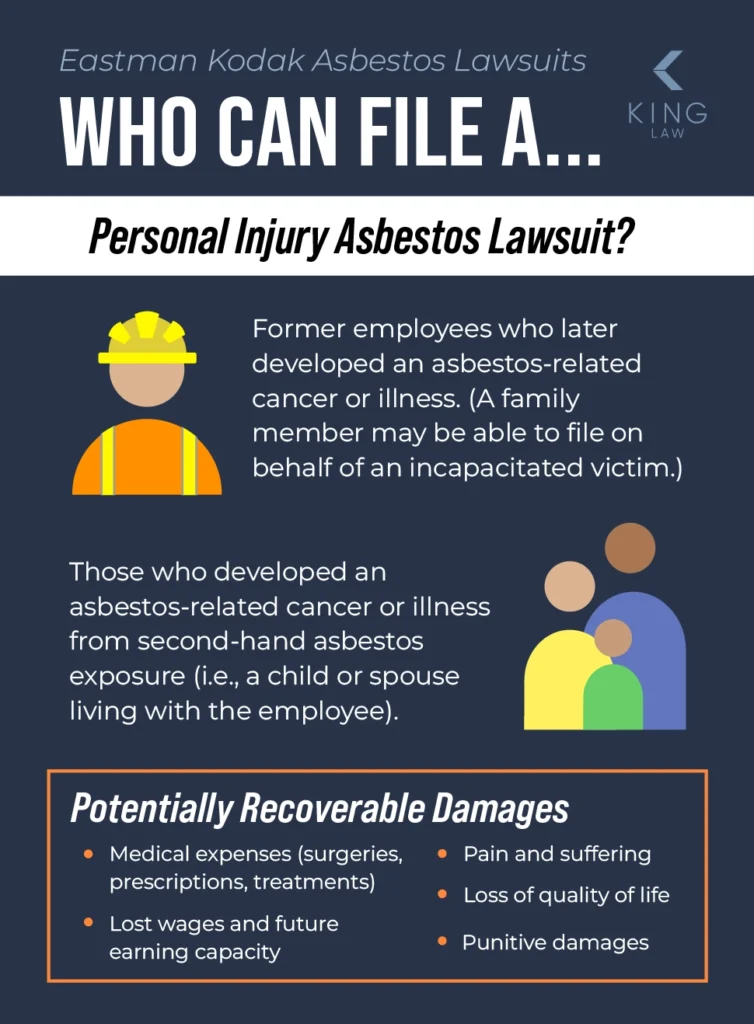
Anyone who worked at Eastman Kodak and developed mesothelioma may qualify to file an asbestos lawsuit. In many cases, the lawsuit would be filed against the third-party asbestos companies that made products used at the plant (e.g., Johns-Manville or Owens-Corning).
People who may be eligible to file a lawsuit related to asbestos use at Eastman Kodak include:
- People diagnosed with mesothelioma or another cancer related to asbestos exposure
- People who developed asbestos-related diseases, like asbestosis
- Family filing on behalf of someone incapacitated by mesothelioma
- Surviving children or spouses who lost a loved one
- People who were exposed to second-hand asbestos fibers
People who lost loved ones because of asbestos-related diseases may be eligible to file a mesothelioma wrongful death lawsuit if their loved one worked at Eastman Kodak.
Mesothelioma patients who think they were exposed to asbestos brought home on their close relative’s Eastman Kodak work clothes may also be able to file. Secondary asbestos exposure is a common reason people file asbestos lawsuits.
What Damages Can I Recover in an Eastman Kodak Asbestos Lawsuit?
Here are some of the damages you may be able to recover in an Eastman Kodak asbestos lawsuit:
- Medical expenses (past and future surgeries, treatments, and prescription costs)
- Lost wages
- Lost earning capacity
- Pain and suffering
- Loss of quality of life
- Loss of consortium
- Wrongful death damages (funeral and burial costs, loss of relationship, loss of support, etc.)
- Punitive damages (if applicable)
The exact amount that you are entitled to depends on several factors, including whether you have reliable proof that Eastman Kodak was where your asbestos exposure occurred. An asbestos attorney can help you by crafting and presenting a mesothelioma claim that connects your time at Eastman Kodak to your current condition.
How Can I File an Eastman Kodak Asbestos Lawsuit?
Some steps to file an Eastman Kodak asbestos lawsuit are as follows:
- Talk to an experienced asbestos lawyer at King Law (we provide free consultations).
- Collaborate with your attorney to get your medical records and prove that you or a loved one worked for Eastman Kodak.
- Your attorney will determine where you were exposed to asbestos, how, and when.
- Your attorney prepares and files legal complaints against the companies that made the asbestos products used at Eastman Kodak.
- Your attorney negotiates a fair settlement for your mesothelioma claim involving Eastman Kodak.
Your attorney can file additional types of mesothelioma claims that you may be entitled to, such as an asbestos trust fund payout.
What Is the Deadline to File an Eastman Kodak Asbestos Lawsuit?
The deadline to file an asbestos lawsuit depends on the type of claim you are filing and against whom. For example, New York law states that some asbestos claims must be filed within 2 years after the person links their mesothelioma to their time at Eastman Kodak.
However, other deadlines may apply that give the mesothelioma patient or their families more time to file. A qualified attorney can explain what deadlines could apply in your situation, and they can take steps to preserve your legal rights.
Estimated Eastman Kodak Asbestos Lawsuit Settlement Amounts
The estimated settlements for Eastman Kodak asbestos lawsuits are around $250,000 to over $1,000,000 for some mesothelioma patients. However, this is not a guarantee. Some patients may receive higher payouts, such as if they have a strong case to prove where their asbestos exposure occurred or if their loved one died from mesothelioma. King Law can provide a personalized estimate for your potential settlement from an Eastman Kodak asbestos lawsuit.
King Law Is Accepting Eastman Kodak Asbestos and Mesothelioma Claims
King Law is accepting and actively reviewing asbestos claims for people who worked at Eastman Kodak or lived with a relative who did. We have brought and won many mesothelioma claims against companies that manufactured asbestos products. We can thoroughly investigate your case to determine who is responsible for your asbestos-related illness. Our team can help you understand your legal options for filing an asbestos claim.
Contact an Eastman Kodak Asbestos and Mesothelioma Lawyer Today
If you or a loved one worked at Eastman Kodak and were diagnosed with mesothelioma, call King Law today at (585) 496-2648. Our intake specialists are available to collect your information and schedule a complimentary consultation with an experienced Rochester mesothelioma lawyer on our team. If your loved one died from mesothelioma after working for Eastman Kodak, our team can help, too. We understand the intricacies of filing an Eastman Kodak mesothelioma claim.