

Rhode Island Clergy Sexual Abuse Lawsuit [2026 Update]
Complete the form below to see if you qualify for a Rhode Island Sexual Abuse Lawsuit

Survivors of childhood sex abuse are filing lawsuits against the Roman Catholic Diocese of Providence. In their lawsuits, survivors allege that the diocese failed to protect them from sexual assault by members of the church. A new law passed in Rhode Island will allow adult survivors of clergy abuse to file claims outside of the statute of limitations.
From July 2026 through June 2028, any survivor of abuse committed by someone serving in the Rhode Island Diocese can file a civil lawsuit. For two years, survivors can pursue compensation, regardless of when that abuse occurred.
Lawsuits are expected after Rhode Island Attorney General Peter Neronha revealed the results of an investigation into the Diocese of Providence. That investigation found at least 75 current or former clergy members were credibly accused of abuse from 1950 to the present.
This page covers sexual abuse accusations against the Rhode Island clergy, new legal developments that affect survivors, and how someone can pursue a lawsuit against the Diocese of Providence.
About the Rhode Island Clergy Sexual Abuse Lawsuits
Rhode Island Clergy Sexual Abuse Lawsuit Updates and Case Developments
What Is a Rhode Island Clergy Sexual Abuse Lawsuit?
Can You Still File a Rhode Island Clergy Abuse Lawsuit?
What Is the Rhode Island Clergy Abuse Revival Window?
What Did the Rhode Island Attorney General Report Find About Clergy Abuse?
When Did Clergy Sexual Abuse Happen in Rhode Island?
Which Rhode Island Clergy Have Been Accused of Sexual Abuse?
Which Parishes Are Implicated in Abuse?
What Are the Most Notable Rhode Island Clergy Abuse Cases?
Did the Diocese of Providence Cover Up Clergy Sexual Abuse?
How Did Annie’s Law Affect Rhode Island Clergy Abuse Lawsuits?
Why Is the 2026 Rhode Island Revival Window So Important?
Who Can File a Rhode Island Clergy Sexual Abuse Lawsuit?
What Evidence Can Help Support a Rhode Island Clergy Abuse Lawsuit?
What Are the Recoverable Damages in a Rhode Island Clergy Sexual Abuse Lawsuit?
Estimated Rhode Island Clergy Sexual Abuse Lawsuit Settlements
Is There a Deadline to File a Rhode Island Clergy Sexual Abuse Lawsuit?
How Can I File a Rhode Island Clergy Sexual Abuse Lawsuit?
How Has the Diocese of Providence Responded to Abuse Allegations?
King Law Is Actively Investigating Rhode Island Clergy Sexual Abuse Claims
Rhode Island Clergy Sexual Abuse Lawsuit Updates and Case Developments
If you want to skip this timeline and read the content below, click here.
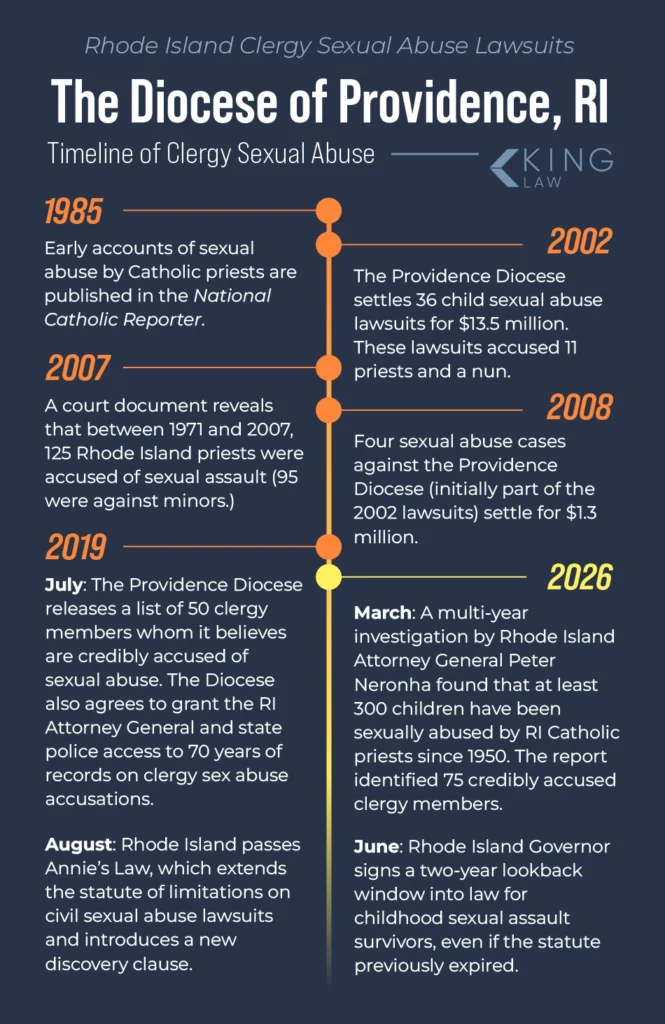
July 1, 2026: As Revival Window Opens, First Sex Abuse Lawsuit Filed Against RI Church
On the first day of Rhode Island’s revival period, an anonymous plaintiff filed a lawsuit related to childhood sexual abuse at a Rhode Island Catholic church. The lawsuit names the Diocese of Providence and Saint Matthew’s Church of Central Falls. The plaintiff alleges that he was sexually abused from 1980 through at least 1981 by the Rev. Roland Lepire. Additionally, his complaint says that his abuse was part of a broader pattern that the Diocese of Providence knew, should have reasonably known, and acted to hide. He also says that the diocese “harbored abusers, ignored red flags, and failed to institute basic safeguards,” to protect children in its congregation. The plaintiff is seeking damages and compensation for the lifelong impacts of his alleged abuse.
June 11, 2026: Rhode Island Governor Signs Law Allowing Adult Survivors of Childhood Sex Abuse Two Years to File Lawsuits
Rhode Island Governor Dan McKee signed a law opening a two-year lookback window for childhood sexual assault survivors. The revival window will run from July 1, 2026, to June 30, 2028. During that time, childhood sex abuse survivors will be able to file civil claims, even if the statute of limitations on their cases had previously expired. The law also affects future abuse survivors, allowing those sexually abused as minors to file civil lawsuits against institutions that enabled the abuse up until the survivor turns 53 years old. (This law effectively overturns the results of Houllahan v. Gelineau). The bill also establishes that institutions, organizations, and individuals can be held liable for negligence or concealment of sexual abuse of minors.
March 4, 2026: AG Investigation Finds Catholic Priests Assaulted Hundreds of Rhode Island Minors
Rhode Island Attorney General Peter Neronha released the results of a multiyear investigation, called the Report on Child Sexual Abuse in the Diocese of Providence. The report found that Catholic priests in Rhode Island have sexually abused at least 300 children since 1950. Additionally, the report identified 75 clergy members credibly accused of sexual abuse. The report notes that bishops frequently minimized abuse accusations, transferring accused priests to new assignments or treatment rather than referring them to authorities. In many cases, the accused priests faced no consequences from either the law or the Diocese. Twenty priests investigated during that time period faced criminal charges, and only 14 were convicted. Around a dozen were dismissed from the clergy. The attorney general believes there were likely more victims who never came forward or whose records were lost or destroyed by the church.
July 28, 2023: Rhode Island Supreme Court Rules on Childhood Sexual Abuse Lawsuits Filed Against Institutions
The Rhode Island Supreme Court ruled, in Houlihan v Gelineau, that the extended statute of limitations for childhood sex abuse survivors passed in 2019 did not retroactively apply to lawsuits filed against non-perpetrator defendants. Non-perpetrator defendants include institutions like the Diocese of Providence or individuals overseeing those institutions, like former Bishop Louis Gelineau. The plaintiffs in the case alleged that Gelineau and the corporate entity through which the Diocese did business were aware that priests under their auspices were sexually abusing children. However, the plaintiffs alleged that the bishops failed to warn the victims or their parents and failed to adequately address the issue.
November 5, 2020: Rhode Island Grand Jury Indicts Former Woonsocket Priest
Former Catholic priest John Petrocelli is indicted by a Rhode Island grand jury on charges of first-degree child molestation and nine counts of second-degree child molestation. Petrocelli had served as an assistant pastor at Holy Family Parish between 1981 and 1990. The indictment alleges that Petrocelli committed multiple acts of sexual abuse against three male parishioners who were under the age of 14 at the time.
August 5, 2019: Rhode Island Passes Annie’s Law, Extending Statutes Of Limitations
Governor Gina Raimondo signs legislation into law that extends the statute of limitations on civil sexual abuse lawsuits. The law raises the statute of limitations from seven years after the victim turns 18 to 35 years from their 18th birthday. It also introduces a discovery clause into law, allowing a survivor to sue up to seven years after recalling a suppressed memory of abuse, even if they are over age 53. The law is named after Dr. Ann Hagan Webb, who was abused by a priest as a minor.
July 23, 2019: Diocese Of Providence Agrees To Turn 70 Years Of Records Over To The State
Following the public release of a list of credibly accused clergy members earlier in July, the Diocese of Providence announced that it will grant the Rhode Island Attorney General’s Office and state police access to nearly 70 years of records on clergy sex abuse accusations. Attorney General Peter Neronha also announces his intention to conduct an investigation to vet the accusations and share that information with the public. Neronha had initially wanted to conduct a grand jury inquiry similar to the 2018 Pennsylvania investigation of sexual abuse in the Catholic church, but Rhode Island law limits the amount of information that can be publicly shared if it is not part of a formal indictment.
July 1, 2019: Diocese Of Providence Releases A List Of Credibly Accused Clergy
The Roman Catholic Diocese of Providence released a list of 50 clergy members whom it believes were credibly accused of sexual abuse since 1950. The list includes living and deceased clergy, with the living suspects ranging in age from 60 to 98. Critics question why the list was not longer, citing previous estimates of 125 credibly accused clergy. Among those named are Rev. James Silva and Monsignor Anthony DeAngelis. The Providence disclosure is one of many released by American Catholic Dioceses following a watershed grand jury report from Pennsylvania.
August 30, 2008: Providence Diocese Agrees To Settle Four Sexual Abuse Cases For $1.3 Million
The Diocese of Providence agrees to settle four sexual abuse claims for $1.3 million. The plaintiffs had initially been part of the 2002 cluster of lawsuits filed against the church, but failed to reach a settlement at that time. The four men, one of whom is deceased and being represented by his sisters, claim they were sexually abused by three different priests during the 1970s and 1980s. Church officials deny any misconduct on the part of the Diocese.
October 20, 2007: Court Document Reveals 125 Rhode Island Priests Were Accused Of Sexual Assault
A court document filed by Bishop Thomas J. Tobin of the Catholic Diocese of Providence reveals that 125 Rhode Island priests were accused of sexual assault between 1971 and 2007, 95 of whom were accused of sexually abusing minors. The number was notably higher than 56, the number cited by Tobin’s predecessor, Robert E. Mulvee, in 2004. The Diocese claimed the new number is higher because it includes claims that had not been vetted, as well as those made after the 2002 cases brought national attention to the issue.
September 10, 2002: Providence Diocese Settles 36 Abuse Lawsuits For $13.5 Million
The Catholic Diocese of Providence announced a $13.5 million settlement with 36 childhood sex abuse survivors, the culmination of lawsuits filed in the 1990s. The settlement follows a ruling in July 2002 that found the First Amendment could not function as a blanket shield against cooperating with authorities on such cases. The Diocese had argued that it could refuse to turn over documents under the freedom of religion clause. The lawsuits accused 11 priests and a nun of sexual abuse.
What Is a Rhode Island Clergy Sexual Abuse Lawsuit?
Rhode Island clergy sexual abuse lawsuits are civil lawsuits filed by adults who allege that they were sexually abused as children by Catholic priests, deacons, religious-order clergy, or church personnel. These lawsuits are different from criminal lawsuits against individual clergy members. Instead, plaintiffs in these civil lawsuits claim that the Diocese of Providence and associated parishes failed to protect them from the abuse and properly react to reports of abuse. Thus, the institution is the defendant, not the priest accused of abuse.
Through civil claims, survivors may pursue compensation through settlements with the diocese and any compensation programs that may be established.
Who Can Be Sued in a Rhode Island Clergy Abuse Lawsuit?
The Rhode Island revival window allows survivors to bring claims against individuals and institutions involved in perpetrating, covering up, or failing to reasonably address sexual abuse they alleged occurred during childhood.
Possible defendants in Rhode Island clergy abuse lawsuits include:
- The Diocese of Providence
- Individual Parishes
- Catholic schools
- Religious orders
- Catholic residential facilities or orphanages
- Supervisors negligent in their duties
- Organizations that negligently hired, retained, trained, monitored, or supervised an abuser
Survivors may also sue the perpetrators themselves, whether or not they were criminally charged or convicted.
Rhode Island Clergy Abuse Lawsuit Quick Facts
| Type of lawsuits | Civil claims |
| Revival window for old lawsuits | July 1, 2026 – June 30, 2028 |
| Revival law signed | June 11, 2026 |
| # of Rhode Island clergy credibly accused | 75 |
| Diocese involved | Diocese of Providence and associated entities |
| Who can be sued? | Diocese, parishes, schools, religious orders |
| Who can file lawsuits? | Anyone alleging childhood sex abuse committed by Rhode Island clergy |
Can You Still File a Rhode Island Clergy Abuse Lawsuit?
On June 11, 2026, Rhode Island enacted a law that allows survivors of childhood sex abuse two years to file a civil lawsuit, regardless of how long ago the alleged abuse happened. That means that anyone who experienced abuse by a member of Rhode Island’s Catholic clergy can file a civil lawsuit, even if that abuse happened decades ago.
What is the Statute of Limitations on a Clergy Abuse Lawsuit in Rhode Island?
Rhode Island recently passed a law temporarily changing the statute of limitations related to childhood sexual abuse lawsuits filed in civil courts, against both perpetrators and associated institutions.
Here are the current and future statutes for childhood sexual abuse claims in Rhode Island:
- From July 1, 2026, to June 30, 2028: Anyone of any age can file a civil lawsuit related to sexual abuse that occurred when they were a child, regardless of when that abuse occurred.
- After June 30, 2028: People alleging new incidents of childhood sex abuse have until their 53rd birthday to file a civil lawsuit (or until 7 years after they realize their injuries were caused by their abuse).
What Is the Rhode Island Clergy Abuse Revival Window?
The Rhode Island clergy abuse revival window is a temporary, two-year period that allows survivors of childhood sexual abuse to file civil lawsuits even if their claims were previously barred by the statute of limitations. Passed in June 2026, the legislation addresses oversights in 2019’s Annie’s Law.
The new law is designed to reopen claims against defendants who were not direct perpetrators of the abuse, such as institutions, organizations, and supervisors who covered up the incidents or acted negligently in their duties to address complaints.
Key Dates for the Rhode Island Revival Window
The two-year Rhode Island revival window officially opens on July 1, 2026. It will close on June 30, 2028. Claims that are not filed before June 30, 2028, may become time-barred again, so survivors should speak with an attorney promptly to ensure that they meet critical deadlines.
What Did the Rhode Island Attorney General Report Find About Clergy Abuse?
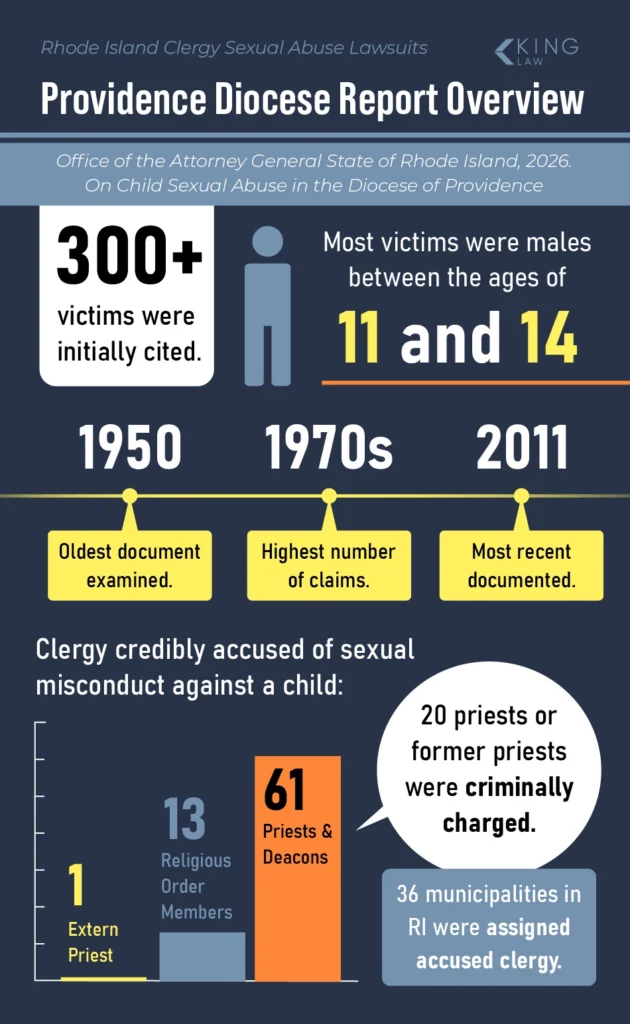
On March 4, 2026, Rhode Island Attorney General Peter Neronha published the results of a multiyear investigation into sexual abuse within the Diocese of Providence. The investigation examined records and evidence, including over 250,000 pages of diocesan documents, from 1950 to the present. Here are some of the findings from the Report on Child Sexual Abuse in the Diocese of Providence:
- More than 300 individuals claim they were abused by clergy
- There were 75 credibly accused clergy
- 20 priests or former priests were criminally charged
- 14 priests or former priests were convicted or pled guilty
- Abuse occurred between 1950 and 2011
- 36 municipalities in Rhode Island were assigned accused clergy
- Most victims were male and between the ages of 11 and 14
- The 1970s had the highest number of abuse claims
The report, though thorough, only documents recorded complaints of abuse obtained from church records. Actual rates are likely significantly higher. The Attorney General, in a press release, stated that survivors are still coming forward.
When Did Clergy Sexual Abuse Happen in Rhode Island?
While clergy sexual abuse can, and most likely did, occur outside of this window, the investigation and lawsuits are mainly focused on incidents that occurred from 1950 onward. The attorney general’s investigation reviewed incidents from 1950 to 2011.
During the second half of the 20th century, the Catholic church frequently handled sexual abuse complaints internally, transferring, laicizing, or attempting to rehabilitate clergy who were accused of sexual abuse rather than reporting them to the police. The Attorney General’s investigation found that a disproportionate number of abuse claims were filed during the 1970s.
Many survivors of childhood sexual abuse disclose their abuse long after the event. The Attorney General’s report found that the average time to disclose was 26 years after the abuse occurred. This delay, well-documented in research, provides a rationale for the revival windows and extended statutes of limitations outlined in reform efforts like the two-year look-back window enacted by Rhode Island lawmakers.
Which Rhode Island Clergy Have Been Accused of Sexual Abuse?
At this time, around 75 Rhode Island clergy members have been credibly accused of sexual abuse. “Credibly accused” means there is a reasonable basis to believe that the accusation could be true based on available evidence, accounts, and circumstances. It does not mean that the accused individual is automatically criminally guilty of, or civilly liable for, the abuse. By the same note, those 75 individuals do not represent an exhaustive list. Some sexual abuse may never have been reported or formally documented.
Diocese of Providence Priests and Deacons Accused of Abuse
Of the 75 individuals credibly accused of sexually abusing minors, 61 are or were diocesan priests and deacons, meaning they were ordained to serve within the Roman Catholic Diocese of Providence.
Here are some of the notable priests accused of abuse who served in the Rhode Island diocese:
- Anthony DeAngelis
- Edward Kelley
- Francis Santilli
- James Silva
- John Allard
- John Petrocelli
- Kevin Fisette
- Michael LaMountain
- Robert Marcantonio
- William O’Connell
The complete list of credibly accused clergy listed in the report, along with details of their assignment history and the accusations against them, is available on the Attorney General’s Diocese report website.
Religious Order Members and External Clergy Accused of Abuse in Rhode Island
Of the remaining 14 credibly accused individuals from the Attorney General’s report, 13 are religious order members, and 1 is an extern priest. These individuals temporarily served within the Diocese of Providence. Among the individuals credibly accused are:
- Aaron Joseph Cote, Dominican friar
- Bede Gorman, Benedictine monk
- Geoffrey Chase, Benedictine monk
For this reason, survivors may have claims involving not only the Diocese of Providence, but also religious orders, Catholic schools, Catholic residential facilities, or other institutions responsible for supervising clergy.
Which Parishes Are Implicated in Abuse?
It is possible that abuse occurred at any church or parish in Rhode Island. However, according to the Report on Child Sexual Abuse in the Diocese of Providence, some parishes had high rates of reported abuse.
Here is a list of the Rhode Island parishes with the highest number of reports of sexual abuse:
- St. Mary’s Church, Cranston
- Our Lady of Mercy Church, East Greenwich
- St. Aloysius Home, Smithfield
- Jesus Savior Church, Newport
- St. Matthew Church, Cranston
- St. Mary Church, Bristol
- Our Lady of Mt. Carmel Church, Providence
Where Did the Abuse Occur?
According to the Attorney General’s report, abuse occurred at many locations associated with the church. Not only did members of the church abuse minors in churches and rectories, but they also abused in parish schools, during church programs (like Catholic Youth Organization (CYO)), in the private homes of priests or parishioners, in vehicles, and in other locations.
What Are the Most Notable Rhode Island Clergy Abuse Cases?
Notable Rhode Island clergy abuse litigation includes civil lawsuits, criminal prosecutions, and appellate cases involving statutes of limitations and institutional liability. While the revival window will likely usher in many new cases of note, here are some ongoing and settled cases.
The 2002 Diocese of Providence Settlement
Before the Attorney General’s report, the Diocese of Providence agreed to settle with 36 plaintiffs who claimed they were sexually abused by clergy members. The initial settlement was $13.5 million. Four plaintiffs who were unable to reach a settlement in 2002 later settled their cases for $1.5 million in 2008. Many of the complaints involved Father James D. Silva, who pleaded guilty to a criminal charge of sexual assault in 1995.
Also accused were Father John Petrocelli, Father Daniel Azzarone, Jr., and Father Roland Lepire. A total of 10 priests and one nun were accused.
The 2002 settlement revealed the scope and scale of the abuse in the Rhode Island Diocese, prompting later reform and investigation efforts.
The William O’Connell Case
Father William O’Connell’s case is described in the Attorney General’s report as being “one of the most notorious.” While he eventually pleaded no contest to multiple sexual assault charges in 1986, accusations against O’Connell date back to 1950, when a then 13-year-old boy claimed O’Connell invited him to sleep in the St. Francis Rectory. O’Connell would be accused of sexually abusing at least 23 boys from 1950 to 1985, with most of the survivors reporting that he pressured them into sleeping with him in his bed or served them alcohol.
The investigation could not find any documentation that the Diocese was formally aware of his conduct prior to 1978, when another priest at St. Mary Church in Bristol wrote a letter to Bishop Gelinau outlining his concerns. A second priest came forward in 1984. In both cases, Diocese leadership instructed the whistleblowers to gather more evidence. O’Connell served only one year of his five-year sentence, with the diocese continuing to financially support him until 1994, when he was arrested in New Jersey on multiple accounts of obscenity, child endangerment, sexual contact, and sexual assault. He was sentenced to 10 years at a treatment center and died in 1996. Additional victims have come forward since his death.
The O’Connell case serves as an example of how both institutional and legal responses to clergy sex abuse in the past generally favored treatment over other penalties.
The Petrocelli, Silva, Fisette, and Kelley Indictments
The Attorney General’s investigation has resulted in the indictments of four current or former members of the clergy: John Petrocelli, James Silva, Kevin Fisette, and Edward Kelley.
- Petrocelli was indicted in 2020 on three counts of first-degree child molestation from his time as an assistant pastor at Holy Family Parish from 1985 to 1990.
- Kelley was indicted on three counts of first-degree sexual assault in 2021 that allegedly occurred during his time as pastor at St. John’s Church in North Smithfield. However, a court found him not competent to stand trial in February 2022. Kelley died in September 2022.
- Silva, who previously pleaded guilty to a criminal charge of sexual assault in 1995, was indicted on two counts of first-degree child molestation sexual assault and nine counts of second-degree child molestation sexual assault from his time as Assistant Director at the Diocese Office of Ministerial Formation between 1989 and 1990.
- Fisette was indicted on one charge of first-degree sexual assault in 2022 for allegedly abusing a boy between 1981 and 1982 in Burrillville. Fisette was assigned as a deacon to Our Lady of Victory Church in Ashaway.
Houllahan v. Gelineau and the Fight Over Institutional Liability
In 2020, three lawsuits against the Roman Catholic Diocese of Providence and its former Bishop Louis Gelineau were grouped together into a single case, Houllahan v. Gelineau. The cases were grouped due to their identical legal arguments, which were based on the extended statutes of limitations outlined in the 2019 Annie’s Law.
The Rhode Island Supreme Court ultimately ruled that Annie’s Law only retroactively extended the statute of limitations on filing civil suits against the direct perpetrators of the abuse. So while survivors could sue the priest who abused them up until their 53rd birthday, the statute of limitations on suing implicated institutions was ruled to be just three years.
The ruling limited survivors’ ability to sue, as, in many cases, their alleged abuser had limited resources or was deceased. The passing of the updated law in June 2026 directly addresses this situation and allows survivors with time-barred complaints to file claims against non-perpetrators.
Did the Diocese of Providence Cover Up Clergy Sexual Abuse?
The Rhode Island Attorney General’s report concluded that the Diocese of Providence frequently prioritized avoiding public scandal over protecting children in their parishes.
The attorney general’s report accuses the Rhode Island Diocese of doing the following after receiving abuse reports:
- Failure to refer abuse allegations to state or local law enforcement
- Adoption of policies and procedures that protected accused clergy
- Transferring accused clergy to new assignments (a process called priest shuffling)
- Sending priests to treatment centers or sabbaticals instead of removing them
- Publicly advocating for criminally charged clergy
- Making misleading public statements regarding its knowledge of sex abuse complaints
- Downplaying allegations as boundary violations or spiritual problems
- Failing to properly monitor credibly accused clergy
- Using veiled language and euphemisms to minimize abuse incidents
The report notes reform efforts on the part of the Diocese of Providence beginning in the 1990s. However, it found the organization still has substantial gaps in its policies, particularly its lack of monitoring of credibly accused clergy and inconsistent investigations of complaints.
“Through these practices, the Diocese prioritized protecting its own reputation at the expense of survivors and the public, while minimizing the legal and public fallout from complaints of child sexual abuse by Diocesan clergy. Realistically, these tactics served only to keep predator priests within the priesthood, where they could–and often did–continue to abuse children.”
~From the “Report on Child Sexual Abuse in the Diocese of Providence” compiled by the Office of the Rhode Island Attorney General
How Did Annie’s Law Affect Rhode Island Clergy Abuse Lawsuits?
Annie’s Law, Senate Bill 0315 Substitute A as amended, extended the statute of limitations for filing a civil lawsuit for childhood sex abuse claims. The bill allowed claims to be filed up to 35 years after the survivor’s 18th birthday or within seven years of discovering the connection between the abuse they suffered and later injuries. The law was soon found to have major limitations as written, with the Rhode Island Supreme Court ruling in Houllahan v. Gelineau that it only applied to lawsuits against the direct perpetrators of this abuse. This limitation prompted additional legislation to correct its oversights, dubbed Annie’s Bill, which passed in June 2026.
Why Did Some Rhode Island Clergy Abuse Claims Get Dismissed?
Some Rhode Island clergy abuse claims were dismissed after the passage of Annie’s Law between 2019 and 2026 because their claims against institutions and non-perpetrators were ruled to be time-barred in Houllahan v. Gelineau. During this period, survivors could sue perpetrators under the new, 35-year statute of limitations, but any claims they made against institutions or supervisors were dismissed if they had previously expired under the state’s existing three-year statute of limitations on personal injury claims.
Why Is the 2026 Rhode Island Revival Window So Important?
The 2026 Rhode Island revival window allows survivors to file claims against institutions and non-perpetrators even if their statute of limitations (lawsuit filing deadline) has previously expired. This is extremely important given that the Attorney General’s investigation found that at least 300 people reported sexual abuse involving clergy dating back to 1950. All of these people could, theoretically, file civil lawsuits during the revival window, allowing survivors to hold institutions that enabled their abuse accountable.
The revival window is the result of years of advocacy from survivors and lawmakers. Both the 2019 “Annie’s Law” and 2026 “Annie’s Bill” are named after Ann Hagan Webb, a psychologist who was sexually abused by clergy as a child. Webb remains a prominent advocate in institutional sexual abuse legal reform, including on the shortfalls of the 2019 law. Her sister, Rep. Carol McEntee, introduced both the initial 2019 bill and the 2026 legislation.
Who Can File a Rhode Island Clergy Sexual Abuse Lawsuit?
Anyone who alleges they were sexually abused as a child by an official within the Diocese of Providence can file a civil claim. People alleging abuse by the following church officials can speak with a lawyer about filing a claim:
- A priest, deacon, or employee of the Roman Catholic Diocese of Providence
- An employee or contractor of a Rhode Island Catholic institution
- A member of a religious order operating within Rhode Island at the time of the abuse
From July 1, 2026, to June 30, 2028, there will effectively be no statute of limitations on filing a Rhode Island clergy sexual abuse lawsuit against individuals or institutions. However, cases that are not filed by June 30, 2028, may become time-barred again. If you are interested in filing a claim, consult with an attorney promptly to make sure you do not miss any critical deadlines.
What Evidence Can Help Support a Rhode Island Clergy Abuse Lawsuit?
Survivors will have to provide evidence to support their clergy abuse claim. However, survivors are not expected to have perfect recollection of an event that may have happened decades earlier.
Here is some of the evidence that can support a lawsuit against a Catholic institution in Rhode Island:
- Name of the perpetrator or a physical description
- Church, parish, school, rectory, hospital, or institution where the abuse occurred
- Approximate timeframe of the abuse
- Names of any possible witnesses
- Therapy or counseling records
- Police reports
- Diocese records or clergy lists
A clergy abuse lawyer can help investigate the claim, gather evidence, and reconstruct a timeline of events from available records and reports. Hiring a lawyer to track down pertinent records can help take some of the burden off of survivors.
What Are the Recoverable Damages in a Rhode Island Clergy Sexual Abuse Lawsuit?
Survivors may be able to recover economic, non-economic, and punitive damages in a Rhode Island clergy sexual abuse lawsuit. Damages may be awarded for the following injuries:
- Pain and suffering
- Emotional distress
- PTSD, depression, anxiety, and trauma-related injuries
- Counseling and therapy costs
- Medical expenses
- Lost wages
- Loss of enjoyment of life
- Punitive damages
Compensation may vary depending on the age of the survivor at the time of abuse, the circumstances of the abuse, the strength of available evidence, institutional behavior, and whether the claim is resolved through a settlement, court decision, or compensation program.
Estimated Rhode Island Clergy Sexual Abuse Lawsuit Settlements
Settlement amounts for the Rhode Island clergy sexual abuse lawsuits may vary widely depending on the details of each case. There have been two major settlements with the Diocese of Providence on public record so far:
- 2002: $13.5 million settlement with 36 survivors
- 2008: $1.3 million settlement with four survivors
The Diocese claims to have paid out more than $21 million in settlements and resolved more than 130 complaints of sexual abuse by clergy as of 2019. Future settlements, however, may depend on the number of claims filed during the revival window and whether the Diocese and other institutions decide to pursue a global settlement or establish an independent compensation fund.
Is There a Deadline to File a Rhode Island Clergy Sexual Abuse Lawsuit?
The deadline for filing a Rhode Island clergy sexual abuse lawsuit depends on the age of the survivor and when the survivor connected their injuries to their childhood abuse. The deadlines are as follows:
- Individuals of any age may file a claim during the revival window running from July 1, 2026, to June 30, 2028. This includes individuals whose statutes of limitation had previously expired.
- After June 30, 2028, individuals alleging present-day abuse will have until their 53rd birthday to file a claim or seven years from the date on which they discovered their lifetime injuries are related to childhood sexual abuse.
Because gathering the necessary evidence can take time, individuals who wish to take advantage of the revival window should speak with an experienced attorney as soon as possible.
How Can I File a Rhode Island Clergy Sexual Abuse Lawsuit?
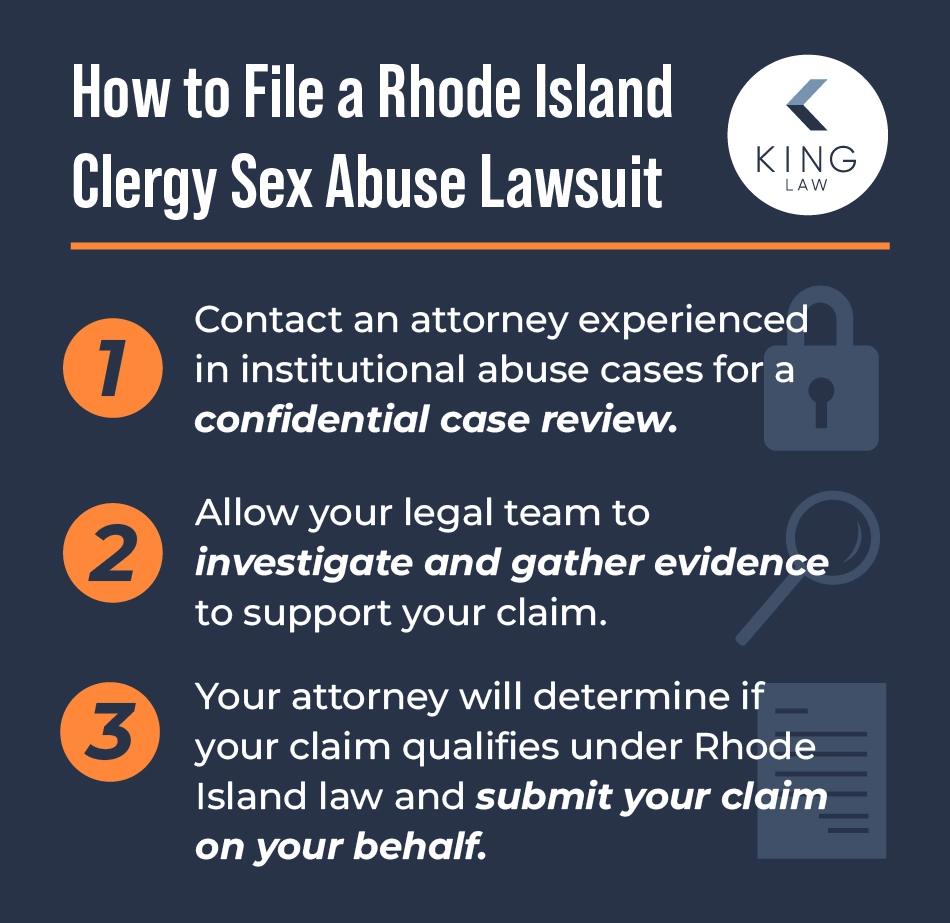
You can file a Rhode Island clergy sexual abuse lawsuit by following these steps:
- Contact an attorney with experience in institutional abuse cases for a confidential consultation.
- Under a confidential process, identify the abuser, institution, parish, school, or location involved.
- Provide as many details as you can recall to your lawyer.
- Allow the legal team to investigate and gather evidence.
- Determine whether the claim qualifies under Rhode Island’s statute of limitations or revival window.
- File your claim before the applicable deadline.
- Pursue compensation through settlement negotiations, litigation, mediation, or any available compensation program.
Note that many attorneys who work on clergy abuse cases work on a contingency basis. That means that, rather than charging an upfront fee, your attorney will collect a percentage of any compensation you are awarded. This allows survivors to pursue their claims regardless of their current financial situation.
Can You File a Rhode Island Clergy Abuse Lawsuit Anonymously?
In most cases, the name of a childhood sexual victim is not disclosed in legal proceedings or within legal complaints. However, some survivors choose not to file anonymously. This choice is highly personal. King Law respects the privacy of our clients and is committed to protecting their identities whenever requested.
Will My Name Be Disclosed if I Receive a Settlement or Compensation from a Victim Compensation Fund?
The names of those abused as minors are typically not made public, even if that person receives compensation from an institution. Survivors of childhood sexual assault who file lawsuits often file as John Doe, Jane Doe, or J. Doe, effectively removing their names from their complaints. People who have disclosure concerns should speak with their attorney to address each concern independently.
How Has the Diocese of Providence Responded to Abuse Allegations?
The Diocese of Providence, along with the Roman Catholic Church more broadly, has acknowledged past abuse, though disclosures and reform efforts have unfolded slowly since the 1980s. According to the Attorney General’s report, the Diocese of Providence had created the infrastructure to investigate sexual abuse claims in the 1990s through a new Office of Education and Compliance.
The 2002 Dallas Charter implemented a zero-tolerance policy toward sexual abuse of minors. This charter is often considered a major turning point for American dioceses. However, the report notes that many of these reforms were effectively forced upon the Diocese of Providence by outside pressure, and that figures like former Bishop Gellineau were clearly aware of incidents from as far back as 1981. The report also notes inconsistencies in modern internal investigation practices, though the Diocese has responded by claiming that the
The Attorney General investigation’s inability to identify any recently credibly abused clergy is evidence that current documentation practices may be ineffective. In an official response to the Attorney General’s report, the Diocese admits to “missteps” in early identification and handling of the issue, but criticized the implications in the report that the problem was ongoing.
The Attorney General has argued that additional reforms are still needed, including more transparency, stronger monitoring of accused clergy, an independent compensation program, better survivor-rights policies, and broader public disclosure of documents and accused clergy.
King Law Is Actively Investigating Rhode Island Clergy Sexual Abuse Claims
King Law is actively investigating abuse lawsuits filed against the Catholic Church. We work with those who were victims of childhood sex abuse involving clergy, religious-order members, Catholic institutions, and other organizations. We are actively representing people who wish to pursue justice against the Rhode Island institutions that may have enabled, concealed, or failed to address their abuse. Our attorneys offer free, confidential, trauma-informed case evaluations. We can help determine if your case qualifies under Rhode Island’s 2026 revival window. There is no obligation to continue unless you wish to.
Contact a Rhode Island Clergy Sexual Abuse Lawyer Today
If you are a survivor of childhood sexual abuse involving Catholic church clergy or personnel, contact King Law today by dialing (585) 496-2648 to schedule a free consultation with a Rhode Island clergy sexual abuse lawyer. Our experienced team offers free reviews and has the resources to help build your case before the Rhode Island revival window closes.