

Lyft Sexual Assault Lawsuits [2026 Update]
Complete the form below to see if you qualify for an Uber Lawsuit

Survivors of sexual assault during Lyft rides are filing lawsuits alleging the company failed to implement adequate safety measures and maintain proper driver oversight. The lawsuits claim that safety features in Lyft’s app and driver screening processes fail to adequately protect passengers from sexual assaults while using Lyft rides.
Lyft is also accused of failing to adequately respond to complaints or implement safety features to address points of failure. These lawsuits are currently being consolidated at the federal level as MDL 3171: Lyft, Inc. Passenger Sexual Assault Litigation.
Some survivors are choosing to sue Lyft to hold the company accountable for allegedly failing to protect riders. Below, this page will cover the current status of these lawsuits, the accusations being made against Lyft, and who may qualify to file a claim with King Law.
About the Lyft Sexual Assault Litigation
Key Information in the Lyft Sexual Assault Litigation
Lyft Sexual Assault Lawsuit Updates and Case Developments
What Is the Lyft Sexual Assault Lawsuit?
Federal Lyft Sexual Assault MDL (MDL No. 3171)
California Lyft Sexual Assault Case Coordination (State Court Lawsuits)
What Do Lyft’s Safety Reports Say About Sexual Assault?
What Are the Differences Between Lyft and Uber Sexual Assault Lawsuits?
What Are the Allegations in Lyft Sexual Assault Lawsuits?
What Safety Features Did Lyft Implement Following Claims of Sexual Assault?
Who Can File a Lyft Sexual Assault Lawsuit?
What Proof Is Needed to File a Lyft Sexual Assault Lawsuit?
How Can I File a Lyft Sexual Assault Lawsuit?
How Long Does a Lyft Sexual Assault Lawsuit Take?
Is There a Deadline to File a Lyft Sexual Assault Lawsuit?
How Much Could A Survivor Receive in a Lyft Settlement?
King Law Is Investigating Lyft Sexual Assault Claims
Key Information in the Lyft Sexual Assault Litigation
- Summary of Lyft Lawsuits: Lyft sexual assault lawsuits claim the company failed to take reasonable steps to screen drivers, prevent account sharing, and respond to assault reports.
- Name of Litigation: Lyft, Inc. Passenger Sexual Assault Litigation
- MDL #: 3171
- Name of Defendant: Lyft, Inc.
- Core Allegation: Lyft did not do enough to protect passengers from alleged sexual assaults by drivers or properly respond to reports of assault.
- Name of Venue: U.S. District Court in the Northern District of California
- When the Lyft MDL was created: Centralization ordered on February 5, 2026
- Judge assigned to MDL: Honorable Rita F. Lin
- Common claims against Lyft: Negligence, misrepresentation, breach of contract, strict product liability, and failure to warn
- Related litigations: Some cases have been centralized in California state court in January of 2020, under California JCCP No. 5061 (CJC-20-005061), In re Lyft Rideshare Cases, in San Francisco Superior Court
- Number of sexual assaults reported to Lyft: According to Lyft’s most recent safety report from 2020–2022, there were 2,651 instances of reported sexual assault. However, this timeframe saw declining rideshare use due to the Covid pandemic
Lyft Sexual Assault Lawsuit Updates and Case Developments
April 1, 2026: More Lyft Lawsuits Filed in March Over Sexual Assault Claims
As of April 1, 2026, there are 35 pending claims in MDL -3171 IN RE: Lyft, Inc. Passenger Sexual Assault Litigation. This newly formed federal litigation represents Lyft passengers who say they were sexually assaulted by their drivers. Some of those passengers have joined a centralized litigation, which allows many of the up-front steps of a civil lawsuit to be completed as a group. However, each passenger who files a case files their own lawsuit and seeks unique damages. People who were assaulted by their Lyft drivers can talk to an attorney about filing a case as part of this litigation.
March 5, 2026: Lawyers in Lyft Sexual Assault Litigation Submit Choice for Special Settlement Master
Attorneys for Lyft and attorneys representing sexual assault survivors have agreed to a special settlement master in MDL 3171. Parties on both sides have submitted their choice to the court for approval. Both sides have suggested using Fouad Kurdi of Resolutions, LLC. Kurdi has worked on other Lyft settlements. The judge has to approve Kurdi. A special master helps to manage complex civil litigations, like MDLs. They can also help manage discovery-related disputes and help negotiate settlements. As this litigation moves forward, the special master can support both sides throughout the litigation. People who allege sexual assault committed by their Lyft drivers can still talk to a lawyer about filing as part of this litigation.
March 4, 2026: Plaintiffs Join Newly Created Lyft MDL
The federal multidistrict litigation (MDL) was created on February 5, 2026. The original centralization request contained 17 lawsuits. Now, just about one month after filing, the Lyft assault MDL has 28 pending actions (lawsuits) against the rideshare company. U.S. Judge Rita F. Lin has already begun appointing the plaintiff leadership committee. On March 4, 2026, three more lawsuits were transferred to the Lyft MDL. It is expected that more plaintiffs will come forward and join this litigation. Plaintiffs allege that Lyft did not do enough to protect them from sexual assaults committed by their drivers.
February 5, 2026: Arizona Jury Holds Lyft Competitor Liable for $8.5 Million in Rideshare Sexual Assault Lawsuit
According to CNBC, Lyft competitor Uber is ordered to pay $8.5 million to Jaylyn Dean, who claims she was raped by her driver in 2023. (King Law is only naming the plaintiff because the plaintiff allowed their name to be public). and The jury found Uber liable for apparent agency, a decision that may open up ridesharing companies to lawsuits involving the conduct of their contractors. However, the jury did not find the company liable for negligence or design defects in this case, and no punitive damages were awarded. Uber announced its intention to appeal the decision.
February 5, 2026: Lyft Sexual Abuse Cases Consolidated into Multidistrict Litigation
According to a transfer order, the Judicial Panel on Multidistrict Litigation (JPML)
January 14, 2025: Colorado State Representative Discloses Sexual Assault and Files Lawsuit Against Lyft
A year after she was allegedly assaulted during a Lyft ride, Colorado State Rep. Jenny Willford publicly disclosed her civil suit against Lyft. Willford was able to flee from her Lyft driver, who she says had tried to prevent her from leaving after a sexually suggestive line of questioning. Though she says Lyft gave her a refund and promised to never match her with that driver again, Willford says she later learned that the driver was not an authorized user, but had used the verified account of another individual. The complaint notes that Lyft, at the time of the incident, lacked safety measures like periodic background checks and video verification while on duty.
May 3, 2024: NBC Investigation Finds Rideshare Services Used in Human Trafficking
An NBC investigation finds sexual abusers sometimes use rideshare services to transport unaccompanied minors to homes or hotel rooms. While transporting children and teens unaccompanied is a violation of the app’s terms of service, it is alleged that some drivers are not following protocols. Drivers have, in turn, complained that the apps do not require passengers to verify their age, placing unfair burdens upon them as contractors, and are even penalized for declining such rides. The youngest reported victim was 11 years old.
October 22, 2021: Lyft Admits to Having Received Thousands of Sexual Assault Claims
Lyft admits to receiving over 4,000 complaints of sexual assaults that allegedly occurred during rides between 2017 and 2019. The number of assaults increased year-over-year during all three of those years, from 1,096 in 2017 to 1,807 in 2019, though Lyft contends that the rate of complaints relative to the number of overall rides decreased by 19% during the same period. The majority of complaints involved non-consensual touching of a sexual body part. Another 156 involved non-consensual sexual penetration.
September 17, 2019: Woman Claims She was Kidnapped and Raped at Gunpoint by Lyft Driver
Alison Turkos filed a lawsuit in San Francisco Superior Court against Lyft after allegedly being kidnapped at gunpoint by a driver and raped. The complaint accuses Lyft of negligence, breach of contract, and vicarious liability for her assault. Turkos claims Lyft offered her only a partial refund for the ride and an apology for the “inconvenience.” According to a Lyft spokesperson, the driver in question had passed a background check. The lawsuit also claims Lyft had been uncooperative with NYPD and FBI investigations.
September 4, 2019: Lyft Drivers Accused of Sexual Assault by 14 Women
A lawsuit filed by 14 women who say they were sexually assaulted by Lyft drivers claims the company is not doing enough to protect passengers. The lawsuit also claims the Lyft app is defective and enables drivers to sexually abuse passengers. The complaint alleges that Lyft has a financial incentive to hire as many drivers as possible, leading to lax screening, missing safety features, and an opaque reporting system.
December 5, 2019: 19 Women File Lawsuit Against Lyft
Alleging that Lyft failed to screen its drivers or adequately respond to sexual assault complaints, 19 women sue Lyft. The women, who say they were assaulted by Lyft drivers during rides, claim Lyft did not cooperate with police investigators. The plaintiffs range between 20 and 40 years of age.
[TABLE OF CONTENTS]What Is the Lyft Sexual Assault Lawsuit?
The Lyft sexual lawsuits are a group of civil lawsuits filed by plaintiffs who allege they were sexually assaulted or harassed by Lyft drivers. Plaintiffs in these lawsuits claim Lyft played a role in their assaults by failing to take reasonable steps to ensure passenger safety.
Survivors who have filed lawsuits say Lyft should have taken additional steps to screen and train drivers, responded differently to complaints of sexual assault filed by passengers, and implemented better in-ride and in-app safety features.
Companies like Lyft have long tried to shield themselves from liability by emphasizing that drivers are contractors rather than employees, but a recent verdict against Uber may render that defense less effective going forward.
Can Survivors Sue Lyft for Sexual Assault?
Some survivors can sue Lyft for sexual assault committed by drivers. However, eligibility depends on the facts, venue, and filing deadlines. There are currently two centralized litigations with lawsuits filed by survivors. If you were sexually assaulted while on a Lyft ride, you should talk to a qualified lawyer to understand your legal rights and case-filing options. Existing cases hope to hold Lyft liable for sexual assaults committed by its contracted drivers.
Is the Lyft Sexual Assault Lawsuit a Class Action?
Although there are class action lawsuits against Lyft involving matters like pay, there is not a class action for people alleging sexual assault committed by their drivers. Sexual assault claims against the company are generally filed as individual lawsuits. Many of these cases are, however, being consolidated into a federal MDL, which allows discovery and other proceedings to be shared across similar cases. Additionally, a centralized proceeding has been created in a California state court in San Francisco.
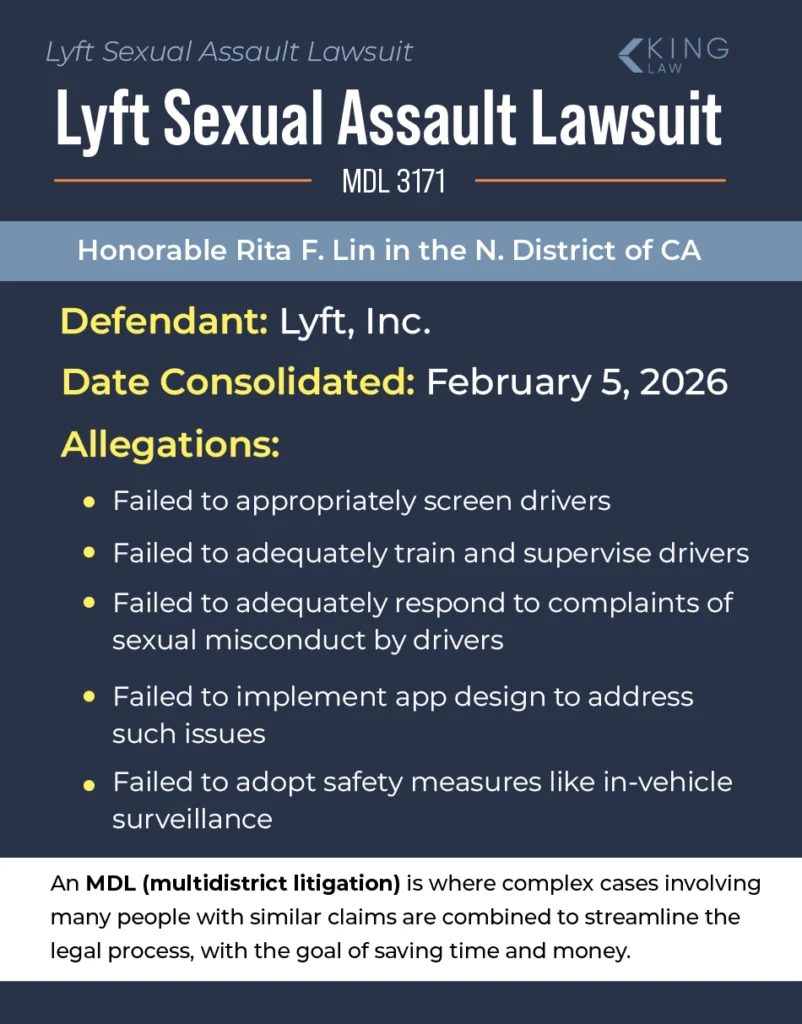
Federal Lyft Sexual Assault MDL (MDL No. 3171)
The JPML consolidated federal Lyft sexual assault cases into MDL No. 3171 Lyft, Inc. Passenger Sexual Assault Litigation in February 2026 in the Northern District of California. The panel identified several commonalities between the cases and decided they could be more efficiently litigated as an MDL.
Summary of Allegations Against Lyft
In existing Lyft lawsuits, plaintiffs make several accusations against how the rideshare company screens drivers and ensures the safety of passengers using its service.
Here are some of the allegations in sexual assault lawsuits against Lyft:
- Failed to appropriately screen drivers
- Failed to adequately train or supervise drivers
- Failed to adequately respond to complaints of sexual misconduct by drivers
- Failed to implement design changes to the Lyft app that would address such issues
- Failed to adopt safety measures like video and audio surveillance
Potential plaintiffs (survivors) are free to file in state or federal court as long as jurisdictional requirements are met.
Why Were Lyft Sexual Assault Cases Centralized Into an MDL?
When a large volume of cases involves very similar allegations, as with the Lyft sexual assault lawsuits, the JPML will sometimes decide to consolidate them into an MDL. This is done for two primary reasons:
- To reduce duplication of effort and improve the efficiency of litigation by, for example, streamlining discovery
- To avoid inconsistent rulings between cases
Note that an MDL differs from a class action lawsuit in that plaintiffs are not considered a “class,” and the circumstances of their case are still considered separately.
How Does the Lyft MDL Affect Individual Lawsuits?
Lyft lawsuits consolidated under MDL No. 3171 will continue to be treated as individual claims. However, pretrial discovery and motions will be coordinated between all such cases to improve efficiency and consistency. Early bellwether MDL trials may establish precedents for future settlements, but outcomes are still determined on a case-by-case basis. This means that survivors who transfer their case to the MDL will still be able to pursue individual damages and potentially receive compensation specific to their circumstances.
California Lyft Sexual Assault Case Coordination (State Court Lawsuits)
Prior to MDL No. 3171, numerous Lyft sexual assault cases had been
Many of these cases involve out-of-state passengers. The JPML decision does not supersede California’s civil case coordination, but instead exists alongside it. In other words, plaintiffs are no longer required to file their cases in California at the state level. In fact, the federal MDL will coordinate with the California lawsuits, which is why the Northern District of California was chosen to handle the federal litigation. The state-level cases, which have been in progress since 2020, have a head start in discovery and trial preparations.
What Do Lyft’s Safety Reports Say About Sexual Assault?
Data on Lyft sexual assaults comes not only from independent reports and lawsuits, but from the company’s own reporting systems as well. Lyft publishes its own safety data, which includes incidents of sexual assault reported on its platform by riders or authorities. Lyft uses the RALIANCE Sexual Misconduct and Violence Taxonomy standard for its data. Note that this data does not reflect arrests or convictions and may not capture all sexual assaults, which tend to go underreported.
The following sections contain statistical information and raw data about sexual assaults reported to Lyft. This data may be triggering to some readers. Click here to skip to the next section.
Lyft Sexual Assault Reports (2017–2019)
- Non-consensual sexual penetration
- Attempted non-consensual sexual penetration
- Non-consensual kissing of a sexual body part
- Non-consensual touching of a sexual body part
- Non-consensual kissing of a non-sexual body part
From 2017 to 2019, the number of reported sexual assaults fitting one of those categories increased by 14.5% from 1,096 to 1,255. From 2018 to 2019, they increased nearly 44% year-over-year to 1,807. Non-consensual touching of a body part made up over 50% of reported sexual assaults for years. However, the rate of sexual assaults in all five categories fell between 2017 and 2019, with reported incidents making up a smaller percentage of total rides as ridership grew. In other words, while Lyft reports that complaint rates relative to ride volume declined, raw numbers of reported assaults increased.
Lyft Sexual Assault Reports (2020–2022)
Lyft’s 2024 Safety Transparency Report included the same five categories as the one above, covering the years 2020-2022. Raw numbers of reported sexual assaults decreased in four of the five categories by 36.2% from 4,158 to 2,651. However, non-consensual sexual penetrations actually increased from 360 to 365, as did the rate of non-consensual sexual penetrations per ride. Additionally, the rate of fatal physical assaults rose by a staggering 185% between the 2017-2019 and 2020-2022 blocks, painting a mixed picture of safety progress.
Why Lyft Sexual Assault Data May Understate the True Risk
According to the United States Government Accountability Office, sexual assaults are generally underreported for reasons that include trauma and lack of faith in reporting systems. Additionally, Lyft discloses data on only five of RALIANCE’s 21 Sexual Misconduct and Violence Taxonomy categories. Although these five categories capture the most direct forms of sexual assault, they fail to include behavior like sexual harassment, indecent exposure, or non-consensual touching of a non-sexual body part (unwanted massages, etc.). The omission of these categories makes the rate of sexual harassment look lower than it probably is in reality.
What Are the Differences Between Lyft and Uber Sexual Assault Lawsuits?
Lyft offers a very similar service to Uber, which is also the subject of sexual assault lawsuits, but there are some differences in how the legal terrain has unfolded for each company. Legal actions against Uber are, for the most part, farther along than those for Lyft, although certain rulings against one company–such as an Arizona case that found Uber liable through apparent agency–could inform cases involving the other. Additionally, both companies differ somewhat in reporting practices and safety policy, which can also affect litigation structure.
How Do Lyft Sexual Assault Lawsuits Compare to Uber Cases?
One of the biggest differences between Uber and Lyft is in ridership volume, with Lyft accounting for only around 31% of rideshare rides in the U.S., despite recent gains by Lyft. The larger ride volume also translates into more incidents of sexual assault; Uber had nearly twice as many reported sexual assaults between 2017 and 2022 as Lyft.
However, allegations regarding driver screening, reporting systems, and passenger safety are similar.
Why Did Uber Face an Earlier Sexual Assault MDL Than Lyft?
One theory of why Uber had an MDL formed before Lyft is due to its higher volume of the rideshare market and higher sexual assaults. Uber lawsuits hit the threshold for consolidation into a federal MDL over two years earlier than those against Lyft. As a result, settlements involving Uber are likely to come earlier than those against Lyft.
What Are the Allegations in Lyft Sexual Assault Lawsuits?
Each Lyft sexual assault lawsuit has its own unique circumstances, but many share a set of allegations that have been identified by the JPML. Decisions made in the MDL’s bellwether cases on these allegations will inform and expedite other lawsuits. The four central allegations are as follows:
- Failure to properly screen and monitor drivers
- Failure to properly verify drivers and allegations of account sharing
- Failure to warn riders about known risks
- Failure to implement adequate safety measures for passengers
Failure to Properly Screen and Monitor Drivers
Lawsuits against Lyft have alleged that the company does not effectively screen its drivers. The claims have criticized Lyft’s name-based background checks, which they say are less effective than fingerprint-based criminal checks. Additionally, Lyft has been criticized for insufficiently monitoring drivers during rides, which can allow unauthorized drivers to use the accounts of drivers in good standing.
Unauthorized Driver and Account-Sharing Allegations
Lyft’s previous lack of video monitoring sometimes rendered background checks entirely moot. Without it, Lyft had no way to determine whether the person driving the car was the account owner. This has allowed unvetted individuals to transport riders under the Lyft banner.
Failure to Warn Riders About Known Risks
Lyft has also been accused of failing to adequately warn passengers about the risks of using its services. Given the poor screening and monitoring of Lyft drivers, as well as the number of reported sexual assaults made to the company, plaintiffs are arguing that they were not given enough information to properly assess the risk of using the app. This concept is known as informed consent, arguing that someone was not given enough information to assess the risks of using Lyft.
Failure to Implement Reasonable Safety Measures
Lawsuits also allege that Lyft, despite being aware of the risks and flaws in its systems and design, failed to implement reasonable safety measures to protect riders from sexual assault. These include more thorough background checks, mandatory video monitoring, and improvements to the reporting system.
What Safety Features Did Lyft Implement Following Claims of Sexual Assault?
Lyft has since implemented safety features in response to the sexual assault lawsuits and greater public scrutiny. The effectiveness of these policies and their impact on overall sexual assault statistics largely remains to be seen, with many advocates claiming these policies do not go far enough. Here are some of the notable changes Lyft has made to its policies and design.
Lyft Background Checks and Driver Monitoring Policies
Lyft’s current background check process still relies on name- and Social Security Number-based screening through a third-party service. Disqualifying factors include:
- Being listed in the National Sex Offender Registry
- Having been convicted of a violent crime
- Having been convicted of a sexual offense
- Having been convicted of driving under the influence
- Having been convicted of fraud in the last seven years
- Having been convicted of a drug-related offense in the last seven years
- Having been convicted of theft or property damage offenses in the last seven years
Lyft now conducts these checks periodically, not just when the driver signs up.
Lyft’s In-App Safety Tools (Alert 911, Trip Monitoring, Live Support)
The Lyft app now has a number of built-in safety tools that riders, as well as drivers, can use. These include:
- Real-time ride monitoring. Lyft claims this feature flags rides that exhibit unusual activity like long stops or route deviations. If the ride is flagged, a Lyft rep contacts the user.
- Concealing addresses from drivers. Drivers don’t receive an exact destination location, just a nearby pin for pick-up or drop-off.
- Matching features. Drivers rated three stars or less by a user will no longer be matched with that user. Likewise, users can favorite drivers they like and be matched with them in the future if available.
- Audio recording. The app has an optional audio recording feature that can be turned on during the trip.
- ADT emergency help. Riders can tap “get emergency help” to request assistance through Lyft’s partner, ADT.
Women+ Connect and Gender-Based Ride Matching
Lyft offers a feature called Women+ Connect to women and non-binary riders. When utilized, the app will attempt to match the rider with a driver who is also a woman or non-binary. In the event that such a driver is not available, the rider will be matched with a male driver. The legality of this feature is currently being contested, however, as male drivers claim the policy is discriminatory and negatively affects their earnings.
Who Can File a Lyft Sexual Assault Lawsuit?
Eligibility for filing a Lyft sexual assault lawsuit with King Law depends on the circumstances of the incident and the statute of limitations in your jurisdiction. The following individuals may qualify for a Lyft sexual assault lawsuit:
- Individuals who have been sexually assaulted or sexually harassed by a Lyft driver
- Family members of individuals who died during a sexual assault by a Lyft driver may also be able file a lawsuit
- The family members of minors who were transported, unaccompanied, by a Lyft driver to a location where they were sexually assaulted
A free consultation with a Lyft sexual assault lawyer can help determine your eligibility. Note that a civil sexual assault lawsuit can be pursued alongside criminal charges against your attacker. Speaking with an attorney does not require filing a lawsuit. A consultation simply helps you understand your rights.
Can Lyft Be Held Liable for a Driver’s Sexual Assault?
Existing lawsuits filed against Lyft look to hold Lyft liable for sexual assaults committed by its contracted drivers. Lyft could potentially be held liable for these assaults, if courts and juries find that Lyft did not do enough to protect people who use the rideshare app. Pending litigation will determine if Lyft will be held liable for these assaults.
What Proof Is Needed to File a Lyft Sexual Assault Lawsuit?
If you can do so safely, try to preserve ride details, screenshots, and any communications as soon as possible. If you choose to involve a lawyer or the police, having records will help their investigations.
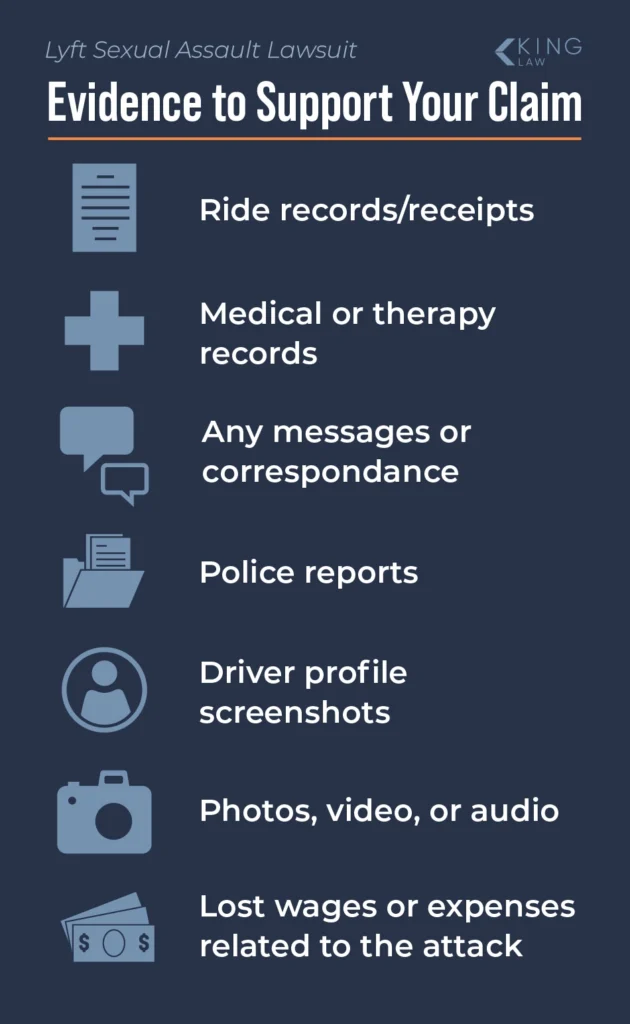
The success of a Lyft sexual assault lawsuit depends heavily on the amount and quality of evidence you are able to provide. Details vary from case to case, but common types of evidence may include:
- Lyft ride records and receipts
- Documentation of report to Lyft
- Driver profile screenshots
- Video or audio recordings
- Any police reports filed
- Medical or therapy records
- Witness statements or messages
- Lost wages or expenses related to the attack or its emotional fallout
Your evidence does not need to be complete at the start of your case; your attorney will help you collect it as part of their investigation. However, any evidence you’re able to provide at your consultation will help your lawyer evaluate your case.
How Can I File a Lyft Sexual Assault Lawsuit?
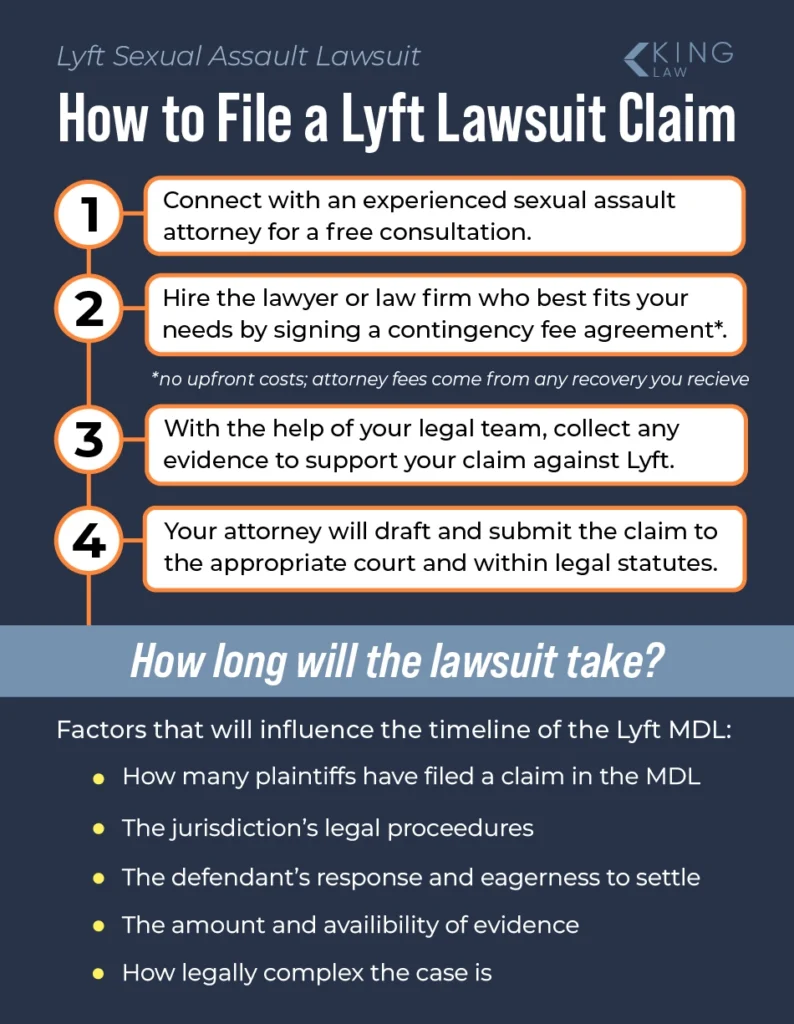
Filing a sexual assault lawsuit against Lyft involves speaking with a qualified attorney. King Law and our legal partners understand the sensitivities involved with working with survivors of sexual assault. We will handle your case with the care you deserve. Here are the steps typically involved in filing a Lyft lawsuit with King Law:
- Take advantage of a free consultation with an experienced sexual assault attorney.
- When you find a lawyer who fits your needs, hire them.
- Preserve and collect evidence with the help of your attorney.
- File a lawsuit within the statute of limitations in your jurisdiction, or join coordinated litigation.
- Pursue a settlement with the defendant(s) or go to trial if necessary.
Consultations with experienced Lyft sexual assault attorneys are confidential and have no upfront costs.
How Long Does a Lyft Sexual Assault Lawsuit Take?
Several factors can affect how long it takes for a Lyft sexual assault lawsuit to resolve. The Lyft MDL was only recently consolidated, for example, and may take several years. Factors that can influence a case’s length include:
- Whether the case is part of the MDL, the California state coordination, or an individual action. The state coordination has been in progress for much longer, for example.
- Whether the case is settled out of court or goes to trial. Settlements generally resolve more quickly.
- Procedural factors like court schedules and case burden.
As a point of comparison, the Uber MDL, which was consolidated in 2023, had its first bellwether decision in February 2026.
Is There a Deadline to File a Lyft Sexual Assault Lawsuit?
All Lyft sexual assault cases need to be filed within the statute of limitations. Statutes of limitations in civil sexual assaults can be very complicated, and an experienced attorney can help you understand what is applicable in your case.
Typically, the clock starts from the date of the assault or, in some cases, when the survivor discovers their injuries. The statute of limitations varies depending on the jurisdiction. While many states have recently expanded the filing windows for sexual assault lawsuits, it is best to act quickly in order to preserve your legal right to sue. An attorney can help you identify critical deadlines during your free consultation.
How Much Could A Survivor Receive in a Lyft Settlement?
As of yet, there haven’t been any bellwether trials in the Lyft sexual assault MDL. Bellwether trials often set the tone for what types and how much compensation will be awarded. A recent bellwether trial against Uber resulted in an $8.5 million verdict, but results may ultimately vary depending on the following factors:
- The severity of the survivor’s economic damages (medical and therapy bills, lost income)
- The severity of the survivor’s non-economic damages (pain and suffering, trauma)
- Punitive damages, if applicable, awarded due to egregious conduct on the part of one or more defendants
- Whether the case is settled or determined by a court verdict
- State caps on damages
Be sure to ask your prospective lawyer to assess how much your case may be worth during your consultation. High case values, like the $8.5 million verdict, are uncommon. Settlement offers are usually lower than awards secured during bellwether trials. Potential payouts will vary based on a number of factors and individual circumstances.
King Law Is Investigating Lyft Sexual Assault Claims
King Law is actively investigating Lyft sexual assault cases nationwide. Our experienced sexual assault attorneys and legal partners have decades of experience providing confidential, trauma-informed counsel to survivors, and have a record of success litigating complex cases against large corporate defendants. Our attorneys work on a contingency basis, meaning there’s no upfront cost to pursuing your case.
Contact a Lyft Sexual Assault Attorney Today
If you are the survivor of a sexual assault that occurred during a Lyft ride, contact King Law today for a free case evaluation by calling (585) 496-2648 or filling out a form on this site. Our consultations are 100% confidential, and there is no obligation to move forward with your case unless you want to.
Frequently Asked Questions (FAQs)
The Lyft sexual assault lawsuits are being filed by passengers who claim they were sexually assaulted by Lyft drivers during their rides. The lawsuits allege that Lyft was negligent in protecting them from assault.
People are filing Lyft sexual assault lawsuits alleging that the company’s screening and safety practices left them vulnerable to sexual assault by drivers, and that the company failed to provide ample warning of the risks.
There are class action lawsuits against Lyft involving its treatment and classification of drivers, as well as its advertising practices. The sexual assault lawsuits against Lyft, however, are not class actions but individually filed cases. These have been consolidated into a federal MDL and California state coordination due to their high volume.
The Lyft sexual assault MDL is a multidistrict litigation consolidated in the Northern District of California. This move reduces duplication of discovery efforts in similar cases and helps avoid inconsistent rulings. The cases are still resolved individually.
According to Lyft’s safety disclosures, there were over 6,800 reports of sexual assault between 2017 and 2022. While this number is a small fraction of total rides, survivors of sexual assaults by Lyft drivers claim the company does not effectively screen its contractors or adequately respond to reports of sexual assault. The 6,800 figure also fails to capture all instances of sexual misconduct, such as sexual harassment and unwanted non-sexual touching.
Lyft has reported 6,809 sexual assaults that fall into five of RALIANCE’s 21 categories of sexual misconduct. While these categories include the most direct forms of sexual assault, they do not include all the complaints reported on the platform.
There were 6,809 reported sexual assaults during Lyft rides between 2017 and 2022 that fell into the category of: non-consensual sexual penetration, attempted non-consensual sexual penetration, non-consensual kissing of a sexual body part, non-consensual touching of a sexual body part, or non-consensual kissing of a non-sexual body part.
Unauthorized account usage is a known problem with the Lyft ecosystem and a factor in a prominent lawsuit against the company by Colorado State Rep. Jenny Willford.
While police records can serve as valuable evidence in a Lyft lawsuit, they are not required to file one.
Evidence that can help support a Lyft sexual assault lawsuit includes: ride records and receipts, police reports, medical records, therapy records, witness testimony, and video or audio recordings.
The statute of limitations for filing a Lyft sexual assault lawsuit varies greatly by jurisdiction. Consult with an attorney to determine what deadlines apply to your case.
Lyft sexual assault cases may award both economic and non-economic damages. In specific circumstances, punitive damages may also be awarded.
There haven’t yet been any bellwether trials for the Lyft sexual assault lawsuits, though the first bellwether verdict against Uber awarded $8.5 million. However, settlement values are unlikely to match this singular verdict.
The time to settle a Lyft sexual assault lawsuit will vary depending on whether the case is being pursued individually, is part of the federal MDL, or is part of the California state coordination. It may take several years for MDL cases to settle, for example, while state coordination cases are further along.
You do not need a lawyer to file a Lyft sexual assault lawsuit, but most such cases benefit greatly from representation by an experienced attorney.
Most Lyft sexual assault lawyers work on contingency. This means their firm advances the costs of pursuing the case and takes a cut, typically between 33-40%, of any compensation awarded by settlement or verdict. This model removes financial barriers to filing.
Yes, existing lawsuits are attempting to hold Lyft liable for assaults committed by its drivers. In at least one recent case, a jury found Uber liable for a passenger’s sexual assault.
Yes, you can still sue Lyft, even if criminal charges were not filed against the driver who committed the assault.
Lyft refunding your ride or blocking a driver does not prevent you from filing a lawsuit related to an alleged sexual assault.
List of Sources Used in This Article
- BBC News Article. BBC News.
- Civil Case Coordination. California Courts.
- Checkr. Checkr.
- Uber Liable to Pay $8.5 Million in Driver Rape Suit. CNBC.
- Jenny Willford Lyft Driver Lawsuit. The Colorado Sun.
- Informed Consent. Cornell Law School.
- Male Uber and Lyft Drivers Sue Over Women-Only Ride Options. Forbes.
- Driver Requirements. Lyft.
- Women+ Connect for Riders. Lyft.
- 14 Women Allegedly Assaulted by Lyft Drivers Sue the Company. KHSU.
- Man Impersonating Rideshare Driver Charged with Unlawful Sexual Contact. KDVR.
- Uber and Lyft Lawsuit Involving Abuse and Sexual Assault Claims. NBC News.
- Uber Ordered to Pay $85 Million in Trial Over Driver Sex Assault Claims. NBC News.
- Lawsuits Say Lyft Doesn’t Do Enough to Protect Women From Predator Drivers. NPR.
- CEO David Risher: Lyft Inroads Uber. Observer.
- Lyft Sexual Assault Reports and Uber Ridesharing. The Guardian.
- Lyft Faces Lawsuit That Alleges Kidnapping at Gunpoint and Rape. TechCrunch.
- Apparent Agency. The Law Dictionary.
- Lyft Sexual Assault Lawsuit. The New York Times.
- Uber Safety and Rape Verdict. The New York Times.
- Uber Sexual Assault Coverage. The New York Times.
- GAO Report. U.S. Government Accountability Office.
- MDL 3171 Transfer Order. U.S. Judicial Panel on Multidistrict Litigation.
- MDL 3084 Transfer Order. U.S. Judicial Panel on Multidistrict Litigation.
- Lyft Rider. Lyft.
- Statute of Limitations. Wikipedia.