

Sterigenics Lawsuit – Ethylene Oxide Cancer Claims [2026 Update]
Complete the form below to see if you qualify for a Ethylene Oxide Lawsuit

Plaintiffs are filing lawsuits against Sterigenics related to emissions from its facilities in Willowbrook, IL, Smyrna, GA, and Vernon, CA. These lawsuits allege that ethylene oxide (EtO) emissions from the plants caused residents in nearby communities to develop cancer.
Sterigenics has settled multiple lawsuits from residents in these states and faces additional lawsuits. Ethylene oxide is a known carcinogen that some researchers suggest can elevate the risk of cancer for residents near the facilities. EtO is used to sterilize medical equipment at Sterigenics plants.
The page will cover the allegations against Sterigenics, the facilities involved, and who may qualify to file a lawsuit.
About the Sterigenics Cancer Lawsuit
Sterigenics Cancer Lawsuit Updates
What Are the Health Risks Associated with Emissions from Sterigenics’ EtO Facilities?
Why Are People Who Live Near Sterigenics Facilities Suing?
Where Are Sterigenics’ EtO Facilities Located?
Sterigenics Business Operations and EtO Sterilization Procedures
Federal Actions Taken Against Sterigenics Facilities
State-Level Legislative Actions Taken Against Sterigenics
Has Sterigenics Reduced Its Ethylene Oxide Emissions?
EtO Exposure Linked to Cancer in the Communities Near Sterigenics Facilities
Who Can File a Sterigenics EtO Lawsuit?
How to File a Sterigenics Lawsuit
Deadline to File a Sterigenics Cancer Lawsuit
Contact a Sterigenics Ethylene Oxide Lawyer Today
Sterigenics Cancer Lawsuit Updates
March 13, 2026: Trump EPA Proposes Amendments to NESHAP Standards
The U.S. Environmental Protection Agency announced proposed amendments to the 2024 National Emission Standards for Hazardous Air Pollutants (NESHAP) on the grounds that EtO sterilization plays a critical role in medical device sterilization. The press release cites industry concerns that the stringent standards outlined in NESHAP would threaten supply chains. The proposal would change risk-based emission standards, along with the requirement for continuous emissions monitoring. It would also change requirements for PTEs (permanent total enclosures).
April 4 – July 24, 2025: Sterigenics Agrees to Settle 226 Additional Illinois Lawsuits
In two consecutive press releases, Sterigenics announced it will settle 226 EtO claims in Illinois. The first press release outlines a $31 million outlay to settle 97 exposure lawsuits pending 100% participation by all of the claimants involved. The second press release offers an additional $34 million to settle 129 more claims pending against Sterigenics, also contingent upon a 100% participation rate. All of the claims in question would be dismissed with prejudice (meaning they cannot file a lawsuit for EtO harms again) should the settlements be accepted. In the press releases, Sterigenics denies wrongdoing and claims it will continue to contest other lawsuits in Illinois, Georgia, and California.
March 29, 2024: LA County Residents Claim Sterigenics Caused Their Cancer
Thirteen Los Angeles County residents filed a lawsuit alleging a Vernon-based Sterigenics plant’s emissions caused their cancer. All the plaintiffs have been diagnosed with cancers allegedly associated with EtO exposure, including breast cancer, lymphoma, and leukemia. The claims against Sterigenics include wrongful death, negligence, nuisance, and fraudulent concealment. One plaintiff claims she knew nothing about EtO emissions and the alleged risk of exposure until she received a flier from an environmental attorney, having previously chalked her struggles with cancer to bad luck. Sterigenics vowed to contest the claims.
October 19, 2023: Sterigenics Agrees to Pay $35 Million to Settle Georgia Lawsuits
Sterigenics agreed to settle 79 cancer lawsuits related to its Smyrna, GA, sterilization plant’s emissions for around $35 million. Homeowners located within two miles of the plant also sued Sterigenics for allegedly devaluing their property. Around 400 cases against Sterigenics were still pending in Cobb County at the time of settlement. Sterigenics announced to investors that it intends to actively defend its remaining ethylene oxide exposure cases. The plant, however, was allowed to remain in operation.
January 9, 2023: Sterigenics Settles Hundreds of Chicago-area EtO Lawsuits for $408 Million
Sterigenics agreed to pay $408 million to settle over 870 lawsuits that alleged its Willowbrook, IL, facility exposed nearby families to dangerous emissions. Sterigenics decided to settle the complaints rather than contest them after citing “years of biased media coverage.” The settlement comes a year after a jury awarded $363 million in damages to a Willowbrook woman who alleged the company had exposed her to carcinogenic EtO emissions. Sterigenics maintains that the Willowbrook plant did not pose a health risk to its neighbors.
September 19, 2022: Sterigenics Trial Ends in Record-breaking $363 Million Verdict
A jury ruled in favor of Susan Kamuda, a Willowbrook, IL, cancer survivor who filed a civil claim against Sterigenics in 2018. The jury awarded the 70-year-old woman $363 million in damages, then the largest amount awarded by a jury to an individual plaintiff in Illinois history. Kamuda had lived within a quarter-mile of Sterigenics’ Willowbrook plant for 40 years. She developed breast cancer in 2007, and her son developed non-Hodgkin lymphoma in 2021 despite no family history of cancer. The defense had argued that the plant had not been emitting enough EtO to cause the plaintiff’s cancer. Kamuda had sought $346 million.
July 18, 2019: Sterigenics Faces 32 Additional Lawsuits from Chicago-area Cancer Victims
Willowbrook, IL, cancer patients who allege their diseases were caused by ethylene oxide emissions from a former Sterigenics plant filed 32 civil lawsuits against the company. Sterigenics had recently reached an agreement with the state of Illinois to resume operations at the Willowbrook plant, pending upgrades to its emission control equipment. In addition to damages related to their illness, the plaintiffs seek to keep the plant shuttered. Sterigenics had also agreed to fund $300,000 in community projects as part of previous settlements. At least nine law firms were involved in the Willowbrook lawsuits.
February 15, 2019: Illinois EPA Shuts Down Willowbrook Sterigenics Plant
The Illinois EPA shuts down Sterigenics’ Willowbrook, IL, plant, citing elevated cancer risks to nearby residents. The order prevents Sterigenics from starting any new EtO sterilization cycles at the site. The order follows an independent monitoring program of the site, which found extreme fluctuations in EtO emissions, including the “highest levels of EtO recorded in the area to date.” The Chicago-Tribune had previously reported that Willowbrook tracts were one of just 109 in the nation with a cancer risk score greater than 100, meaning that if 1 million people were exposed to its conditions 24 hours a day for 70 years, 100 would develop cancer.
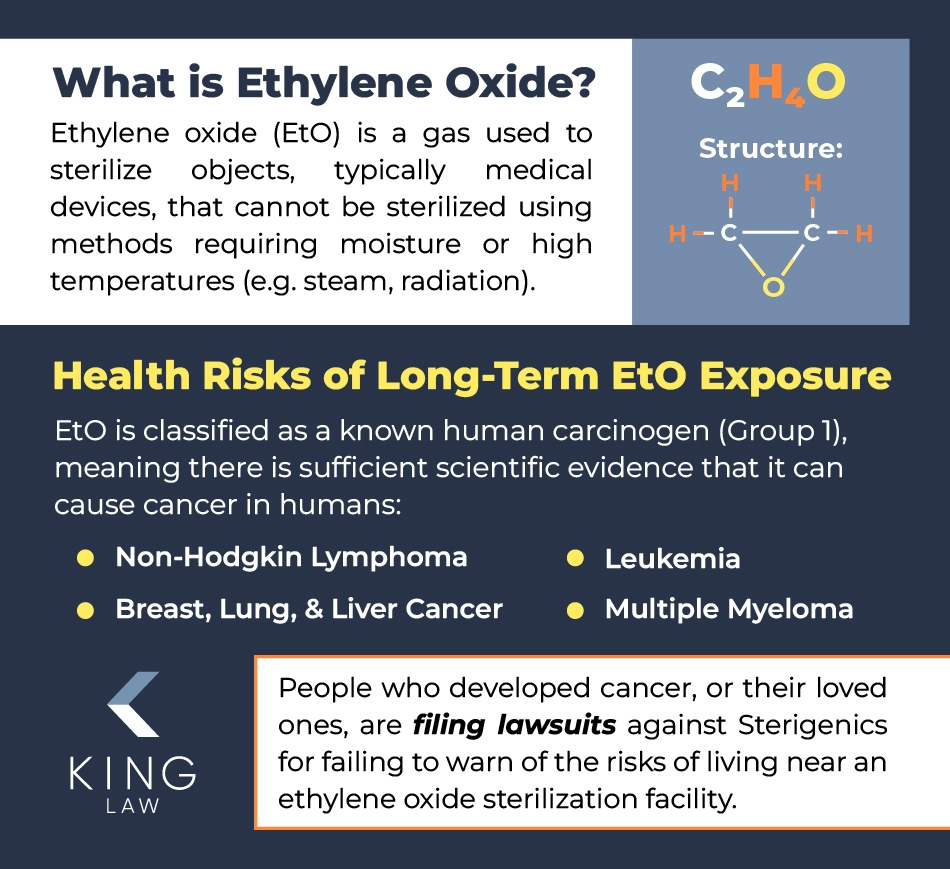
What Are the Health Risks Associated with Emissions from Sterigenics’ EtO Facilities?
Federal agencies, like the EPA and ATSDR, have
Of particular concern is EtO’s carcinogenic properties. EtO is
- non-Hodgkin lymphoma
- Myeloma
- Lymphocytic leukemia
- Breast cancer
Additional long-term risks from EtO include DNA damage, nervous system damage, respiratory issues, and organ damage.
Why Are People Who Live Near Sterigenics Facilities Suing?
Hundreds of individuals who live near Sterigenics facilities have filed EtO lawsuits, claiming emissions from the plant are responsible for their cancer. In addition, some plaintiffs claim Sterigenics’ emissions wrongfully decreased the value of their properties.
The lawsuits accuse Sterigenics of:
- Negligence in failing to adequately monitor and control emissions
- Failing to warn nearby residents of the risk of living near a sterilization facility
- Public nuisance on the grounds that the emissions interfered with their ability to use their property comfortably, or that it allegedly devalued their property
- Wrongful death in cases where a family member died of a cancer that is allegedly linked to EtO exposure
Under these and other legal theories, Sterigenics may be liable for the losses and injuries incurred by those filing lawsuits.
About Sterigenics, LLC
Oak Brook, IL-based Sterigenics operates 48 sterilization facilities around the globe. Sterigenics, along with testing service Nelson Labs and gamma technology supplier Nordion, is owned by Sotera Health LLC. Sotera is based in Broadview Heights, OH.
Sotera Health, previously Sterigenics International, went public in 2020, with private equity firm Warburg Pincus controlling the largest minority stake of the company. Of Sterigenics’ 48 sterilization facilities, 17 are ethylene oxide-based, 23 use gamma irradiation, and 8 use e-beam/x-ray processes.
Although the EtO sterilization services offered by Sterigenics and similar companies form a critical part of the medical supply chain, control of hazardous emissions remains a public health concern.
The History of Sterigenics and Its EtO Sterilization Facilities
Sotera Health, LLC is the result of multiple mergers and acquisitions. Sterigenics’ forerunner, Radiation Sterilization, was founded in 1978 in Tustin, CA, where it operated a gamma radiation facility. Sterigenics EtO operations, however, follow an older link back to Griffith Laboratories, which developed a process for sterilizing spices with EtO in the 1930s.
A Belgian company, Ion Beam Applications, acquired Radiation Sterilization (now Sterigenics International) and Griffith Laboratories spin-off Griffith Micro Science in 1999, which added several EtO plants to the brand, including the Willowbrook facility.
Private equity firms would acquire the aggregated sterilization operations in 2004, rebranding them as Sterigenics. The company would acquire additional companies, including Nordion and Nelson Labs, in the 2010s, rebranding as Sotera Health in 2017 and going public in 2020. However, Sotera Health’s sterilization operations still function under the Sterigenics name.
Where Are Sterigenics’ EtO Facilities Located?
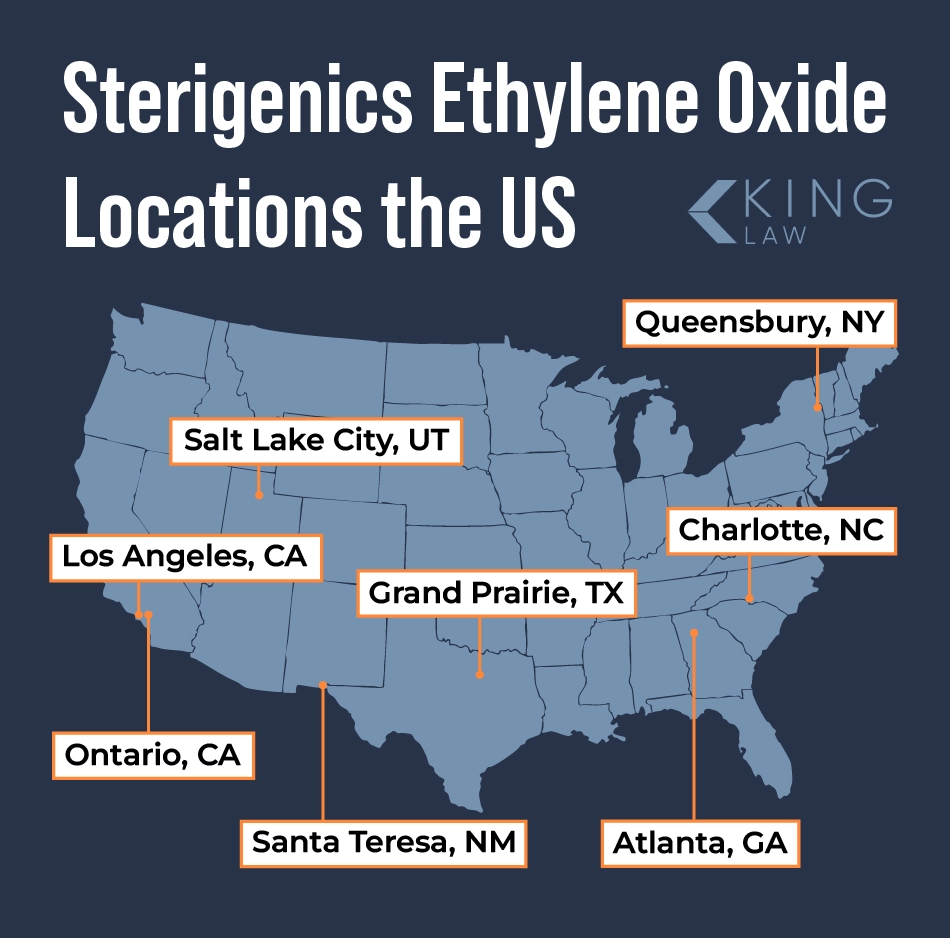
Sterigenics currently operates 8 EtO facilities in 7 states. They are located at:
- 2971 Olympic Industrial Drive Southeast, Suite 116, Atlanta, GA, 30339 (high risk)
- 10821 Withers Cove Park Drive, Charlotte, NC, 28278
- 1302 Avenue T, Grand Prairie, TX 75050
- 4900 Gifford Avenue, Vernon, Los Angeles, CA 90058 (high risk)
- 687 South Wanamaker Avenue, Ontario, CA 91761
- 84 Park Road, Queensbury, NY 12804
- 5725 Harold Gatty Drive, Salt Lake City, UT (high-risk)
- 2400 Airport Road, Santa Teresa, NM 88008 (high-risk)
Source: ArcGIS data from Storymaps, which identified risk levels
Although all of these sites present risks to their surrounding areas, the Atlanta (Smyrna) and Vernon plants have generated the most controversy and lawsuits to date, along with a ninth facility at 7775 Quincy Street and 830 Midway, Willowbrook, IL 60527, which ceased operation in 2019. Others, like the Queensbury, NY site, are being monitored but haven’t yet been associated with major lawsuits or regulatory actions.
Map of Sterigenics Ethylene Oxide Facilities
Sterigenics Business Operations and EtO Sterilization Procedures
As Soterra Health’s sterilization brand, Sterigenics’ operations include EtO and radiation-based sterilization facilities. Although gamma and X-ray radiation are effective for sterilizing many medical devices, it can damage some commonly used materials and electronic components.
EtO does not cause chemical damage to the devices and, as a gas, can easily slip into small channels and other hard-to-reach places. According to the EPA, approximately 50% of all sterile medical devices in the United States are sterilized with EtO. Ethylene oxide is also used to sterilize food (mainly herbs and spices), cosmetics, and drugs. However, the EPA is phasing out its use as a food sterilization agent for some herbs and spices, where safer alternatives are available.
Sterigenics EtO Gas Sterilization Process
Sterigenics’ EtO gas sterilization process involves several steps. Products must be placed into gas-permeable packaging that allows it to reach their surfaces. A typical EtO gas sterilization process involves:
- Environmental preconditioning to bring the products to a stable internal temperature and humidity, usually in a separate chamber.
- Evacuation of air from the sterilization chamber.
- Humidification, typically through steam injections.
- Injection of EtO gas into the chamber. Exposure times may vary depending on the product and sterility standards.
- EtO gas purges to below flammable limits, around 30,000 parts per million (ppm), followed by postexposure “washes.”
- Heated aeration to remove residual gases.
As of 2026, safety regulations for EtO sterilization facilities are in flux, with safety features like the proposed requirement for permanent total enclosures (PTE) likely to be left to state regulations. Acid-water scrubbers remain the industry standard for meeting Clean Air Act regulations.
Federal Actions Taken Against Sterigenics Facilities
At least four federal agencies have taken action against Sterigenics facilities for various safety concerns, including the EPA, FDA, OSHA, and Chemical Safety Board (CSB). Notable federal actions include:
- The EPA’s 2018 risk assessment report on the Willowbrook facility, conducted by the Agency for Toxic Substances and Disease Registry (ATSDR), which led to lawsuits and the shutdown of the facility.
- The EPA’s 2024 emissions actions and subsequent 2026 proposed rollback.
- In light of growing concerns over EtO emissions and potential medical product supply chain disruptions from facility shutdowns, the FDA is encouraging the industry to switch to vaporized hydrogen peroxide when viable.
- OSHA has cited Sterigenics for failures in process safety management of hazardous materials, most notably resulting in an explosion that injured several workers at its Ontario, CA, plant in 2004. The CSB later investigated the explosion, criticizing the plant’s lack of engineering controls in its report.
Other regulatory actions have taken place at the state level.
State-Level Legislative Actions Taken Against Sterigenics
Although there have not been legislative actions specifically directed against Sterigenics, some states have passed laws governing or restricting ethylene oxide usage beyond federal EPA standards. Some prominent examples include:
- 2019’s Matt Haller Act (Illinois), which limits emissions to 0.2 parts per billion and requires facilities to install PTEs.
- 2020’s Ethylene Oxide Reporting Act (Georgia), which requires any plants to report spills or releases to the Georgia Environmental Protection Division within 24 hours and increased public transparency.
- 2022’s Community Right to Know Act (Colorado), which allows the state to set stricter-than-EPA emission limits on toxic air contaminants, and requires air quality monitoring in disproportionately impacted communities
Three states–Illinois, Georgia, and California–have also taken regulatory actions against Sterigenics specifically.
Actions Taken by Illinois Against Sterigenics
Following the federal EPA’s report on Sterigenics’ Willowbrook facility, the Illinois EPA issued an emergency seal order on the plant. The order prevented the plant from starting any new sterilization cycles, alleging that the elevated cancer risks caused by the emissions were a public health hazard. The Matt Haller Act and a 2019 consent order imposed more stringent restrictions on the plant. Sterigenics would ultimately decide to shutter the facility.
Actions Taken by Georgia Against Sterigenics
Sterigenics entered into a consent order with the Georgia Environmental Protection Division (EPD) to reduce emissions at its Smyrna facility in 2019. As part of the agreement, Sterigenics shut the plant down for several months and installed additional emission controls, including dry bed scrubbers.
Actions Taken by California Against Sterigenics
The South Coast Air Quality Management District (SCAQMD) designated the Vernon Sterigenics facility as “high-risk” in 2022. The designation requires the plant to pause operations whenever EtO levels exceed 10 parts per billion (ppb). In 2023, the SCAQMD amended Rule 1405, requiring the Vernon facility, along with 14 others, to install PTEs and advanced scrubbers. Sterigenics was also fined $587,000 for permit violations.
California utilizes air districts, local government agencies tasked with regulating air pollution from stationary sources like factories and plants.
Has Sterigenics Reduced Its Ethylene Oxide Emissions?
Data on whether Sterigenics has effectively reduced its emissions of ethylene oxide is mixed and varies from facility to facility and state-level regulations. Further complicating matters are the two-year federal exemptions granted to 41 EtO facilities, including those operated by Sterigenics in:
- Charlotte, NC
- Atlanta (Smyrna), GA
- Ontario, CA
- Grand Prairie, TX
These exemptions delay EPA requirements to add advanced emissions controls. However, even after those protections are added, people with historical exposures to EtO could still be at an increased risk of developing cancer.
EtO Exposure Linked to Cancer in the Communities Near Sterigenics Facilities
The EPA’s publishing of its 2014 National Air Toxics Assessment (NATA) in 2018 identified hot spots around the nation where computer models predicted cancer risk for air pollutants exceeded 100 per one million individuals.
Among the areas the model found to be the highest risk was the Sterigenics Willowbrook facility in Illinois. Subsequent real-world air sampling by ATSDR confirmed that the computer model’s predictions were accurate.
The Illinois Department of Public Health (IDPH) subsequently published a Cancer Incidence Assessment in 2019, which analyzed cases from 1995 to 2015. Although the results did not completely line up with expected EtO-related cancers, some rates were lower than the national average, the report did find:
- A 90% higher rate of Hodgkin’s lymphoma in females
- A 10% higher rate of breast cancer in females than expected
- A small increase in the rate of prostate cancer in males
- Increased rates of pancreatic, ovarian, and bladder cancers
The IDPH concluded that the results raised serious health concerns, but could not conclusively link the cancer rates to EtO, saying it could not establish a causal relationship with EtO exposure.
Public Response to Emissions from Sterigenics Facilities
In addition to lawsuits, citizens have organized in response to the EPA’s emission studies and media coverage of Sterigenic’s Willowbrook facility. In Illinois, citizens launched the Stop Sterigenics campaign, which mobilized local residents through protests, town halls and lobbying efforts. Though the plant is now closed, lawsuits involving the plant are ongoing.
Additional citizen groups applying pressure to Sterigenics and government agencies include:
- Stop Sterigenics Georgia: inspired by the Illinois group.
- Clean Air Laredo Coalition: successfully lobbied the city of Laredo, TX, to monitor the air near the local sterilization plant and verify company data.
Periodic protests have also been reported near other facilities.
Who Can File a Sterigenics EtO Lawsuit?
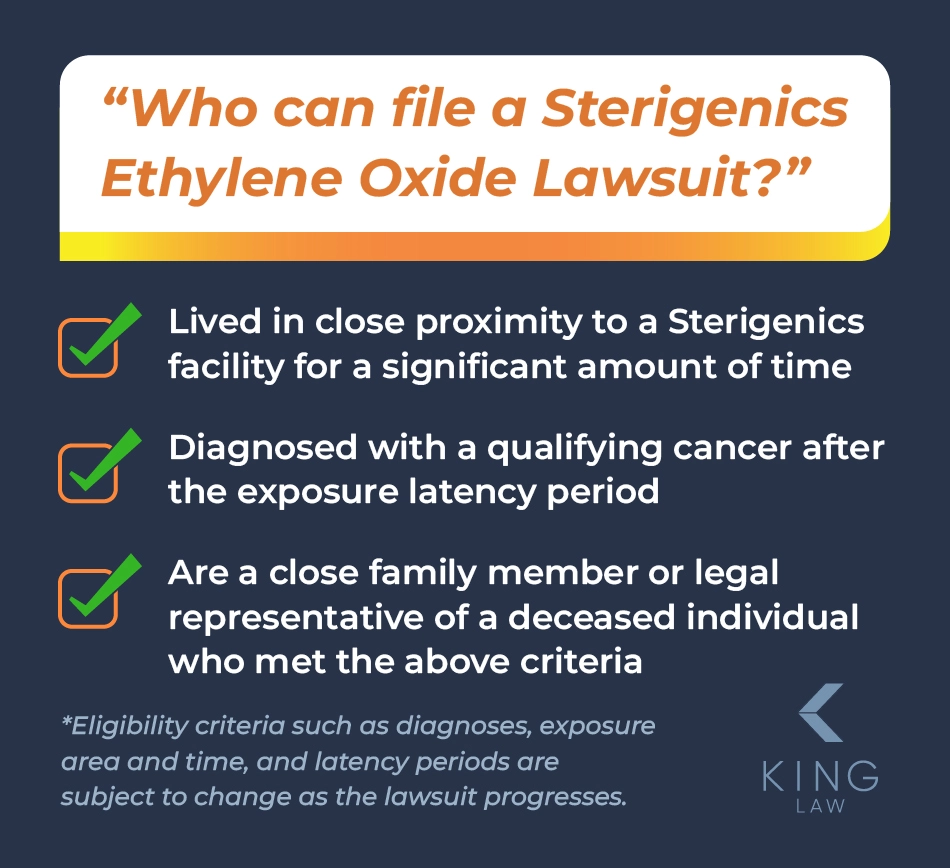
Individuals who live near a Sterigenics ethylene oxide sterilization plant and have been diagnosed with an EtO-linked cancer may be eligible to file a Sterigenics EtO lawsuit. King Law’s specific criteria is as follows:
- Must have lived within 4 miles of a Sterigenics EtO facility for at least 1 continuous year
- Must have been diagnosed with a qualifying cancer after exposure (i.e., leukemia, non-Hodgkin lymphoma, multiple Myeloma, breast cancer, liver cancer, lung cancer
- Must meet latency periods (2+ years for most cancers; 5+ for breast/leukemia)
- Family members of deceased individuals may file wrongful death claims
Contact us for a free consultation if you are unsure if you meet these prerequisites.
How to File a Sterigenics Lawsuit
Filing a Sterigenics lawsuit involves hiring a lawyer, building your case, and negotiating a settlement or going to trial. The steps involved in an ethylene oxide cancer case typically look something like this:
- Request a free case consultation with an attorney who has experience in personal injury cases, especially those involving corporate polluters.
- Gather medical records and proof of diagnosis to show that you have a disease allegedly associated with EtO exposure.
- Provide proof of exposure. This will typically be your residence history in an ethylene oxide case.
- Work with your attorney to file a legal complaint.
- Proceed through case review, discovery, and potential settlement or trial
Many ethylene oxide lawyers work on a contingency basis, so rather than charging a fee upfront, they will collect a percentage of any payout you receive. This allows victims to file a lawsuit regardless of their financial status.
Deadline to File a Sterigenics Cancer Lawsuit
Deadlines to file a Sterigenics cancer lawsuit vary depending on the state and the legal theory under which they’re filed. Typically, personal injury and wrongful death claims have statutes of limitations between 1 and 3 years from the cancer diagnosis or the individual’s death (though some states have longer statutes). In some cases, exemptions may apply if the diagnosis or death was only recently discovered to be linked to ethylene oxide exposure, invoking the discovery rule. Consult with an attorney promptly if you believe your illness or a family member’s death was caused by EtO to make sure you don’t miss any critical deadlines.
Contact a Sterigenics Ethylene Oxide Lawyer Today
If you or a loved one lived within four miles of a Sterigenics ethylene oxide sterilization facility and were diagnosed with cancer, you may be eligible for compensation for your pain, suffering, and expenses.
King Law is currently investigating EtO cases nationwide, including those involving Sterigenics. Our attorneys have decades of experience holding corporate polluters accountable. Call (585) 496-2648 or fill out our contact form to schedule a free, no-obligation case review today.
Frequently Asked Questions (FAQs)
List of Sources Used in This Article
King Law used the following sources when writing this article about Sterigenics ethylene oxide lawsuits. We apply rigorous editorial standards to create content for our visitors.
“Ethylene Oxide Regulation Signed into Law.” 11Alive News, 2024.
“Sterigenics Environmental Assessment Report.” South Coast Air Quality Management District, 2022.
“Sterigenics Community Investigation.” South Coast Air Quality Management District, 2022.
“Sterigenics Lawsuit: Willowbrook Verdict and Locations.” ABC7 Chicago, 2022.
“Sterigenics to Pay Millions to Settle Georgia Lawsuits.” Associated Press, 2023.
“Ethylene Oxide: Clinician Brief.” Agency for Toxic Substances and Disease Registry (ATSDR), 2024.
“Public Health Assessment: Sterigenics International, Inc..” Agency for Toxic Substances and Disease Registry (ATSDR), 2019.
“Laredo Activists Plan Meeting on Cancer-Causing Air Pollution.” BorderReport, 2023.
“Ethylene Oxide and Cancer Risk.” National Cancer Institute, 2024.
“Lawyer Represents Cancer Victims Linked to Ethylene Oxide.” CBS News Chicago, 2023.
“High Cancer Risk Linked to Sterigenics in DuPage County.” Chicago Tribune, 2018.
“Sterigenics to Pay $408 Million to Settle Lawsuits.” Chicago Sun-Times, 2023.
“Sterigenics Explosion Investigation Report.” U.S. Chemical Safety Board, 2024.
“Sterigenics Ethylene Oxide Explosion.” U.S. Chemical Safety Board, 2024.
“Criteria for a Recommended Standard: Occupational Exposure to Ethylene Oxide.” National Institute for Occupational Safety and Health, 1981.
“Completed Application: Sterigenics U.S., LLC.” New York State Department of Environmental Conservation, 2025.
“Sterigenics Willowbrook Cancer Investigation Report.” Illinois Department of Public Health, 2019.
“Ethylene Oxide (EtO).” U.S. Environmental Protection Agency, n.d.
“EPA Finalizes Protections for Ethylene Oxide.” U.S. Environmental Protection Agency, 2024.
“EPA Proposes Safeguards for Medical Sterilizers.” U.S. Environmental Protection Agency, 2024.
“National Air Toxics Assessment Fact Sheet.” U.S. Environmental Protection Agency, 2018.
“Sterigenics Consent Order Overview.” Illinois Environmental Protection Agency, 2019.
“Georgia Approves Plan to Reduce Ethylene Oxide Emissions.” Georgia Environmental Protection Division, 2019.
“Ethylene Oxide Emissions Standards (2024 Rule).” Federal Register, 2024.
“Ethylene Oxide Emissions Standards (2026 Rule).” Federal Register, 2026.
“EPA Moves to Set Stricter Ethylene Oxide Rules.” Yahoo Finance, 2024.
“Sterilization Modalities White Paper.” Global Industry Analysts, 2017.
“Colorado Ethylene Oxide Legislation.” Colorado General Assembly, 2023.
“Residents Claim Cancer Linked to Toxic Chemical.” NBC Los Angeles, 2023.
“Illinois EPA Shuts Down Sterigenics.” WTTW News, 2019.
“Sterigenics Inspection Detail.” Occupational Safety and Health Administration, 2024.
“Sotera Health.” Sotera Health Company, n.d.
“Our History.” Sotera Health Company, n.d.
“Sterigenics.” Sterigenics, n.d.
“Ethylene Oxide Sterilization Technology.” Sterigenics, n.d.
“Stop Sterigenics.” Stop Sterigenics Advocacy Group, n.d.
“Mapping Ethylene Oxide Risk.” ArcGIS StoryMaps, 2023.
“Illinois Announces Sterigenics Actions.” State of Illinois, 2019.
“California Air Districts.” California Air Resources Board, n.d.
“EtO Follow-Up Testing Results.” Village of Willowbrook, 2019.