

Olympus Duodenoscope Recalls [2026 Update]
Complete the form below to see if you qualify for a Olympus Scope Lawsuit

Olympus duodenoscopes and accessories have been the subject of medical device recalls and warnings from the FDA. Several Class II recalls were issued after some Olympus duodenoscopes were linked to antibiotic-resistant infections.
Investigations suggested that the devices transmitted bacteria to some patients, even when hospitals followed the manufacturer’s reprocessing (cleaning) instructions. Reports have linked at least 25 outbreaks and 250 patient infections to Olympus duodenoscopes.
This page provides information about which Olympus duodenoscopes were recalled, when they were recalled, what led to the recalls, and who was impacted. This article also explains who may qualify for compensation through a lawsuit if they experienced an infection after a procedure with an Olympus duodenoscope.
About the Olympus Duodenoscope Recalls
What Are Olympus Duodenoscope Recalls?
Why Were Olympus Duodenoscopes Recalled?
Which Olympus Duodenoscope Models Were Affected?
When Did the Major Olympus Duodenoscope Recalls Occur?
What Infections Are Linked to Olympus Duodenoscopes?
How Many People Were Affected by Olympus Duodenoscope Infections?
Did Olympus Know About the Risks Before the Recalls?
What Design Flaws Potentially Make Duodenoscopes Dangerous?
Are Olympus Duodenoscopes Still Being Used Today?
What Are the Current FDA Recommendations for Duodenoscopes?
What Injuries and Complications Have Been Reported?
What Settlements or Legal Actions Have Occurred?
King Law Is Investigating Olympus Duodenoscope Recall Claims
Contact an Olympus Duodenoscope Lawyer Today
What Are Olympus Duodenoscope Recalls?
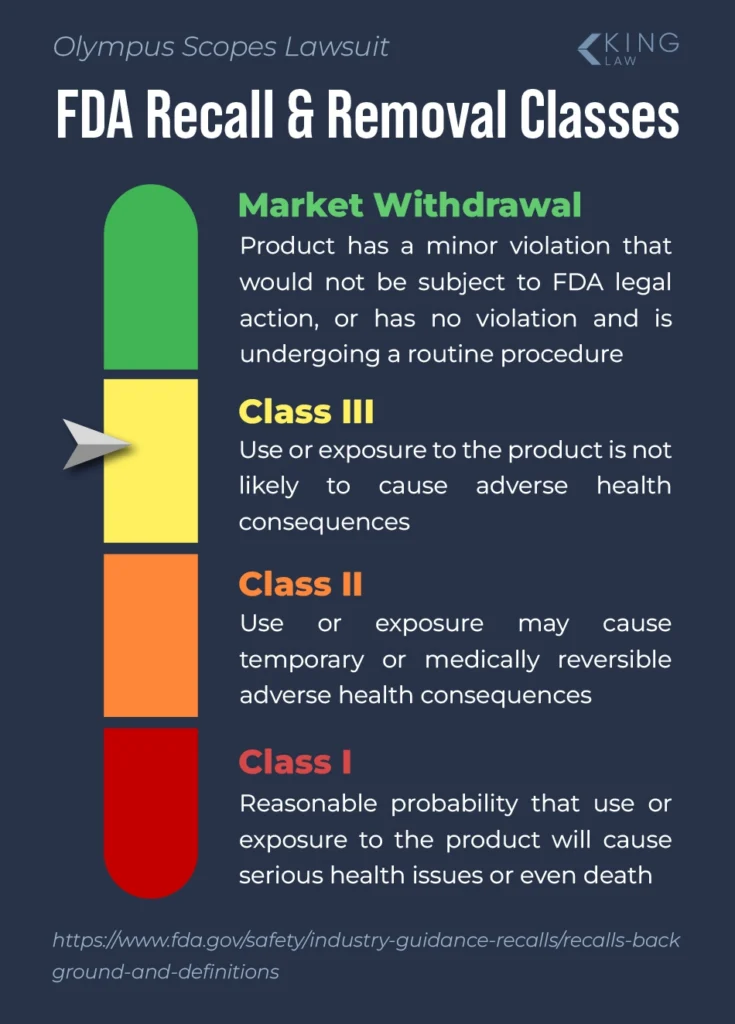
Olympus duodenoscope recalls are FDA-classified safety actions about contaminated and potentially defective endoscopes and associated accessories. Some of the Olympus duodenoscope recalls were labeled as Class II. A recall is classified as Class II when using the
Some of the recalls required medical providers to return the devices to Olympus so the company could replace some parts with potentially safer alternatives. For example, in one recall, providers were asked to return Olympus’s TJF-Q180V endoscopes to Olympus so a new elevator sealing channel mechanism could be installed.
In other recalls, Olympus issued new guidelines for reprocessing (i.e., disinfecting) duodenoscopes. However, most Olympus duodenoscope recalls did not involve removing the devices from the market entirely.
Why Were Olympus Duodenoscopes Recalled?
Some Olympus duodenoscopes were recalled because their design made them difficult to clean (reprocess). Those Olympus duodenoscopes were reusable, and the hospitals were responsible for properly cleaning the devices in between patient uses.
However, reports alleged that bacteria and patient debris were becoming trapped in the Olympus duodenoscope’s tiny pieces and channels, even when hospitals followed the manufacturer’s cleaning (i.e., reprocessing) guidelines. Some of these reports suggested that the way the duodenoscope was designed made it harder, or even impossible, for medical personnel to properly sterilize the devices.
Investigations suggested that the design of some Olympus duodenoscopes was defective, which could increase the likelihood of patient infections. For example, in 2013, the CDC informed the FDA that reusable duodenoscopes (including those manufactured by Olympus) were associated with multidrug-resistant bacterial infections.
The FDA required Olympus and two other duodenoscope manufacturers to participate in a post-marketing study, which was overseen by the FDA. In 2016, Olympus sent letters to many medical facilities that had purchased duodenoscopes, asking them to return the devices so Olympus could install a new,
What Are Duodenoscopes and What Are They Used For?
A duodenoscope is a flexible tube fitted with a camera that is inserted into the body to explore the upper part of the small intestine (i.e., the duodenum). A duodenoscope is typically used in a procedure called an ERCP (endoscopic retrograde cholangiopancreatography), which is done to diagnose and treat pancreatic and bile duct conditions. According to the FDA, about 500,000 ERCP procedures are done in the U.S. each year.
Which Olympus Duodenoscope Models Were Affected?
The Olympus duodenoscope models that were included in FDA recalls and safety notices included the following:
- Olympus Evis Exera III TJFQ190V Duodenovideoscope (August 2023 and June 2025)
- Olympus TJF-Q180V duodenoscope (December 2021)
- EVIS EXERA Duodenovideoscope Olympus TJF Type 160F/VF (May 2016)
- MAJ-2315 distal cover (February 2024)
Some older Olympus duodenoscope models contained fixed endcaps, which may have had a higher association with patient infections. Some newer Olympus duodenoscope models have disposable or removable parts, which may aid proper disinfection.
When Did the Major Olympus Duodenoscope Recalls Occur?
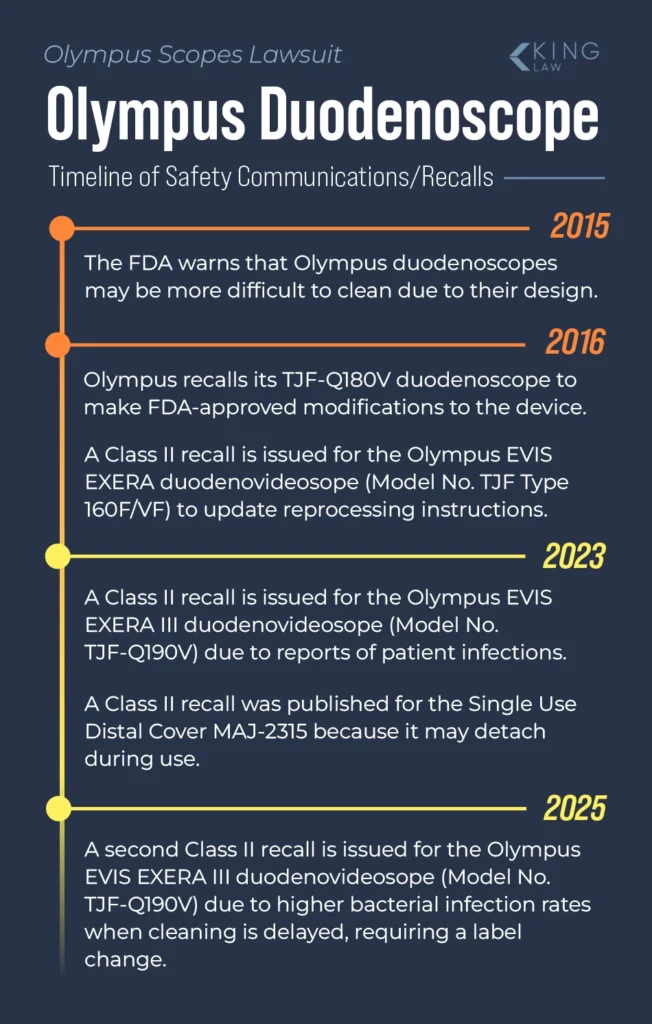
Here is a timeline with some of the major Olympus duodenoscope recalls:
- 2015: The FDA sent out a safety communication about Olympus duodenoscopes, warning people that how duodenoscopes are designed may make them harder to clean.
- 2016: Olympus duodenoscope model TJF-Q180V was recalled so Olympus could swap out the existing forceps elevator mechanism with an upgraded, sealed version.
- 2016: A Class II recall was announced for the Olympus EVIS EXERA Duodenovideoscope (Model No. TJF Type 160F/VF) to update disinfection and reprocessing instructions.
- 2023: A Class II recall was issued for the EVIS EXERA III Duodenovideoscope Olympus TJF-Q190V because of reports of patient infections.
- 2023: A Class II recall was published for the Single Use Distal Cover MAJ-2315 (used with EVIS EXERA Model TJF 160F-VF) because it may detach during use.
- 2025: A second Class II recall was issued for Olympus EVIS EXERA III Duodenovideoscopes (Model No. TJF-Q190V) because of higher rates of bacterial infection when cleaning was delayed by one hour, which required a label change.
The FDA is continuing to monitor the safety of Olympus duodenoscopes. Olympus may recall more duodenoscopes and accessories in the future.
What Infections Are Linked to Olympus Duodenoscopes?
Olympus duodenoscopes have been linked to several bacterial infections, including “superbugs” that were resistant to antibiotics. Some of the bacterial infections that may be associated with Olympus duodenoscopes are:
- Pseudomonas aeruginosa
- Escherichia coli (E. coli)
- Carbapenem-Resistant Enterobacteriaceae (CRE)
Some people who developed an infection had recently had an ERCP procedure performed using an Olympus duodenoscope. Patients with these severe, antibiotic-resistant infections may experience sepsis, hospitalization, or death. Some bacterial infection
How Many People Were Affected by Olympus Duodenoscope Infections?
Dozens of people were affected by Olympus duodenoscope infections. For example, in 2018, the Department of Justice announced that Olympus and its former CEO pleaded guilty to not informing the FDA about at least three overseas bacterial infection outbreaks involving Olympus duodenoscopes. About 25 patients were injured because of those outbreaks.
In 2025, Olympus indicated that at least 7 patient infection incidents involving its duodenoscopes had been reported between 2024 and October 2025. A U.S. Senate subcommittee report suggests that Olympus duodenoscopes may be linked to at least 19 outbreaks affecting about 250 patients. According to the report, the way the duodenoscopes are designed may cause bacteria to remain in the scope after being cleaned, which can spread the bacteria to other patients the device is used on.
Did Olympus Know About the Risks Before the Recalls?
Public reports and investigations suggest that Olympus was aware of the risks of infection and death before the recalls were issued, but failed to tell the FDA or hospitals. According to some reports, Olympus may have known that the way its duodenoscope was designed may have made it more likely for bacteria to survive on the device after reprocessing.
For example, the Department of Justice’s legal complaint alleges that Olympus’s internal 2012 report indicated that debris and bacteria could become trapped in the Q180V Olympus duodenoscope. The complaint alleges that the report also said that the Q180V model was associated with several outbreaks where patients suffered the same infection after they had a procedure performed with the same reprocessed scope.
The previous head of Olympus’ Quality Assurance and Environmental Division, which is responsible for reporting adverse events to the FDA, pled guilty to three of the charges brought against it in the Department of Justice’s lawsuit.
What Design Flaws Potentially Make Duodenoscopes Dangerous?
Some of the design flaws that may have made the Olympus duodenoscope more likely to have bacteria in it after cleaning include:
- Sealed elevator channel: Allows bacteria to enter and become trapped, and cannot be accessed during manual cleanings.
- Forceps elevator mechanism: The forceps elevator has tiny parts (such as hinges and channels) that are difficult to clean.
- Complex internal channels: These pathways were difficult for cleaning solutions and brushes to reach.
The crevices, hinges, channels, sealed chambers, and other tiny parts of duodenoscopes make it difficult, and in some cases nearly impossible, to completely disinfect them.
Are Olympus Duodenoscopes Still Being Used Today?
Olympus duodenoscopes are still being used in medical procedures today. However, some of the reusable parts have been replaced with disposable alternatives (such as single-use distal caps).
The FDA has encouraged Olympus and other duodenoscope manufacturers to transition to fully disposable duodenoscopes to lower infection rates due to reprocessing issues. That said, many Olympus duodenoscopes are still FDA-approved.
What Are the Current FDA Recommendations for Duodenoscopes?
The FDA and Olympus have recommended that providers who use duodenoscopes do the following:
- Transition to safer alternatives or single-use duodenoscopes
- Use 10x magnification when checking reprocessed duodenoscopes for bacteria
- Track the microbes found on reprocessed duodenoscopes to identify trends and outbreaks
- Begin cleaning the duodenoscope within 1 hour after it has been used
The above steps were developed after investigations showed that some duodenoscopes still had bacteria on them after being cleaned, leading to patient infections. The FDA and other stakeholders (such as Olympus and the CDC) may update their recommendations as they receive more information.
What Injuries and Complications Have Been Reported?
According to reports, injuries and complications that some patients may have experienced from defective duodenoscopes include:
- Severe infections, including antibiotic-resistant bacteria/superbugs
- Sepsis, which can be fatal
- Internal injuries from defective duodenoscope parts or accessories
- Death, related to infections
Duodenoscope-related complications can quickly develop into an urgent or life-threatening situation. Patients who experience symptoms of infection after a scoping procedure should immediately consult with a medical professional.
What Settlements or Legal Actions Have Occurred?
The Olympus duodenoscope lawsuits are in their early stages, but a few settlements have occurred, including:
- $85 million settlement (including $5 million in forfeiture) with the U.S. Department of Justice
- $6.6 million jury award to a hospital (some of the award was paid to victims)
Olympus duodenoscope lawsuits are ongoing, and some of those settlements may be kept confidential. As these lawsuits progress, individual patients could receive jury awards or settlements due to their injuries. However, it is important to note that Olympus continues to deny wrongdoing regarding the above settlements.
King Law Is Investigating Olympus Duodenoscope Recall Claims
King Law is actively investigating potential claims by patients and their family members who believe they were harmed by recalled Olympus duodenoscopes. We are closely tracking the Olympus scopes litigation, and we are ready to fight for people affected by contaminated scopes.
Some of the claims we are assessing include sepsis, infections, death, and other injuries that occurred after someone had a procedure done with an Olympus duodenoscope. Our law firm has vast experience fighting for people who were harmed by defective drugs and devices, and we are ready to fight for you.
Contact an Olympus Duodenoscope Lawyer Today
Contact King Law today by calling (585) 496-2648 or filling out an online form to schedule a free Olympus duodenoscope case evaluation. Our intake specialists are ready to take your call and guide you through the onboarding process. We take Olympus duodenoscope cases on contingency, so you do not have to pay upfront attorney’s fees to hire us.
Frequently Asked Questions (FAQs)
Some of the Olympus duodenoscope recalls involved patients experiencing infections, caused by bacteria that allegedly remained in the scopes, even after cleaning.
Some Olympus duodenoscopes were recalled because the way they were designed may have allowed bacteria to get trapped in the devices and infect other patients.
Some of the Olympus duodenoscope models that were recalled include Olympus Evis Exera III TJFQ190V Duodenovideoscope, Olympus TJF-Q180V duodenoscope, EVIS EXERA Duodenovideoscope TJF Type 160F/VF, and the MAJ-2315 distal cover.
Some of the Olympus duodenoscope recalls started in 2016.
Some defects that caused Olympus duodenoscope recalls included accessories or parts that were difficult or impossible to clean after use.
Yes. Some Olympus duodenoscopes were recalled due to infection risks.
Some of the infections that were linked to recalled Olympus duodenoscopes included Pseudomonas aeruginosa, E. coli, and Carbapenem-Resistant Enterobacteriaceae (CRE).
The FDA announced recalls for Olympus duodenoscopes. However, the recalls were initiated by Olympus, and those recalls occurred after discussions with the FDA.
A Class II recall for Olympus duodenoscopes may be issued if patients may experience “temporary or medically reversible harm” (e.g., from an infection) from the scope, or there is a remote probability of severe injuries or death.
Yes. Olympus recalled some of its duodenoscopes even after proper cleaning procedures were followed.
Some of the changes Olympus made after the duodenoscope recalls were issued included updating the cleaning instructions and swapping forceps elevator mechanisms.
Yes. Olympus duodenoscopes are still being used today.
Patients can talk to their doctors about the potential risks and benefits of procedures performed with Olympus duodenoscopes.
Some of the new Olympus duodenoscopes have disposable, removable, or sealed parts.
Yes. Some Olympus duodenoscopes have disposable parts that were created after the recalls.
One of the most recent Olympus duodenoscope recalls occurred in 2025.
Olympus had about an 85% market share of the duodenoscopes used in the United States. As a result, many people may have been affected by the Olympus duodenoscope recalls.
List of Sources Used in This Article
King Law uses stringent editorial standards when creating articles for this site. Here is a list of sources used to generate this article.
- Alexander, Lamar. “Letter to Karl Watanabe, President and Chief Financial Officer, Olympus Corporation of the Americas.” U.S. Senate Committee on Health, Education, Labor, and Pensions, 3 Apr. 2017.
- American Hospital Association. “Olympus Recalls Duodenoscope Model for Safety Modification.” AHA News, 15 Jan. 2016.
- Conti, Costantino B., et al. “Disposable Duodenoscopes: Evidence and Open Issues.” Life, vol. 13, no. 8, 2023.
- Olympus America Inc. “Urgent Medical Device Removal and Corrective Action: Elevator Mechanism Replacement, Updated Operation Manual, and New Reprocessing Instructions for the Olympus TJF-Q180V Duodenoscope.” 15 Jan. 2016.
- Olympus Corporation of the Americas. “Urgent: Medical Device Correction: Olympus Duodenoscopes.” 14 Oct. 2025.
- Terhune, Chad, and JoNel Aleccia. “Jury Orders Olympus to Pay $6.6 Million but Rejects Claims Its Medical Scopes Are Unsafe.” Los Angeles Times, 25 July 2017.
- U.S. Department of Justice. “Olympus Medical Systems Corporation, Former Senior Executive Plead Guilty to Distributing Endoscopes After Failing to File FDA-Required Adverse Event Reports of Serious Infections.” U.S. Department of Justice, 10 Dec. 2018.
- U.S. District Court for the District of New Jersey. “United States of America v. Olympus Medical Systems Corporation: Information.” U.S. Department of Justice, 2018.
- U.S. Food and Drug Administration. “Class 2 Device Recall Duodenovideoscope.” FDA, posted 5 June 2025.
- U.S. Food and Drug Administration. “Class 2 Device Recall EVIS EXERA Duodenovideoscope OLYMPUS TJF 160F/VF.” FDA, created 31 May 2016.
- U.S. Food and Drug Administration. “Class 2 Device Recall Olympus Olympus Single Use Distal Cover MAJ2315.” FDA, posted 9 Feb. 2024.
- U.S. Food and Drug Administration. “Class 2 Device Recall OLYMPUS TJFQ190V Duodenoscope.” FDA, updated 8 May 2026.
- U.S. Food and Drug Administration, Centers for Disease Control and Prevention, and American Society for Microbiology. “Duodenoscope Surveillance Sampling and Culturing Protocols.” FDA, Feb. 2018.
- U.S. Food and Drug Administration. “Infections Associated with Reprocessed Duodenoscopes.” FDA, updated 30 June 2022.
- U.S. Food and Drug Administration. “Recalls, Corrections and Removals (Devices).” FDA, updated 7 Mar. 2025.
- U.S. Food and Drug Administration. “The FDA Is Recommending Transition to Duodenoscopes with Innovative Designs to Enhance Safety: FDA Safety Communication.” FDA, 29 Aug. 2019.
- U.S. Senate Committee on Health, Education, Labor, and Pensions. “Preventable Tragedies: Superbugs and How Ineffective Monitoring of Medical Device Safety Fails Patients.” 13 Jan. 2016.