

Pensacola Shipyard Mesothelioma Lawsuit [2026 Update]
Complete the form below to see if you qualify for a Mesothelioma Lawsuit

The Pensacola Shipyard was a privately owned shipbuilding center located in Florida. It made and repaired shipping vessels for the military during World War I, World War II, and the mid-1900s.
During this time, asbestos was used in the Pensacola Shipyard, exposing some shipyard workers to airborne asbestos fibers. Exposure to asbestos at Pensacola Shipyard has caused some workers to develop mesothelioma. Those affected are suing the companies that made asbestos products used at the shipyard.
This page discusses how asbestos exposure may have occurred at the Pensacola Shipyard, which job positions were most at risk, and where asbestos may have been found. This article also provides useful information on who can file an asbestos claim involving the Pensacola Shipyard, what compensation may be available, and the steps to take to file a claim.
About the Pensacola Shipyard Mesothelioma Lawsuit
Pensacola Shipyard Asbestos and Mesothelioma Lawsuit Updates
About the Pensacola Shipyard and Asbestos Exposure
When Did the Pensacola Shipyard Contain Asbestos?
What Asbestos Materials Were Used at the Pensacola Shipyard?
How Were Pensacola Shipyard Workers Exposed to Asbestos?
Which Pensacola Shipyard Workers Had the Highest Rate of Exposure?
Who Can File a Pensacola Shipyard Mesothelioma Lawsuit?
What Proof Is Needed to File a Pensacola Shipyard Mesothelioma Lawsuit?
How Can I File a Pensacola Shipyard Mesothelioma Lawsuit?
How Long Does a Pensacola Shipyard Mesothelioma Case Take?
Is There a Deadline to File a Pensacola Shipyard Mesothelioma Lawsuit?
How Much Is a Pensacola Shipyard Mesothelioma Lawsuit Worth?
King Law Is Investigating Pensacola Shipyard Asbestos Claims
Pensacola Shipyard Asbestos and Mesothelioma Lawsuit Updates
The Pensacola Shipyard has a long history, and it reportedly relied on asbestos in some of its operations from the 1900s through to today. People who were involved with the Pensacola Shipyard may have encountered asbestos that caused them to develop mesothelioma. Lawsuits and trust fund claims are being filed by former Pensacola Shipyard workers and their loved ones, requesting compensation for their losses.
2026: Claims for mesothelioma related to asbestos exposure at Pensacola and other shipyards continue to be filed in state and federal courts. Plaintiffs with mesothelioma are filing civil, personal injury lawsuits and trust fund claims to compensate them for their losses related to the cancer.
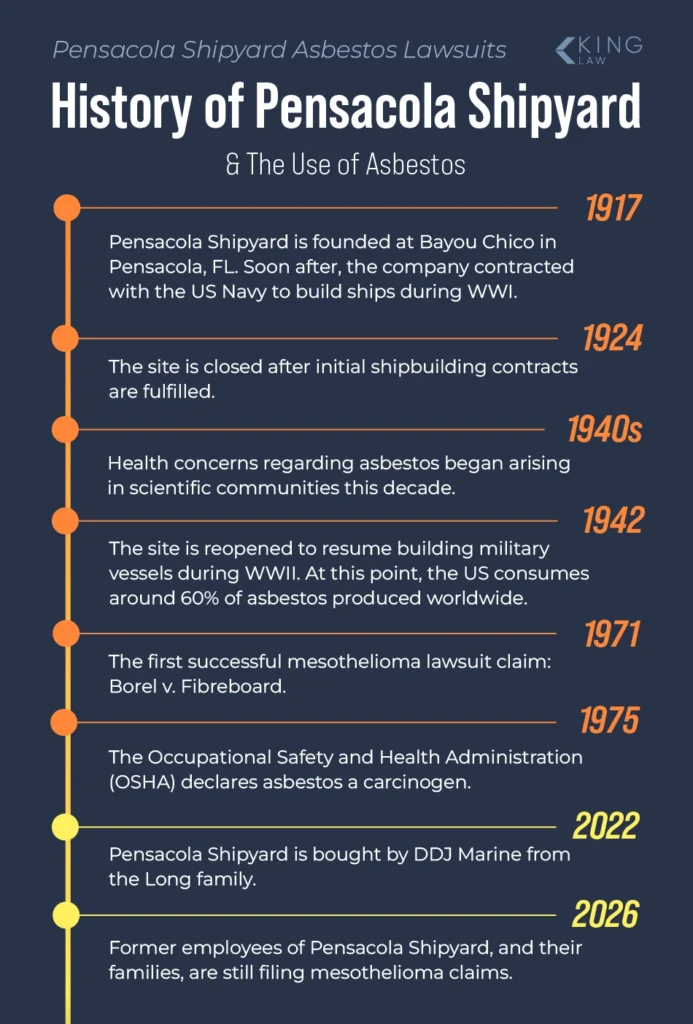
2022: Pensacola Shipyard is purchased by another private company, DDJ Marine, from the Long family. The Long family says they have owned and operated the shipyard for nearly 50 years.
1942: The Pensacola Shipyard was reopened when WWII began, and it resumed building military vessels and Liberty Ships for the US military.
1924: Shipbuilding at the Pensacola Shipyard stopped once the existing shipbuilding contracts were fulfilled, and the site was closed down.
1900s: The Pensacola Shipyard contracted with the U.S. military to build ships for World War I.
1917: Pensacola Shipyard was founded by John Merritt and Charlie Turner at Bayou Chico in Pensacola, Florida.
About the Pensacola Shipyard and Asbestos Exposure
As with most active shipyards that operated in the 1900s, asbestos was used at Pensacola Shipyard. Workers could have been exposed to asbestos while performing job duties throughout the shipyard.
The Pensacola Shipyard was established in 1917 and became a central figure in wartime shipbuilding and repair during World War I, World War II, and other conflicts. The Pensacola Shipyard was privately owned, but other organizations and the United States military contracted with it to build ships. The Pensacola Shipyard no longer builds ships, and it is now known as the Pensacola Marine Center. It is a cultural and historical landmark that serves its community in other ways.
During the time the Pensacola Shipyard built ships, asbestos was considered integral for fireproofing, insulation, and heat resistance on ships and shipyards. As such, asbestos may have been incorporated into many aspects of shipyard operations and vessels with the Pensacola Shipyard.
Asbestos was most likely part of the workers’ housing units on H and O streets, too, including in the insulation, ceiling tiles, gaskets, and other fixtures. People who worked at the Pensacola Shipyard on a full-time or contract basis may have been exposed to asbestos that caused them to develop mesothelioma years later.
Was NAS Pensacola Part of Pensacola Shipyard Asbestos Exposure?
Naval Air Station (NAS) Pensacola was not part of Pensacola Shipyard, even though both were connected to naval and other military operations. The Pensacola Navy Yard was built in 1826 and transitioned from ship-based to aviation operations in the 1910s. The NAS Pensacola, as it became known, was the United States’ first Navy aviation center and was pivotal during World War I, World War II, the Korean War, Vietnam, and other wars. The site is now home to several Naval training centers, aviation schools, a museum, and the Barrancas National Cemetery.
When Did the Pensacola Shipyard Contain Asbestos?
Asbestos may have been used at the Pensacola Shipyard from the company’s founding until it stopped shipbuilding. Asbestos was prized as a key material for insulation against heat and fire and was widely used in manufacturing and on ships. OSHA issued the first restrictions on workplace asbestos exposure in the 1970s. However, no broad federal ban was enacted that would have prevented the Pensacola Shipyard from using any asbestos products. As such, the Pensacola Shipyard may have continued to use or contain asbestos years later, and fibers could have been released during renovations, repairs, maintenance, and standard operations.
What Asbestos Materials Were Used at the Pensacola Shipyard?
Asbestos-based materials were used in repairing, building, and operating ships, and they were most likely at the Pensacola Shipyard. When Pensacola Shipyard was constructing ships, asbestos was commonly found in:
- Boiler and turbine components
- Corrugated asbestos cement sheets
- Gaskets
- Insulation found on bulkhead walls, hulls, floor tiles, steam lines, pipes (lagging), and ceiling panels
- Pumps
- Sand machinery casing
- Valves
As such, asbestos-containing materials could have released dangerous fibers when disturbed by workers and contractors, including those at the Pensacola Shipyard.
Asbestos Pipe Insulation
Asbestos-based pipe insulation was wrapped around steam lines, exhaust systems, and hot-water pipes on ships and in shipyard buildings. Asbestos fibers could be freed when the pipe insulation was cut, installed, removed, replaced, or worked on. Once disturbed, asbestos fibers could remain in the air in enclosed spaces, such as a ship’s boiler and engine rooms, and be breathed in by workers who entered those areas. Given the eras that the Pensacola Shipyard constructed ships, it is likely that asbestos pipe insulation was used.
Boilers, Turbines, and Engine Components
Boilers, turbines, pumps, and other engine components were commonly insulated with asbestos to help contain and withstand extreme heat. These components were central to ships and shipbuilding and may have been present at the Pensacola Shipyard. Boilermakers, mechanics, shipmates, engineers, and other workers may have encountered asbestos when operating, servicing, removing, or installing boilers, turbines, pumps, and related machinery.
Asbestos Gaskets, Valves, and Packing Materials
Asbestos-containing gaskets, valves, packing materials, and related components were also found on shipyards and ships during the time when the Pensacola Shipyard was making ships. Adding asbestos to these materials helped them contain and survive extreme heat. Workers who had to scrape, grind, install, operate, or work with these asbestos-containing gaskets, valves, and other materials would disturb and breathe in asbestos fibers.
Other Asbestos-Containing Materials
Other asbestos-containing materials on shipyards during the time when the Pensacola Shipyard was making vessels included spray-on fireproofing, asbestos-cement, ceiling tiles, floor tiles, bulkhead paneling, and electrical insulation. Workers could be exposed to these asbestos-containing products at the shipyard, on vessels, and in their living quarters.
Pensacola Shipyard workers could have breathed in asbestos from the materials they worked with directly. Or they could have breathed in fibers lingering in the workspace after another worker had interacted with asbestos-containing materials.
How Were Pensacola Shipyard Workers Exposed to Asbestos?
Pensacola Shipyard workers could have been exposed to asbestos by inhaling airborne fibers released when constructing or repairing ships, buildings, or machinery. Similarly, workers could have ingested asbestos that settled on food and drinks or
On-site demolitions or renovations could also have released asbestos fibers that circulated in the air on the ships. Because ships were poorly ventilated, asbestos fiber concentrations could build up over time and move through the ventilation system, unknowingly exposing even low-risk workers to asbestos. People who lived with someone who worked at Pensacola Shipyard may have also been exposed to asbestos fibers that were inadvertently taken home on the person’s work clothes.
Where on Ships Did Asbestos Exposure Happen Most Often?
Asbestos exposure could have occurred at several different locations at the Pensacola Shipyard, including:
- Areas under renovation
- Boiler rooms
- Electrical panels
- Engine rooms
- Insulation
- Machine shops
- Pipes chases
- Turbine compartments
Living quarters may have also contained asbestos-based products, such as ceiling tiles, flooring panels, paint, and insulation.
Which Pensacola Shipyard Workers Had the Highest Rate of Exposure?
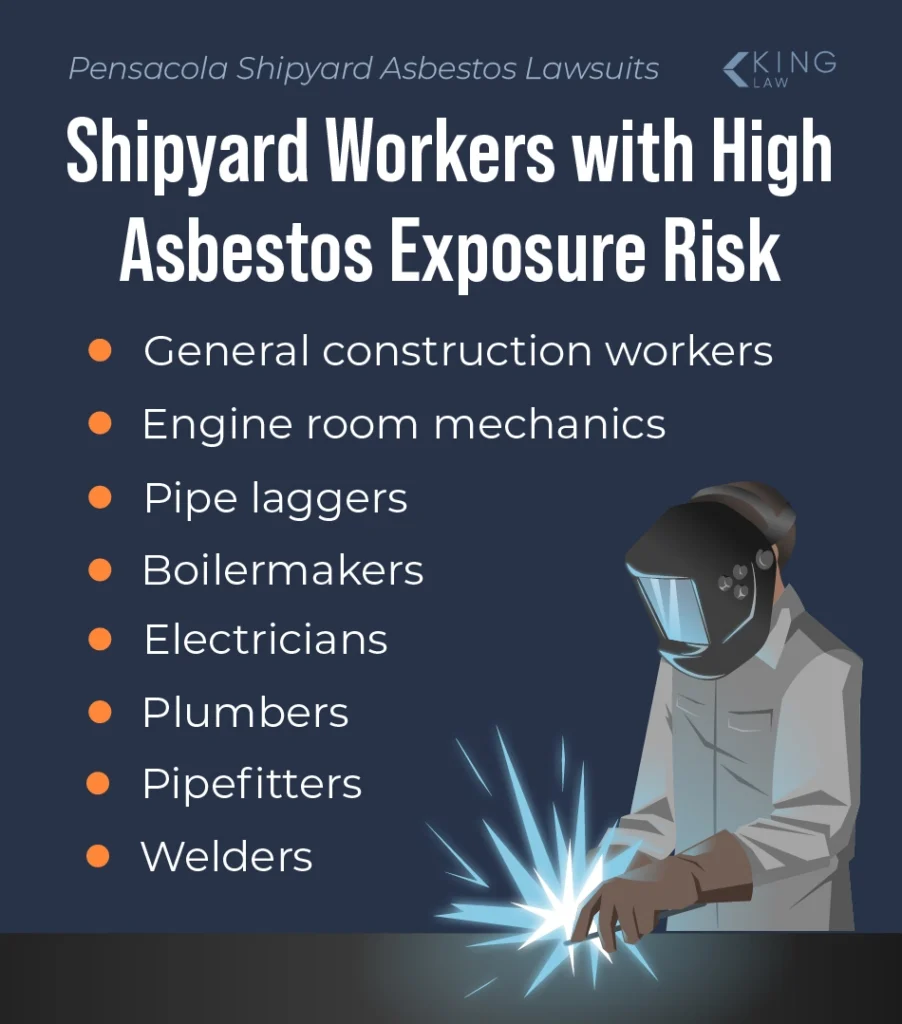
Everyone who worked at the Pensacola Shipyard may have been exposed to asbestos, especially if they worked at the shipyard during the mid-1900s. However, some professions carried a higher risk than others, including boilermakers, pipefitters, insulators, and electricians.
Some of the shipyard occupations at Pensacola that had historically high rates of asbestos exposure include:
- Boilermakers
- Electricians
- Engine room mechanics
- General construction workers
- Pipefitters
- Pipe laggers
- Plumbers
- Welders
Boilermakers and Engine Room Mechanics
Oftentimes, boilermakers and engine room mechanics worked in heavily-insulated and poorly-ventilated spaces, which may have exposed them to high concentrations of asbestos. Asbestos was frequently used in insulation around pipes, electrical gear, walls, gaskets, valves, and other components. As such, boilermakers and engine room mechanics at Pensacola Shipyard may have been at high risk of exposure to asbestos fibers.
Pipefitters, Welders, and Plumbers
Asbestos-based insulation was used on and around pipes, putting plumbers, pipefitters, and welders at risk of exposure to asbestos. Asbestos-containing or asbestos-lined piping (like Transite pipes) and pipe insulation may have been used at the Pensacola Shipyard. Pipefitters and plumbers may have disturbed asbestos fibers when cutting, fitting, removing, installing, and re-insulating pipes. They may have breathed in the asbestos dust in the air, and the dust may have also circulated in the working space on the ships made at the Pensacola Shipyard.
Insulators (Pipe Coverers and Pipe Laggers)
Asbestos-based insulation was widely used in shipbuilding during the 1900s, and anyone who worked directly with it was at risk of inhaling the harmful fibers. Insulators, pipe laggers, and pipe coverers would apply, cover, and remove asbestos-based insulation and pipe lagging. Pensacola Shipyard workers who applied, mixed, or removed insulation may have been exposed to asbestos.
Other Pensacola Shipyard Workers at High Risk
Other Pensacola Shipyard workers who could have encountered asbestos-based materials include:
- Carpenters
- Crane operators
- Electricians
- Laborers
- Machinists
- Machinist’s mates
- Maintenance workers
- Painters
- Riggers
- Sheet metal workers
- Shipfitters
- Shipwrights
Additionally, anyone who was called in to work at the Pensacola Shipyard as a contractor may have encountered asbestos-based products while working or surveying the sites. Renovators and demolition crews could have also disturbed asbestos fibers in the on-site materials at the Pensacola Shipyard or one of her ships, putting them at risk, too.
Who Can File a Pensacola Shipyard Mesothelioma Lawsuit?
Someone may be able to file a mesothelioma lawsuit if they worked at or for the Pensacola Shipyard and were diagnosed with mesothelioma. Someone may also be able to file a lawsuit if their loved one (e.g., father or spouse) used to work at the Pensacola Shipyard and died with mesothelioma. Mesothelioma patients who lived with someone who worked at the Pensacola Shipyard may also qualify for compensation if they can prove that take-home asbestos may be what made them sick.
Can Family Members File a Claim for Secondhand Asbestos Exposure?
Family members of someone who worked at the Pensacola Shipyard may be able to sue if they developed mesothelioma and can relate it to take-home asbestos. Some research studies have suggested an association between asbestos-related diseases and asbestos fibers that are brought home on someone’s hair, clothes, shoes, work gloves, or tools.
What Proof Is Needed to File a Pensacola Shipyard Mesothelioma Lawsuit?
In order to file a viable mesothelioma claim, you need to prove which companies were responsible for your asbestos exposure. Proof that you may need to prove your mesothelioma case includes the following:
- Records proving you worked at the Pensacola Shipyard
- Medical documents showing your mesothelioma diagnosis
- Evidence that your mesothelioma symptoms and diagnosis occurred after you worked at the Pensacola Shipyard
An experienced mesothelioma attorney can help you identify and gather needed evidence to connect your time at the Pensacola Shipyard to a later asbestos-related diagnosis. Mesothelioma attorneys have robust internal databases of asbestos exposure sources that they can cross-reference when investigating your case.
How Can I File a Pensacola Shipyard Mesothelioma Lawsuit?
Filing a Pensacola Shipyard mesothelioma lawsuit involves following these steps:
- Call a mesothelioma attorney and discuss your Pensacola Shipyard-related asbestos exposure.
- Partner with your attorney to gather evidence to show that your time at the Pensacola Shipyard exposed you to asbestos.
- Your legal team investigates what possible sources of asbestos you were exposed to when you were at the Pensacola Shipyard.
- Your attorney writes and files a legal complaint against the companies that made asbestos products used at the Pensacola Shipyard.
- Your mesothelioma legal team tries to settle your Pensacola Shipyard asbestos claim.
Reputable attorneys can help you navigate these steps during your Pensacola Shipyard mesothelioma case. They can file lawsuits, asbestos trust fund claims, and VA disability benefit claims on your behalf, including VA disability and survivor benefits for eligible veterans.
How Long Does a Pensacola Shipyard Mesothelioma Case Take?
The length of time it takes to resolve a Pensacola Shipyard mesothelioma case can vary. Some mesothelioma claims may take a year or more to resolve, while others may reach a settlement sooner. It depends on the complexity of the case, administrative obstacles, business status of liable companies, the type of claim (e.g., lawsuit versus asbestos trust fund claim), and other factors.
Is There a Deadline to File a Pensacola Shipyard Mesothelioma Lawsuit?
Under Florida law, Pensacola Shipyard mesothelioma lawsuits must be filed before the statute of limitations expires. In most cases, that timeframe is two years from a medical diagnosis. These filing deadlines are determined by each state’s law. However, your lawsuit may not be filed in Florida. Your attorney can advise on state filing deadlines for your specific mesothelioma claim.
The exact timeframes depend on the type of case being brought (e.g., wrongful death or personal injury), who is filing the claim, and other factors. Because the statute of limitations is fact-dependent, it is important for people to get accurate and timely legal advice from a qualified mesothelioma attorney.
How Much Is a Pensacola Shipyard Mesothelioma Lawsuit Worth?
The settlement values of Pensacola Shipyard mesothelioma lawsuits can vary widely. The final payout is determined by many variables, including the severity of the person’s injuries, the strength of their legal arguments, and the applicable compensation laws in that state.
Compensation packages for mesothelioma patients who were exposed to asbestos at the Pensacola Shipyard could include medical bills, lost income, pain and suffering, and related losses. People who lost a loved one to mesothelioma could also receive mesothelioma wrongful death damages, such as funeral and burial costs, loss of relationship, loss of support, and mental anguish.
King Law Is Investigating Pensacola Shipyard Asbestos Claims
King Law is accepting calls about asbestos exposure and mesothelioma claims connected to the Pensacola Shipyard. We have vast experience investigating and bringing mesothelioma claims against large organizations, and we have a wealth of resources and experts to help us craft effective legal cases for our clients. We are committed to holding asbestos product manufacturers accountable for not properly warning workers at the Pensacola Shipyard.
Contact a Pensacola Shipyard Asbestos Attorney Today
Mesothelioma patients are encouraged to call King Law if they believe their diagnosis is related to their time at the Pensacola Shipyard. Our office provides free, confidential consultations, and we take mesothelioma cases on a contingency basis (meaning there is no upfront legal fee for you). We can be reached by calling (585) 496-2648 or filling out an online contact form.