

Shipyard Mesothelioma Lawsuit for Asbestos Exposure Claims [2026 Update]
Complete the form below to see if you qualify for a Mesothelioma Lawsuit

Former shipyard workers, Navy veterans, and sailors face some of the highest rates of mesothelioma and other asbestos-related illnesses. Civilians and veterans who worked in the shipping and shipbuilding industries worked in areas where asbestos use was prevalent.
People who built and traveled in ships may develop mesothelioma decades later due to their asbestos exposure. Shipyard workers may be eligible to file a mesothelioma lawsuit or make a claim with an asbestos trust fund to recoup damages for their medical expenses and pain and suffering.
This page will discuss the high risks of asbestos-related illnesses faced by shipyard workers and the compensation options available to people who developed mesothelioma from their time in the shipping industry.
About the Shipyard Mesothelioma Lawsuit
Shipyard Mesothelioma and Asbestos Exposure Lawsuit Updates
Why Do Shipyard Workers Face a High Risk of Mesothelioma
How Was Asbestos Used in Shipyards
High-Risk Shipyards and Shipbuilding Centers Linked to Asbestos Exposure
Health Effects of Shipyard Asbestos Exposure
Who Can File a Shipyard Mesothelioma Lawsuit
Who Is Being Held Liable for Asbestos Exposure in Shipyards
Shipyard Asbestos Trust Funds and Compensation Options for Victims
How Can I Prove Asbestos Exposure in a Shipyard Mesothelioma Case
How Can I File a Shipyard Mesothelioma Lawsuit
How Long Do I Have to File a Shipyard Mesothelioma Lawsuit
Estimated Shipyard Asbestos and Mesothelioma Lawsuit Settlement Amounts
King Law Is Investigating Shipyard Asbestos and Mesothelioma Claims
Shipyard Mesothelioma and Asbestos Exposure Lawsuit Updates
September 8, 2025 – Richard D. Long v. 3M Company et al. – A Portland jury holds John Crane Inc. liable for $34.2 million. Shipyard worker Richard Long developed mesothelioma after working with asbestos-laden gaskets sold by John Crane.
August 13, 2021 – Woodruff v. Port of Tacoma – A jury awards a Tacoma man who dismantled World War II-era ships in the 70s $11.2 million. Zidell Dismantling was held liable for Dennis Woodruff’s mesothelioma.
May 2020 – Nearly a decade after she first submitted it, Navy veteran Myra Harwood’s disability claim was approved by the VA. Harwood contracted peritoneal (abdominal) mesothelioma after serving on a tugboat in Pearl Harbor, HI. The approval was backdated to 2011. The VA had rejected her claim due to her lungs showing no signs of mesothelioma.
January 10, 2013 – Exxon Mobil Corporation v. Minton – The Supreme Court of Virginia renders an oft-cited decision on the appeal of the Exxon Mobil v. Minton jury verdict. The Supreme Court of Virginia ruled that there was sufficient evidence to establish a duty of active control and intervention under the Scindia standard. However, it also ruled that the punitive damages awarded by the lower court were invalid.
September 14, 2012 – John Crane, Inc. v. Hardick – The Supreme Court of Virginia rules that pre-death pain and suffering damages are allowed under maritime law, but loss of society was not applicable for deaths in state waters, limiting damages under the Death on the High Seas Act (DOHSA). Robert Hardick developed mesothelioma after serving on Navy vessels. A lower court awarded his estate wrongful death damages.
November 8, 1984 – A group of Portsmouth, NH, shipyard workers successfully reaches a $3 million settlement for their asbestos-related illnesses. The settlement represents an early example of successful consolidated asbestos claims.
Why Do Shipyard Workers Face a High Risk of Mesothelioma
Shipyard workers face a high risk of developing mesothelioma due to the high amount of asbestos used in 20th-century Navy and commercial shipyards. Asbestos was used in the construction of ships, putting builders, sailors, and maintenance crews at risk of asbestos-related disease.
Frequent asbestos exposure led to asbestos-related illnesses decades later for many of the skilled tradesmen and women who worked at shipyards. Although the use of asbestos in new construction decreased in the 1980s, asbestos-containing structures and vessels from that era continue to pose a risk even to this day.
This history forms the basis of today’s shipyard mesothelioma lawsuits and claims.
How Was Asbestos Used in Shipyards
A mid-century shipyard worker or Navy veteran was surrounded by asbestos in their daily life. Asbestos, the name for six naturally occurring silicate minerals, was very common in shipyards. Most workers who worked in shipyards between the 1930s and 1980s came in contact with asbestos.
Components like gaskets, pipes, and turbines were coated in asbestos. Hulls, bulkheads, and even deck tiles and paints were also commonly infused, coated, or wrapped with asbestos, with many Navy vessels containing dozens to even hundreds of tons of the substance. Asbestos was even used in some fabrics like clothing and bedding.
At the time, asbestos was seen as a cheap way to fireproof and strengthen materials at scale.
Places Where Asbestos Could be Found on Ships and in Shipyards
Because asbestos is an excellent insulator and fire-resistant, it was used throughout most of the components of the ship. Many workers on these sites had little to no personal protective equipment. Here are some of the places asbestos was used on ships:
- Asbestos cement
- Ceiling tiles
- Block insulation
- Boilers
- Cement
- Fireproof blankets & welding curtains
- Decking
- Electrical wires
- Engine rooms
- Floor tiles
- Gaskets
- Insulation on bulkheads, pipes, ceilings, floors, and cables
- Metal sheeting
- Packing materials
- Paint
- Pipe coverings
- Pump and propulsion rooms
- Turbines
People who built ships may have been at a higher risk of asbestos exposure because they were disturbing asbestos-containing products during construction, repair, and demolition. Asbestos was present in most ships built during the mid-20th century, including on cargo ships, container ships, destroyers, submarines, aircraft carriers, tankers, and liberty ships.
Which Shipyard Jobs and Work Areas Had the Heaviest Asbestos Exposure
Although proximity to asbestos does increase the risk of developing an asbestos-related illness, some shipyard jobs came with a greater risk of exposure. Shipyard workers who worked in engine rooms or other closed spaces were likely exposed to greater quantities of asbestos.
When stable, asbestos is not easily inhaled or ingested. However, when the fibrous crystals are disturbed, they can dislodge and become airborne. Once airborne, they can enter the body and embed in sensitive tissues, like the lungs. For this reason, jobs that are more likely to disturb asbestos come with higher risks.
Shipyard jobs with elevated risks of asbestos exposure include:
- Boiler technicians
- Electricians
- Engineers
- Laggers/insulators
- Machinists
- Pipefitters
- Repairmen and maintenance crews
- Scaffolders
- Ship dismantlers
- Welders
Although some jobs exposed people to higher amounts of asbestos, anyone who worked in a shipyard risked exposure. General maintenance workers, transporters, and clerical workers were all possibly exposed to asbestos from shipyards.
Does Evidence Show That Shipyards Drove a Mesothelioma Epidemic
The link between shipyard work and mesothelioma is well-established, presenting some of the highest rates of asbestos-related illnesses of any cohort. Some epidemiological findings include:
- Substantially
higher asbestos fiber burdens in shipyard workers in Italy. - Japanese laggers had a 275% higher rate of mortality from lung cancer.
- A study of shipyard workers and their families found
radiographic signs of asbestosis in 64% of the male workers 20 years later.
Due to the long latency of asbestos-related diseases, former shipyard workers are still presenting with mesothelioma symptoms to this day. Many shipyard workers do not show signs of mesothelioma until several decades after asbestos exposure.
High-Risk Shipyards and Shipbuilding Centers Linked to Asbestos Exposure
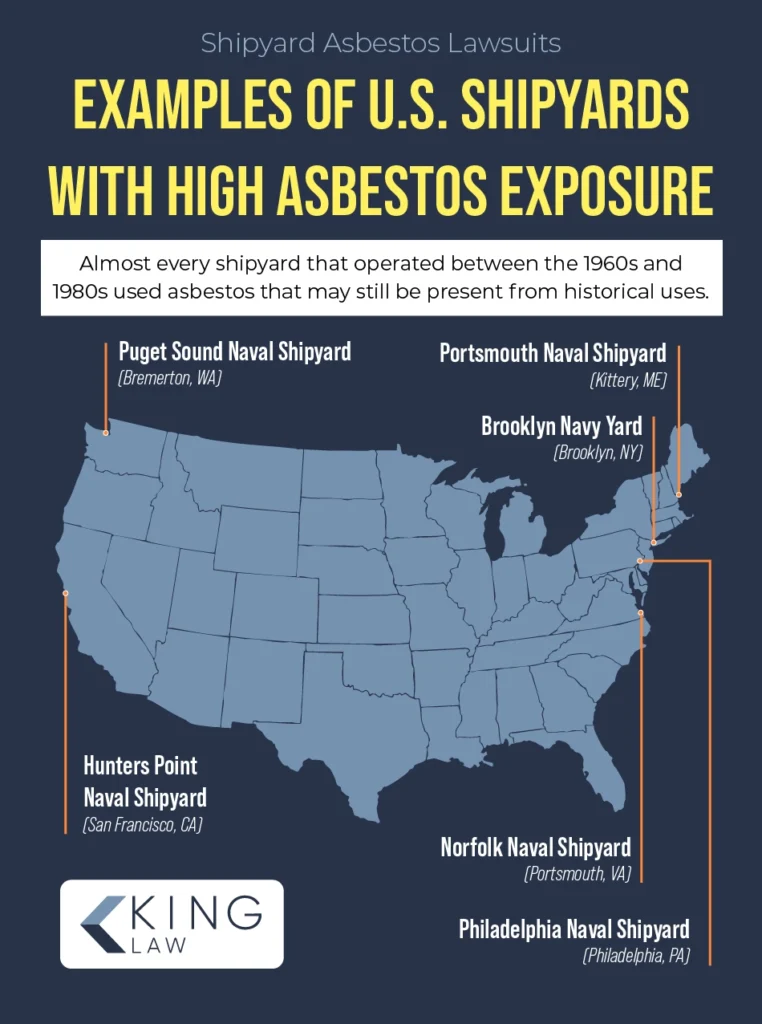
Nearly every shipyard in the U.S. that operated in the mid-20th century handled asbestos. However, certain large yards have been associated with particularly high incidences of asbestos exposure.
These shipyards and their workers often serviced large Navy or commercial ships that contained large amounts of asbestos. These ships often needed frequent repairs and upgrades. Additionally, during wartime, U.S. shipyards made thousands of ships.
For example, between 1939 and 1945, the US built 40 million gross tons of merchant cargo-carrying ships. During World War II, 3,600 cargo ships, more than 700 tankers, and more than 1,300 naval vessels were produced at U.S. shipyards.
Major U.S. Naval Shipyards with Heavy Asbestos Use
Though all shipyards that were in operation before 1980 pose some risk of asbestos exposure, these large Naval shipyards have exposed tens of thousands of veterans, civilian workers, and sailors to asbestos. The Navy mandated the use of asbestos in shipbuilding during the World Wars.
- Brooklyn Navy Yard, NY: Though it dates back to the early 1800s, the Brooklyn Navy Yard saw extensive reconstruction before the U.S. entered World War II, where it was the site of construction for three battleships, two aircraft carriers, and numerous barges and smaller ships, employing over 70,000 at its wartime peak. The site was retired as a military operation in 1966.
- Hunters Point Naval Shipyard, CA: This shipyard was another 19th-century Naval yard that saw extensive retrofitting prior to World War II, becoming a key facility on the West Coast. It was closed in 1994.
- Norfolk Naval Shipyard, VA: This shipyard is one of the oldest and largest of the Navy’s facilities and dates back to the late 18th century. It underwent major expansions during World War I and again during World War II and remains in operation to this day.
- Puget Sound Naval Shipyard, WA: Washington’s Puget Sound Naval Shipyard saw extensive use in submarine construction during World War I and as a major repair facility during World War II. It remains in operation.
- Philadelphia Naval Shipyard, PA: Peaking at over 40,000 workers during World War II, the Philadelphia Naval Shipyard ceased military operations in the 1990s, but continues smaller-scale operations as a commercial shipyard.
- Portsmouth Naval Shipyard, ME: As the Navy’s oldest, continuously operating shipyard, it saw extensive use in submarine construction during the World Wars. It continues to serve as a Navy shipyard specializing in the repair and modernization of submarines.
Many ships were also constructed and repaired at Boston Naval Shipyard, Long Beach Naval Shipyard, Mare Island Naval Shipyard, and Charleston Naval Shipyard.
Many veterans were exposed to asbestos at Navy facilities, including those who served in the Navy, Air Force, Marines, and Coast Guard. In turn, many veterans have filed lawsuits against asbestos companies.
Private and Commercial Shipyards That Used Asbestos
Private shipyards also commonly handled asbestos, servicing Navy, as well as commercial vessels during the mid-20th century. These shipyards used many of the same products as military installations and have also exposed workers to asbestos. These sites include:
- Avondale Shipyards, LA
- Bethlehem Steel Shipyards (Various locations)
- Ingalls Shipbuilding, MS
- Newport New Shipbuilding, VA
- Pensacola Shipyard, FL
- Todd Shipyards (Various locations)
Almost all private shipyards used asbestos from the 1930s until the 1980s.
Maritime Workers and Seamen Exposed On Asbestos-Lined Ships
Almost all military bases used asbestos at the height of asbestos use in the U.S. The risks of asbestos exposure are not limited to shipyards. Mid-20th-century ships contained massive amounts of asbestos, exposing sailors and maintenance crews while at sea. Particularly at risk are boiler operators and staff who work within the superstructure of ships, as well as crewmen participating in in-port overhauls and dry-dock repairs.
Pleural Plaques and Other Cancers
It’s important to note that asbestos fibers can travel and cause damage slowly over time. Asbestos fibers can shed over time during normal operations, travel on clothing, or accumulate in tissue over time. For this reason, Navy and Coast Guard personnel who did not work in a land-based shipyard or in a high-risk position on a vessel may still qualify for a lawsuit or VA disability benefits.
Health Effects of Shipyard Asbestos Exposure
Shipyard workers who inhale or ingest asbestos fibers run the risk of slowly developing serious medical conditions. The fibers, not easily expelled from sensitive tissue, like the lining of the lungs, can cause scarring and thickening over time.
These changes in organ linings can lead to diseases, like asbestosis or cancer. Even relatively short, intense bouts of exposure can lead to asbestos-related diseases, though the risks are likely higher with regular exposure over extended periods of time.
Because the damage caused by these fibers takes a long time to develop, patients often present with symptoms decades after asbestos exposure.
Mesothelioma and Its Long Latency Period
Mesothelioma is known for its very long disease latency, often not presenting with symptoms like chest pain, fluid build-up, and weight loss until 20 to 50 years after exposure. One large study put the latency period for pleural mesothelioma between 33 and 40 years. Unfortunately, by the time the disease is detected, it carries a poor prognosis. For this reason, financial compensation is often critical for the families of people who develop mesothelioma.
Mesothelioma is a form of cancer rarely seen outside of asbestos exposure. When people refer to mesothelioma, they typically mean pleural mesothelioma, which affects the lining of the lungs. However, asbestos can in rare cases also affect the mesothelium, or lining, of other organs.
Other Asbestos Diseases Seen in Shipyard Workers
The damage caused by asbestos may present as other types of diseases as well. These include:
- Asbestosis: Characterized by scarring and decreased lung capacity.
- Asbestos-related lung cancer: asbestos exposure raises the risk of other types of lung cancer as well.
- Pleural thickening/pleural plaques/pleural effusions: Often a symptom of asbestos damage.
- COPD: A progressive disease characterized by airflow limitation.
Although many of these diseases are not malignant, they can cause severe quality-of-life disruptions. Additionally, conditions such as asbestosis raise the risk of developing malignancies, such as mesothelioma.
Family Members and Second-hand Asbestos Exposure
Family members of shipyard workers also face an elevated risk of asbestos exposure. Asbestos fibers can lodge in clothing and travel home with workers, where they can later be inhaled by family members. Family members of shipyard workers who develop mesothelioma or another asbestos-related disease may also be eligible to file a claim.
Who Can File a Shipyard Mesothelioma Lawsuit
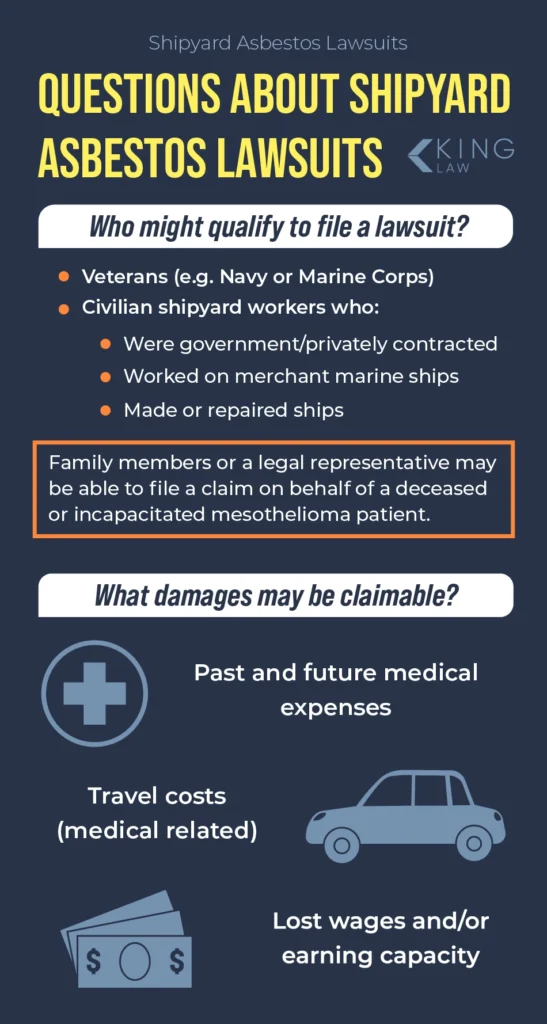
Here are some of the people who can file a lawsuit related to asbestos exposure in a shipyard:
- Navy veterans
- Civilian shipyard workers who were government contractors
- Civilian shipyard workers (e.g., general workers, dock workers, engineers, maintenance crews) who worked on merchant marine ships
- Civilians who made and repaired ships for other commercial shipping purposes
If you spent time in a shipyard and later developed mesothelioma, it is likely that occupational asbestos exposure is the cause of your disease. Our partners at King Law will work with you to determine the asbestos products that were responsible for your asbestos exposure. We will then work to file claims against the companies that made those products.
Family members of shipyard workers with mesothelioma may also file a claim on behalf of the mesothelioma patient. If a former shipyard worker succumbed to mesothelioma, their surviving family members may be able to file an asbestos wrongful death claim on their behalf.
Who Is Being Held Liable for Asbestos Exposure in Shipyards
While military and commercial shipyards are common sites of exposure, mesothelioma lawsuits are typically aimed at the asbestos manufacturers and suppliers of asbestos-containing products. Claims are not typically filed against the Navy or federal government. Many of the companies that made products like pipe insulation, gaskets, and packing sprays were aware of the risks of asbestos long before they stopped using them in their products. This negligence forms the basis of mesothelioma lawsuits and claims.
Major Asbestos Product Manufacturers Used in Shipyards
Major asbestos product manufacturers often supplied shipyards in the 20th century. Many of these companies were aware of the risks of asbestos, but failed to adequately warn workers. Here are some of those companies:
- Johns-Manville
- Keene Corp.
- National Gypsum
- Owens-Corning
- Pittsburgh Corning
- USG
Boiler, Turbine, and Equipment Manufacturers
Equipment manufacturers often used asbestos to strengthen, insulate, or fireproof their products. These products often shed asbestos fibers, putting boilermakers, machinists, and mechanics at risk when servicing or utilizing these products. Like the asbestos product manufacturers, these equipment manufacturers were also aware of the risks and failed to adequately warn workers:
- Babcock & Wilcox
- Cleaver-Brooks
- Foster Wheeler
- Aurora Pump Co.
- Flowserve
- Raybestos-Manhattan
Shipyard Owners, Contractors, and Premises Liability
Though rarer, in some cases the owners or operators of the sites themselves may be liable depending on the jurisdiction and the worker’s employment status. Shipyard owners or contractors may be liable in cases where they failed to provide a safe workplace despite being aware of the hazards. For example, failing to provide respirators, failing to provide adequate ventilation, or failing to warn workers of known risks. Lawsuits filed against these entities typically involve more-recent asbestos exposure, not historical asbestos exposure.
Shipyard Asbestos Trust Funds and Compensation Options for Victims
Not all shipyard asbestos claims result in a lawsuit. Some mesothelioma claims are resolved with an asbestos trust fund claim. Some of the companies that made asbestos products are no longer in business or have been acquired by other companies.
Some companies entered bankruptcy due to their asbestos liabilities and, as part of that process, have established an asbestos trust fund to pay out future claims. A shipyard mesothelioma claim may involve both lawsuits against solvent defendants (companies that have not filed for bankruptcy) and trust fund claims against bankrupt companies, depending on the parties responsible for the exposure.
Types of Compensation Available
Shipyard mesothelioma settlements and verdicts may award both economic and non-economic damages. Victims may be compensated for:
- Past and future medical expenses
- Travel costs for treatments
- Lost wages or earning capacity
- Pain and suffering
- Loss of companionship and funeral costs (wrongful death claims)
How Asbestos Trust Claims Work for Shipyard Workers
Once you and your attorney have identified the products responsible for your asbestos exposure at a shipyard, you may learn that the product’s manufacturer has an asbestos trust fund. These funds typically have a claims process that involves submitting work records or ship assignments, along with supporting evidence, like co-worker affidavits. You will also need to provide a qualifying medical diagnosis.
Note that it is possible to make claims with multiple trust funds if more than one bankrupt company was responsible for your exposure.
Veterans Benefits Plus Civil Claims
While Navy veterans cannot sue the government for their exposure, they can file a VA asbestos disability claim. Determinations are made based on the severity of your disease and the occupation in which you served while enlisted. These claims are separate from any lawsuit or trust claims you pursue, but a mesothelioma lawyer can help you coordinate each of these processes.
How Can I Prove Asbestos Exposure in a Shipyard Mesothelioma Case
Asbestos exposure claims tend to be very complex, but an experienced law firm can help you build a strong case and maximize your compensation. While it may be difficult to remember the exact circumstances of your exposure from decades earlier, your lawyer can access product and exposure databases to help you identify the responsible parties. A strong case has several important components.
Work History, Shipyard Records, and Ship Assignments
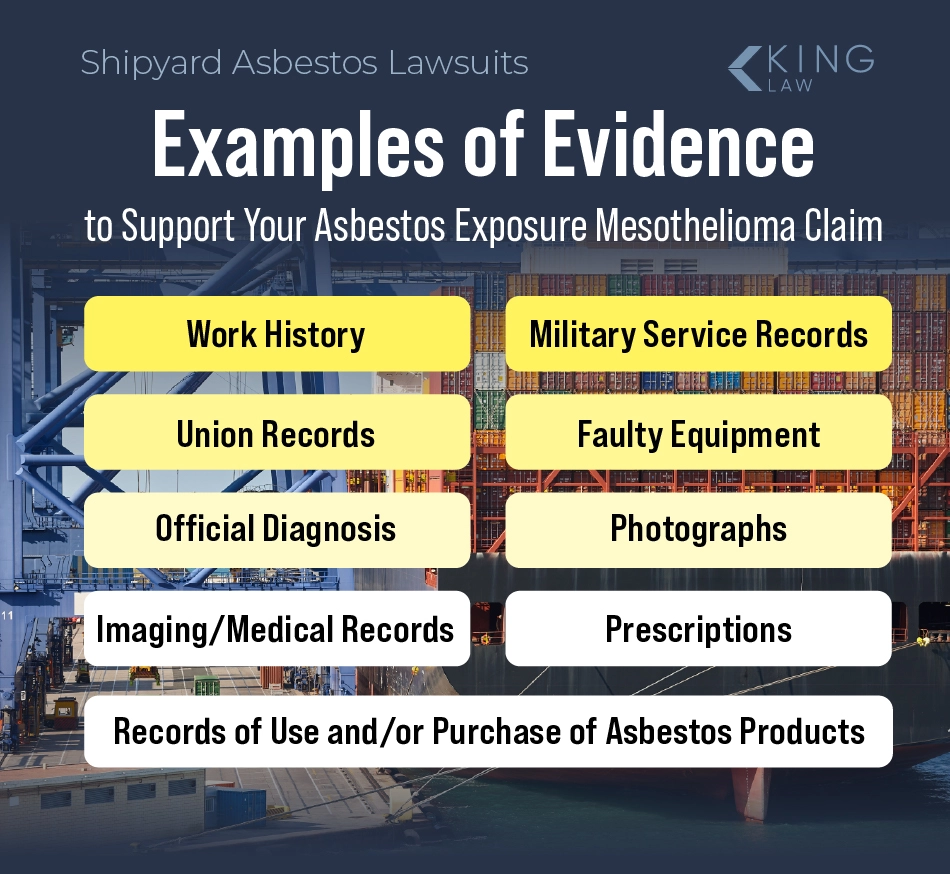
Establishing your presence at the shipyard or on a shipping vessel is an important foundation for your case. Knowing the specific yard and time period you were exposed can help your lawyer narrow down the list of products you may have been exposed to. Supporting documents include:
- Work history
- Union records
- Service records
- Ship logs
- Shipyard blueprints
- Master repair logs
- Naval technical manuals
You do not have to personally be in possession of each of these items. An experienced attorney can help track down these materials.
Product Identification and Historical Evidence
Product identification is critical for finding defendants and/or trust funds. Historical evidence like old purchase orders, depositions, previous lawsuits, and exposure databases, can all be employed to make this determination. This allows your case to move forward even if you don’t recall the exact products you used on the job.
Medical Records and Expert Testimony
To be eligible for a claim in the first place, you’ll need to show that you have a qualifying medical condition like mesothelioma. Evidence like medical records, imaging, and pharmacy records can help build a link between your condition and asbestos exposure.
Note that, in the case of mesothelioma, asbestos exposure is the leading cause of the disease, so there’s less of a need to establish a link. Instead, you will mainly need to provide evidence that you have a mesothelioma diagnosis and were exposed through certain job tasks.
How Can I File a Shipyard Mesothelioma Lawsuit
Filing a shipyard mesothelioma lawsuit is a complex process best undertaken with the help of an experienced attorney. If you have received a mesothelioma diagnosis, you’ll want to quickly follow these steps:
- Consult a Mesothelioma Attorney – Schedule a free consultation with an experienced law firm like King Law.
- Gather Evidence – Collect medical and work records to strengthen your case.
- Identify Asbestos Exposure Sources – Using the records you provided, your attorney will help you identify the products you were exposed to.
- File Your Claim – Lawsuits may target asbestos product manufacturers, contractors, or responsible entities.
- Pursue Settlement Or Go To Trial – Your legal team will pursue compensation through settlement or trial.
How Long Do I Have to File a Shipyard Mesothelioma Lawsuit
Mesothelioma lawsuits, including those involving shipyard or at-sea exposure, need to be filed within the statute of limitations. Statutes of limitation vary from state-to-state and may also vary depending on whether you’re filing a personal injury or wrongful death case. Consult with your attorney to determine what deadlines apply to your case.
Due to the long disease latency of mesothelioma, the statute of limitations for personal injury cases typically starts from the date of diagnosis rather than the date of exposure. The statute of limitations for wrongful death cases typically begins from the time of death.
Estimated Shipyard Asbestos and Mesothelioma Lawsuit Settlement Amounts
Settlements for shipyard mesothelioma cases can vary greatly depending on the severity of disease and the strength of the evidence. King Law estimates a typical settlement will range between $250,000 to $1 million or more per claimant. However, each case is unique, and compensation will depend on a number of individual factors, such as the number of companies involved in the patient’s exposure.
King Law Is Investigating Shipyard Asbestos and Mesothelioma Claims
King Law is currently reviewing asbestos exposure claims for former shipyard workers, sailors, and their families. King Law’s attorneys have decades of experience identifying asbestos product exposures and holding companies accountable for their negligence. We can help you maximize your compensation, whether you’re filing a lawsuit, an asbestos trust fund claim, or a VA disability claim.
Contact a Shipyard Asbestos and Mesothelioma Lawyer Today
If you’ve recently received a mesothelioma diagnosis or have lost a family member to mesothelioma, contact King Law today for a free, no-obligation case evaluation through this site or by calling (585) 496-2648. We understand how to build a strong case against all of the companies responsible for asbestos exposure. Our team helps people recover the best compensation possible.