

Niagara Mohawk Asbestos Lawsuit for Mesothelioma Claims [2026 Update]
Complete the form below to see if you qualify for a Mesothelioma Lawsuit

Some people who worked at Niagara Mohawk’s power-generating facilities in New York were exposed to asbestos. This asbestos exposure caused some workers to develop mesothelioma later in life. As a result, those workers and their families are filing lawsuits against the companies that made asbestos-based products used at Niagara Mohawk’s Power Corporation power plants.
On this page, you will learn about how asbestos was used at Niagara Mohawk’s power plants, which facilities had asbestos in them, and how workers were exposed to asbestos. We also discuss the health risks associated with asbestos use at Niagara Mohawk, who can file a lawsuit or asbestos trust fund claim, and what forms of compensation are available. Lastly, we provide instructions for filing a claim and answer frequently asked questions about the Niagara Mohawk asbestos lawsuit.
About the Niagara Mohawk Asbestos and Mesothelioma Lawsuit:
About Niagara Mohawk Power Plant and Its History of Asbestos Use
Historical Timeline of Asbestos Use at Niagara Mohawk Power Plant
Which Niagara Mohawk Power Plant Had Asbestos Exposure?
Which Niagara Mohawk Power Plant Employees Were at the Highest Risk for Asbestos Exposure?
How Were Niagara Mohawk Power Plant Workers Exposed to Asbestos?
Health Risks Linked to Asbestos Exposure From Working at Niagara Mohawk Power Plants
Who Can File a Niagara Mohawk Power Plant Asbestos and Mesothelioma Lawsuit?
What Are the Recoverable Damages in a Niagara Mohawk Asbestos Lawsuit?
How Can I File a Niagara Mohawk Asbestos and Mesothelioma Lawsuit?
Is There a Deadline to File a Niagara Mohawk Asbestos and Mesothelioma Lawsuit?
Estimated Niagara Mohawk Asbestos Lawsuit Settlements and Payouts
Is There a Niagara Mohawk Asbestos Trust?
King Law Is Accepting Niagara Mohawk Asbestos and Mesothelioma Claims
Contact a Niagara Mohawk Asbestos and Mesothelioma Lawyer Today
About Niagara Mohawk Power Plant and Its History of Asbestos Use
Like many utility companies during the 20th century, Niagara Mohawk relied on asbestos products. These products were made by asbestos product manufacturers. Historically, lawsuits allege that these manufacturers did not provide adequate warning about the dangers of asbestos exposure, putting workers at Niagara Mohawk facilities at risk.
Niagara Mohawk Power Corporation was formed when 59 different utility and power companies were consolidated into one operation. This process began in the early 1900s and continued until 1950, when Niagara Mohawk Power Corporation was formed.
Some of these companies were founded in the 1800s. Some predecessors used Niagara Falls as a power source (hydroelectric power) to provide electricity to Buffalo, New York, and surrounding areas. Niagara Mohawk and its successors expanded to incorporate coal-fired, oil-fired, and nuclear power generation stations as a means to generate electricity.
Asbestos was used in Niagara Mohawk’s operations because it could withstand high heat and was an effective fire-proofing and insulating agent. Asbestos was sometimes present in machinery, including boilers, turbines, pumps, valves, and steam lines.
Additionally, asbestos was used in the physical buildings (e.g., ceiling tiles, flooring, walls, and pipes), as well as the equipment used by the workers. For example, nuclear power plant workers at Niagara Mohawk may have worn protective aprons and gloves containing asbestos, which insulated them against heat and fire.
Workers could have been exposed to asbestos through machinery and buildings, especially during installation, maintenance, repairs, and shutdowns.
Historical Timeline of Asbestos Use at Niagara Mohawk Power Plant
The exact dates when Niagara Mohawk began and ended using asbestos are unknown. However, it is known that Niagara Mohawk, like other power-generating facilities, relied on asbestos to protect workers from and control the unwanted spread of heat and fire. Asbestos was frequently used in power-generating facilities built in the mid- and late- 20th century.
For example, the Charles R. Huntley (in Tonawanda, New York) and Dunkirk (in Dunkirk, NY) coal-fired complexes were built in the 1910s through 1950s and used asbestos in the insulation around the pipes and in the walls. Likewise, nuclear power plants Nine Mile Point and FitzPatrick (in the Oswego, New York area) were built in the 1950s through the 1970s. These plants incorporated asbestos into their insulation, workers’ personal protective gear, and turbines.
In the 1970s,
Niagara Mohawk eventually began to use safer alternatives to asbestos, such as Fiberfrax. In the early 2000s, Niagara Mohawk was acquired by National Grid. Similarly, in the early 2000s, the company sold some of its nuclear plants to Constellation Energy (Exelon) and Entergy.
Some of the more outdated Niagara Mohawk facilities were later decommissioned, and plans were made to demolish or repurpose them. These demolitions and repurposing efforts involved disturbing historical asbestos products.
Which Niagara Mohawk Power Plant Had Asbestos Exposure?
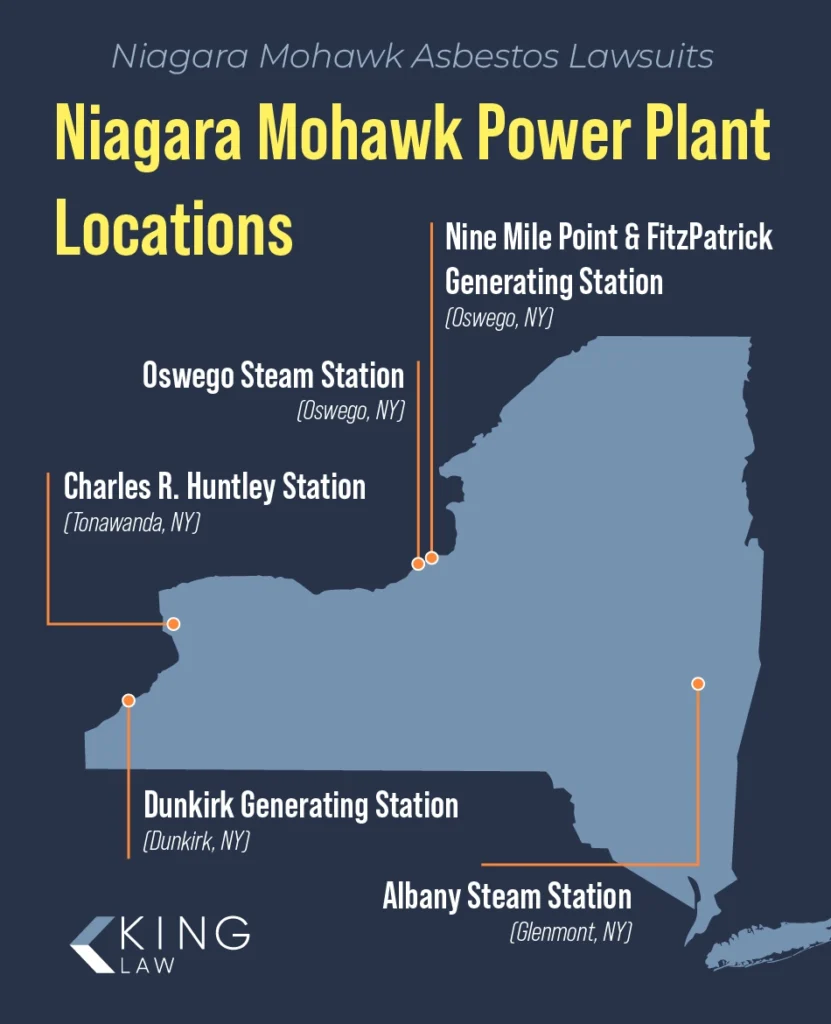
Many Niagara Mohawk power plants utilized asbestos products in their daily operations. Notable sites with known asbestos contamination include the Charles R. Huntley Station, the Dunkirk Generating Station, Albany Steam Station, Nine Mile Point Nuclear Station, and the James A. FitzPatrick Nuclear Station. Asbestos was a key component in insulation, which helped control the high temperatures, steam, and fires at Niagara Mohawk’s power plants.
Several Niagara Mohawk facilities across New York State are known to have contained asbestos-containing materials, exposing workers across multiple decades.
Charles R. Huntley Station – Tonawanda, NY
The Charles R. Huntley Power Generating Station (the Huntley Station) in Tonawanda, New York, was opened in 1916. The Huntley Station operated 13 coal-fired power generation units before it was sold by Niagara Mohawk to NRG Energy in 1999.
Asbestos was used to insulate the plant’s buildings, as well as gaskets, turbines, pipes, and other equipment at the Niagara Mohawk site. The Huntley Station is part of a redevelopment plan that may repurpose this older, outdated plant into usable spaces for the community at large. Workers who were at the Huntley Station when it was operational and those who are part of the renovation were at risk of inhaling asbestos fibers, which can cause mesothelioma.
Dunkirk Generating Station – Dunkirk, NY
Niagara Mohawk’s coal-fired Dunkirk Generating Station is located in Dunkirk, New York, and operated from the 1950s to 2015. The coal-fired generation units contained asbestos in the insulation, roofing material, and in components like the gaskets, pipes, and turbines.
NRG Energy bought the Dunkirk Station in 1999. The site was officially decommissioned in 2020 and is part of a large-scale redevelopment project. NRG Energy notes that one key challenge in demolishing and repurposing the Dunkirk facility is the presence of significant amounts of asbestos.
Albany Steam Station – Glenmont, NY
The Albany Steam Station was built in Glenmont, New York, in the 1950s and, in 1997, housed four 100-MW Rankine-cycle units. These units used a combination of boilers, turbines, condensers, and cooling systems to burn off oil and natural gas and condense steam to generate power.
In 2003, Albany Steam Station was part of a settlement agreement to resolve environmental contamination allegations and related concerns. Asbestos insulation was found throughout the plant, especially in the boiler rooms and in the boilers, duct work, and piping. Asbestos was most likely released into the air and circulated through the ductwork at Albany Steam Station, exposing people at this Niagara Mohawk facility, even if they did not directly work with it.
Other Notable Power Plants With Asbestos Exposure
Other Niagara Mohawk facilities may have been contaminated with asbestos, too. For example, its oil-fired electrical generation plant in Oswego, which was constructed in the 1930s through the 1950s, may have been insulated with asbestos. Additionally, its nuclear facilities, Nine Mile Point and James A. FitzPatrick, both contained asbestos.
Nuclear facilities relied on asbestos to contain heat and prevent workers from being exposed to dangerously high temperatures. For instance, asbestos was found in the roof of the FitzPatrick site owned by Niagara Mohawk. Boilers, steam lines, turbines, and pumps were also common sources of asbestos.
Which Niagara Mohawk Power Plant Employees Were at the Highest Risk for Asbestos Exposure?
Historically,
- Boilermakers
- Boiler tenders
- Pipefitters
- Electricians
- Millwrights
- Welders
- Sheet-metal workers
- Insulators
- Maintenance mechanics
- Laborers
- Turbine technicians
- Nuclear outage contractors
- Steamfitters
- Laggers
- Laggermates
Niagara Mohawk workers in these positions may have used or encountered asbestos daily, such as by removing, installing, cutting, or mixing asbestos-containing insulation. Since many pipes, gaskets, valves, turbines, and other equipment were insulated with asbestos, Niagara Mohawk workers who used or serviced these components were also at risk. Crews who were called in to demolish or renovate Niagara Mohawk facilities could also disturb asbestos fibers and potentially develop mesothelioma.
Additionally, administrative staff who worked in buildings where asbestos was used could also have been exposed to the mineral and developed an asbestos-related disease.
How Were Niagara Mohawk Power Plant Workers Exposed to Asbestos?
Many power plant workers have been exposed to asbestos on the job, especially if they worked at or performed maintenance at plants during the mid- to late- 1900s.
Workers and contractors at Niagara Mohawk’s facilities were exposed to asbestos fibers when the fibers were disturbed and released into the air. For instance, asbestos was used in pipe lagging, insulation, gaskets, and some personal protective equipment, such as aprons and gloves, at nuclear facilities.
Because of this, Niagara Mohawk’s nuclear power plant workers may have breathed in the fibers. Asbestos fibers at Niagara Mohawk’s nuclear facilities could have been disturbed when those sites were being decommissioned.
Niagara Mohawk employees could have also encountered asbestos in insulation, gaskets, cement, lagging, or other materials used at the company’s power plants. Demolitions and planned maintenance outages could cause asbestos fibers to roam freely in Niagara Mohawk’s complexes, too.
How Niagara Mohawk Family Members Were Exposed to Asbestos
People who lived with someone who worked at Niagara Mohawk could have also been exposed to asbestos fibers brought home from the facilities. Studies have shown that this take-home asbestos exposure can lead to pleural plaques, which are a thickening of the lungs’ lining. Asbestos-laden dust could have traveled from Niagara Mohawk’s power plants to the home on the worker’s uniform, boots, bags, and other belongings.
Health Risks Linked to Asbestos Exposure From Working at Niagara Mohawk Power Plants
People who worked at Niagara Mohawk have been diagnosed with asbestos-related diseases, including mesothelioma, asbestos lung cancer, asbestosis, and pleural plaques. Working at older power plants has been associated with mesothelioma because of the high amounts of asbestos found at these facilities.
For example, laggers and laggermates applied asbestos-containing insulation throughout power plants, and studies have linked this workplace asbestos exposure to mesothelioma, lung cancer, and pleural plaques. Mesothelioma can develop decades after someone encounters asbestos, so even people who worked at Niagara Mohawk in the 1950s may be at risk.
Who Can File a Niagara Mohawk Power Plant Asbestos and Mesothelioma Lawsuit?
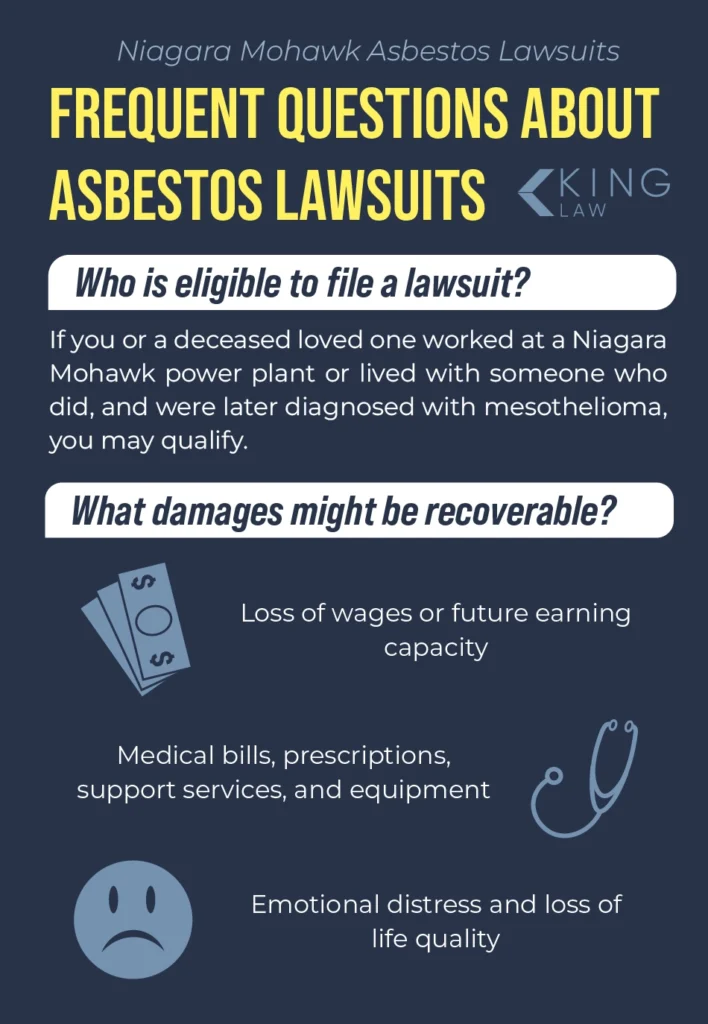
People who worked at Niagara Mohawk under a regular, part-time, or contract-based work arrangement can pursue compensation if they develop mesothelioma. The patients’ lawyers can collaborate with them to link their asbestos exposure to their time at Niagara Mohawk’s facilities.
Mesothelioma patients who lived with someone who worked at Niagara Mohawk may also be eligible for compensation if they can prove their diagnosis is related to take-home asbestos exposure from the sites. Surviving family members may also file wrongful death claims if their loved one died of a disease related to asbestos exposure at a Niagara Mohawk plant.
What Are the Recoverable Damages in a Niagara Mohawk Asbestos Lawsuit?
Mesothelioma patients who win their Niagara Mohawk asbestos lawsuits may recover a range of damages. Examples of potential compensation include:
- Medical expenses for treatments, surgeries, palliative care, and prescription costs
- Lost wages and earning capacity
- Treatment-related travel costs
- Medically necessary in-home care and home modification expenses
- Pain and suffering
- Funeral and burial costs and loss of companionship and support (in wrongful death claims)
In some cases, the mesothelioma patient may also be awarded punitive damages, which punish the at-fault asbestos product manufacturer for egregious conduct. Each state has its own rules about what types of compensation, including punitive damages, are allowable.
How Can I File a Niagara Mohawk Asbestos and Mesothelioma Lawsuit?
Mesothelioma patients can file a Niagara Mohawk asbestos lawsuit by doing the following:
- Write down basic information about your mesothelioma diagnosis and work history at Niagara Mohawk.
- Contact an attorney to discuss your potential mesothelioma lawsuit involving Niagara Mohawk or the companies that supplied asbestos products to the facility.
- Provide your attorney with information they can use to submit official record requests for your medical and employment history.
- Your attorney compiles your information into a legal complaint and files it with the appropriate court or asbestos trust fund.
- Your legal team negotiates a mesothelioma settlement on your behalf.
- Your attorney takes your case to trial if the at-fault asbestos manufacturers will not settle.
King Law helps mesothelioma patients through all stages of a Niagara Mohawk asbestos lawsuit. Our asbestos attorneys can help at each step in the legal process. For example, we can retrieve important records, hire medical, legal, and technical experts, and guide settlement negotiations.
Is There a Deadline to File a Niagara Mohawk Asbestos and Mesothelioma Lawsuit?
Yes. There is a deadline for mesothelioma patients and their surviving loved ones to file a Niagara Mohawk asbestos lawsuit. State law dictates the deadline that these lawsuits must be filed by, and there are also many exceptions that can change how this deadline is calculated. Mesothelioma patients are encouraged to talk to an asbestos lawyer to discover the deadline for their specific claim involving Niagara Mohawk and its suppliers. Our mesothelioma lawyers can help you understand deadlines that are applicable to your specific case.
Estimated Niagara Mohawk Asbestos Lawsuit Settlements and Payouts
Asbestos settlements involving Niagara Mohawk can vary greatly, and the final payouts depend on the laws, facts, and other factors in the individual’s case. Some Niagara Mohawk workers have received multimillion-dollar settlements, including a boilermaker who settled for $3 million and an ironworker who won $2.4 million.
Some people who file mesothelioma lawsuits could receive $250,000 to $1 million or more in compensation, according to historical settlements. Even so, not everyone who files a Niagara Mohawk mesothelioma lawsuit will win a payout, and, if they do, their settlement will reflect their losses and the law of the state where they file their case.
Is There a Niagara Mohawk Asbestos Trust?
No. Niagara Mohawk did not file for bankruptcy protection, so the company did not create an asbestos trust fund. However, some companies that made asbestos products used at Niagara Mohawk’s facilities have filed for bankruptcy due to asbestos-related litigation.
Some of those businesses established asbestos trust funds as a condition of bankruptcy. People who developed mesothelioma because of asbestos exposure caused by those companies may also be eligible for an asbestos trust fund payout. In many cases, mesothelioma patients who worked at Niagara Mohawk qualify for trust fund settlements from multiple funds, in addition to personal injury lawsuits.
King Law Is Accepting Niagara Mohawk Asbestos and Mesothelioma Claims
King Law is taking calls from mesothelioma patients who were exposed to asbestos at Niagara Mohawk. We have the tools necessary to thoroughly investigate your asbestos claim and develop a strong case in your favor. We have helped mesothelioma patients secure much-deserved settlements and trial verdicts so they can move forward. Our team can uncover asbestos exposure from Niagara Mohawk from decades ago and connect it to a present-day mesothelioma diagnosis.
We will work to determine which companies are at fault for you or your family member’s asbestos exposure. We will then pursue the compensation options that give you the best chance of receiving fair compensation.
Contact a Niagara Mohawk Asbestos and Mesothelioma Lawyer Today
Call King Law today at (585) 496-2648 to schedule a free intake appointment with a trusted asbestos lawyer. Our attorneys can help you by crafting a legal case against Niagara Mohawk and its asbestos suppliers. Our team can help you secure a settlement to cover your losses from your mesothelioma diagnosis.