

Proving Asbestos Exposure in a Mesothelioma Claim [2026] Guide
Complete the form below to see if you qualify for a Mesothelioma Lawsuit

In order to file a successful mesothelioma claim, you must provide evidence of asbestos exposure. You can prove asbestos exposure by providing an attorney with documents related to your diagnosis, job history, military history, product information, and witness statements.
Although it is easy to link a mesothelioma diagnosis to asbestos, liability often lies with multiple companies in more than one jurisdiction. Most people were exposed to asbestos decades ago. So, proving asbestos exposure due to specific products can be challenging.
Due to the complexity of these claims, hiring a mesothelioma lawyer can help you receive the best possible compensation. After you provide occupational and health information, your attorney will trace your asbestos exposure to specific companies and prove those companies exposed you to asbestos.
This page will discuss how attorneys prove asbestos exposure, what information you need to provide to file a claim, and how companies are found liable for causing mesothelioma.
About Proving Asbestos Exposure in a Mesothelioma Claim:
Steps for Proving Asbestos Exposure
How Do Lawyers Prove Asbestos Exposure in Mesothelioma Claims?
How Do You Prove Historical Asbestos Exposure?
Mesothelioma Latency and Proving Prior Asbestos Exposure
How to Prove Present-Day Asbestos Exposure
How Do You Prove Injuries From Asbestos?
Do You Need to Prove Asbestos Exposure for a Mesothelioma Claim?
How Do You Prove Mesothelioma from Asbestos Exposure?
Proving Asbestos for Other Types of Asbestos Disease Claims
Proving A Company’s Products Exposed You To Asbestos
Proving Liability in an Asbestos Lawsuit
What Information Will I Need to Prove Asbestos Exposure?
Qualifying for an Asbestos Lawsuit and Compensation
How an Attorney Can Help You Prove Asbestos Exposure
Steps for Proving Asbestos Exposure
Individuals with an asbestos-related diagnosis, like mesothelioma, can file a lawsuit against companies that manufactured, transported, or used asbestos. However, the burden of proof is on the plaintiff (the person who developed mesothelioma). You and your attorney need to prove that the companies named in your lawsuit were responsible for your exposure.
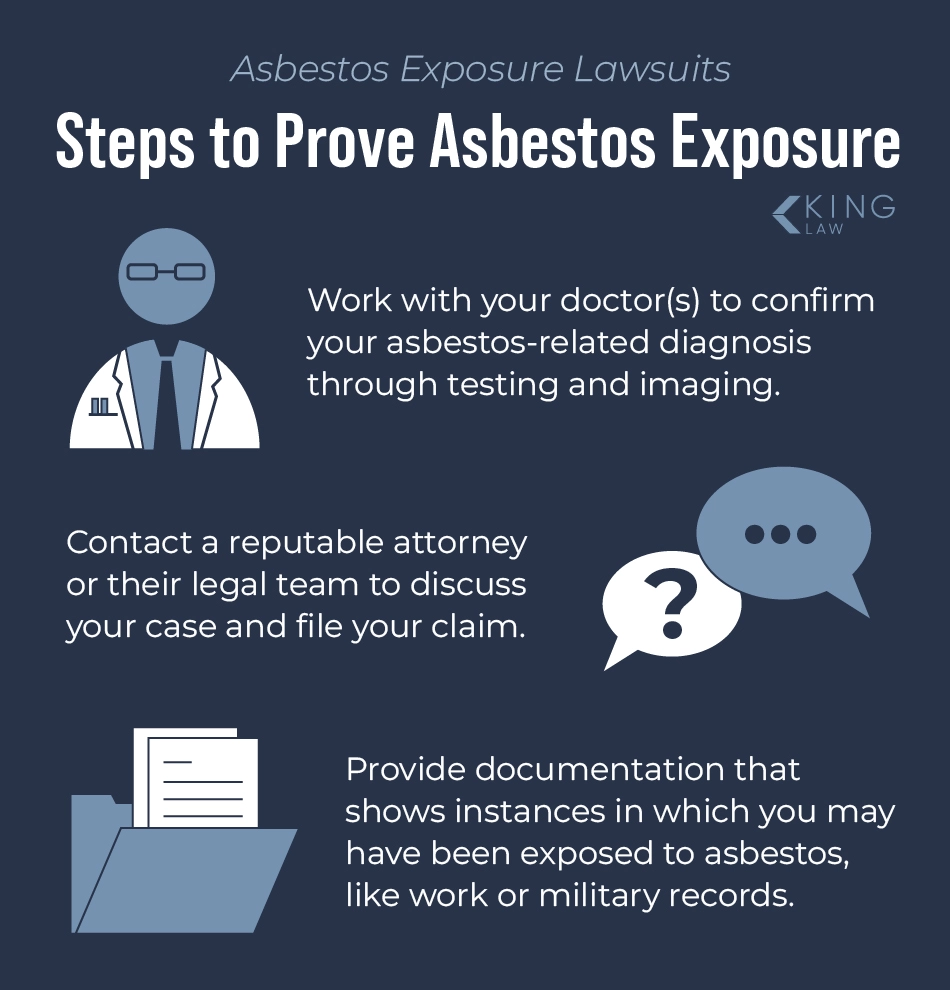
Here are the steps to follow to prove your asbestos exposure and related diagnosis:
- Work with your doctors to secure the proper imaging and testing to confirm a mesothelioma diagnosis.
- Contact and retain a reputable attorney to file your claim.
- Provide documentation about work, employment, and residential history.
- Work with your attorney to determine what products and companies were responsible for your exposure to asbestos.
You do not need to recall exactly when you were exposed. Your attorney will only need to prove that a specific company is the most likely source of your asbestos exposure.
In addition to providing medical records, patients will need to establish that they were present at contaminated sites and that the products they were exposed to at those sites were manufactured or handled by the defendants.
How Do Lawyers Prove Asbestos Exposure in Mesothelioma Claims?
In order to prove asbestos exposure for mesothelioma claims, lawyers work with you to collect documentation. Reputable lawyers also have access to databases that relate certain professions, military bases, and other sites to specific asbestos products.
Lawyers will combine information about your work, military, union, and health history with their internal resources. They will use this information to prove where you were exposed to asbestos and build your case.
How Do You Prove Historical Asbestos Exposure?
In order to prove asbestos exposure that happened a long time ago, you will need to gather information and share that information with an attorney. You will then need to provide proof that you developed a disease caused by asbestos exposure.
Here are some of the ways you can prove previous exposure to asbestos:
- Employment records that prove you worked in an occupation where you worked with asbestos-containing products
- Medical records proving you developed mesothelioma
- Military service records, including assignments, deployments, and bases you were stationed at
- Purchase logs from previous employers
- Receipts for asbestos products or images of asbestos products that you used
- Residential history (home owner or rental records)
- Witness statements from family, coworkers, or friends that confirm you worked with or around asbestos
Mesothelioma Latency and Proving Prior Asbestos Exposure
One of the traits that makes mesothelioma cases so complicated is the amount of time it takes to develop mesothelioma, which is called disease latency. Mesothelioma and other asbestos-related diseases
A lot can change during that time. Businesses that manufactured asbestos products may have gone out of business, been acquired by other companies, or have established an asbestos bankruptcy trust. Knowledgeable attorneys understand how to prove and trace liability despite those changes.
Access to asbestos exposure databases can be critical to tracking down defendants decades later. A reputable mesothelioma attorney should have access to these resources.
How to Prove Present-Day Asbestos Exposure
Although many people think asbestos is a thing of the past, many people currently work with materials that contain asbestos and live or work in buildings that contain asbestos. People who work around asbestos should be documenting their current exposure. That way, they have records available if they are diagnosed with mesothelioma later in life.
Here is how to document that you are currently being exposed to asbestos:
- Keep receipts or purchase logs for any asbestos-containing materials you or your company purchased.
- Record and photograph the types/brands of asbestos products and personal protective equipment used on the job.
- Keep all employment records for jobs that exposed you to asbestos.
- Document any personal protective equipment (PPE) you use on the job.
People in some occupations are still exposed to asbestos on the job. Occupations at a high risk of asbestos exposure include plumbers, firefighters, first responders, asbestos-abatement professionals, and construction workers, who face health risks even to this day.
Individuals who believe they were recently exposed to asbestos should inform their physician and monitor their condition for early warning signs of the disease.
If you are currently working around asbestos, you should log the names of products used in your occupation, the dates you may have been exposed, and the locations of the exposures.
You may also request air quality monitoring reports and other documentation that could be used to build a case for a future mesothelioma claim.
How Do You Prove Injuries From Asbestos?
Diagnoses like pleural mesothelioma, asbestosis, and asbestos lung cancer are caused by asbestos exposure. That means people do not typically need to prove they were exposed to asbestos. They do, however, need to prove that specific companies and products made by those companies were responsible for exposing them.
Ideally, documenting the companies and products can begin at the time of exposure, even if the exposed individual never develops an asbestos-related illness. However, people who worked with asbestos decades ago were not told asbestos was dangerous. So, they did not document their exposure.
However, databases available to mesothelioma lawyers can help people conduct forensic investigations long after the initial exposure. A knowledgeable asbestos attorney can help you file a viable mesothelioma claim.
Do You Need to Prove Asbestos Exposure for a Mesothelioma Claim?
Yes, you will need to provide proof of asbestos exposure to file a mesothelioma claim. You will also need to prove that one or more companies were responsible for your asbestos exposure. Doing so will involve establishing your presence at a contaminated site owned or operated by a defendant, or that an asbestos product manufactured or transported by the defendant was used at that site.
How Do You Prove Mesothelioma from Asbestos Exposure?
The only known cause of mesothelioma is
Even if you are unsure of where you were exposed to asbestos, your attorney will critically review your occupational history, places you lived and worked, and your potential for secondary exposure to asbestos.
Proving Asbestos for Other Types of Asbestos Disease Claims
Asbestos causes disease by shedding sharp fibers that damage and scar vulnerable tissue, most commonly in the lungs. This damage can lead to a range of illnesses, including cancer.
Asbestosis
Asbestosis is caused by the build-up of scar tissue in the lungs, which leads to shortness of breath and less efficient breathing. Unlike mesothelioma or asbestos lung cancer, it is not a form of cancer, although it can raise the risk of developing lung cancer. Like mesothelioma, a diagnosis of asbestosis assumes the patient was exposed to asbestos.
Asbestos Lung Cancer
Mesothelioma is not the only form of cancer that asbestos exposure can cause. Inhaling asbestos, particularly in combination with smoking, can increase one’s risk of developing
Pleural Disease & Other Conditions
The scarring mechanism of asbestos fibers can cause other types of illness as well, many of which are recognized by the Veterans Administration. These conditions include pleural plaques and effusion. If asbestos is swallowed, particularly in the form of contaminated water, it can lead to cancers of the GI tract.
Proving A Company’s Products Exposed You To Asbestos
Tracing your asbestos exposure back to a specific company will likely require research and investigation. Asbestos was commonly used in construction and insulation during the mid-20th century. Although its use tapered off by the early 1980s, asbestos is still present in buildings and materials. However, asbestos in older buildings and products from that time continue to expose individuals to this day.
Common Products that Exposed People to Asbestos and Their Manufacturers
Thousands of products are known to contain asbestos, presenting varying degrees of exposure risk. Examples of products that may contain asbestos include:
- Ceiling panels and tiles
- Brake pads and linings
- Chimney linings and ducts
- Shingles
- Siding
- Pipes
- Electrical wires and panels
- Fire blankets, curtains, and insulation
- Gaskets
- Boilers
- Flooring
- Laboratory hoods
Companies that are known to have made or distributed products containing asbestos include:
- Armstrong World Industries
- Aurora Pump Company
- Babcock and Wilcox
- Cleaver Brooks
- DuPont
- Foster Wheeler
- Eagle-Picher
- Garlock Sealing Technologies
- General Electric
- General Motors
- Georgia Pacific
- Honeywell
- Johns-Manville Corporation (J-M)
- Owens-Corning Fiberglass Company
- Owens-Illinois
- Raybestos-Manhattan
- United States Gypsum Co.
- W. R. Grace & Co.
These are just some of the companies that made or distributed asbestos-containing products. Many other companies used products made by these companies. Companies that used such products are not typically named in asbestos lawsuits.
Proving Liability in an Asbestos Lawsuit
Filing a successful claim means proving that an asbestos company is liable for your exposure and subsequent disease. Asbestos law falls under the umbrella of product liability. Product liability may be based on negligence or breach of warranty as defined at the state level.
Your attorney will have to prove that the asbestos company acted negligently because the following things happened:
- The defendant had a legal duty to provide a safe product.
- The defendant breached that duty.
- Their breach caused an injury.
- The injury resulted in damages to the plaintiff.
Examples of How Lawyers Match Asbestos Products to Defendants
After a lawyer has documentation of your work or service history, they can begin matching the products you worked with to the companies that made those products.
Your attorney has the resources to prove that certain materials were used by certain industries during certain time periods. For example, they may be able to say:
- You worked as a pipefitter in the U.S. Navy from 1968 to 1975. You likely used Super 66 insulating cement made by Eagle-Picher.
- You worked in building construction from 1960 to 1985. You likely used flooring adhesives made by Armstrong World Industries, Johns-Manville, or GAF Corporation.
Your attorney will interview you and review statements to relate your asbestos exposure to the precise products you used. Then, they will build your case against asbestos manufacturers.
Asbestos Manufacturers’ and Sellers’ Responsibilities
Courts or trust fund administrations ultimately determine liability for injuries caused by asbestos exposure. Companies that mine asbestos, manufacture asbestos products, or handle asbestos improperly can be found liable on one of the following legal principles:
- Breach of warranty: A failure to honor an explicit or implied contract about the product’s safety, quality, or condition
- Negligence: Failure to take reasonable care in the design, production, or marketing of a product
- Strict liability: Liability for injuries caused by the product, whether or not negligence is involved
What Information Will I Need to Prove Asbestos Exposure?
To prove your asbestos exposure, you will need to present evidence that connects your disease to your proximity to a product made or used by an asbestos company. Here is a list of documents that can prove asbestos exposure:
- Medical diagnosis
- Medical test results
- Address records
- Employment records
- Union records
- Military service records
- Testimonies from coworkers, family members, or experts
- Spousal employment or service records (for secondary exposure)
Gathering this information and providing it to your attorney will allow them to file a mesothelioma lawsuit on your behalf. You can also file a mesothelioma lawsuit on behalf of a family member, if that family member is unable to do so themselves.
Proving Asbestos Exposure in the Military
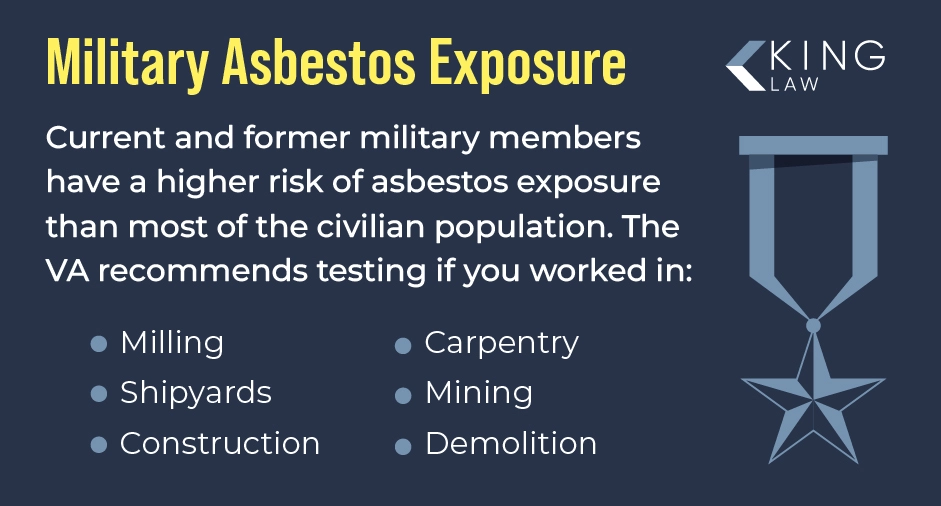
Military veterans run a higher risk of asbestos exposure than the civilian population. Individuals who served on vessels, such as Navy veterans and Coast Guard in particular, have higher rates of asbestos-related disease due to the common use of the substance in ships and shipyards.
The VA suggests getting tested if you worked in one of the following areas while enlisted:
- Milling
- Shipyards
- Construction
- Carpentry
- Demolition (knocking down old buildings)
- Mining
While the military cannot directly be named as a defendant, veterans can file an asbestos disability claim with the VA. The VA uses a policy of presumptive exposure, wherein it is assumed the military is responsible for exposure if certain conditions are fulfilled. If you fulfill those conditions, the VA will adjust your disability rating. A diagnosis of mesothelioma, for example, typically results in a 100% disability classification.
How to Prove Occupational Asbestos Exposure
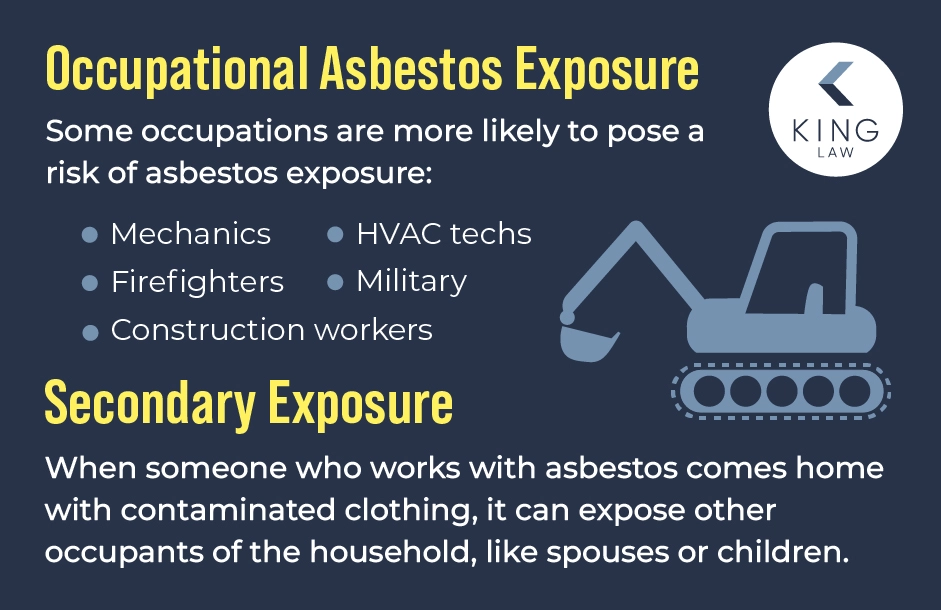
Some occupations are more likely to be exposed to asbestos than others. Individuals who work with the “guts” of older buildings, boats, or machinery are at an elevated risk. This includes:
- Construction workers
- Shipyard workers
- Mechanics
- Firefighters
- Industrial workers
- Power plant workers
- HVAC workers
- Military service
Collecting information on work locations, products used, company records, and site documentation can all help prove an occupational claim.
How to Prove Non-Occupational Asbestos Exposure and Secondary Exposure
Proving non-occupational or secondary exposure may involve collecting evidence that a spouse or family member worked with asbestos, or that you were exposed during a renovation project at home or at work. For example, you may have been exposed to asbestos when tearing out old insulation, floor tiles, or joint compound during a home or work renovation.
As is the case with other forms of exposure, collecting information on the products you were indirectly exposed to is critical to building a strong mesothelioma claim. For cases of secondary exposure, you will need to provide your spouse’s or family member’s employment or service records.
Do You Need to Prove an Employer Exposed You to Asbestos?
In most cases, you will not be filing a lawsuit against your employer, except in cases where your job involved handling raw asbestos, such as working in an asbestos mine.
Qualifying for an Asbestos Lawsuit and Compensation
To qualify for an asbestos lawsuit, you will need to prove that you have a diagnosis related to asbestos exposure or that a loved one died of a condition related to asbestos exposure. This will involve getting a diagnosis and presenting medical records and tests corroborating the diagnosis. You will also need to file your case within your state’s statute of limitations, which varies between jurisdictions.
How an Attorney Can Help You Prove Asbestos Exposure
An experienced attorney is a valuable asset in an asbestos claim. While proving you have been exposed to asbestos is usually straightforward, identifying the companies responsible can be very challenging, particularly given the latency of asbestos-related diseases. An asbestos claim may involve a lawsuit against multiple defendants, each of whom is partially responsible for your exposure. Or it may involve filing a claim with an asbestos bankruptcy trust. Or both. An experienced attorney can help craft an asbestos claim that maximizes your chances of getting the best compensation.
Hiring an Attorney for Your Mesothelioma Claim
Choosing an attorney for your mesothelioma claim is an important early step. Look for proven experience with asbestos cases and technical knowledge of laws, precedents, asbestos trust funds, and asbestos exposure databases. Additionally, the ability to file a claim nationwide can allow you to pursue your case in an advantageous jurisdiction, particularly with defendants who operate in multiple states. You can use our free consultation to evaluate your prospective attorney and ask questions about their experience and methods.
King Law Can Prove Your Asbestos Exposure and File Your Claims
King Law and its partners have decades of experience helping families coping with asbestos-related disease receive compensation for their suffering and expenses. Contact us today for a free consultation with no obligation. You will not pay any money up front or be pressured into pursuing a case. Our team and legal partners will work to understand your situation and file the best claim possible for you and your family.