

Hunters Point Shipyard Lawsuit & Asbestos Claims [2026 Update]
Complete the form below to see if you qualify for a Mesothelioma Lawsuit

Hunters Point Naval Shipyard in San Francisco, California, is frequently named as a site of asbestos exposure in mesothelioma lawsuits. Like most shipyards of its age, Hunters Point relied on asbestos-containing materials during the early and mid-20th century, where it was used in ship construction and maintenance.
Hunters Point alternated between private and government ownership throughout its history. As a result, many veterans and private workers were exposed to asbestos at Hunters Point. Some of those people developed mesothelioma decades later and are filing lawsuits against the responsible asbestos companies.
This page will cover the history of asbestos use and exposure at Hunters Point, who may qualify to file a lawsuit, and what kinds of compensation are available to those diagnosed with mesothelioma.
About the Hunters Point Shipyard Lawsuit:
Hunters Point Shipyard Asbestos and Mesothelioma Lawsuit Updates
About the Hunters Point Shipyard and Asbestos Exposure
When Did the Hunters Point Shipyard Contain Asbestos?
What Asbestos Materials Were Used at Hunters Point Shipyard?
How Were Hunters Point Shipyard Workers Exposed to Asbestos?
Which Hunters Point Shipyard Workers Had the Highest Risk of Asbestos Exposure?
Did Hunters Point Shipyard Exposure Also Affect Nearby Residents?
What Is Naturally Occurring Asbestos and Why Does It Matter at Hunters Point?
Have the Navy or Contractors Been Accused of Cleanup Failures at Hunters Point?
What Health Conditions Have Been Linked to Hunters Point Asbestos Exposure?
Who Can File a Hunters Point Shipyard Lawsuit?
What Proof Is Needed to File a Hunters Point Shipyard Lawsuit?
How Can I File a Hunters Point Shipyard Lawsuit?
Is There a Deadline to File a Hunters Point Shipyard Lawsuit?
How Much Is a Hunters Point Shipyard Lawsuit Worth?
King Law Is Investigating Hunters Point Shipyard Asbestos Claims
Hunters Point Shipyard Asbestos and Mesothelioma Lawsuit Updates
2020: Concerns Over Contaminated Dust Renew Calls For Excavation Moratorium – Citing complaints of toxic dust from Hunters Point excavation sites, 9,000 plaintiffs file a notice of Proposition 65 violation. While the complaint was not specific to asbestos, asbestos has long been a Proposition 65 chemical of concern at the site.
2018: Harris v. Ingersoll-Rand – A couple has filed an asbestos lawsuit in federal court due to alleged asbestos exposure at Hunters Point and another shipyard. In their complaint, a former sheet metal worker/pipefitter and his wife claim asbestos exposure at Hunters Point between 1966 and 1973 led the worker to develop mesothelioma.
2008: Residents Accuse Developers, San Francisco Department of Health of Concealing Airborne Asbestos Levels – A reading of 138,000 airborne asbestos fibers per cubic meter was detected at a Hunters Point excavation site. Readings exceeding 16,000 structures/m3 result in an automatic work shutdown by law. However, no work shutdown occurred. The asbestos levels were likely linked to historical asbestos use at the Hunters Point Shipyard.
2006: Lennar Corporation Fined $587,000 For Failing To Monitor Asbestos – Lennar Corporation receives a fine for failing to monitor asbestos concentration levels while grading a hilltop at Hunters Point. The fine follows multiple violations.
2002: Trinchese v. Union Carbide – A jury awards former electrician Victor Trinchese $4.2 million. Trinchese was exposed to asbestos at Hunters Point, where he worked from 1969 to 1980. His lawsuit said the exposure occurred when he installed plastic switches that contained asbestos.
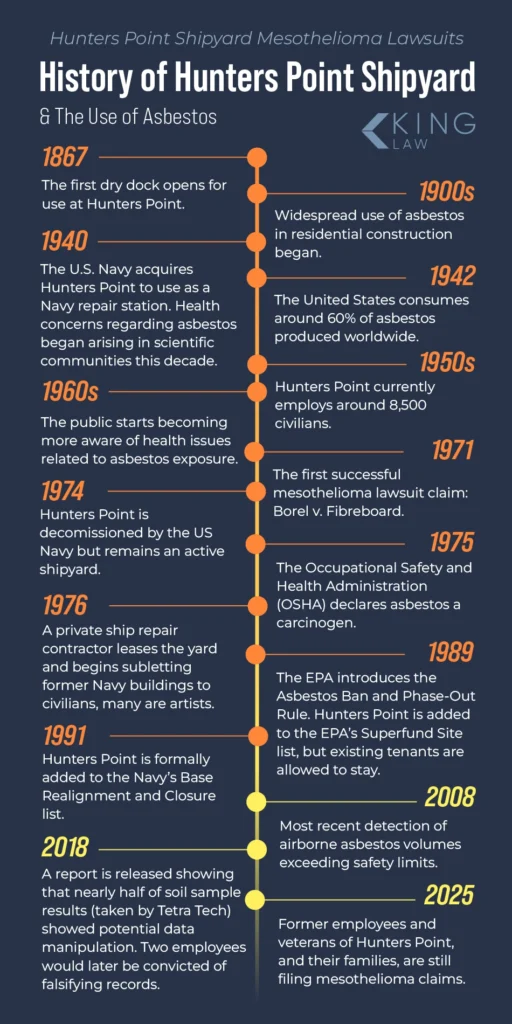
1991: Hunters Point Naval Shipyard Closes – Hunters Point Naval Shipyard (HPNS) is formally listed on the Navy’s Base Realignment and Closure (BRAC) process.
1993: Coughlin v. Owens-Illinois Inc – Plaintiff Frank J. Coughlin names Hunters Point as one of multiple sites in which he may have been exposed to asbestos. Coughlin removed insulation from ships at Hunters Point from 1972 to 1973.
1989: Hunters Point Listed As A Superfund Site By EPA – Hunters Point is listed as a superfund site with multiple types of contaminants, including asbestos, identified as present on site in soil deposits.
About the Hunters Point Shipyard and Asbestos Exposure
Hunters Point was one of the Navy’s most important West Coast shipyards during World War II, though it began service in the 19th century as a commercial shipyard. Located in San Francisco, California, the shipyard was initially a private enterprise contracting with the Navy. However, the Navy purchased the site in 1939 and used it for multiple purposes over the coming decades.
Asbestos was widely used in shipyards, with the fibrous material used in everything from hull insulation to fireproofing, to electrical, boiler, and mechanical components. Asbestos was so inexpensive and effective that its usage was once mandated in Navy shipbuilding processes.
Asbestos usage in shipyards like Hunters Point decreased during the 1970s and largely stopped by the 1980s. However, the long disease latency of asbestos-related illnesses means individuals who were exposed before 1980 may now be presenting with symptoms. Further, remnants of asbestos used at Hunters Point, including fibers present in sediments, present an ongoing risk to workers and residents at the site.
When Did the Hunters Point Shipyard Contain Asbestos?
Asbestos usage in shipyards like Hunters Point often began in the early 20th century, and began to peak during the World Wars, with phase-outs beginning in the 1970s. However, buildings, ships, and equipment containing asbestos remained an exposure threat long after 1980, with removals and cleanups occurring sporadically. Sediments containing asbestos fibers remained a concern during 21st-century construction projects, with airborne volumes exceeding safety limits detected as recently as 2008.
What Asbestos Materials Were Used at Hunters Point Shipyard?
Asbestos was incorporated into a wide variety of buildings, ships, systems, and infrastructure at Hunters Point Shipyard. The widespread presence of asbestos on site put workers at risk not only when they were installing asbestos-coated components, but also when repairing, maintaining, or dismantling ships.
Here are some of the materials that potentially exposed workers at Hunters Point Naval Shipyard (HPNS) to asbestos:
- Asbestos cement
- Boilers
- Flanges
- Fireproof textiles
- Gaskets
- Pipes
- Pumps
- Ship hulls, walls, docks
- Structural building materials (ceiling and floor tiles, metal sheeting, insulation)
- Valves
Pipe, Boiler, and Duct Insulation (Thermal System Insulation)
The heat-resistant properties of asbestos led to its widespread use in piping, boilers, and ducts to both control heat and reduce the risk of fire. Over time, the insulation tends to become brittle, at which time it can shed crystalline fibers, particularly when moved, cut, or otherwise disturbed. When inhaled or ingested, these fibers can cause long-term damage, potentially leading to diseases like mesothelioma.
Gaskets and Packing in Valves, Pumps, and Flanges
Asbestos was also a common material in gaskets, pumps, and high-pressure systems, valued for its strength and heat-resistant properties. As is the case with pipes and boilers, workers who maintain or replace these parts run the risk of inhaling or ingesting airborne asbestos fibers.
Fireproofing Textiles and Heat Shields
Asbestos usage was not limited to infrastructure. It was common for clothing, blankets, ropes, gloves, and heat shields used in proximity to high-temperature equipment to be coated in asbestos. Repeated handling and aging of these fibers can cause them to break loose.
Other Asbestos-Containing Materials
Mid-century Navy ships were sometimes coated bow-to-stern with asbestos, presenting a risk not just to maintenance crews and sailors. Additionally, asbestos was commonly used in buildings on shore, including roofing and flooring. Even workers who didn’t directly handle asbestos at Hunters Point may have been exposed to fibers from deteriorating structures, clean-up activities, or excavation of contaminated soil.
How Were Hunters Point Shipyard Workers Exposed to Asbestos?
People working or stationed at Hunters Point could have been exposed to asbestos while performing many of their job duties and assignments.
Veterans, contractors, and employees at Hunters Point Shipyard may have encountered asbestos when:
- Installing or repairing boilers, pumps, sheet metal, and other ship infrastructure
- Installing, removing, or repairing HVAC materials, pipe lagging, building materials, and other asbestos products
- Building, repairing, and dismantling ships, submarines, and other marine vessels
- Building shipyard infrastructure like barracks, garages, hangars, and other buildings
Individuals who cut asbestos-laden pipes, remove insulation, or dismantle aging structures typically are at the highest risk of developing an asbestos-related illness.
The risk of exposure also extends to the family members of these workers. Asbestos fibers can travel on clothing or skin and later be inhaled off-site. Second-hand asbestos exposure could have caused workers’ family members to develop asbestos-related diseases.
Which Hunters Point Shipyard Workers Had the Highest Risk of Asbestos Exposure?
Although many shipyard workers ran some risk of asbestos exposure, some occupations were more at risk than others. Workers who regularly handled insulation or worked around high-heat systems tend to present with the highest rates of asbestos-related illness. These include the following roles.
Some of the Hunters Point Shipyard workers who had a high risk of asbestos exposure include:
- Boilermakers
- Electricians
- Insulators and laggers
- Maintenance workers
- Pipefitters
- Sanders/sandblasters
- Welders
Insulators (Laggers)
Laggers, individuals who directly installed or removed asbestos insulation on equipment, were often in direct contact with asbestos. Their duties often generated large amounts of asbestos dust within confined spaces with limited ventilation.
Pipefitters and Boilermakers
Pipefitters and boilermakers worked on high-pressure systems insulated with asbestos. These workers ran the risk of inhaling asbestos fibers shed during cutting, fitting, and repairing these systems. Like insulators, they often worked in confined spaces.
Welders
Welders were often exposed to asbestos when cutting or fusing pipes lined with asbestos or using heat shields insulated with the fibers. Like other shipyard workers, welders generally did not present with symptoms until decades later.
Other Hunters Point Shipyard Workers at High Risk
Working within a contaminated area presents a risk of exposure regardless of occupation. These shipyard occupations also present with higher rates of asbestos-related illnesses:
- Demolition crews
- Electricians
- Machinists
- Maintenance workers
- Painters
- Sandblasters
This list does not include all possible occupations that might have been exposed to asbestos products used at Hunters Point Shipyard and Hunters Point Naval Air Station. Anyone who worked at a shipyard may have come in contact with asbestos.
Did Hunters Point Shipyard Exposure Also Affect Nearby Residents?
The legacy of asbestos use at Hunters Point Shipyard has continued to present health risks even after its closure in 1994. Dust and sediments containing asbestos have been a concern to residents in nearby neighborhoods and housing. Redevelopment projects in and around Hunters Point have been accused of stirring up toxic dust and sickening nearby residents.
These residential claims are legally distinct from occupational claims; however, they illustrate ongoing issues with contaminants, including asbestos, at the site. Similarly, there are natural asbestos deposits in rocks and sediment at Hunters Point. So, any new construction and associated remediation could potentially release asbestos into the air in surrounding communities.
What Is Naturally Occurring Asbestos and Why Does It Matter at Hunters Point?
Asbestos is a group of six similar, naturally occurring silicate minerals. These minerals are often found in igneous rocks, such as those commonly found near volcanoes or fault lines. Hunters Point, coincidentally, sits on serpentinite rock, which naturally contains asbestos fibers.
While the origin of these fibers has little to do with human asbestos usage on-site, the presence of naturally occurring asbestos compounds increases the risks associated with construction projects on-site.
Have the Navy or Contractors Been Accused of Cleanup Failures at Hunters Point?
Ever since its 1989 designation as a Superfund site, the environmental state of Hunters Point has been mired in controversy. A 2018 report, for example, found that 414 out of 853 soil sample results showed potential data manipulation or falsification. The soil samples were taken by the Navy contractor, Tetra Tech. Two Tetra Tech employees were later convicted and sentenced to prison for falsifying records.
Tetra Tech was also the subject of federal civil lawsuits, leading to a $97 million settlement in early 2025.
What Health Conditions Have Been Linked to Hunters Point Asbestos Exposure?
The fine, crystalline fibers shed by asbestos can cause small but persistent injuries to sensitive tissues. Over a long period of time, this scarification and inflammation can contribute to serious illnesses like mesothelioma, a deadly cancer. Most asbestos diseases take many years to present through symptoms. Shipyard workers, including those at Hunters Point, face
Mesothelioma
Mesothelioma, in the context of asbestos exposure, generally refers to
- Fever
- Hoarseness
- Lower back pain
- Night sweats
- Persistent cough
- Swelling
- Unexplained weight loss
Mesothelioma is a rare cancer. Almost all cases of mesothelioma are believed to be caused by asbestos exposure, often through occupational exposure.
Asbestos-Related Lung Cancer
Asbestos exposure has also been linked to other forms of lung cancer, with risks compounding based on the level of exposure and other irritants like smoking. Lung cancer can present with similar symptoms to mesothelioma.
Asbestosis and Pleural Disease
The damage caused by asbestos fibers does not always lead to cancer, but the scarring can still reduce lung functioning. This may manifest as asbestosis or another form of pleural disease that can greatly impact quality of life.
Asbestosis symptoms include:
- Chest tightness or pain
- Clubbing in the fingers or toes
- Persistent dry cough
- Shortness of breath
Who Can File a Hunters Point Shipyard Lawsuit?
Individuals who were employed, stationed, or contracted at Hunters Point Shipyard and have been diagnosed with an asbestos-related illness may qualify to file a personal injury lawsuit. Family members may be eligible to file a wrongful death lawsuit on behalf of a deceased loved one who was exposed to asbestos at Hunter’s Point Shipyard. Veterans may also qualify for VA disability benefits in addition to lawsuits.
Can Family Members File Claims for Secondhand Asbestos Exposure?
Family members of Hunters Point workers who developed an asbestos-related disease through secondhand exposure may be eligible to file a claim in some circumstances. Eligibility varies by state law and should be discussed with a reputable attorney.
What Proof Is Needed to File a Hunters Point Shipyard Lawsuit?
A successful Hunters Point Shipyard lawsuit or trust fund claim will need to present supporting evidence.
Here are some of the documents and information your attorney may request when filing a mesothelioma lawsuit related to asbestos exposure at Hunters Point:
- An asbestos-related medical diagnosis. As most asbestos-related illnesses are rarely seen outside of asbestos exposure, the cause of the disease is rarely contested.
- Employment/deployment history. You’ll need to present evidence that you worked, contracted, or were stationed at Hunters Point Shipyard.
- Testimonies, shipyard records, union records. These can support exposure claims.
- Products and exposure. Your attorney can help you identify the asbestos products you were exposed to on-site based on your occupation and work history.
- Medical bills and history. These can help establish a diagnosis and economic damages.
How Can I File a Hunters Point Shipyard Lawsuit?
Asbestos exposure lawsuits can be complex, involving multiple defendants or trust funds based in different states. For this reason, it is best to begin the lawsuit process by consulting with an experienced attorney.
Here are the steps for people who developed mesothelioma after spending time at Hunters Point Shipyard and are interested in filing a lawsuit:
- Consult with an experienced mesothelioma lawyer. Look for a free consultation with a law firm with a history of litigating asbestos exposure cases. When you find one you like, hire them.
- Participate in an Investigation. Your attorney will conduct an investigation based on the information you’re able to provide. In the process, they will identify products, exposure scenarios, and supporting evidence for your case. Most investigations take several weeks to a few months.
- File claims. Your lawyer will file your claims against defendants and/or trust funds identified during the investigation.
- Resolve through settlement or trial. In many instances, your case could resolve through a settlement with defendants or trust funds, or through a trial verdict.
If you currently live in California, you may be interested in hiring a California mesothelioma lawyer. However, you should ensure your lawyer has national reach and can file a claim in the jurisdiction that is best for your circumstances, which may not be a jurisdiction in California.
Is There a Deadline to File a Hunters Point Shipyard Lawsuit?
Asbestos lawsuits are usually governed by statutes of limitations on personal injury or wrongful death claims. In California, the deadline to file a personal injury claim is typically 2 years. These deadlines vary from state to state, but typically begin on the date on which you received your diagnosis, or the date of your loved one’s death. While Hunters Point Shipyard is in California, your case may ultimately be filed in another state, depending on your state of residence or the headquarters of your defendants.
Due to the complexity of these cases and the limited windows in which to act, it is best to contact an attorney soon after you have connected your diagnosis or a loved one’s death to asbestos exposure.
How Much Is a Hunters Point Shipyard Lawsuit Worth?
Payouts for Hunters Point Shipyard lawsuits can vary substantially depending on the diagnosis, economic injuries, and the number of parties involved in your exposure. In rare cases, gross negligence on the part of one or more defendants may also result in punitive damages in some jurisdictions.
Many claims payout between $1 million and $1.5 million in aggregate, though individual results are not guaranteed. Filing a lawsuit or trust fund claim does not guarantee compensation, in any amount.
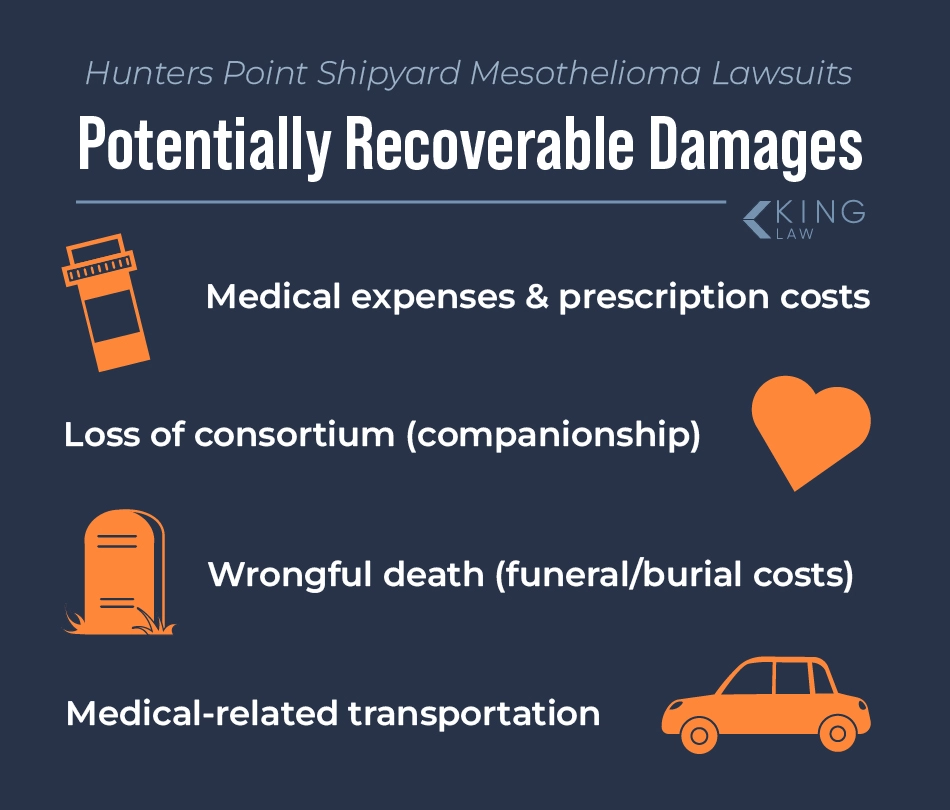
Compensation from a mesothelioma claim can help people pay for things like:
- Medical expenses
- Lost income
- Pain and suffering
- Travel for treatment
- Wrongful death damages
King Law Is Investigating Hunters Point Shipyard Asbestos Claims
King Law is currently investigating asbestos exposure claims involving Hunters Point Shipyard. Our experienced attorneys are reviewing work histories, identifying asbestos products used on-site, and pursuing all available options for our clients. Our firm has national reach and can track down defendants and asbestos trust funds in any state in the nation.
Contact a Hunters Point Shipyard Asbestos Attorney Today
If you worked at Hunters Point Shipyard and have been diagnosed with an asbestos-related illness, or are a family member of a recently deceased person who was, King Law can help you file for the compensation and closure you deserve. Our legal partners are experienced asbestos attorneys who can navigate the complexities of your claim. Contact us today at (585) 496-2648 for a free consultation with no obligation.